
On an attached garage, the most common source is failed flashing where the garage roof meets the house wall or roof. Roofing on a slope too flat for it, ice at the eave, worn roll roofing and failed flashing around vents are the other usual causes.
Get My Free Estimate →Most garage roof leaks start in one of three places. On an attached garage it is usually the joint where the garage roof meets the house, and on any garage it can be a roof too flat for shingles or ice at the eave.
A detached garage is often reroofed on a different schedule from the house, so its roofing may be years older. Buckshot repairs garage roofs across Madison from our office on North Sherman Avenue, and this guide shows how to find where the water gets in.
Where garage roofs leak
Where the water shows up inside the garage points to where it gets in.
| What you see | Likely cause | What it takes |
|---|---|---|
| Drips or stains along the wall the garage shares with the house | Failed flashing where the garage roof meets the house wall | Re-flashing behind the siding |
| Water at the inside corner where the garage roof joins the house roof | A worn or poorly built valley | A rebuilt valley with ice and water barrier |
| Drips across the middle of a flat or nearly flat roof | Roll roofing or shingles on a slope too flat for them | A membrane roof |
| Water along the back wall or over the door after a thaw | Ice at the eave or a backed-up gutter | Ice dam work, ice and water barrier, drip edge |
| Stains around a vent, skylight or old antenna mount | Failed flashing or a cracked pipe boot | New flashing or a new boot |
| Drips under a metal garage roof on clear, cold mornings | Condensation rather than a leak | Moisture control and ventilation |
Where an attached garage roof meets the house
An attached garage roof meets the house in one of two ways, and each joint depends on flashing. Where it ends against a house wall, headwall or step flashing runs up behind the house wrap and siding so water running down the wall lands on the roof.
That joint causes most porch roof leaks too, and our guide to a porch roof leaking explains how it fails when the flashing is caulked on top of the siding. At the bottom corner, a kickout flashing turns the water into the gutter.
Where the garage roof ties into the main roof, the two slopes meet in a valley that carries water from both roofs at once. Valleys need ice and water barrier underneath, and our guide to roof valley types covers how each kind is built.
Our guide to flashing repair shows how failed flashing is traced along a wall or valley.
Flat and low-slope garage roofs
Many older garages have flat or nearly flat roofs. Asphalt shingles need a slope of at least 2 in 12, and on a flatter roof they hold water in the laps until it backs up underneath.
Older flat garages are often covered with mineral-surfaced roll roofing, whose lap seams open up as it ages. Water then sits on the roof after rain, and a low spot that holds water for days points to sagging decking or framing underneath.
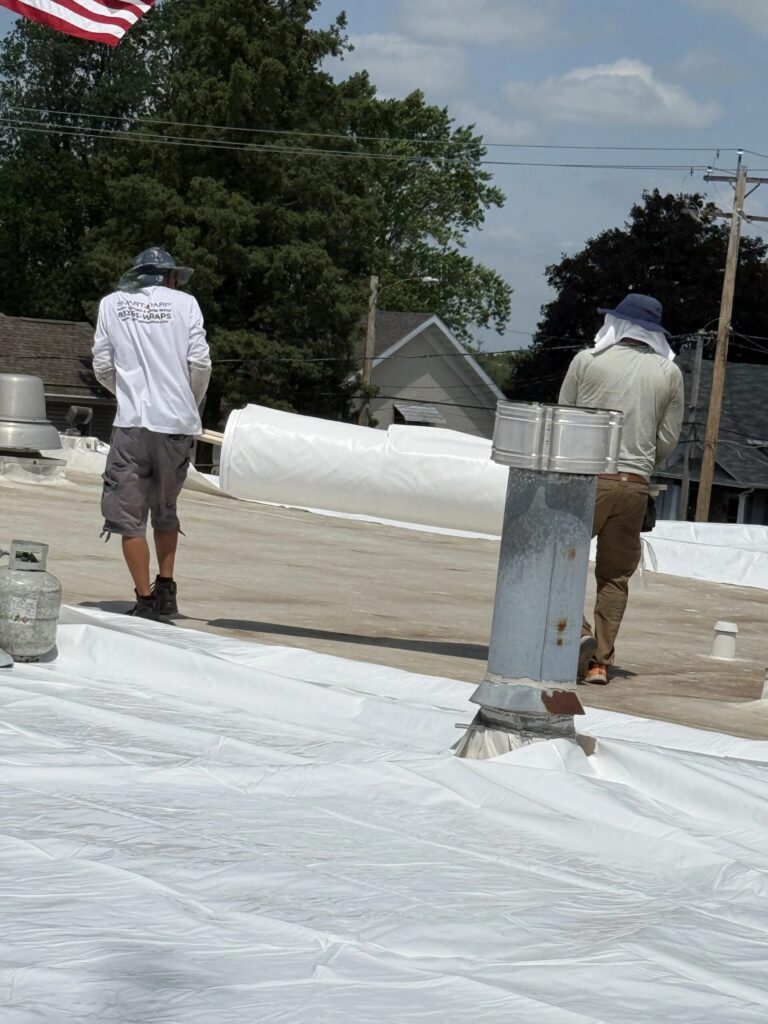
Below roughly 3 in 12, a sealed membrane is the better roof. Our flat and low-slope roofing crews install modified bitumen, EPDM and TPO, and our guide to roof pitch explains how slope decides the material.
Our guide to flat roofing in Madison compares those membranes and covers converting a flat garage roof to a pitched one.
Ice dams and snow on garage roofs
A heated garage behaves like the house in winter. Heat escaping through the ceiling melts the snow on the roof, and the meltwater refreezes at the cold eave into an ice dam that pushes water under the shingles.
An attached garage roof that sits below the main roof also collects what the main roof sheds. Snow slides down onto it and drifts into the valley and against the house wall, so some garage leaks only show up during a thaw.
A garage roof built without ice and water barrier at the eave leaks in these thaws. Our guides to ice dams in Wisconsin and roof leaks when snow melts explain both patterns, and our ice dam removal crews respond within 2 hours with low-pressure steam.
Metal garage roofs
Many garages, shops and pole barns have metal roofs fastened with exposed screws. The rubber washers under those screws age and the screws work loose, so leaks often follow the screw rows, and our guide to a metal roof leaking covers screws, laps and flashing.
Drips under a metal garage roof on a cold, clear morning are usually condensation rather than a leak. A car carrying snow into the garage adds a lot of moisture, and our guide to metal roof condensation explains how garages are fixed.
Want a straight answer on your roof?
We'll inspect it, document everything, and tell you honestly what you're looking at, even if the answer is patch it for now. No pressure.
What to do when the garage roof leaks
- Move what is stored under the drip. Boxes, tools and anything electrical come out of the wet area, and a bucket or tarp goes down.
- Turn off any wet light. If water is dripping near a ceiling light or the door opener, switch that circuit off at the breaker, and our guide to water leaking from a ceiling light covers the next steps.
- Note when it drips. A leak during rain, during a thaw or only on cold mornings each points to a different cause.
- Photograph the damage. Date-stamped photos of the ceiling, the roof and any storm damage help with an insurance claim.
- Check the gutters from the ground. A gutter full of leaves or ice backs water up at the eave.
Garage ceiling dripping? Our roof leak inspection is free, and we find where the water enters before quoting any repair. Call (608) 909-9109 to schedule it.
Free on-site inspection · Family-owned since 1979Does insurance cover a leaking garage roof?
It depends on what caused the leak and whether the garage is attached. An attached garage is usually covered with the house, while a detached garage usually falls under the "other structures" part of a homeowners policy, often up to 10% of the house coverage.
Sudden damage, such as wind tearing off shingles, hail or a falling limb, is usually covered. Leaks from age and wear usually are not, so read your own policy and photograph the damage before anything is repaired.
Our insurance claims team documents storm damage in the format adjusters ask for and meets the adjuster at the roof.

How a garage roof leak is repaired
- Find the entry point. The wall joint, valley, roofing, edge and every penetration are checked together, and a course of siding comes off at the wall if the flashing is suspect.
- Re-flash the wall and valley. Headwall and step flashing go in behind the house wrap, a kickout goes in at the bottom corner, and the valley is rebuilt over ice and water barrier.
- Replace soft decking. Wet or rotted sheathing is cut out and replaced before any new roofing goes on.
- Match the roof to the slope. A garage roof too flat for shingles gets a sealed membrane, and a steeper one gets new shingles with ice and water barrier at the eave and in the valleys.
- Fix the edge. A drip edge goes on and the gutter is re-hung so water leaves the roof.
Our Madison roof repair crews handle the flashing, roofing and decking in one visit. If the house roof is due too, our residential roofing crews can do the garage and the house together, and our guide to roof permits in Madison explains the city's permit rule before a full reroof.
Get your garage roof checked
Buckshot Exteriors is family-owned, has served homeowners since 1979, and is headquartered on North Sherman Avenue in Madison. Our own crews repair flashing, membranes and shingle roofs, and our Madison roofing page covers the rest of our work in the city.
Call (608) 909-9109 to schedule a free roof leak inspection, or send us a message and we will set a time. If water is coming in now, the same number is answered 24/7.
Get a straight answer on your Madison roof
Wisconsin storm season and insurance non-renewal letters do not wait. Get a free, no-obligation inspection and an honest assessment of exactly what your roof needs, even if the answer is to wait.