Most chimney flashing repairs in Madison run $400-$900 for partial re-flashing. A full tear-out and re-flash with new step and counter-flashing typically costs $800-$1,800 depending on chimney size, roof pitch, and whether the masonry needs a reglet cut. If the decking underneath is rotted from a slow leak, add more. These are current ranges and can shift with material costs.
Get My Free Estimate →- Why Chimney Flashing Fails in Wisconsin
- Is It the Flashing, or Something Else?
- Why Caulk Is a Band-Aid, Not a Fix
- What a Proper Chimney Flashing Repair Actually Involves
- Chimney Flashing Repair Costs in Madison, WI
- How Long Can You Wait Before It Does Real Damage?
- What to Watch Out For When Hiring a Contractor
- Get a Free Chimney Flashing Inspection in Madison
- FAQs
If you have water staining on your ceiling near the chimney, the flashing is the first place to look. In our experience working on Madison-area homes, chimney flashing is one of the most common sources of roof leaks we find, and it is almost always fixable without replacing the whole roof.
Here is what you need to know: what causes it, how to tell flashing from other chimney problems, what a real repair involves, and what it costs in the Madison area right now.
Why Chimney Flashing Fails in Wisconsin
Chimney flashing sits at one of the hardest junctions on your roof: metal against masonry, in a climate that swings from -20F winters to 90F summers. Dane County goes through dozens of freeze-thaw cycles every winter. That constant movement is relentless on any joint between two different materials.
Separated Counter-Flashing
Counter-flashing is the piece of metal that laps over the step flashing and is supposed to be anchored into the mortar joint of the chimney. The right way to do it is to cut a thin slot called a reglet into the mortar, bend the flashing into it, and seal it.
The shortcut is to caulk the counter-flashing flat against the brick face. It looks fine for a year or two. Then the masonry expands and contracts, the caulk cracks, and water finds the gap. This is the most common thing we see on Madison homes, especially on roofs done by contractors who were moving fast.
Rusted or Corroded Step Flashing
Step flashing is the L-shaped metal tucked behind each course of shingles along the sides of the chimney. On older Madison homes, especially those with roofs that are 20-plus years old, the galvanized coating wears through and rust sets in. Once the metal pits and perforates, no amount of caulk saves it. It needs to come out and be replaced.
Caulk-Over-Flashing Shortcuts
This deserves its own mention because it is so common. A previous roofer or handyman fills every gap with roof caulk or roofing tar, covers the whole flashing area, and calls it done. The problem is that tar and caulk trap moisture, hide what is actually failing underneath, and make the next repair more expensive. If you peel back a thick layer of black goop and find the flashing, that is a red flag the repair was done wrong.
Masonry Movement and Mortar Deterioration
Chimneys move. Brick expands in summer and contracts in winter. Over time, the mortar joints crack. When the mortar crumbles where the counter-flashing is anchored, the flashing comes loose. This is especially common in Madison-area homes built in the 1950s-1980s, where the original mortar is now 40-70 years old.
Is It the Flashing, or Something Else?
Not every leak near the chimney is a flashing problem. Before spending money on re-flashing, it helps to narrow down the actual source.
Signs It Is Likely the Flashing
- Water staining on the ceiling or wall directly beside the chimney, or just downhill of it on the roof slope
- Staining appears during or after rain, not just cold weather
- You can see daylight or a visible gap between the flashing and the chimney when you look from the roof
Signs It Might Be the Chimney Cap or Crown
- Water drips straight down inside the firebox
- Staining is at the very top of the interior chase
- The concrete chimney crown (the sloped cap at the top of the masonry) is visibly cracked
Signs It Might Be Something Else on the Roof
If the staining is more spread out, or if you have multiple leak points, the problem may be with the shingles, the decking, or even ice dams in winter. Wisconsin winters are hard on roofs. Ice damming can push water back up under shingles and make it look like a flashing leak when it is not.
Our residential roofing team can sort out what is actually happening before any work gets done.

Why Caulk Is a Band-Aid, Not a Fix
We hear this a lot: "I had someone caulk it last spring and now it is leaking again." That tracks.
Caulk has its place. If the flashing is sound and a small joint has opened up, a quality urethane sealant can extend the life of the flashing for a few more years. But caulk is not a structural fix. It does not bond metal to masonry permanently. It does not stop the underlying movement that caused the gap. And Wisconsin's freeze-thaw cycles are brutally hard on any sealant, especially at a chimney where the masonry holds and releases heat differently than the surrounding roof.
When the flashing itself has failed, separated, or was never properly installed to begin with, the only real fix is to tear it out and re-flash correctly.
What a Proper Chimney Flashing Repair Actually Involves
A real repair is more than bending new metal and slapping it up. Here is what it should include.
Remove the Old Flashing Completely
Anything that was caulked over gets taken off. The area around the chimney gets inspected for rotted decking underneath. If there is rot, it has to be replaced before the new flashing goes on.
Install New Step Flashing, Woven With the Shingles
Each piece of step flashing is L-shaped and installed one course at a time, alternating with the shingles. It cannot be done properly without removing the shingles along the sides of the chimney. Anyone who installs new step flashing without touching the shingles is cutting corners.
Cut a Reglet and Anchor the Counter-Flashing
The counter-flashing gets its own slot cut into the mortar joint, bent in, and secured. A small bead of sealant finishes the joint. The sealant is the secondary seal, not the primary one. The mechanical connection into the reglet is what holds it.
Inspect and Repair the Chimney Crown if Needed
If the crown is cracked, it should be patched or replaced at the same time. A good crown directs water away from the flashing joint and extends the life of the whole repair. Note that significant crown damage or deteriorated masonry may need a chimney specialist in addition to a roofing contractor. We will tell you honestly if that is the case.
Does the Repair Require Interior Access or Affect Your Fireplace?
This is a question we hear often. In almost all cases, no. Chimney flashing work happens entirely on the roof and exterior masonry. We do not need to access the firebox or interior of the home. Your fireplace can typically be used normally once the exterior work is done and any sealant has cured, usually within 24 hours. If we find something that suggests an interior issue, we will flag it before we start.
Chimney Flashing Repair Costs in Madison, WI
These are current ranges based on what work in this area actually costs. Prices can shift with material costs, so treat these as a realistic starting point rather than a guarantee.
- Partial re-flash (one or two sides, flashing still mostly intact): $400-$900
- Full re-flash (all four sides, step and counter-flashing, reglet cut): $800-$1,800
- Full re-flash plus chimney crown repair: $1,100-$2,400 (significant masonry work may require a separate chimney specialist)
- Add for rotted decking replacement: $200-$600 depending on how much is affected
Final price depends on chimney size, roof pitch, accessibility, and what the contractor finds once the old flashing is off. Anyone who gives you a firm price without getting on the roof first is guessing.
If the leak was triggered by a storm, hail, or wind event, there may be an insurance component. We meet homeowners' insurance adjusters on-site and help document what happened. Storm damage claims are something we handle regularly across Dane County.
Not sure if your leak is a flashing problem or something bigger? We offer free inspections in Madison and across Dane County. A quick look from the roof is usually all it takes to know what you are dealing with. Reach out through our contact page and we can usually get eyes on it within a day or two.
Want a straight answer on your roof?
We'll inspect it, document everything, and tell you honestly what you're looking at, even if the answer is patch it for now. No pressure.
How Long Can You Wait Before It Does Real Damage?
Not long, honestly. A slow chimney flashing leak can go unnoticed for months because the water often travels along a rafter or ceiling joist before it shows up as a stain. By the time you see discoloration, the moisture has usually been sitting in the decking or framing for a while.
In our experience, a leak that goes unaddressed through one full Wisconsin winter, with its freeze-thaw cycles and ice buildup, can turn a $600 flashing repair into a $2,000-plus job once rotted decking and damaged framing get added to the scope. If you are seeing staining now, before winter hits, that is the best possible time to get it looked at. Waiting until spring after a hard winter almost always costs more.
What to Watch Out For When Hiring a Contractor
A few things that separate a real repair from a patch job:
- They get on the roof. No legitimate diagnosis happens from the ground.
- They show you what they found. Photos of the failed flashing before and after are standard.
- They pull the shingles. Proper step flashing cannot be installed over existing shingles.
- They talk about the reglet. If a contractor never mentions how the counter-flashing is anchored, ask. The answer tells you a lot.
- They do not just caulk it. If the quote is for sealant only on a flashing that has clearly separated or rusted, keep looking.
We have been doing this work in south-central Wisconsin since 1979. We have seen every version of this problem, including the ones left behind by contractors who were in a hurry. You can read what Madison-area homeowners say about working with us on our customer reviews page.
Get a Free Chimney Flashing Inspection in Madison
If you have water staining near your chimney, do not wait on it. A slow leak that started at the flashing will eventually rot the decking, damage the interior framing, and invite mold. Catching it early is almost always cheaper, and this is exactly the kind of problem that gets worse through a Wisconsin winter.
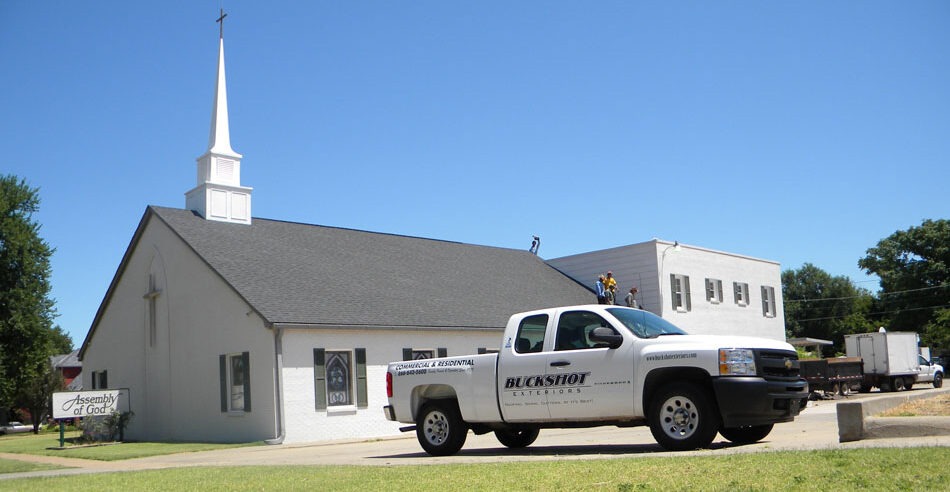
Buckshot Exteriors serves Madison and all of Dane County. We offer free inspections, meet insurance adjusters on-site when needed, and do not use caulk as a substitute for real work. Contact us today to schedule your free inspection. Tell us what you are seeing and we will get someone out to take a look, no pressure, no obligation.
Get a straight answer on your Madison roof
Wisconsin storm season and insurance non-renewal letters do not wait. Get a free, no-obligation inspection and an honest assessment of exactly what your roof needs, even if the answer is to wait.