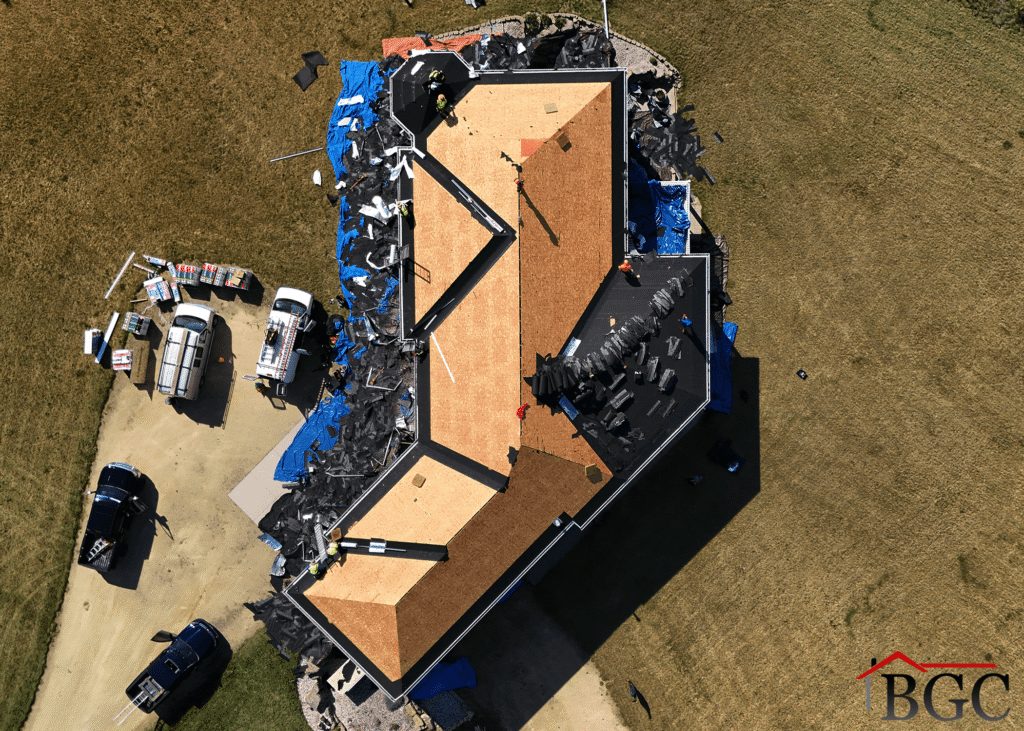
For most south-central Wisconsin roofs we recommend an open metal valley. The smooth metal channel sheds snow, ice and pine debris faster than shingles do, and water never runs across granules, so the valley does not wear out ahead of the rest of the roof. A properly built closed-cut valley is fine on simple, steep, sunny roofs. Open metal is the upgrade we push on anything shaded, complex or debris-prone.
Get My Free Estimate →- The three roof valley types and how each is built
- Why valleys fail before the rest of the roof
- Wisconsin reality: ice dams, snow slide and freeze-thaw
- What goes underneath, whichever valley type you choose
- How to tell which valley type you have from the ground
- The honest downsides of open metal valleys
- What each valley type costs, and why the upgrade is small
- How to check what a quote actually specifies, and who is on your roof
- Can you replace just the valleys, or does the whole roof have to go?
- Valleys, insurance, and protecting yourself in a storm claim
- Get eyes on your valleys before winter does its work
- FAQs
If you are holding two roofing quotes on a Madison house and one says "open metal valleys" while the other says nothing at all about valleys, that line matters more than the shingle brand on the cover page.
Short version: there are three roof valley types, woven, closed-cut, and open metal. For most Wisconsin roofs an open metal valley performs best, because it sheds snow, ice and debris faster and water never scrubs across shingle granules. Closed-cut is more common because it is cheaper and faster. Woven is the weakest of the three with today's thicker laminated shingles.
Valleys carry the highest water volume on any roof. They are also where we find most of the rotted decking on Dane County tear-offs. Getting this detail right costs a little. Fixing it later costs a lot.
The three roof valley types and how each is built
A valley is the interior crease where two roof planes meet. Runoff from both planes funnels into it. Three ways to finish that crease:
Woven valley
Shingles from both planes run through the valley and interlace, alternating course by course, like a braid. Nothing is cut and no metal shows.
It looks tidy from the ground. The trouble is at the fold. Architectural shingles are thick and stiff, and bending them through a crease leaves voids underneath. After years of thermal cycling the mat cracks right along the bend. You also cannot nail near the valley center without putting a fastener in the wettest spot on the roof, so installers push nails outward and the fold stays loose.
Several major manufacturers now steer installers away from weaving laminated shingles. Per GAF's published shingle application instructions for its Timberline laminated products, valleys are to be built as closed-cut or open metal rather than woven. Those instructions are printed on the bundle wrapper and posted on the manufacturer's site, so check your specific product, since details vary by line. We do not build woven valleys.
Closed-cut valley
Shingles from the less visible plane run through the valley and up the adjoining slope roughly 12 inches. Shingles from the other plane run over the top and get cut in a straight line about 2 inches off the valley center. The cut edge is set in sealant and no metal shows.
Built correctly, a closed-cut valley is a legitimate, code-compliant assembly. On the tear-offs our crews did last year across Madison, Sun Prairie, Verona and Middleton, most of the existing valleys were closed-cut. That is the default in this market.
Built poorly (nails too close to center, no sealant at the cut edge, narrow or missing membrane) it is the number one leak location we get called out to.
Open metal valley
A formed metal channel is installed over the ice-and-water membrane, and shingles are cut back on both sides to leave 4-8 inches of metal exposed down the middle. Fasteners go through the outer flanges only, never near the center, and the shingle edges are sealed.
We specify 24-gauge painted steel, which is heavier than the 26- or 28-gauge valley metal that usually shows up on a standard bid. It resists denting better and holds its shape when snow loads slide across it. If your quote lists 26-gauge, you are not being cheated, just know it is the lighter common grade.
Water lands on smooth metal and leaves. That is the whole advantage, and in Wisconsin it is a big one.
Why valleys fail before the rest of the roof
A valley on a typical Madison gable-and-dormer roof can gather runoff from several hundred square feet and squeeze it into a channel a few inches wide. Three consequences follow.
- Granule scour. On woven and closed-cut valleys, all that concentrated flow runs straight across the granules that armor the shingle. Where flow is heaviest the granules go first, and you get shiny black asphalt in the valley while the rest of the roof still looks fine.
- Debris packing. Maple seeds, oak tassels and pine needles collect in creases. On shingle valleys the debris wedges into the cut line or the woven folds and dams water sideways, under the shingles.
- Fastener error. Nails within a couple inches of valley center are the most common installer mistake we find. It does not leak the first year. It leaks after the sealant dries out.
A real one: a 1960s ranch off Monroe Street, original woven valley, homeowner called about a small stain on a hallway ceiling. When we pulled the shingles we found two sheets of decking soft enough to push a thumb through, right under the fold where the mat had cracked. The shingles above looked fine from the driveway. That is how valleys go, quietly.
Wisconsin reality: ice dams, snow slide and freeze-thaw
In south-central Wisconsin valleys are the last place on the roof to clear. Snow slides off the open planes and piles into the crease, sits in the shade, thaws on a 35-degree February afternoon and refreezes overnight. That is a textbook ice dam location, and ice in a valley pushes water uphill under the shingles.
Metal helps twice. A smooth channel releases snow and ice sooner, so valleys clear faster and dam less. And when a dam does form, backed-up water sits on one continuous surface instead of a cut shingle edge and a bead of sealant.
Now the part you need to hear, because plenty of contractors will happily let you believe otherwise: valley metal treats a symptom, it does not cure ice dams. Ice dams are driven by heat loss. Warm air leaking out of your living space through can lights, bath fans, top plates and attic hatches melts snow high on the roof, and that meltwater refreezes at the cold eave or in a shaded valley. The real fix is air sealing the attic floor, getting insulation up to depth, and balancing intake ventilation at the soffit with exhaust at the ridge. If we see heavy dams on your house, we will look in the attic too, and tell you if the roof is not the whole problem.
Then there is freeze-thaw. Repeated freeze-thaw swings through a typical Wisconsin winter work on that cut edge or woven fold, season after season. Metal does not care.
One honest caution. On a steep plane above a lower roof, a porch or an entry door, open metal can dump snow harder and faster. Sometimes the right answer is snow retention below the valley, or keeping metal off one specific run. That is an on-site judgment call, not a brochure decision.
What goes underneath, whichever valley type you choose
Self-adhering ice-and-water membrane, in every valley, before the metal or shingles.
Ice-and-water shield is a rubberized asphalt membrane that bonds to the deck and seals around nails driven through it. Felt and synthetic underlayment do not do that. In a valley, where backed-up ice water is a normal winter event, a self-sealing membrane is the last line between your ceiling and that water.
This is code territory, not just opinion. Wisconsin's Uniform Dwelling Code (SPS 321) governs roof coverings on one- and two-family homes, and the model code provisions behind it require valley lining under asphalt shingles and an ice barrier in cold climates like ours. Your Madison or Dane County inspector will point you to the same sections. Useful to know if you are arguing with a lowball bid that skipped it.
The right detail is a full-width run (36 inches is common) centered in the valley, running its full length. On our residential roofing installs that is standard in valleys, along eaves and around every penetration.
Worth noting: valley metal and valley membrane both cost money and both are invisible once the roof is done. That is exactly why some bids leave them out.
Not sure what is in your valleys right now? We will get on the roof, look, photograph it and tell you straight. Free, no pressure, no obligation. Reach out here or call our office.
How to tell which valley type you have from the ground
Stand back at the driveway and look at the crease lines:
- Strip of metal down the middle: open metal valley.
- Shingles running continuously with one clean straight cut line: closed-cut valley.
- Shingles braided back and forth: woven valley, common on older three-tab roofs around Madison's near-west and east side.
While you are down there, check two more things. Is the valley darker or shinier than the rest of the roof? That is granule loss. Is there a debris line, moss or a stain trailing out of the valley bottom? That is slow drainage.
The honest downsides of open metal valleys
Fair questions we get every time we recommend it.
Will the metal stripe look industrial? Valley metal comes in standard roofing colors, and we match it to the shingle or the trim. On a weathered wood or charcoal roof most people never notice it from the street. Painted Kynar-type finishes hold color well, though any exposed metal will soften slightly over 20 years, the same as your gutters have.
Is rain louder? No. The valley metal is fastened to a fully sheathed, membrane-covered deck, not spanning open air, so there is no drum effect. Homeowners tell us they hear no difference.
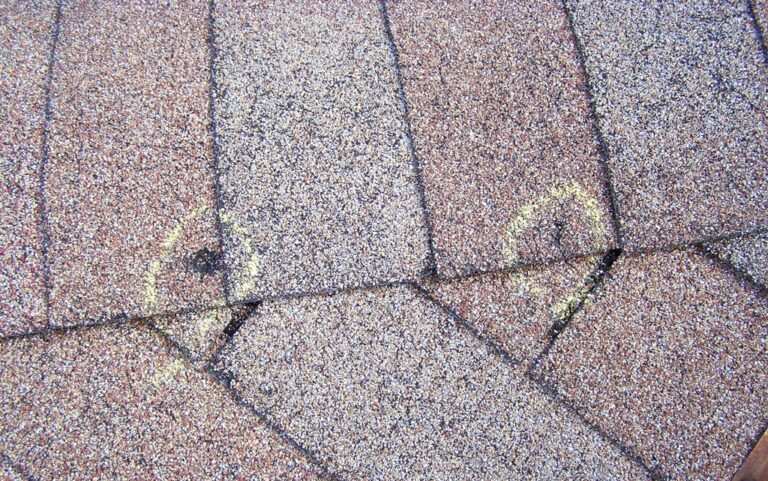
Does hail dent it? Exposed valley metal can show cosmetic denting from large hail, the same as your gutters or roof vents. It is one reason we run the heavier 24-gauge. Shallow cosmetic dents in the flat pan generally do not leak. What does leak is sharp creasing, a split or opened seam, or dents right at the fastener flanges, so those get replaced, not admired. And when hail is hard enough to mark valley metal it has usually bruised the shingles too, which is a claim conversation.
Dissimilar metals. This one is real and it gets ignored. Aluminum valley metal in direct contact with copper flashing, or fastened with the wrong nails, will corrode at the contact point. We keep the metals compatible, use matching fasteners, and isolate the joint where an older copper chimney flashing or a galvanized detail meets new valley metal.

Want a straight answer on your roof?
We'll inspect it, document everything, and tell you honestly what you're looking at, even if the answer is patch it for now. No pressure.
What each valley type costs, and why the upgrade is small
Ballpark only, and it varies with pitch, roof height and access:
- Woven: cheapest in material, slow to install, and not worth doing.
- Closed-cut: the default. Fast, no metal cost. This is what most bids assume when they say nothing.
- Open metal: figure roughly $8-$15 per linear foot installed in this market for formed metal plus the slower, more careful labor. A typical Madison home has 60-100 linear feet of valley, so the upgrade over closed-cut usually lands somewhere around $500-$1,500. Steep, tall or cut-up roofs run higher.
Set that against a full replacement number and the math is easy. You are protecting the part of the roof most likely to fail for a small share of the total. And if you are already paying to replace rotted valley decking, you have spent more than the upgrade would have cost.
How to check what a quote actually specifies, and who is on your roof
Valley language to look for
- Valley type named. "Open metal valley, 24-gauge painted steel" or "closed-cut valley." If it only says "install architectural shingles," you do not know what you are buying.
- Ice-and-water shield in valleys, listed separately from eave protection.
- Valley footage. A real bid measures linear feet of valley, hip and ridge.
- Decking replacement language. What happens if we find rot, and at what price per sheet.
- Nailing detail. Better bids specify no fasteners in the valley center zone.
If two quotes are $2,000 apart, this is often where the difference hides. Ask both contractors to explain their valley detail.
Credentials, permits and warranties to ask about
On a purchase north of $15,000, verify the boring stuff:
- Wisconsin credentials. Work on one- and two-family homes requires DSPS Dwelling Contractor certification (which itself requires proof of liability insurance and workers compensation coverage) plus a certified Dwelling Contractor Qualifier. Ask for the certification numbers and a certificate of insurance sent directly from the agency, not a photocopy.
- Permit and inspection. A tear-off and reroof in the City of Madison and most Dane County municipalities needs a permit, and someone has to be there for the inspection sign-off. Ask who pulls it. A contractor who wants you to pull your own permit is putting the liability on you.
- Two warranties, not one. The manufacturer covers the shingles. Your contractor covers the labor, and labor is where valley leaks come from. In this market you will see anywhere from one year to ten on workmanship. Get the length and what it excludes in writing, next to the material warranty. Ask us for ours before you sign anything.
- Shingle warranty and valley style. Open metal valleys are an approved method in the application instructions of every major shingle line we install and do not disqualify you from enhanced coverage. Those tiers depend on installer certification and required qualifying components (underlayment, starter, ridge cap, ventilation). As a GAF Master Elite contractor we register the warranty for you and show you which components your tier requires.
Can you replace just the valleys, or does the whole roof have to go?
Valleys can be repaired on their own, and often should be. We cut the field shingles back a couple of feet on each side, replace any soft decking, run new ice-and-water membrane and new valley metal, then tie the shingles back in.
Two honest limits. Color match: a 12-year-old roof has faded, so new shingles will be close but not identical, and the blend shows more on lighter colors. Brittleness: shingles past roughly 15 years crack when lifted, so the repair zone keeps growing.
A valley repair is usually a one-day job. A full asphalt shingle roof replacement in Madison on an average home is typically one to two days on site. Here is what that day actually looks like: dumpster or trailer placed where you approve, plywood down to protect the driveway, tarps and plywood shielding landscaping, shrubs and AC units, gutters protected at the drop zones, and a magnet sweep of the lawn, drive and terrace at the end of each day. Walk it with the foreman before the crew leaves and point out anything you find. Nails in a tire is the complaint we work hardest to never earn.
We do offer financing on full replacements through third-party lenders. Ask for the actual terms in writing (rate, monthly payment, term length, and whether there is a prepayment penalty) and compare them to your bank or credit union before you commit. It is worth considering when a repair keeps buying you one more winter and nothing more.
Valleys, insurance, and protecting yourself in a storm claim
After hail or straight-line wind in Dane County, valleys deserve a close look. Hail bruising concentrates where granules are already thin, and wind-driven rain finds any weak cut edge. Adjusters do inspect valleys, but valley metal and valley decking do not always make the scope unless the damage is documented well. That is why we meet your adjuster on the roof and walk the valley granule loss and creased shingles with them. Here is more on how we handle storm damage restoration in Dane County.
Now the part a lot of contractors skip, so read it:
- You are not obligated to use the company that inspects your roof or meets your adjuster. Get a second opinion if you want one.
- Get the scope in writing with line items before work starts, and do not sign a work authorization while the claim scope is still unsettled.
- Know what a contingency agreement does before you sign it. It commits you to a contractor if the claim is approved. Some are fair, some are not.
- On cancellation rights, be precise. Under Wisconsin's home improvement trade practices rule (ATCP 110) and the FTC cooling-off rule, a contract signed at your home following a direct solicitation, the storm-chaser knocking on your door, generally carries a three-business-day right to cancel with written notice. That does not automatically apply to a contract you initiated yourself or signed at a contractor's office. Read the cancellation clause in the document actually in front of you and ask before you sign.
- If the adjuster denies valley metal or decking, request a re-inspection with supplemental photos and manufacturer or code documentation. Denials get reversed regularly when the paperwork is right.
Get eyes on your valleys before winter does its work
Valleys are the honest test of a roofing job. They are where the water goes, where the ice sits, and where shortcuts show up three winters later as a stain on a bedroom ceiling.
If your valleys look dark, shiny or debris-packed, or you are holding two quotes and cannot tell which is better, let us take a look. Buckshot Exteriors has been on south-central Wisconsin roofs since 1979, we photograph what we find, and if the answer is a valley repair instead of a new roof, that is what we will tell you. The inspection and the estimate cost nothing, there is no obligation, and nobody gets a hard sell at your kitchen table.
Call our office or request your free roof inspection here. If you have active water coming in, say so when you call. We run 24-hour emergency storm response, and emergency tarping is a billed service (usually a small charge, and often recoverable through your claim as mitigation), so we will give you the number before we do the work. The inspection itself stays free either way.
Get a straight answer on your Madison roof
Wisconsin storm season and insurance non-renewal letters do not wait. Get a free, no-obligation inspection and an honest assessment of exactly what your roof needs, even if the answer is to wait.