
Kickout flashing is a small angled piece at the bottom of a roof-to-wall joint. It sends roof runoff into the gutter instead of down the wall behind the siding.
Get My Free Estimate →- What kickout flashing does
- Where your home needs kickout flashing
- Why a missing kickout causes hidden damage
- Signs your kickout flashing is missing or failing
- How kickout flashing is added to an existing home
- Why kickout repair is a roof and siding job
- Other leaks at roof-to-wall joints
- Get your roof-to-wall joints checked
- FAQs
Kickout flashing is a small angled piece of metal or plastic at the bottom of a roof edge where it meets a sidewall. It turns roof runoff away from the wall and into the gutter, so the water does not run down behind the siding.
When a kickout is missing, the wall below that corner gets soaked every time it rains. The rot usually stays hidden behind the siding until the sheathing, framing or a window below it is damaged.
Buckshot installs kickout flashing and repairs the wall around it through our roof repair and siding repair services. This guide shows where a kickout belongs, how to spot a missing one from the ground and how the fix works.
What kickout flashing does
Kickout flashing protects one specific joint, the spot where the lower edge of a roof runs into a wall that keeps going. Along that wall, step flashing tucked under each course of shingles keeps rain off the siding.
At the bottom of the run, water leaving the last piece of step flashing needs somewhere to go. Without a kickout, it pours down the face of the wall behind the end of the gutter.
A kickout replaces that first piece of step flashing with a piece bent outward, so the water is kicked into the gutter instead. Roofers use molded kickouts or form them on site from sheet metal.
Where your home needs kickout flashing
Your home needs a kickout anywhere the eave of a sloped roof stops against a wall. Walk around the house and look for these joints.
- Where a garage, porch or addition roof meets a taller house wall
- Where a lower roof ends against a second-story wall
- Where a roof edge ends against a sided chimney chase
- Anywhere a gutter ends at a wall instead of at a corner of the house
The International Residential Code, a model code behind many state codes, calls for a flashing that diverts water away where a sloped roof's eave meets a sidewall. The Journal of Light Construction still describes kickouts as required by code yet often overlooked.
Signs your kickout flashing is missing or failing
Check from the ground at every spot where a roof edge stops against a wall. Look at the bottom corner of the roof and at the wall directly below it.
- No angled piece at the bottom of the roof-to-wall joint
- Streaks, stains or peeling paint running down the wall below that corner
- Swollen, warped or soft siding or trim below the joint
- Water spilling down the wall at the end of the gutter during rain
- Rotted trim or water stains on a window or door below the corner
- Damp drywall, stains or a musty smell inside, on the wall below the corner
A kickout can also be present and still fail. Water stains below an existing kickout usually mean it is leaking at its seam, is too short or was set over the house wrap instead of behind it.
Our guide to mold behind siding shows what this moisture looks like once it has been trapped for a while. Do your checks from the yard or from a window, and stay off the roof edge.
Seeing stains below a roof-to-wall corner? Our on-site inspection is free, so you can find out whether the kickout is missing and how far the water has gone.
Free on-site inspection · Family-owned since 1979How kickout flashing is added to an existing home
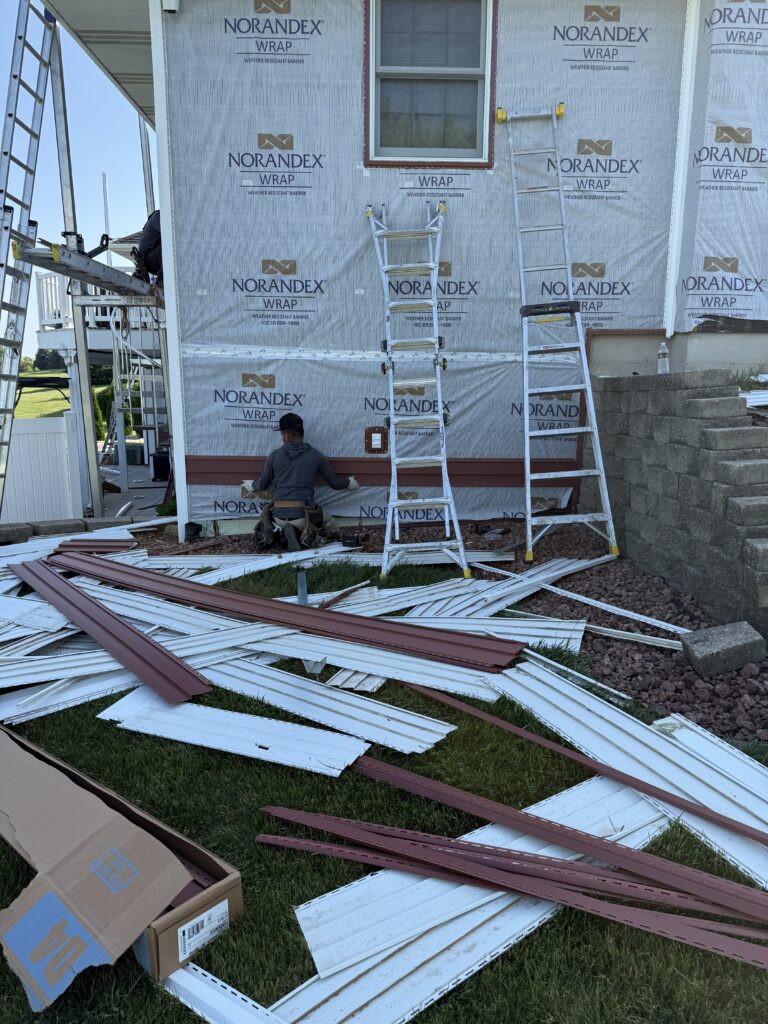
Adding a kickout to an existing home means opening the wall at that corner. The kickout has to sit behind the siding and tie into the house wrap, so a piece of metal caulked onto the face of the siding does not stop water that is already getting behind it.
- Open the corner. The siding and trim at the bottom of the roof-to-wall joint come off, along with the lowest shingles and step flashing.
- Repair the damage. Rotted sheathing and framing are cut out and replaced with sound wood.
- Rebuild the water barrier. New house wrap or flashing membrane is lapped so water drains outward over each layer.
- Install the kickout. The kickout goes in as the first piece of step flashing, angled into the gutter, with new step flashing up the wall.
- Close the wall. Shingles, trim and siding go back on, and damaged siding is replaced to match.
Building America's retrofit guide calls for exposing at least 8 inches of wall during this repair, so the new flashing can be lapped properly. Our house wrap guide explains how the layer behind your siding is meant to shed water.

Want a straight answer on your roof?
We'll inspect it, document everything, and tell you honestly what you're looking at, even if the answer is patch it for now. No pressure.
Why kickout repair is a roof and siding job
A kickout sits where roofing and siding meet, so it often gets missed when one crew does the roof and another does the wall. Fixing it properly means shingles, step flashing, house wrap and siding all come apart and go back together in the right order.
Buckshot's own crews do both the roofing and the siding, so one team handles the whole corner. If the rot reaches further along the wall, our siding replacement service covers the rest.
When you replace a roof or siding, ask whether the quote includes kickout flashing at every roof-to-wall joint. Adding one is far easier while the wall or roof is already open during a roof replacement or new siding.
Other leaks at roof-to-wall joints
Kickouts are one of several places where water gets in along a roof-to-wall joint. Our flashing repair article explains step and counter flashing in more detail.
Leaks around dormers start at the same kind of joint, as our guide to dormer leaks explains. If the water only shows up in storms, read about roofs that leak only in heavy rain.
Get your roof-to-wall joints checked
Buckshot Exteriors is family-owned, has served homeowners since 1979, and has offices in Madison, Wisconsin and Centerville, Iowa. We install kickout flashing and repair the roof and siding around it as part of our residential roofing work, and our on-site inspection is free.
Call (608) 909-9109 to schedule your free inspection, or send us a message and we will set a time. If you would rather check first, walk the house with the list of joints above.
Get a straight answer on your Madison roof
Wisconsin storm season and insurance non-renewal letters do not wait. Get a free, no-obligation inspection and an honest assessment of exactly what your roof needs, even if the answer is to wait.