Yes, and the two are unrelated. Gutters move water away once it reaches the edge; they do nothing about water that has already gone *under* the shingles. Gutter guards actually make no difference to ice dams either way - an ice dam forms on the roof above the gutter, and a gutter full of ice is simply a heavier gutter. The membrane is what protects the house.
Get My Free Estimate →Here is the short version: ice and water shield is a self-adhering waterproof membrane that seals around every nail driven through it, and in Wisconsin it is the single thing standing between an ice dam and your ceiling. Shingles shed water going downhill. They do nothing when melted snow backs uphill under them in February - and that is exactly what an ice dam does.
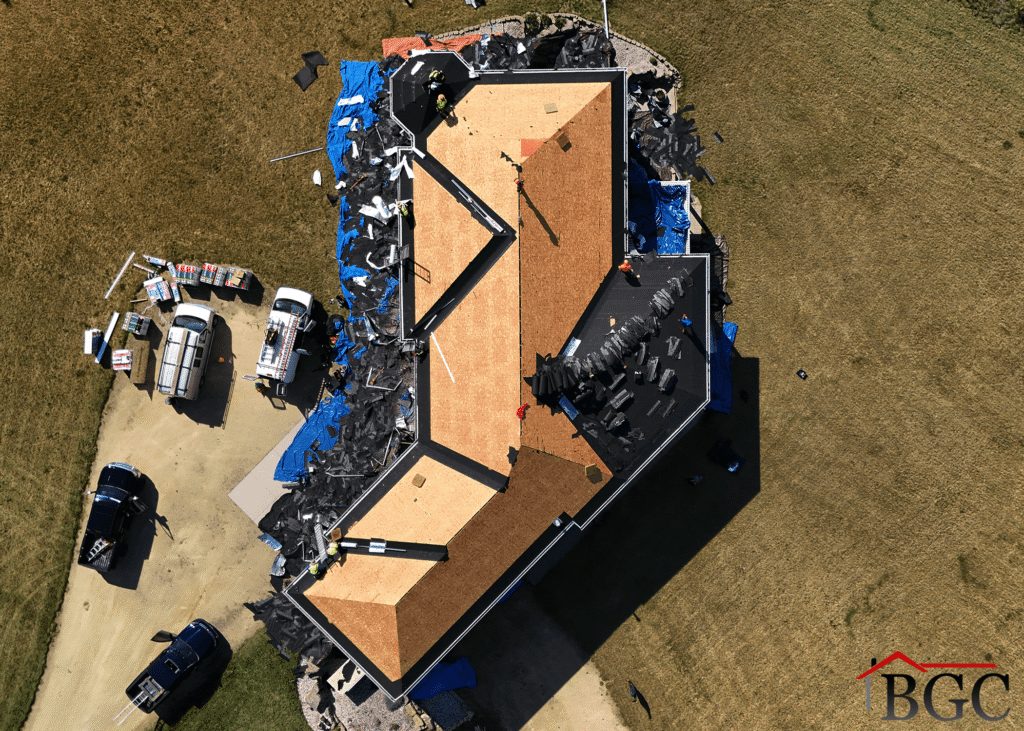
If you are comparing roofing quotes right now, this is the line item most homeowners skim past and the one that most separates a roof that survives our winters from one that leaks in year three. We have been tearing off Madison-area roofs since 1979, and the water damage we find almost always traces back to the eaves, the valleys, or a penetration - the three places this membrane belongs.
What it actually is (and how it differs from the other underlayments)
Your quote may list two or three different layers under the shingles. They are not interchangeable.
Felt or synthetic underlayment is the sheet that covers the whole deck. It is water resistant, not waterproof. It sheds water that gets past a shingle, and it protects the deck during installation. Synthetic is lighter, stronger and does not wrinkle like old-fashioned felt - most quality roofs use it across the field now.
Ice and water shield (also called ice-and-water membrane, or by brand names like WinterGuard or StormGuard) is different in one crucial way: it is self-adhering rubberized asphalt. It sticks directly to the deck, and when a nail goes through it, the material grips and seals around the shank. That nail-sealing property is the whole point. A shingle nail through plain felt is a hole. A shingle nail through ice-and-water shield is not.
That is why it goes in specific high-risk places rather than across the entire roof - it costs several times what synthetic underlayment costs per square.
The places it belongs on a Wisconsin roof
The eaves. This is the ice-dam zone. Snow melts over the warm part of your roof, runs down to the cold overhang past the exterior wall, refreezes, and builds a dam. Water then pools behind that dam and works its way up under the shingles. Membrane at the eaves is what keeps that pooled water out of the house.
How far up matters enormously. The widely used rule is that the membrane must extend from the eave edge to a point past the inside face of the exterior wall - commonly cited as at least 24 inches inside that wall line. On a low-slope roof, or a house with deep overhangs, one 36-inch course does not get you there and a second course is needed. This is the number to ask about specifically, because it is the easiest place to save money invisibly.
Valleys. Two roof planes funnel their water into one channel. Valleys carry more water than anywhere else on the roof and they are where debris collects and dams form. They get membrane, full stop.
Around every penetration. Chimneys, skylights, plumbing vent stacks, exhaust vents, dormer walls. These are the interruptions in an otherwise continuous surface, and interruptions are where roofs leak. Flashing does the primary work; membrane underneath is the backup that catches what flashing eventually misses.
Low-slope sections. Porch roofs, additions, dormer tops. The shallower the pitch, the slower water leaves, and the more time it has to find a way in. Sections below roughly 4/12 deserve extra coverage; very low slopes need a different system entirely.
Rake edges and sidewalls on exposed, wind-driven elevations. Not always necessary, but on a west-facing wall that takes every storm, it is cheap insurance.
Why "meets code" is often not enough here
Building codes set a floor, not a standard of care, and local amendments vary - confirm the current requirement with your municipality rather than taking any contractor's word for it, ours included.
But here is the practical reality we see on tear-offs: a roof built to the bare minimum a decade ago, on a house with an under-insulated attic and blocked soffit vents, has membrane that stops right about where the ice dam starts. The water finds the gap. Meeting minimum coverage on a house that generates heavy ice dams every winter is a technically compliant roof that still leaks.
The honest recommendation is to match the coverage to your house - its pitch, overhang depth, attic condition, and history. A home that has never had an ice dam needs less than one that gets them every January.
The part nobody tells you: membrane is not the actual fix
This is where we will argue against selling you more material.
Ice dams are a heat problem, not a roofing-material problem. They form because warm air leaks from your living space into the attic, warms the roof deck, and melts snow that then refreezes at the cold eave. Ice and water shield is the last line of defence - it keeps the resulting water out of your house. It does not stop the dam from forming, and it does nothing about the ice tearing at your gutters or the icicles over your front step.
The actual fix is air sealing, insulation and balanced ventilation, so the roof deck stays cold and the snow never melts in the first place. We cover the causes in our ice dam guide and the ventilation side in the attic ventilation guide.
So the right sequence is: fix the heat loss, ventilate properly, and put membrane where it belongs when the roof is next opened up. Any contractor who sells you more membrane while ignoring a 140°F attic is selling you a bandage.
Want a straight answer on your roof?
We'll inspect it, document everything, and tell you honestly what you're looking at, even if the answer is patch it for now. No pressure.
How this line item hides in a cheap bid
When two quotes are thousands apart, this is one of the places the difference lives - and it is invisible from the ground for about eight years.
Ways coverage quietly disappears:
- One course at the eaves instead of two, on a house that needs two
- Felt in the valleys instead of membrane
- No membrane around penetrations - just flashing and sealant
- "Ice and water shield included" with no stated coverage area, so you cannot tell what you are getting
- Reusing old step flashing rather than re-flashing, which no membrane compensates for
A complete written estimate states where the membrane goes and how far. If yours does not, ask - the answer tells you a lot about the bid. We wrote a full breakdown of what a proper estimate itemises in our guide to comparing roofing estimates.
What it costs
Ice and water shield is priced per square (100 sq ft) installed, and it runs several times the cost of synthetic underlayment - which is exactly why it is targeted rather than used everywhere. On a typical Madison home, extending eave coverage from one course to two, and adding valleys and penetrations, is usually a modest addition to a five-figure roof replacement. Set against one ice-dam repair - wet insulation, stained drywall, sometimes rotted decking - it is one of the cheapest decisions on the entire project.
Whole-roof membrane coverage exists and is sometimes specified on very low-slope or high-exposure roofs, but for most homes it is money better spent on attic insulation and ventilation.
Get a straight answer on your Madison roof
Wisconsin storm season and insurance non-renewal letters do not wait. Get a free, no-obligation inspection and an honest assessment of exactly what your roof needs, even if the answer is to wait.