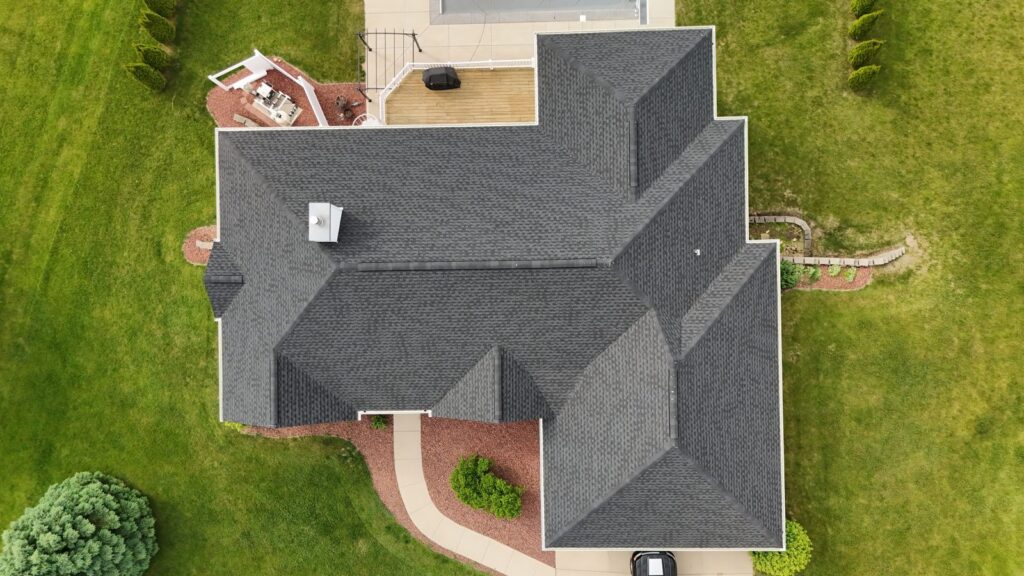
They're almost never for the same scope. Usually the cheaper bid leaves something out: a full tear-off (versus a layover), ice-and-water shield up the eaves and in the valleys, new step flashing at walls and chimneys, an allowance for rotten decking, or a better shingle line. Put both estimates side by side and compare line for line. If one bid can't be compared because it's a single price on a half page, that's your answer.
Get My Free Estimate →- What a complete written roofing estimate must itemize
- What a roof replacement actually costs around Madison
- Why the two bids are thousands apart: the five usual places
- Questions that expose a thin bid
- How to verify the company is real, not a spring startup
- Can you roof in a Wisconsin winter?
- Why the cheapest bid usually costs the most
- Red flags to walk away from
- The insurance money, explained plainly
- While the roof is off: gutters, skylights and siding
- What our free estimate includes, so you can hold everyone to it
- Ready for a second opinion on your bids?
- FAQs
If you have two roofing estimates on the kitchen table and they're thousands of dollars apart, here's the honest truth: they're almost never quoting the same work. Compare roofing estimates line by line instead of bottom line to bottom line, and the gap usually explains itself in about ten minutes.
We've been roofing homes in Madison, Dane County and the surrounding towns since 1979. We've been the higher bid and we've been the lower bid. Either way, the homeowners who end up happy are the ones who figured out what each price actually bought.
Here's how to do that.
What a complete written roofing estimate must itemize
A real estimate is a scope of work with a price attached, not a number on a business card. Before you compare anything, check that each bid spells out these items in writing.
- Tear-off, and how many layers. Full tear-off down to the wood, or a layover on top of the existing shingles? Under the Wisconsin Uniform Dwelling Code re-covering provisions, the ceiling is two layers total: if two roof coverings are already up there, the next roof has to be a full tear-off. Even with one layer, re-covering is only allowed if the existing shingles and decking are sound, dry and not curled or water-soaked. Confirm layer count and disposal on the bid. A layover of any kind also means nobody looked at your decking.
- Decking inspection and a per-sheet replacement price. No one knows what's under your shingles yet. The bid should list a price for replacing bad sheathing per 4x8 sheet of OSB or plywood, installed.
- Underlayment, plus exact ice-and-water shield coverage. This is the line that separates Wisconsin bids. Ice-and-water shield is a self-adhering membrane that seals around nails and blocks water pushed backward by ice dams. Ask exactly where it goes: how far up from the eaves, all valleys, around chimneys and skylights, in dead valleys and behind gutters. "Synthetic underlayment throughout" is not the same thing.
- Shingle line and warranty tier. "Architectural shingles" covers a wide range. Get the manufacturer, the product line, and whether the warranty is just the shingle warranty or a manufacturer-backed system warranty.
- Flashing scope. New step flashing at walls, new counterflashing or a chimney flashing kit, pipe boots, kickout flashing where a roof meets a wall above a gutter. Reusing rusted flashing is the cheapest shortcut in roofing and the most common source of a leak two winters later.
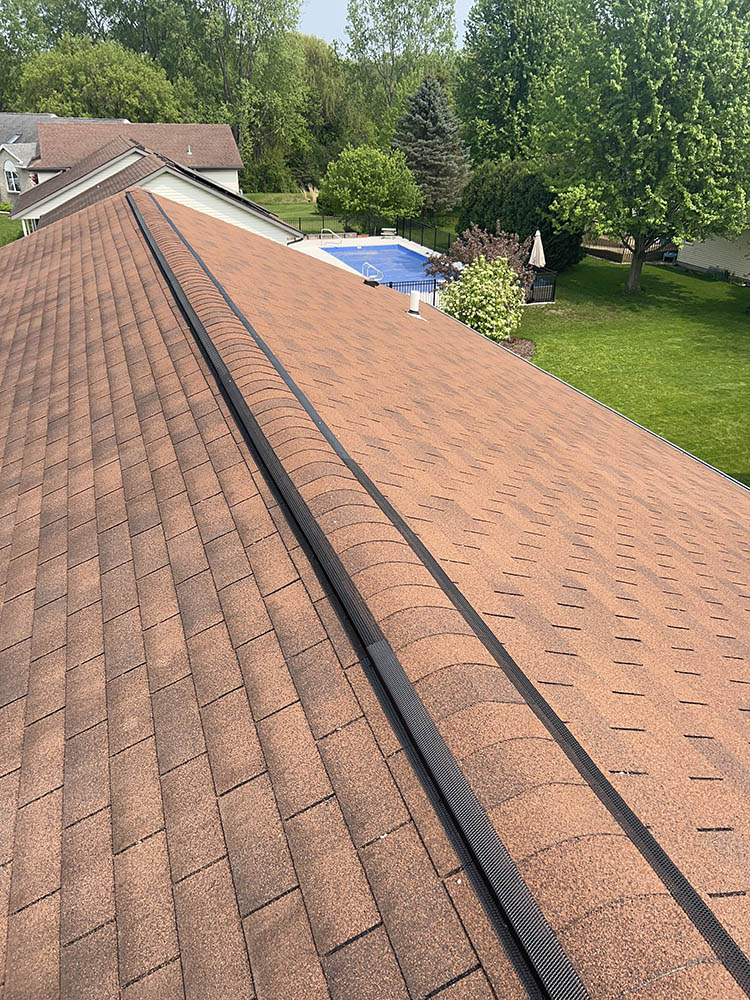
- Ventilation. Ridge vent footage, intake at the soffits, and bath fans routed outside instead of into the attic. Poor intake is why shingles cook and why ice dams keep coming back.
- Cleanup. Dumpster or trailer, tarped landscaping, gutter protection, and a magnetic nail sweep of the drive and yard. Daily, or only at the end?
- Permit, and who pulls it. Madison, Fitchburg, Middleton, Sun Prairie and Verona each have their own permit rules for roof work, and some rural Dane County towns don't require one for a simple re-roof. Your contractor should know which office your address falls under and pull the permit in their own name.
- Workmanship warranty term, in years. Written on the estimate, not promised at the table. Ours is a {{WARRANTY_YEARS}}-year workmanship warranty, printed on every estimate we hand out.
- Payment schedule and how change orders are priced.
The side-by-side check
Print this and hold both bids to it.
| Line item | What a complete bid says | What a thin bid says |
|---|---|---|
| Tear-off | "Full tear-off to deck, 2 layers, disposal included" | "Remove old roofing" |
| Ice-and-water shield | "6 ft up all eaves, all valleys, chimney and skylight, dead valleys" | Not listed at all |
| Decking | "$X per 4x8 sheet, installed, approved by owner before install" | Silent |
| Flashing | "New step, new counterflashing, new pipe boots, kickout at gutter" | "Reflash as needed" |
| Shingles | Brand, product line, system warranty tier | "Architectural shingles" |
| Ventilation | "XX linear ft ridge vent, intake verified at soffits" | Silent |
| Cleanup | "Daily debris pickup, tarped beds, magnetic nail sweep" | "Haul away debris" |
| Warranty | "X-year workmanship warranty" on the page | "We guarantee our work" |
| Payments | Deposit at material delivery, balance on completion | "One third down" |
If you want a sanity check on your own bids, look at how we lay out a residential roofing scope and hold every estimate you've got to that same standard.
What a roof replacement actually costs around Madison
Around here, a straightforward asphalt shingle roof replacement with architectural shingles commonly runs about $400-$700 per square installed. A square is 100 square feet of roof surface, so a 26-square single-story ranch with a walkable pitch usually lands somewhere in the $10,400-$18,200 range.
What moves you inside that range: pitch (steep means harnesses and slower production), number of stories, how cut up the roofline is (valleys, dormers, skylights), how many layers come off, how much decking is bad, chimney and wall flashing work, and material grade. An impact-rated Class 4 shingle or standing seam metal is a different conversation entirely.
Treat those numbers as orientation, not a quote. Nobody can price your roof from a keyboard.
If writing that check this month isn't realistic, ask about financing on the first visit. It runs through a third-party lender, so it's a standard credit application with a fixed monthly payment over a set term, most plans let you pay it off early without a penalty, and you get the lender's real terms in writing before you decide anything.
Why the two bids are thousands apart: the five usual places
Take that same 26-square ranch. A bid at $11,500 and a bid at $17,000 on the identical house almost always differ in these five spots.
1. Tear-off versus layover
A layover skips labor and dump fees. It also traps heat, adds weight, and guarantees no one inspected the deck. On a 1960s ranch in Monona or Sun Prairie with original plank decking, that matters a lot.
2. Ice-and-water shield coverage
Sixty feet of membrane at the two front eaves is a very different number than full-perimeter eaves, every valley, and every penetration. In our freeze-thaw climate, that's the line item that actually protects your ceilings.
3. Flashing: new or reused
New step flashing at a chimney and two wall intersections costs real labor. "Reflash as needed" often means "we'll caulk it."
4. Shingle grade
3-tab, standard architectural, and impact-rated Class 4 can spread several thousand dollars across an average roof. Class 4 is the top impact rating, and many Wisconsin carriers offer a premium discount for it. Ask yours.
5. Who is physically on your roof
A long-tenured employee crew and a rotating sub crew price differently because they are different. Neither is automatically wrong. You just deserve to know which one is coming. Ours are in-house crews under our own foremen. When a job needs a specialty trade (a chimney mason, for instance), we tell you up front and they carry their own coverage.
Once you find the differences, ask the higher bidder to justify them and the lower bidder to add them. Usually the two prices move a lot closer together, and now you're comparing apples to apples.
Questions that expose a thin bid
Ask all six and watch how fast the answers come.
- Who performs the work, employees or subcontractors? If subs, are they covered under their own policy?
- Can I get your certificate of insurance directly from your agent? General liability and workers' comp, current, with your name listed. Legitimate contractors send this without flinching.
- What's your Wisconsin credential? Contractors pulling permits on one- and two-family homes work under a Dwelling Contractor Certification with a certified Qualifier. Ask for the number.
- How are change orders priced and approved? In writing, at a stated rate, before the work happens.
- What's your workmanship warranty, in years, and is it on the estimate?
- Are you manufacturer certified? Certifications like GAF Master Elite allow system warranties, including manufacturer-backed workmanship coverage, that an uncertified installer simply cannot register.
A thin bid usually starts to wobble by question two or three.
Not sure how your bids stack up? Call us at {{PHONE}} and we'll come out, get on the roof, and hand you a free itemized written estimate you can lay next to the others. No cost, no pressure, and you keep the paperwork either way.
How to verify the company is real, not a spring startup
Credentials and insurance tell you they're legal. Track record tells you they'll still exist when you call in year six.
- Read reviews on more than one platform. Google, Birdeye, Angi and HomeAdvisor. Look for a steady history across seasons with photos and owner replies, not thirty five-star reviews inside one month. Ours are collected on our customer reviews page and you can spot-check them at the source.
- Ask for three local addresses from the last two years and drive by. Look at the ridge line, the valleys, the flashing at the chimney.
- Look at completed work with photos. Our recent projects show what the paperwork turned into.
- Check the boring stuff. Real local address, lettered trucks, a business that answers the phone in February and not just after a hailstorm.
Can you roof in a Wisconsin winter?
Yes, and a failing roof shouldn't wait until April. Here's the honest cold-weather picture so you can ask about it.
Asphalt shingles seal with heat, so shingles installed in January may not fully bond until the first warm, sunny stretch. A good crew compensates: hand-sealing with roofing cement at eaves, rakes, valleys and penetrations, keeping bundles warm so shingles don't crack when bent over a ridge, and dialing back nail guns so nails don't blow through cold, brittle mat. Ice-and-water shield needs a clean, dry deck and enough warmth to adhere (many membranes want roughly 40 degrees or a primer, and low-temp versions exist).
We also don't tear off into a snowstorm. The deck gets cleared, we open smaller sections, and everything gets dried in the same day. If a bid doesn't mention any of that in December, ask why.

Why the cheapest bid usually costs the most
Because the savings come out of the parts you can't see from the driveway. Recycled flashing. Underlayment stapled instead of capped. No membrane in the valleys. Nails overdriven through the mat, or four nails where the manufacturer requires six. Rotten decking shingled over instead of replaced.
None of that leaks in July. We were called to a small ranch in Monona two winters after another company's bargain re-roof. Whoever did it had skipped valley membrane and reused the wall flashing. An ice dam backed water under the valley, and we ended up pulling ceiling drywall in the back bedroom before we could even start the new roof. The homeowner saved a few thousand on the bid and spent more than that on the repair. The low bidder's one-year warranty was a phone number that no longer rang.
We see the same pattern after hail and wind. Storm chasers land in a Dane County neighborhood, quote fast and cheap, and are gone by spring. If your project started with a storm, read how storm damage restoration in Dane County and insurance documentation actually work before you sign anything.
Want a straight answer on your roof?
We'll inspect it, document everything, and tell you honestly what you're looking at, even if the answer is patch it for now. No pressure.
Red flags to walk away from
A large cash deposit up front. A material deposit at delivery is normal. A third of the contract before anyone shows up is not.
- No lien waivers offered at final payment. Under Wisconsin's construction lien law (Wis. Stat. ch. 779), suppliers and subcontractors can place a lien on your home if they aren't paid, even if you paid your contractor in full. Ask for signed lien waivers from the contractor and any supplier or sub before you release final payment.
- Deductible games. Wis. Stat. § 100.65 prohibits a residential contractor from advertising or promising to pay, waive, rebate or absorb your insurance deductible, and it's enforced as an unfair trade practice. Depending on how the job is billed to your carrier, it can also cross into insurance fraud.
- "Today-only" pricing. Estimates hold for a stated period because material costs move. Pressure is not a discount.
- They never got on the roof. A satellite measurement is a starting point. Nobody sees a soft deck or failed chimney flashing from a laptop.
- No local address, no written contract, or blanks left in the contract. Never sign around blanks.
The insurance money, explained plainly
If a storm is involved, the check confusion is almost always about ACV versus RCV. Actual cash value (ACV) is replacement cost minus depreciation. Replacement cost value (RCV) is the full cost to replace.
On most RCV policies you get two payments. The first is ACV minus your deductible, before the work. After the roof is completed and the final invoice goes in, the carrier releases the held-back depreciation. That's why the first check looks alarmingly small next to the estimate. It usually isn't the final number.
A supplement is a request to the carrier for scope the adjuster's original estimate missed: extra layers found at tear-off, code-required ice-and-water coverage, decking, drip edge, steep or multi-story charges. Documented properly, supplements are routine, not a fight. We meet your adjuster on site and photograph the hail and wind hits with them so there's less to argue about later.
While the roof is off: gutters, skylights and siding
Some decisions are cheaper now than in three years, and they're a common reason two bids don't match.
Gutters and drip edge come off during tear-off anyway. If yours are dented, sagging or undersized for a Wisconsin downpour, replacing them with the roof costs less than a separate mobilization later. Old skylights are the same story: a 20-year-old unit reflashed under a new roof is the leak you'll be chasing, so ask each bidder whether they priced a replacement curb and flashing kit or just reused what's there.
And if the same storm hit your walls, don't split the claim. Hail bruises steel and aluminum and cracks aging vinyl, and adjusters routinely pay both slopes and elevations. We're one of the siding contractors that work with insurance in south-central Wisconsin, so wall damage gets documented in the same visit instead of becoming next year's project.
What our free estimate includes, so you can hold everyone to it
When we come out for a free estimate in Madison or anywhere in south-central Wisconsin, you get:
- A hands-on roof inspection with photos of what we find, not a drive-by.
- An attic look when access allows: daylight, staining, frost, blocked intake.
- An itemized written estimate covering tear-off and layer count, underlayment and exact ice-and-water shield coverage, shingle line and warranty tier, per-sheet decking pricing, flashing scope, ventilation, permit, cleanup with magnetic nail sweep, our {{WARRANTY_YEARS}}-year workmanship warranty, and the payment schedule.
- Options priced separately, like Class 4 impact-rated shingles or a metal accent, so you can see the difference.
- Third-party financing terms in writing if you want them.
- Adjuster coordination on storm claims, on site with them.
- Our credential and insurance information, unprompted.
Ready for a second opinion on your bids?
Call Buckshot Exteriors at {{PHONE}} for a free, no-pressure roofing estimate. We'll get on your roof, show you the photos, hand you an itemized written estimate, and walk your other bids with you line by line if that's what helps. If your roof has years left, we'll tell you that and shake your hand.
It costs nothing to find out and there's no obligation. No high-pressure close, no today-only price, no calls after you say no.
Family owned and operating out of Madison since 1979. Reach us here or call {{PHONE}} to get on the schedule, usually within a few days. Active leaks and fresh storm damage go to our 24-hour emergency line at the same number, and we'll get a tarp on it before we talk about anything else.
Get a straight answer on your Madison roof
Wisconsin storm season and insurance non-renewal letters do not wait. Get a free, no-obligation inspection and an honest assessment of exactly what your roof needs, even if the answer is to wait.