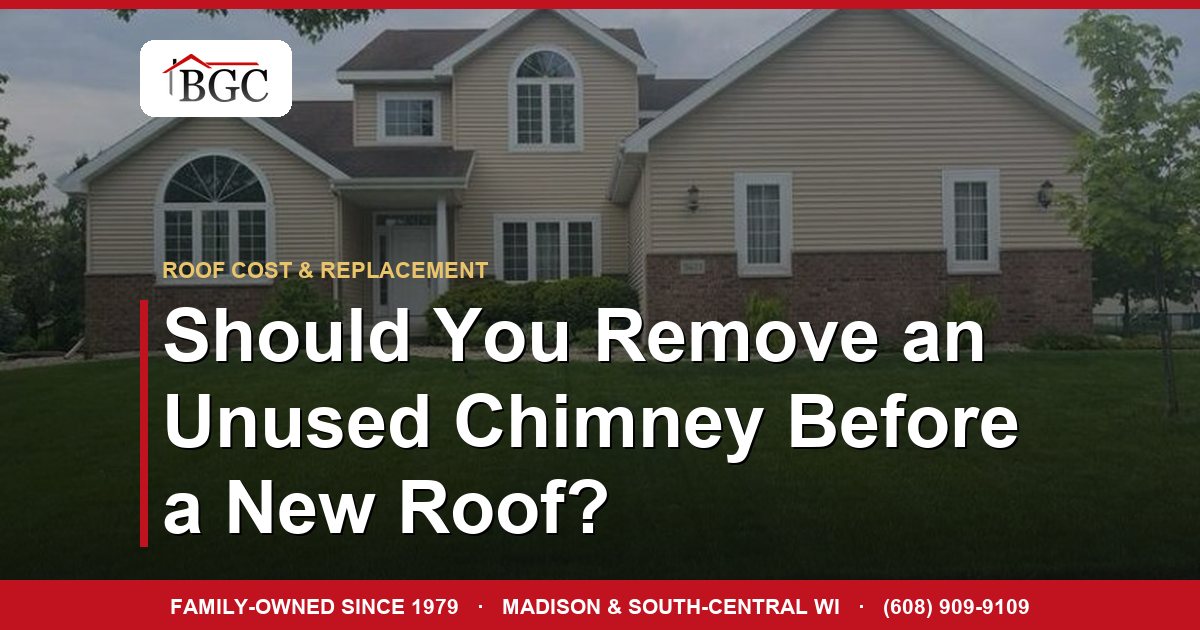
Yes, usually a lot cheaper. The shingles and underlayment around the chimney are coming off anyway, and the crew is already up there with staging and a dump trailer. As a standalone job later, you are paying to cut into a finished roof, re-frame, re-deck and re-shingle that section, and you live with a patch that never quite matches. Handling it with the roof commonly saves several hundred to a couple thousand dollars versus doing it separately.
Get My Free Estimate →- First: Is the Chimney Actually Unused?
- Your Three Real Options
- What Chimney Removal Costs During a Roof Replacement
- What If the Chimney Is Load-Bearing?
- How Long It Takes, and Will the House Sit Open?
- Will Insurance Pay for Any of This?
- "It's Not Leaking Yet. Why Touch It?"
- Can I Hire a Handyman or Do It Myself?
- Appearance and Resale, Honestly
- What to Ask Any Roofer About Your Chimney
- Get Eyes on It Before You Commit
- FAQs
Short answer: if that chimney truly serves nothing anymore, yes, you should strongly consider removing the chimney before the new roof goes on. A roof replacement is the cheapest moment in the life of your house to deal with it. The roof is already open, the crew is already up there, and taking the masonry down below the roofline and sheathing over the hole costs a fraction of what the same job costs two years later on a brand new roof.
There is a second reason to decide now. On the leak calls we run in south-central Wisconsin, chimneys and their flashing are the most common culprit we find. Not the field of shingles. The chimney.
So before you sign a roofing contract, spend ten minutes on this question.
First: Is the Chimney Actually Unused?
Do not skip this. Assume nothing. Go stand in your basement or utility room and look at what vents where.
- White PVC pipe running out a sidewall from the furnace and water heater? Those are high-efficiency, direct-vented appliances. They are not using the chimney.
- Metal vent pipe going up into a brick chimney? Something is still venting through it, usually an older atmospheric-vent water heater or a mid-efficiency furnace.
- A metal liner visible at the top? Same answer. It is in service.
Here is the trap in older homes around Madison, Stoughton, Janesville and Monroe. Somebody upgraded the furnace to a 95% unit that vents out the sidewall and left the original water heater venting into the chimney. The chimney looks abandoned. It is not. Remove it and you have orphaned a gas appliance with nowhere to exhaust, which is a carbon monoxide problem, not a roofing problem.
What if something IS still venting through it?
You are not stuck with the chimney. You just have to give that appliance a new vent path first.
Most of the time it is one water heater. Swapping an older atmospheric-vent tank for a power-vent or direct-vent unit that exhausts out a sidewall commonly runs in the $1,500-$3,000 installed range, and it usually buys you a little efficiency too. If a mid-efficiency furnace is sharing the flue, your options are a furnace change-out or lining the chimney with a stainless steel liner, often $2,500-$5,000 for the liner.
A licensed HVAC contractor or plumber does that work and pulls the venting permit. Get it scheduled before tear-off, so the chimney is genuinely dead the morning the brick comes down.
Roof replacement cost by home size (Madison, 2026)
| Home | Roof size | Typical total |
|---|---|---|
| Small ranch / bungalow | 14-18 squares | $9,000-$13,000 |
| Average two-story | 18-26 squares | $12,000-$18,000 |
| Large or complex (steep) | 26+ squares | $17,000-$25,000+ |
Cost by roofing material (average Madison home, installed)
| Material | Lifespan | Typical total |
|---|---|---|
| Architectural asphalt (standard) | 25-30 yrs | $12,000-$18,000 |
| Impact-resistant (Class 4) | 30+ yrs | $15,000-$22,000 |
| Standing-seam metal | 40-50 yrs | $25,000-$45,000 |
Common add-on costs
| Item | Typical cost |
|---|---|
| Extra tear-off layer | $500-$1,500 |
| Decking replacement | $50-$80 per sheet |
| New flashing & pipe boots | $300-$700 |
| Seamless gutters | $1,000-$2,500 |
Typical Madison-area 2026 ranges. Your exact price depends on an on-site inspection. A new asphalt shingle roof recoups about 61% of its cost at resale on average (2024 Remodeling Cost vs. Value Report).
Quick roof replacement cost estimator
Get a ballpark in 20 seconds. For an exact figure, book a free on-site inspection.
Your Three Real Options
Option 1: Keep It and Flash It Right
Best for a working fireplace, sound masonry, or a house where the chimney is a defining part of the look. Doing it right means all of this, not some of this:
- New step flashing woven up both sides, shingle by shingle
- Counterflashing cut into the mortar joints and sealed, not smeared onto the brick face with caulk
- Ice-and-water shield under the flashing and turned up onto the brick
- A cricket (a small framed and sheathed peak) behind any chimney wider than about 30 inches, so snowmelt and ice divert around it instead of ponding on the uphill side
- Tuckpointing failed joints and swapping spalled brick while access is easy
- A sound crown and cap on top
The cricket is where cheap bids get cheap. We opened up a wide chimney on a Janesville ranch where the only "flashing" was a bead of caulk on the brick and no cricket at all. The decking on the uphill side was black and spongy for about three feet, and the attic insulation under it was matted flat. That roof was eleven years old.
Details on doing this correctly live on our chimney flashing page, and if you have an active drip right now, start with chimney flashing repair in the Madison area.
Option 2: Take It Down Below the Roofline and Roof Over It
This is the sweet spot for most unused chimneys. The masonry comes down to just below the roof deck. Then the roofing crew frames the opening, sheathes it with decking that matches the thickness of what is already there, ties in underlayment and ice-and-water shield, and shingles straight across. From the ground you cannot tell anything was ever there.
On matching and flatness, since everyone asks: during a full replacement, every shingle on the roof is new from the same order, so there is no patch to match. Whether you see a hump or dip afterward is a framing question. New rafters or blocking set flush with the existing framing, plus decking of equal thickness, keeps the plane true. A patch built with thinner or thicker sheathing is what telegraphs as a shadow line when the sun rakes across the roof in the evening.
What happens inside your house: almost nothing. The takedown is done from the roof, working down through the opening, and the brick comes up and out to the trailer rather than down through your living space. The only interior access anyone needs is the attic hatch, to tarp off the area, protect the insulation, seal the flue and vacuum mortar dust. Nobody is opening drywall or plaster.
That flue opening in the attic gets capped and air-sealed. That matters in Wisconsin. An open chimney chase is a warm-air chimney that feeds ice dams.
Does the leftover masonry below the roof trap moisture or smell?
Fair question, and the answer is mostly about water, not air. Once the top of the remaining stack is capped and flashed so rain and snow cannot get in, and the flue is air-sealed at the attic, the masonry stays dry and inert. Damp brick and musty odors usually come from water still entering the top, a cracked crown, or an open cleanout door and thimble down in the basement wicking humid air.
So the checklist is: seal the top properly, air-seal the attic penetration, and cap or seal the thimble and cleanout at the bottom. In most homes the abandoned stack needs no dedicated ventilation. If the masonry is already visibly damp or efflorescing in the basement, have a mason look at it, because that is a moisture source you want identified before it gets buried.
Option 3: Remove It Completely, Top to Bottom
Full removal down through the floors and out of the basement. This is interior remodeling as much as roofing: drywall, plaster, flooring and sometimes framing.
It makes sense when the chimney is failing in the basement, when you are already gutting that part of the house, or when you want the floor space back in a tight room. Otherwise Option 2 gets you most of the benefit for a fraction of the mess.
What Chimney Removal Costs During a Roof Replacement
Nobody should quote your chimney from a phone call, but you deserve an order of magnitude. Typical south-central Wisconsin ranges, done as part of a planned roof replacement:
- Proper reflash with new step and counterflashing, ice-and-water, new cap: roughly $600-$1,500
- Add a cricket behind a wide chimney: roughly $400-$900
- Tuckpointing and brick repair: roughly $500-$2,500 depending on how much is bad
- Above-roofline takedown plus framing, decking and shingle tie-in: roughly $1,200-$3,000
- Full top-to-bottom removal: roughly $4,000-$10,000 and up, before interior finish work
What pushes a job to the high end: a tall two-story exterior stack with a lot of brick to bring down and haul, steep pitch requiring staging, an exterior chimney that needs siding and trim patched where it met the wall, a mason mobilizing separately, and any structural framing. Brick is heavy and disposal is real money.
Where you save is timing. Doing it during an asphalt shingle roof replacement means one mobilization, one dumpster, one tie-in. Doing it eighteen months after your new architectural shingles go on means cutting into a new roof and living with the patch.
And if the full-removal number is the barrier, ask about payment and financing options when you get your estimate. Most homeowners facing a five-figure exterior project are not writing one check, and it is a normal thing to ask about up front rather than after you have already narrowed your choices.
Not sure which camp your chimney falls in? We will get on the roof, look at the masonry and flashing, check the attic side, and tell you honestly which option fits your house. Free, no pressure. Call (608) 909-9109.
What If the Chimney Is Load-Bearing?
Find out, then relax a little, because it rarely changes the popular answer. In plenty of pre-1950 Wisconsin homes the chimney mass is wedged between floor joists or picks up part of a bearing wall.
If you only remove what is above the roof deck, none of that matters. The stack below stays, the load path stays, nothing shifts.
It only becomes structural if you want the whole thing gone through the floors. Then joists or a wall resting on masonry need a header, posts or sistering, designed by a structural engineer or handled by a licensed general contractor. Budget another $1,500-$5,000 or more, and expect a permit. This is also the point where many homeowners look at the number and choose Option 2 instead.
How Long It Takes, and Will the House Sit Open?
An above-roofline takedown usually adds a half day to a day to a normal roof replacement, and your house is not left open to weather overnight. The opening gets framed, sheathed and dried in with ice-and-water shield the same day the brick comes down. That is the whole point of doing it while the roof is open.
Sequencing on a typical job: tear-off starts, masonry comes down that same morning or the following morning, deck gets patched and dried in, shingles go over it with the rest of the roof. If a separate mason is handling heavy masonry or live flue work, that gets scheduled to land on tear-off day so there is no gap. Full top-to-bottom removal is different. Plan on a week or more with interior repairs.
Will Insurance Pay for Any of This?
Be clear-eyed: voluntarily removing an unused chimney is a homeowner-paid improvement, not an insurance claim. No carrier in Wisconsin pays to delete a feature because you are tired of maintaining it.
What can be covered is storm damage. Wind that knocks the crown or top courses off, hail that bruises and splits flashing, or chimney damage bundled into an approved wind or hail claim on the roof. If that is your situation, the documentation decides it, which is why we photograph the masonry and flashing and meet your adjuster on site during storm damage restoration in Dane County. Do not let anyone imply your carrier will fund a voluntary removal.
Want a straight answer on your roof?
We'll inspect it, document everything, and tell you honestly what you're looking at, even if the answer is patch it for now. No pressure.
"It's Not Leaking Yet. Why Touch It?"
Because "not leaking yet" is not a plan, and because a chimney leak does not stay a chimney leak.
Water tracks down the brick, soaks the decking around the opening, and rots it from the top side where you cannot see it. By the time it shows on a ceiling, you are usually replacing decking too. We pulled a 1920s Stoughton bungalow roof where the homeowner had never seen a drip, and the sheathing on the uphill side of the chimney came off in wet pieces by hand.
Capping the top and walking away is not the same as fixing it, either. A cap keeps rain out of the flue. It does nothing for failed counterflashing, open mortar joints, or a missing cricket, which is where the water actually gets in.
Keeping the chimney is sometimes exactly right: a fireplace you use, brick in genuinely good shape, a front-facing feature on a Tudor or Craftsman, or a historic district with review requirements. Right call, just not the do-nothing call. It still needs flashing built to last as long as the shingles.
Can I Hire a Handyman or Do It Myself?
We would not, and not for sales reasons.
Combustion venting is a carbon monoxide risk, and getting the "is anything still using this flue" question wrong can hurt someone. Brick demolition on a pitched roof is a fall hazard with heavy material moving in the wrong direction. And the part that actually keeps water out, the framing, decking, ice-and-water shield and shingle tie-in, is roofing work.
On warranties, here is the accurate version. Your shingles carry a manufacturer limited warranty on the material itself. The enhanced coverage people care about, the system-level warranties that also cover labor and workmanship for a period of years, is tied to a certified installer putting in a complete system and registering it. Bringing in an uncertified party to patch a section can jeopardize that enhanced coverage and will almost always fall outside any workmanship warranty for that area. Practically speaking, an improperly tied-in patch is also one of the most common leak points we get called back to on otherwise healthy roofs.
We are licensed and insured, and we install as a GAF Master Elite contractor, which is the status that makes GAF's enhanced System Plus and Golden Pledge warranties available on the roofs we build. Worth asking any bidder to show you which warranty they can actually register, in writing.
Appearance and Resale, Honestly
The practical resale angle is not curb appeal, it is the inspection report. A chimney with visible mortar failure, spalled brick and rusted flashing gets flagged by nearly every home inspector, and flagged items become negotiation items and repair credits. Handling it with your roof turns that line into a completed improvement with a receipt.
Removing a working fireplace chimney is where people get regret. Plenty of Wisconsin buyers want that fireplace in January. If you love it, keep it. If it was bricked up in 1978 and nobody has used it since, nobody will miss the stack.
And to be clear about what stays with Option 2: firebox, mantel and hearth all remain. What you lose is burning wood, because there is no stack above the roof. If you want fire in that room later, an electric insert drops right in, and a direct-vent gas insert works but needs its own new vent path.
What to Ask Any Roofer About Your Chimney
- Is there a cricket on the uphill side, and if not, why not?
- Is counterflashing being cut into the mortar joints or surface-mounted?
- Does ice-and-water shield run under the flashing and up the brick?
- If it comes off, who frames and sheathes the deck, what thickness, and how is the flue sealed in the attic?
A bid that just says "flash chimney" with no detail is the bid that leaks in three winters. How we handle all of it is part of our residential roofing work across south-central Wisconsin, chimneys included.
- A price dramatically lower than every other bid (corners are getting cut somewhere)
- Pressure to sign on the spot, or a "today only" discount
- A request to sign over your insurance claim (Assignment of Benefits)
- An offer to "waive your deductible" (that is insurance fraud, and it puts you at risk)
- No written, itemized estimate, or no proof of insurance
- A large upfront payment (more than 30%) before any work begins
Get Eyes on It Before You Commit
You do not have to guess. Once somebody who does this for a living looks at the masonry, the flashing, the attic and the venting, the decision is usually obvious in about twenty minutes.
Buckshot Exteriors is family-owned, licensed and insured, GAF Master Elite certified, and you can read what Dane, Rock and Green county homeowners say about us on Google, Birdeye and Angi. We will tell you if the honest answer is "reflash it and move on," because that is often the answer, and we are not going to push you into demolition you do not need. The inspection is free, so it costs nothing to find out, and there is no obligation afterward.
If a roof replacement is coming up, settle the chimney question now, while the roof is still open. Call (608) 909-9109 or request your free inspection here, and we will come out, get in the attic, and put a straight answer in writing.
Get a straight answer on your Madison roof
Wisconsin storm season and insurance non-renewal letters do not wait. Get a free, no-obligation inspection and an honest assessment of exactly what your roof needs, even if the answer is to wait.