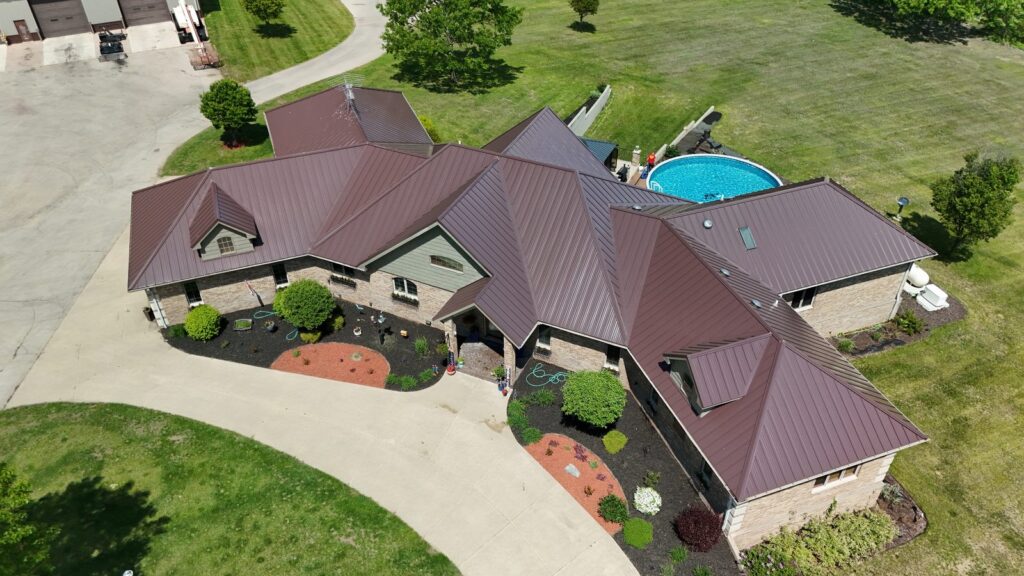
We can connect homeowners with third-party home-improvement lenders, and we will walk you through the terms in plain language before you sign anything. We are equally happy with a check, a card for smaller repairs, or an insurance-paid project - there is no pressure toward any payment method, and the estimate is free either way. Call (608) 909-9109 and ask.
Get My Free Estimate →- First: make sure you actually have to pay for it
- Option 1: Contractor-arranged financing
- Option 2: Home equity - HELOC or home equity loan
- Option 3: Cash, savings, and staging the work
- Option 4: Credit cards and personal loans - the honest warning
- What waiting actually costs
- How to compare your options in one afternoon
- FAQs
A roof replacement on most Wisconsin homes runs five figures, and almost nobody has that sitting in checking. Here is the honest version of how homeowners around Madison actually pay for roofs: insurance covers more storm-damaged roofs than people expect, financing spreads the rest over monthly payments, and the worst option is the one most people default to - waiting, while a small repair grows into a bigger bill.
We are roofers, not bankers, and this article will not push you toward any particular loan. But after four decades of sitting at kitchen tables while homeowners work out how to pay for a roof, we know the options, the traps, and the questions that protect you. One thing to say up front: finding out what your roof needs costs nothing - the inspection and the written estimate are free, and knowing the real number is the starting point for every option below.
First: make sure you actually have to pay for it
Before pricing loans, rule out the scenario where insurance pays for most of the project. If your roof has hail bruising or wind damage from a Wisconsin storm - and large parts of Dane County get hail somewhere almost every summer - your homeowners policy may owe you a roof, minus your deductible. Storm damage is not always obvious from the ground; hail bruises that total a roof can be invisible from the driveway.
The order of operations matters: get the roof inspected and the damage documented before you assume you are paying out of pocket. We photograph everything and deal directly with insurers every week. And one legal note worth knowing: in Wisconsin, a contractor offering to "cover your deductible" is breaking the law - you pay your deductible, and anyone who says otherwise is a contractor to avoid.
If the damage is real wear and age rather than storm damage, insurance will not pay, and it is on you. So - the actual options.
Roof replacement cost by home size (Madison, 2026)
| Home | Roof size | Typical total |
|---|---|---|
| Small ranch / bungalow | 14-18 squares | $9,000-$13,000 |
| Average two-story | 18-26 squares | $12,000-$18,000 |
| Large or complex (steep) | 26+ squares | $17,000-$25,000+ |
Cost by roofing material (average Madison home, installed)
| Material | Lifespan | Typical total |
|---|---|---|
| Architectural asphalt (standard) | 25-30 yrs | $12,000-$18,000 |
| Impact-resistant (Class 4) | 30+ yrs | $15,000-$22,000 |
| Standing-seam metal | 40-50 yrs | $25,000-$45,000 |
Common add-on costs
| Item | Typical cost |
|---|---|
| Extra tear-off layer | $500-$1,500 |
| Decking replacement | $50-$80 per sheet |
| New flashing & pipe boots | $300-$700 |
| Seamless gutters | $1,000-$2,500 |
Typical Madison-area 2026 ranges. Your exact price depends on an on-site inspection. A new asphalt shingle roof recoups about 61% of its cost at resale on average (2024 Remodeling Cost vs. Value Report).
Quick roof replacement cost estimator
Get a ballpark in 20 seconds. For an exact figure, book a free on-site inspection.
Option 1: Contractor-arranged financing
Many established roofing companies, ours included, can connect you with third-party home improvement lenders who finance roofs specifically. You apply, usually online in a few minutes, and if approved the lender pays for the project while you make fixed monthly payments.
The honest pros: it is fast (often same-day approval), it is unsecured (your house is not collateral), and promotional terms sometimes include reduced or deferred interest for an initial period. The honest cons: rates after any promotional window are usually higher than home-equity borrowing, and the convenience is priced in.
Questions that protect you with any contractor-arranged financing: What is the actual APR after any promo period? Is there a prepayment penalty? Is the promotion "deferred interest" (dangerous if you do not pay it off in time - the back interest lands all at once) or true "0% for X months"? A legitimate contractor answers these plainly and does not care whether you finance or write a check.
- A price dramatically lower than every other bid (corners are getting cut somewhere)
- Pressure to sign on the spot, or a "today only" discount
- A request to sign over your insurance claim (Assignment of Benefits)
- An offer to "waive your deductible" (that is insurance fraud, and it puts you at risk)
- No written, itemized estimate, or no proof of insurance
- A large upfront payment (more than 30%) before any work begins
Option 2: Home equity - HELOC or home equity loan
If you have owned your home a while, borrowing against equity is usually the cheapest money available for a roof. A home equity loan gives you a fixed lump sum at a fixed rate; a HELOC is a revolving line you draw as needed. Because the loan is secured by the house, rates run meaningfully below unsecured options, and the interest may be tax-deductible when the money pays for home improvement - confirm that with your tax preparer, not with a roofer.
The trade-offs: setup takes weeks, not days, there can be closing costs, and your home secures the debt. For a planned replacement you can see coming a season away, this route rewards the patience. For a roof that is actively leaking in April, the timeline can be the deal-breaker.
Option 3: Cash, savings, and staging the work
Paying outright is the cheapest option of all, and there is a version of it people forget: staging. If the south slope is failing but the rest of the roof has years left, a reputable roofer will tell you so and quote the partial. We do partial replacements and repairs constantly - the right answer is sometimes a $1,200 repair now and a planned full replacement in three years, saved for on your schedule. Be suspicious of any contractor for whom every roof is an emergency full replacement, today, at once.
Want a straight answer on your roof?
We'll inspect it, document everything, and tell you honestly what you're looking at, even if the answer is patch it for now. No pressure.
Option 4: Credit cards and personal loans - the honest warning
A personal loan is a legitimate middle path: unsecured, fixed payments, faster than home equity. Rates vary widely with credit, so compare against what contractor-arranged lenders offer - sometimes the personal loan wins, sometimes it does not.
Credit cards are the option of last resort for a five-figure roof. Ongoing card interest rates are the highest of anything on this page, and a roof on a card at those rates gets dramatically more expensive. The exception: a small repair of a few hundred dollars that you will pay off in a statement cycle or two - that is what cards are for.
What waiting actually costs
The most expensive financing plan in Wisconsin is deferral. A missing shingle is a $300 repair. Water following that opening for two winters becomes rotted decking, wet insulation, and interior drywall - thousands of dollars that no insurer will cover, because carriers treat slow leaks as neglected maintenance. Freeze-thaw does not pause while you save up; every winter cycle pries opened seams wider.
This is why the free inspection matters regardless of how you would pay. Knowing whether your roof needs $500, $5,000, or a full replacement - and how urgently - is the single piece of information that makes every money decision above rational. Without it you are budgeting blind.
How to compare your options in one afternoon
- Get the roof inspected and get a real number in writing, including a repair-versus-replace recommendation you can sanity-check.
- If there is any chance of storm damage, have that documented first and talk to your insurer before spending your own money.
- Compare total cost of borrowing, not monthly payment: a low payment stretched over long years can cost more than a higher payment over fewer.
- Ask every lender the same three questions - real APR, prepayment penalty, deferred-interest terms.
- Pick the option you can actually sustain. A roof should protect your house, not destabilize your budget.
Get a straight answer on your Madison roof
Wisconsin storm season and insurance non-renewal letters do not wait. Get a free, no-obligation inspection and an honest assessment of exactly what your roof needs, even if the answer is to wait.