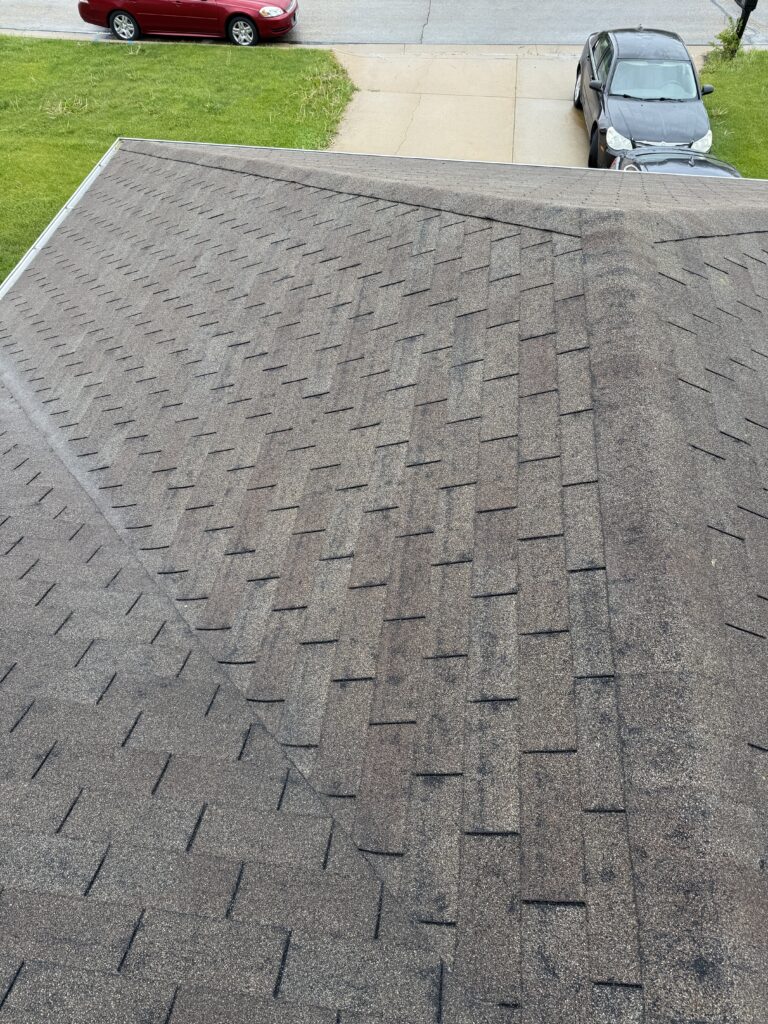
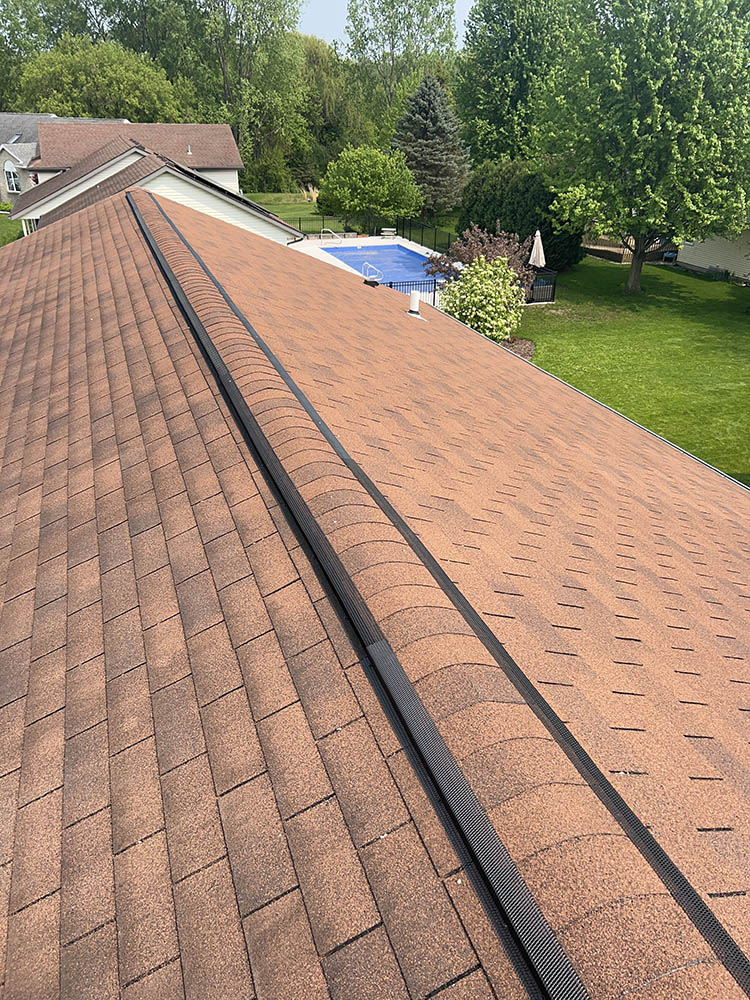
A ridge vent is a ventilation component installed at an opening cut along the peak so warm attic air can escape. Ridge cap shingles are the shingles that cover the ridge line, whether or not a ridge vent is underneath. If a ridge vent is present, the cap shingles are nailed into the vent's baffle rather than solid decking, which is a different nailing detail, but the cap shingles themselves are a separate thing from the vent.
Get My Free Estimate →- What ridge cap shingles actually are
- Ridge cap shingles vs a ridge vent: two different things
- Why the ridge wears out before the rest of the roof
- Warning signs to look for
- Why a ridge leak can show up far from the ridge
- The manufacturer-matching mistake
- What a ridge cap repair actually involves, and what it costs
- A simple annual check
- FAQs
If a roof is going to leak somewhere before its time, the ridge is a good bet. Ridge cap shingles are a small part of the roof by area, but they take more punishment than any other course on it, and when they go, the leak they cause can show up nowhere near the actual problem.
Here is what ridge cap shingles are, why they wear out first, what to look for, and what a fix actually involves.
What ridge cap shingles actually are
Ridge cap shingles are the individual shingles that bend over the peak of the roof, where two slopes meet, and lap down both sides to shed water off each plane. They are not the same product as the field shingles covering the rest of your roof.
A proper ridge cap shingle is purpose-made or pre-cut for the bend: scored or perforated at the fold line so it wraps the ridge cleanly without cracking, and sized to give the right exposure and overlap as each piece laps the one behind it. Manufacturers sell matching ridge cap for most architectural and laminate shingle lines specifically because a regular field shingle does not fold and seal the same way.
The corner-cutting version, and one you will still find on older roofs and some rushed jobs, is a standard 3-tab shingle cut into thirds and bent over the ridge by hand. It can look fine from the driveway. It does not perform the same: the bend point is not reinforced for folding, and the exposure often ends up inconsistent from one piece to the next.
Ridge cap shingles vs a ridge vent: two different things
These get confused constantly, and it is worth clearing up before anything else. A ridge vent is a ventilation component, a strip of material (often a rigid baffle or a rolled product) installed along an opening cut at the peak so warm attic air can escape. Our guide to ridge vent vs box vent covers that decision on its own.
Ridge cap shingles are what covers the ridge, vented or not. If your roof has a ridge vent, the cap shingles are nailed down through the vent's baffle into the ridge board rather than into solid decking, which changes the nailing pattern and matters for wind performance. If your roof has no ridge vent, the cap shingles nail directly into solid wood at the peak. Either way, the shingles on top are still ridge cap. One is airflow, the other is the shingle course, and a roof can need work on one without the other.
Why the ridge wears out before the rest of the roof
Three things stack up against ridge cap shingles that do not apply the same way to the rest of the field.
Sun exposure. The ridge is the highest point on the roof and typically catches direct sun most of the day, on both slopes it caps. UV breaks down asphalt and dries out granule adhesive faster on a surface that never gets a shaded rest.
Wind uplift. Wind rolling up one slope hits the ridge and has to change direction, and that turbulence puts more uplift force on the ridge than on a flat run of field shingles. Every manufacturer's wind-rating testing and installation instructions treat the ridge as a higher-stress zone for exactly this reason, which is why ridge cap nailing patterns are specified separately from field shingle nailing.
Thermal cycling. The bend itself is a stress point. Every hot afternoon and cold night, that folded shingle expands and contracts right at the crease, over and over, for the life of the roof. Flat field shingles do not have a fold to fatigue.
Put those three together and it is not surprising that ridge cap is often the first course on a roof to show real wear, sometimes years before the field shingles look tired.
Warning signs to look for
You do not need to get on the roof to catch most of these. Binoculars from the ground, or a look from a second-story window, cover a lot of it.
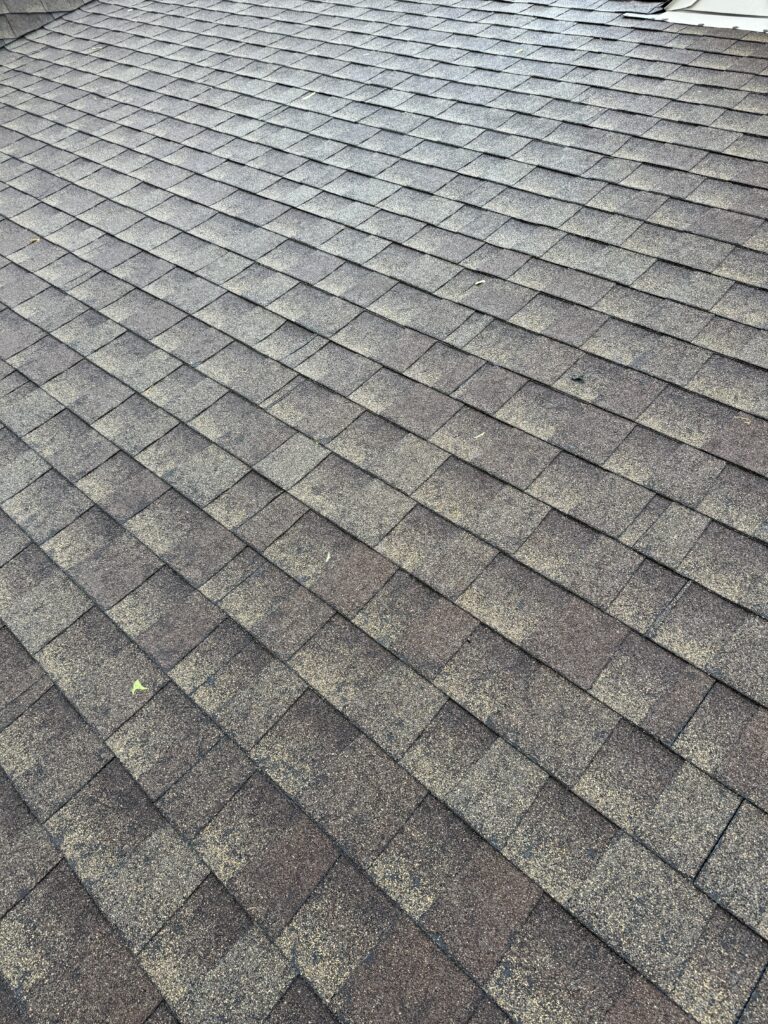
- Curling or lifted edges. Cap shingles that no longer lie flat against the ridge, especially at the tab edges.
- Cracking along the fold. The bend line is the single most stressed point on any ridge cap shingle, and a crack there is usually the first visible failure.
- Granule loss concentrated at the ridge, more than you see across the rest of the roof. Check the gutters and downspout runoff for a heavier-than-normal patch of granules.
- Exposed or backed-out nail heads along the ridge line. A nail head sitting proud of the shingle is an open path for water.
- Gaps between ridge cap pieces, where the overlap has pulled apart rather than lapping tight.
Why a ridge leak can show up far from the ridge
This is the part that catches homeowners off guard. Water getting in at a failed ridge cap does not necessarily drip straight down from the peak. It can travel along the underside of the decking, following the path of least resistance across the rafters or trusses, and only show up as a stain on a ceiling well away from the actual entry point.
That is a common reason a homeowner assumes the leak is coming from a bathroom vent, a skylight, or "somewhere over there," when the real opening is at the ridge. If a stain keeps showing up in roughly the same spot after a wind-driven rain, and there is no obvious local cause, the ridge is worth checking even if it is not directly overhead.
Good ice and water shield placement at eaves and valleys handles a different set of leak points; the ridge is its own detail and depends on the cap shingles themselves being sound, since there is no membrane substitute for a properly lapped, sealed ridge course.
Want a straight answer on your roof?
We'll inspect it, document everything, and tell you honestly what you're looking at, even if the answer is patch it for now. No pressure.
The manufacturer-matching mistake
Ridge cap is not one-size-fits-all, and using the wrong product for the roof is a common corner-cutting mistake worth knowing about if you are getting a repair quote or a full replacement.
Manufacturers publish ridge cap specifically matched to a shingle line, and often in more than one profile: a low-profile cap for standard-pitch roofs and a high-profile cap built for steeper pitches, where a taller, more pronounced ridge line is needed to shed water properly and match the roof's proportions. Using a low-profile cap on a steep roof, or field-cutting standard 3-tab shingles as a substitute regardless of pitch, is how a ridge ends up under-built for the roof it is sitting on. It can also affect whether an enhanced manufacturer warranty applies, since those typically require the full system, including the specified ridge cap, not a substitute.
If you are comparing quotes, it is a fair question to ask directly: which ridge cap product, matched to which shingle line and pitch, is included.
What a ridge cap repair actually involves, and what it costs
Caught early, this is one of the least disruptive repairs on a roof, and that is worth knowing before you assume any roof problem means a full re-roof.
A typical ridge cap repair means removing the failed cap shingles along the affected run, checking the ridge board and any ridge vent baffle underneath for damage, and installing new manufacturer-matched cap shingles with correct nailing and overlap. If the underlying decking or ridge vent baffle turns up damaged from water that got in before the cap was replaced, that adds to the job, which is exactly why catching this early matters.
Market ranges in south-central Wisconsin for a straightforward ridge cap repair commonly run in the low hundreds to around a thousand dollars for a single ridge run, depending on ridge length, roof pitch and accessibility. A ridge cap replacement across a more complex roof with multiple hips and ridges, or one requiring deck repair underneath, runs higher. Treat any number here as a market range that moves with material pricing, not a quote.
Compare that to what a neglected ridge leak eventually costs: soaked decking, insulation and possibly interior drywall and paint, on top of the ridge repair itself. A small ridge cap job is genuinely one of the better dollars spent on roof maintenance.
A simple annual check
Because ridge cap takes more punishment than the rest of the roof, it is worth a specific look once a year rather than waiting until a ceiling stain shows up. From the ground with binoculars, or from a safe vantage point, look for curling, cracking along the fold, exposed nails and gapping at the laps. If your roof has a ridge vent, note that the cap shingles sit directly over it, so both get checked at once.
If anything on that list looks off, or you already have a ceiling stain you cannot explain, it is worth a proper look before the next windy, wet stretch of weather.
Not sure whether what you are seeing at your ridge is cosmetic wear or an active problem? We will get eyes on it, tell you honestly what we find, and if it is a straightforward ridge repair rather than something bigger, we will say so. Our residential roofing services cover everything from a single ridge run to a full replacement, and a free on-site look costs you nothing. Call (608) 909-9109.
Get a straight answer on your Madison roof
Wisconsin storm season and insurance non-renewal letters do not wait. Get a free, no-obligation inspection and an honest assessment of exactly what your roof needs, even if the answer is to wait.