
Based on what we have been quoting across Dane and Rock County over the last year or two, most homes land around $8-$14 per foot installed for 5-inch seamless aluminum and roughly $11-$18 per foot for 6-inch. Downspouts usually run about $8-$12 per foot of pipe plus the outlet and elbows, which works out to roughly $90-$200 per drop depending on height and whether it is 2x3 or 3x4. Aluminum coil pricing moves, so treat those as ballparks, not a quote. Measuring your actual house is free.
Get My Free Estimate →- Town by town: what we see around Madison
- What seamless gutter installation actually involves
- Materials, gauge and how long gutters last here
- 5-inch or 6-inch, and why downspouts matter more
- Where the water has to go
- Winter is what kills gutters here
- Repair or full replacement?
- Cost, fascia surprises and payment
- Guards, cleaning and staying ahead of it
- How to vet a gutter contractor in Wisconsin
- Free estimate, no pressure, nothing to lose by asking
- FAQs
A gutter system around Madison has one job: catch what the roof throws at it and move that water far enough from the foundation that your basement stays dry. Most failures we get called on are not mysterious. The gutter is undersized, hung with the wrong fasteners, pitched backward, or the downspout dumps three inches from the wall.
We have been on roofs and ladders in south-central Wisconsin since 1979. Below is what we actually see town by town, then real numbers on sizing, lifespan, cost, ice damage and guards.
Town by town: what we see around Madison
Madison (isthmus, near east, near west): older homes, steep pitches, mature silver maples and oaks, heavy clay soil and stone or block foundations that were never waterproofed. Undersized 5-inch gutter plus nowhere good to put the water. Six-inch trough with 3x4 downspouts and a rethought discharge route fixes more damp basements here than any other single change.
Monona and Fitchburg: mid-century ranches with long low runs that are easy to re-pitch, plus newer subdivisions where builder-grade gutter was spike-hung and now sags in the middle of every run.
Sun Prairie, DeForest and Waunakee: newer construction with big roof planes and too few downspouts. Open subdivision edges also catch wind that peels loose end sections away.
Middleton and Verona: larger homes, complex roof lines, valleys dumping into a single run. This is 6-inch territory more often than not.
Stoughton, Edgerton and McFarland: older housing stock, original spike-hung gutter and fascia rot. On a Stoughton bungalow last season the gutter looked fine from the driveway. The fascia behind it was soft enough to push a screwdriver into. Board work came first, gutter second.
Cottage Grove: newer builds mixed with rural properties under heavy tree cover, so guards, downspout routing and where the water lands in the yard come up constantly.
Janesville and Rock County: older neighborhoods with layers of past repairs, plus real hail history. After a storm season, roof and gutters should be looked at together, not separately.
We work all of these towns and the small communities between them. If your town is not on the list, call and ask.
What seamless gutter installation actually involves
Seamless gutter is formed on site, at your curb, from a coil of factory-painted aluminum. We measure the roof edge, run continuous lengths through the machine, and the only joints in the system are inside and outside corners, end caps and downspout outlets.
That matters because joints are where gutters leak. Sectional gutter from a big-box store has a seam every 10 feet, and every seam is a future drip that stains fascia and rots trim. There is no way to buy seamless without a machine on site.
A proper install includes things people do not think to ask about:
- Hidden hangers screwed into solid fascia, not spike-and-ferrule nails that back out every freeze-thaw cycle
- Correct pitch, roughly 1/4 inch of fall per 10 feet, so runs drain instead of holding standing water
- Fascia inspected first. New gutter screwed into soft wood pulls loose under the first heavy snow load.
- Drip edge or gutter apron so water leaves the shingle into the trough instead of wicking behind it
- Color matching. Coil comes in a wide range of baked-on colors, and we bring chips out and match fascia, soffit and trim, not the roof.
One common worry: hangers do not touch your shingles. They screw through the back of the gutter into the fascia board, well below the roof edge, so a correct install has no effect on a shingle warranty. If a crew is nailing hangers up through the shingles or the deck, that is wrong, and that is the kind of thing that voids coverage.
More on how we form and hang it on our seamless gutter page.

Materials, gauge and how long gutters last here
Our standard is .027 painted aluminum in K-style, which is what the large majority of Madison-area homes get. Expect roughly 20-30 years out of it when it is hung on hidden hangers with correct pitch.
Heavier .032 aluminum is the upgrade worth paying for on two-story homes, steep roofs that dump sliding snow, and long unsupported runs. It resists denting and holds its shape under ice, and it commonly runs past 30 years.
Other options that come up around here:
- Half-round. The original profile on a lot of pre-1940 near west and near east side homes. We can form half-round in aluminum, and in copper. Round downspouts to match.
- Copper. Expensive, no paint to fail, and commonly 50 years and up. It patinas from bright to brown to green. Worth it on a historic home where the detail shows.
- Galvanized steel. Stronger than aluminum on impact, but in our climate it eventually rusts at seams and cut ends, so figure 15-25 years. We rarely recommend it for residential.
If your house sits in one of Madison's local historic districts, check with the city's Landmarks staff before you switch profile or material. Routine replacement in kind is usually straightforward, but it is a five-minute phone call that saves an argument later.
5-inch or 6-inch, and why downspouts matter more
Most Madison-area homes are fine with 5-inch K-style and 2x3 downspouts. When water still comes over the front lip, the fix is usually outlets, not trough.
Manufacturer and SMACNA capacity tables put a 6-inch K-style at roughly 40 percent more capacity than a 5-inch. Going from a 2x3 downspout (about 6 square inches of outlet) to a 3x4 (about 12 square inches) roughly doubles outlet area. The downspout upgrade is usually the bigger lever, and the two together handle a serious cloudburst.
Go bigger when you have:
- A large roof plane draining into one short run
- A steep pitch, common on 1920s to 1940s near west side homes, that throws water past a 5-inch trough
- A valley dumping into the middle of a gutter
- Overflow at one specific corner in every hard rain
We looked at a two-story on the near west side with roughly 70 feet of gutter feeding a single downspout at the back corner. The homeowner assumed the gutter was bad. It was starved for outlets, and the front elevation overflowed every July thunderstorm. A second downspout and larger outlets solved it without replacing the system.
Wisconsin summers hand us short, violent cloudbursts. That peak rate floods a system, not an all-day drizzle. More on sizing and placement in our downspouts guide.
Where the water has to go
A perfect gutter that discharges next to the foundation is just an efficient way to fill your basement. Around the isthmus and the older near-east and near-west neighborhoods, clay soil holds water against stone and block walls until it finds a mortar joint.
What actually works:
- Downspout extensions carrying water 4-6 feet out, farther on flat lots
- Regrading so the first several feet of soil slopes away from the house
- Buried drain lines, but only when they can be built right
- Splash blocks as a bare minimum, never a solution
On buried lines, the rule is continuous fall to a free, open outlet, either daylighting downgrade in the yard or to an approved discharge point. Practically, that means shallow: usually 8-14 inches of cover, because the pipe has to keep falling all the way to daylight and there is no burying it below Wisconsin frost depth and still getting fall. Since it will be shallow, it has to be able to empty itself completely, or it freezes solid in January and every downspout above it backs up at the foundation.
We use solid smooth-wall PVC rather than flex corrugated (corrugated catches grit and roots), and we put a cleanout access at the top of each run so it can be snaked or flushed. Hand-dug runs we do ourselves. When a run needs machine trenching or ties into an existing storm structure, we bring in an excavation sub and show you that cost as its own line, not buried in the gutter number.
Know the local rules before planning a route. In Madison and most Dane County municipalities, downspouts cannot be tied into the sanitary sewer. Discharge to the street or curb is often restricted, and running roof water across a public sidewalk is a real winter liability, because that sheet of ice is on you. We plan discharge that keeps water on your property and drains freely, and downspout locations and routing go in the written estimate.
Not sure whether the gutters or the grading are behind that damp basement corner? We will come look and tell you straight. The estimate is free and there is no pressure to buy anything.
Winter is what kills gutters here
Gutters in Wisconsin rarely die of old age. They die of ice and snow load.
Water freezes in a partly clogged trough, expands, and levers the gutter off the fascia. Snow slides off a steep roof and bends the front lip. Freeze-thaw backs spike nails out one cycle at a time until a run sags and holds water year round.
What we find most in Dane and Rock County:
- Hanger failure where old spikes have pulled and the gutter tips forward
- Fascia rot from a leaking seam or a run pitched the wrong way
- Crushed downspouts at grade from snowblowers, plows and ice
- Brittle sealant at end caps and miters
- Ice at the eave making an existing ice dam worse
To be clear: gutters do not cause ice dams. Warm air leaking into a cold attic does. A clogged, undersized gutter just makes one meaner. The real fix is attic insulation and ventilation plus ice-and-water shield along the eaves, which is roofing work. See our residential roofing page.
Heat cable treats the symptom. Installed right, zig-zagged at the eave and continued down through the gutter and downspout so meltwater has a drain path, it can keep a problem eave open on a house whose attic cannot be fixed easily. It needs a proper outdoor GFCI circuit and costs money to run all winter. Cable laid loose in a trough with no path down the downspout just makes an ice cube with a wire in it.
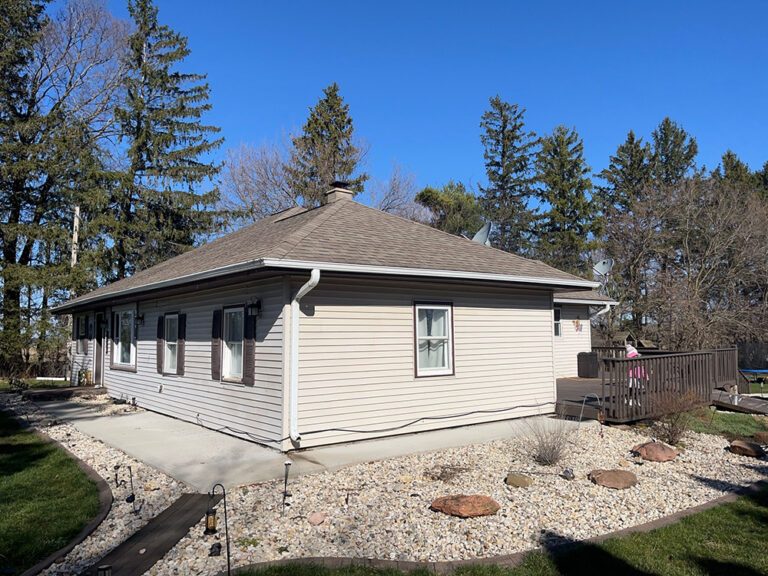
Want a straight answer on your roof?
We'll inspect it, document everything, and tell you honestly what you're looking at, even if the answer is patch it for now. No pressure.
Repair or full replacement?
Repair is the right call more often than most contractors admit. If the aluminum is straight and the color is intact, we would rather fix it.
Repair makes sense when: one run has lost pitch, spikes need swapping for hidden hangers, a miter or end cap leaks, a downspout is crushed, or a branch dented one section.
Replacement makes sense when: the system is bent along most of its length, fascia is rotted behind multiple runs, it was undersized from day one, or hail and wind flattened the troughs. That last one may be a claim, which is where our storm damage restoration work comes in.
Typical scenarios are on our gutter repair page.
Cost, fascia surprises and payment
Across Dane and Rock County over the last year or two, most homeowners land around $8-$14 per foot installed for 5-inch seamless aluminum and roughly $11-$18 per foot for 6-inch. Downspouts run about $8-$12 per foot of pipe plus outlet and elbows, which usually lands $90-$200 per drop depending on height and whether it is 2x3 or 3x4. Aluminum coil pricing moves, so these are ballparks, not quotes.
What moves your number: height and pitch, number of corners and miters, downspout count, buried line work, .032 gauge or copper, custom color, and fascia condition once the old gutter comes off.
On fascia: we look before we quote, but some rot only shows after teardown. Replacing 1x6 fascia board typically runs $12-$20 per linear foot installed and paint-ready, more if it is two stories or the soffit has to come apart. If we find soft wood, we stop, show you, and get your approval on that number before anything goes back up. Full breakdown on our gutter cost page.
On payment, since it comes up: we do not offer in-house financing or a lender program on gutter-only work, and we are not going to steer you into a high-interest loan for a $2,500 job. We do not take a large deposit on a standard gutter job either. Material is formed at your house and payment is due on completion. On bigger exterior projects we write a milestone schedule into the contract, so you know when each payment is due before you sign. Insurance work follows the carrier's own schedule, ACV up front and the remainder after completion, and you cover your deductible. Anyone demanding a big cash deposit before measuring is a contractor to walk away from.
Most single-family gutter replacements are a one-day job. Cleanup is included: we haul and recycle the old aluminum and sweep the perimeter for screws and old spikes.
Warranty is two separate things, and you should make every bidder separate them. The painted coil carries the manufacturer's finish warranty against peeling, chipping and fading. Our workmanship warranty covers what we did: seams, miters, end caps, outlets, hanger pull-out and lost pitch. The term is stated in writing on your estimate.
Guards, cleaning and staying ahead of it
Gutter guards are worth it under trees and a waste of money without them. Under mature maples and oaks on Madison's near east and near west sides, or on tree-heavy lots around Cottage Grove, a quality micro-mesh guard cuts cleanings and helps keep the trough from packing with ice. Cheap foam inserts and plastic screen usually make things worse by trapping debris on top. Our honest breakdown is on the gutter guards page.
Without guards, clean twice a year in a maple or oak neighborhood: late fall after leaf drop and spring after seeds and blossoms. Late fall matters most, because a packed trough going into December is how ice damage starts. With guards, plan on a look once a year. We handle gutter cleaning as a standalone service, and if the real problem is pitch or sizing rather than debris, we will say so instead of selling you a cleaning every year.
How to vet a gutter contractor in Wisconsin
Wisconsin does not license gutter installers specifically, so a "licensed" claim on a gutter job means very little. Insurance and specifics are what matter. We carry general liability and workers compensation and will send certificates on request. Ask any bidder for the same, in writing, from their carrier.
Then ask these:
- Do you form gutter on site, and what gauge aluminum is standard?
- Hidden hangers or spikes, and at what spacing?
- Will you inspect and price fascia before hanging anything?
- Where exactly is the water going, and is that routing in the written estimate?
- What is your workmanship warranty term, and is it on paper?
Look at our recent projects and customer reviews, and read our general gutter overview before you call anyone.
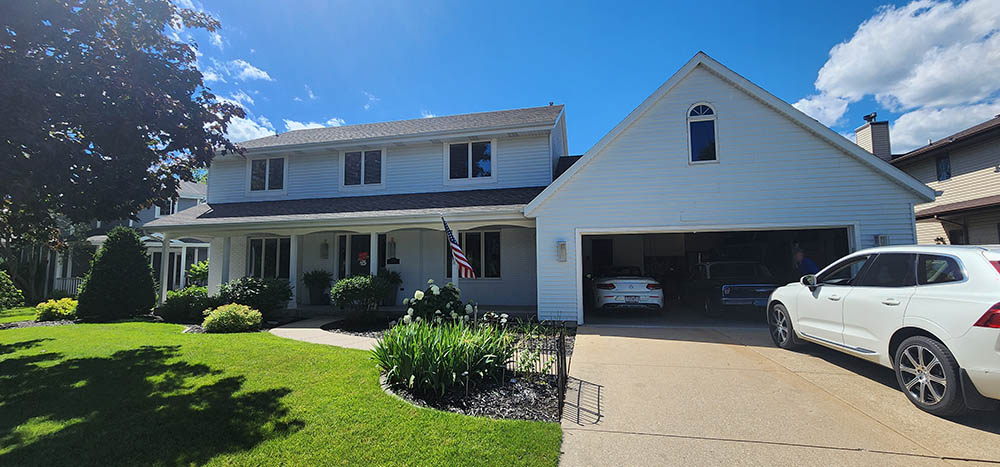
Free estimate, no pressure, nothing to lose by asking
If your gutters overflow, sag, leak at a corner, or your basement gets damp every spring melt, we will come out, get on a ladder, check the fascia, the pitch and the grading, and tell you what we would actually do. If a repair solves it, we will say so. If the system was undersized from the start, we will show you exactly where the water goes over the edge.
The inspection and estimate are free, there is no sales pitch, and you get a written scope you can hold up against anyone else's bid.
Buckshot Exteriors has been doing roofing, siding and gutters for families here since 1979, and the person who measures your house is the person you can call back with questions. We serve Madison, Sun Prairie, Stoughton, Cottage Grove, Middleton, Verona, Waunakee, DeForest, Edgerton, McFarland, Monona, Fitchburg, Janesville and the rest of Dane and Rock County.
Give us a call or send a note through our contact page and we will get you on the schedule.
Get a straight answer on your Madison roof
Wisconsin storm season and insurance non-renewal letters do not wait. Get a free, no-obligation inspection and an honest assessment of exactly what your roof needs, even if the answer is to wait.