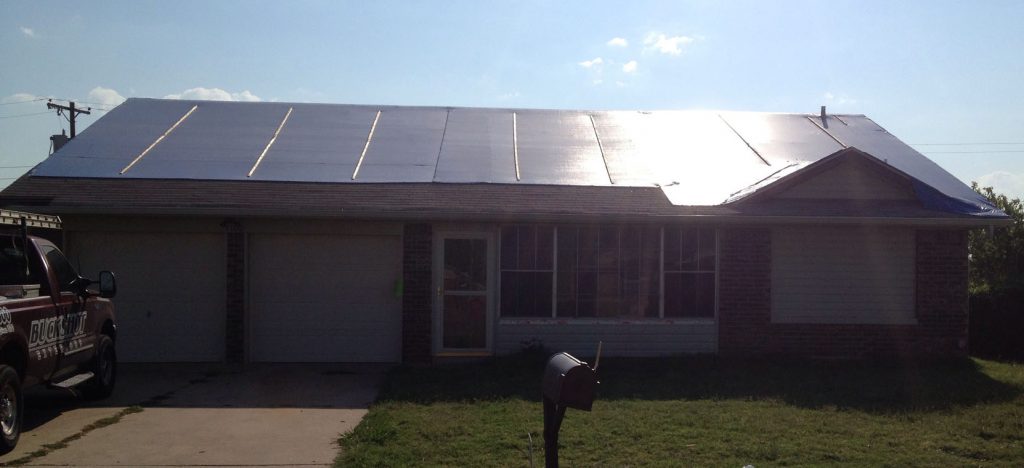
Heavy rain overwhelms small weak points that light rain never reaches. The cause is usually flashing, a vent boot or a valley rather than the open shingles.
Get My Free Estimate →A roof that leaks only in heavy or wind-driven rain usually has a problem at a detail, not in the open shingles. Flashing at walls, chimneys, skylights and valleys, roof vents and the ridge vent are the usual suspects.
Those details hold up in a gentle rain. In a downpour or a storm with strong wind, water arrives faster and sideways, and it finds small gaps that normal rain never reaches.
The leak is also often on the side of the house that faced the wind. Knowing that, and knowing where water travels before it shows, makes the leak much easier to find.
Why heavy and wind-driven rain find leaks that normal rain misses
Roofing works by overlapping layers that shed water downhill. Heavy rain can overwhelm those overlaps, and wind can push water sideways or even uphill under them.
Wind pressure and capillary action can draw water into very small gaps. A flashing joint or nail hole that stays dry in light rain can let water in during a storm.
Water also travels before it shows. It can enter at one spot, run along the roof deck or a rafter, and drip onto a ceiling well away from the entry point.
The most common places these leaks start
Most roof leaks begin at flashing and penetrations rather than in the middle of the shingles. Check the details on the windward side first.
Flashing where a roof meets a wall or chimney
Step flashing and counter flashing seal the joint where a roof slope meets a wall or chimney. Loose, missing or poorly lapped pieces let wind-driven rain run behind them.
Chimneys are a frequent source because they have flashing on all four sides. Our chimney flashing repair service and our guide to roof flashing repair explain what a proper fix looks like.
Skylights
Skylights combine flashing, seals and glass, and any of them can fail in a hard rain. A skylight that drips only in storms often has a flashing or seal problem on its uphill side.
Our article on skylight leaks from the flashing, seal or glass helps you tell the three apart.
Plumbing vents and other roof vents
Rubber boots around plumbing vent pipes crack with age and sun. Once cracked, they can leak in heavy rain while staying dry in light showers.
A ceiling stain in a bathroom is often traced to the vent pipe above it. Read about roof vent leaks for the common causes and repairs.
Ridge vents and gable vents
Some ridge vents let in rain when wind drives it up the roof and over the ridge. Older vents without an outside baffle or an inner weather filter are more prone to this, especially on lower-sloped roofs.
Gable vents in the end walls can also let in blowing rain. Our article comparing ridge vents and box vents explains how roof exhaust vents are meant to work.
Valleys
Valleys carry the water from two roof slopes, so they handle the heaviest flow in a downpour. Debris, worn shingles or a poorly built valley can let that water work under the roofing.
Shingles lifted by wind
Strong wind can lift shingle tabs and break the seal strip that holds them down. Once unsealed, those shingles let wind-driven rain in until they are resealed or replaced.
If a storm came through recently, our guide on how to check for wind damage on a roof shows what to look for from the ground.
It may not be the roof at all
Wind-driven rain can also get in through windows, siding or a wall above a lower roof, then show up on a ceiling. A leak that appears near an outside wall during sideways rain may start in the wall rather than the roof.

How to narrow down the source
Start with the conditions. Note the wind direction, how hard it rained, and how long the storm lasted before the leak appeared.
Check the attic during or soon after a storm if you can reach it safely. Use a flashlight to look for wet decking, stained rafters or drips, and mark the highest wet spot you find.
Compare that spot with what sits above it on the roof, such as a vent, chimney, skylight or valley. Our guide to water stains on the ceiling explains how to read a stain's location and timing.
Never climb onto a wet or icy roof to look. A water test with a hose, run one section at a time while someone watches inside, is best left to a roofer who can do it safely.
Leak only shows up in storms? Our on-site inspection is free, so you can find the entry point before the next heavy rain does more damage.
Free on-site inspection · Family-owned since 1979What the fix usually involves
The right repair depends on the entry point, but it should restore the overlapping layers that shed water. Caulk alone is only a temporary measure, because sealant breaks down with sun and movement.
- Flashing leaks are fixed by resetting or replacing the flashing so each piece laps correctly.
- Cracked vent boots are replaced.
- A ridge vent that admits rain can be replaced with a baffled, filtered vent rated for wind-driven rain.
- Lifted shingles are resealed or replaced.
- Valley problems may need the valley rebuilt.
Our roof repair team handles these repairs. On an older roof with several weak points, it can also make sense to compare repair costs with the remaining life of the roof.
Want a straight answer on your roof?
We'll inspect it, document everything, and tell you honestly what you're looking at, even if the answer is patch it for now. No pressure.
What to do while it is leaking
Put a bucket under the drip and move furniture and electronics away. Photograph the leak and any damage, and note the date, time and wind direction.
If water is pooling in a ceiling bulge, keep people out from under it and call for help. Our 24-hour emergency repair line can arrange a temporary cover until a permanent repair is possible.
Find the leak before the next storm
Buckshot Exteriors is family-owned, has served homeowners since 1979, and has offices in Madison, Wisconsin and Centerville, Iowa. Our on-site inspection is free, and our 24-hour storm line is there when a leak cannot wait.
Call (608) 909-9109 to schedule a free residential roofing inspection, or send us a message and we will set a time. If you would rather check first, the attic steps above will help you narrow it down.
Get a straight answer on your Madison roof
Wisconsin storm season and insurance non-renewal letters do not wait. Get a free, no-obligation inspection and an honest assessment of exactly what your roof needs, even if the answer is to wait.