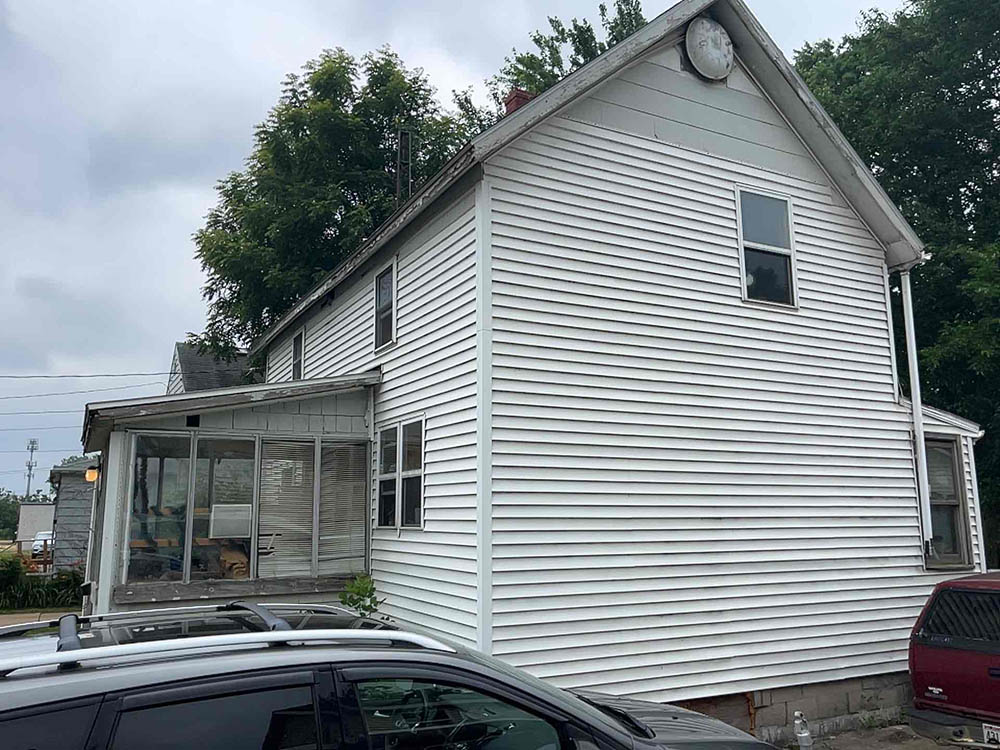
Surface mildew washes off with a soft brush and a siding-safe cleaner and stays gone. Staining that sits at seams, laps or under windows, or keeps coming back in the same spots, points to moisture behind the panels.
Get My Free Estimate →Mold behind siding means water is getting into your wall and not drying out. Siding sheds most rain, but it is not a waterproof layer.
Growth behind the panels means the drainage path behind them has failed somewhere. The fix is finding and stopping that water path, then replacing the wrap and sheathing that stayed wet.
Washing the face of the siding does nothing for mold inside the wall. This guide covers the signs, the usual causes, how to check and what a real repair involves.
What mold behind siding means
Mold behind siding tells you the wall has stayed damp long enough for growth, which takes far longer than one rainstorm. Something is letting water in, or keeping it from draining out.
A wall is built in layers. The siding takes the weather and sheds most of the water, while a water-resistive barrier behind it, such as house wrap or felt, catches what gets past and drains it down and out. Flashing at windows, doors and other openings ties into that barrier.
The siding industry's installation guidance calls for siding over a weather-resistant barrier with flashing integrated around openings. Homes sided decades ago may have no wrap behind the siding at all.
A water barrier is not a vapor barrier
Most house wraps are vapor-permeable on purpose, so a damp wall can dry outward. Plastic sheeting behind siding does the opposite.
Plastic traps moisture against the sheathing and can rot it. If you find plastic behind your siding, mention it to whoever inspects the wall.
The EPA notes that the longer mold grows, the more damage it does to what it grows on. Behind siding, that means the sheathing, trim and framing.
Signs of mold behind siding
Outside, the signs show at seams, laps and the bottom of the wall, because that is where water collects.
- Dark staining at panel seams, laps and the bottom course, especially stains that return after washing
- Staining or peeling finish below window corners
- Soft or rotting trim at corner boards and window casings
- Warped, loose or bulging siding where a roof edge meets a wall
- Blistering paint on wood or fiber cement siding, pushed off from behind
Inside, the signs are easy to blame on something else.
- Stains or peeling paint on the inside of an exterior wall, often near a window or the floor
- A musty smell in one closet or corner room that cleaning does not fix
- Baseboard pulling away from an outside wall
Water that enters high on a wall often shows up much lower, so damage can hide for years. If the stain is on a ceiling rather than a wall, read our guide to a water stain on the ceiling from a roof leak.
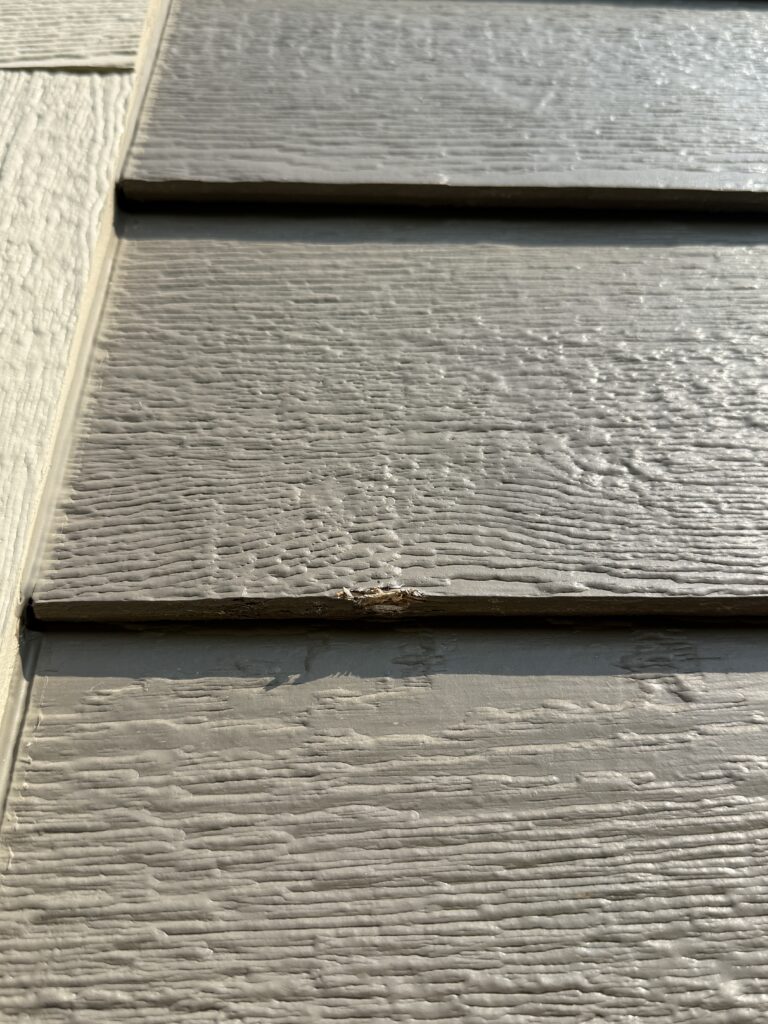
Surface mildew vs mold in the wall
Surface mildew on the face of your siding is a different problem, and it washes off. It usually grows on shaded walls, under overhangs and behind shrubs, as an even gray or black film across the panels.
Test a small area with a soft brush and a siding-safe cleaner. If it comes clean and stays clean, it was mildew, so wash the wall, trim the shrubs back and aim sprinklers away.
If the staining sits at seams, laps, the bottom course or under windows, or comes back in the same spots, the moisture is coming from behind. That calls for a closer look.
Why water gets behind siding
Water rarely comes through the middle of a panel. It gets in at a detail, such as a roof-to-wall corner, an opening or a seam.
Missing kickout flashing
Where a roof edge runs into a sidewall, a kickout flashing at the bottom of the step flashing turns runoff out into the gutter. Without it, water from that roof edge pours straight behind the siding.
Damage from a missing kickout is often hidden for years. It usually gets worse lower down the wall, well below the roof edge where nobody looks.
House wrap and flashing tape problems
Torn wrap, wrap lapped the wrong way and missing flashing tape all let water reach the sheathing. Wrap has to overlap like shingles, so water runs over the layer below and never behind it.
Our guide to house wrap behind siding shows how it should be lapped and taped.
Windows, doors and failed caulk
Openings are the hardest part of a wall to get right. Window and door flashing has to work with the wrap in the correct order, so water that gets in drains back out.
Caulk at trim is a seal, not a flashing. When old caulk is the only thing keeping water out, it eventually fails and the first leaks are invisible.
Gutters, grade, sprinklers and indoor air
Overflowing or sagging gutters dump water down the wall. If yours are separating from the fascia, read about gutters pulling away from the house.
Siding run too close to the ground or down onto a roof surface wicks water and holds snow against the bottom. Lawn sprinklers that hit the wall keep it wet, and humid indoor air moving into the wall in winter can add moisture from the inside.
Many of these are installation details rather than wear. If your siding is fairly new and already showing signs, check the signs of bad siding installation.
How to check behind your siding
On vinyl, a siding zip tool unlocks a lower panel so it can be removed and the wrap and sheathing behind it can be seen. Do it on a mild day, because cold vinyl is brittle and cracks.
Start low on the wall with the staining. Look for these things.
- Whether there is any wrap at all, or bare sheathing
- Wrap that is torn, lapped the wrong way or marked with water lines
- Dark growth on the wrap or the sheathing
- Soft sheathing that a screwdriver pushes into easily
- Framing that looks dark or damp
Fiber cement, wood and stucco are harder to open without damage, so have an inspector open those walls. Before anyone looks, photograph the staining, turn off sprinklers that hit the wall, and do not caulk over the problem.
If you plan to call your insurer, read your policy first. Policies often treat long-term leaks and mold differently from sudden damage.
Want a straight answer on your roof?
We'll inspect it, document everything, and tell you honestly what you're looking at, even if the answer is patch it for now. No pressure.
What the repair involves
A real repair stops the water, opens the wall, replaces what stayed wet and rebuilds the drainage details. Cleaning alone does not fix it, and EPA guidance is to fix the water problem as well as clean up the mold.
- Find and stop the water path. That may be a kickout, window flashing, gutters or grade clearance.
- Open the wall. Remove siding past the visible damage, because hidden damage usually extends further.
- Remove and clean. Cut out wet or rotted sheathing and trim, then clean and dry what stays.
- Replace sheathing and wrap. Install new sheathing and a vapor-permeable barrier, lapped and taped correctly.
- Flash the openings. Integrate window and door flashing with the wrap, and add a kickout wherever a roof meets a wall.
- Reinstall or replace the siding. Leave proper clearance at the ground and at roof surfaces.
The EPA says a homeowner can usually handle mold cleanup on an area smaller than about 10 square feet, roughly 3 feet by 3 feet. Larger areas or significant water damage call for a contractor experienced in mold cleanup, alongside the crew that rebuilds the wall.
For damage confined to one wall or one opening, siding repair is usually enough. Ask to see the wall while it is open, before it gets covered, and take your own photos.
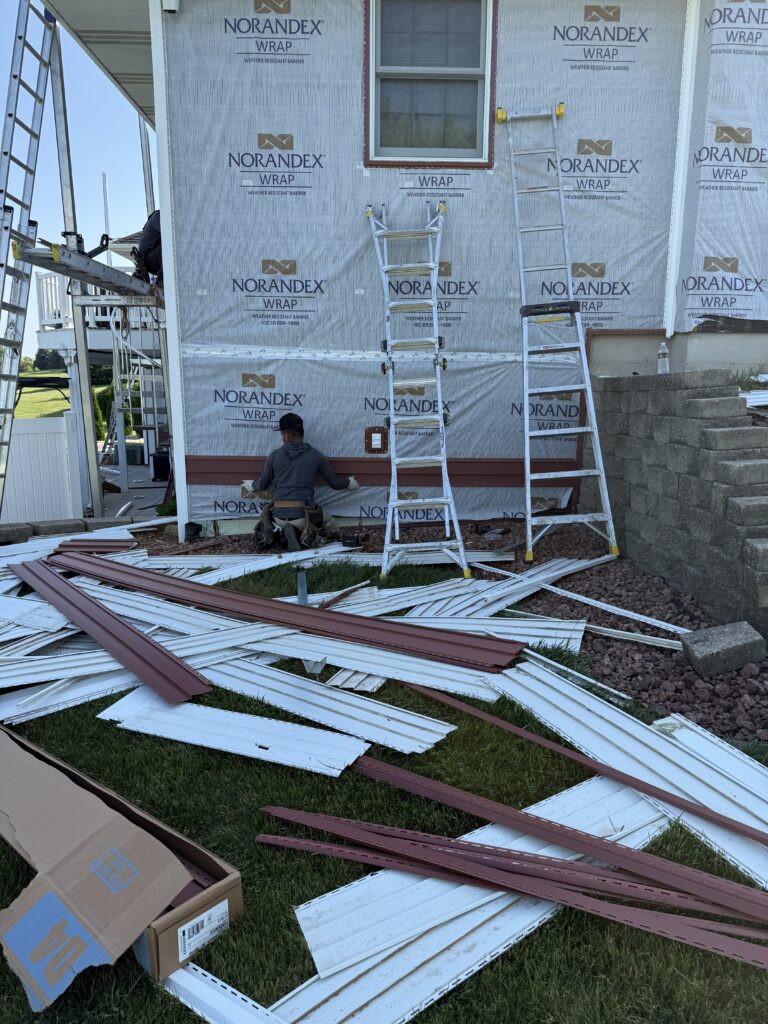
Repair or replace the siding
Repair makes sense when the damage is limited to one area and the rest of the wall is sound. Lean toward siding replacement if any of these are true.
- Staining or rot shows on several walls or at several openings
- There is no wrap behind the siding at all
- The existing wrap is torn, lapped the wrong way or was never tied into the window flashing
- The siding itself is brittle, faded or loose
When the wrap and flashing are wrong across the whole house, patching one wall moves the problem to the next one. Replacement is the chance to correct the entire wall assembly at once, and our siding services page shows the options.
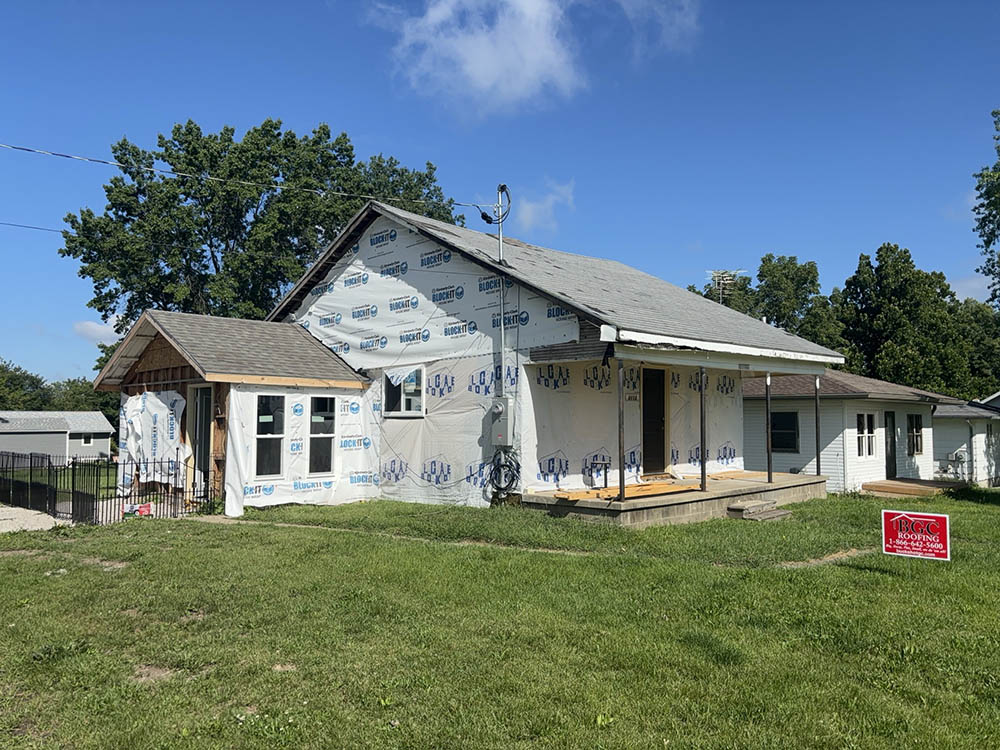
How to prevent mold behind siding
Keep water off the wall and give the wall a chance to dry. These steps cover most of it.
- Clean gutters in spring and fall, and fix sagging runs
- Check for a kickout flashing wherever a roof edge meets a sidewall
- Run downspouts away from the foundation
- Trim shrubs back from the siding so air can move
- Aim sprinklers away from the house
- Keep mulch, soil and snow piles off the bottom row of siding
- Check the caulk at trim each year
- Run bath and kitchen fans so humid air does not build up indoors
Get the wall checked
If you see staining at seams, soft trim or a musty smell on an outside wall, have it looked at soon. Water in a wall does not dry out on its own while the leak is still open.
Buckshot Exteriors is family-owned, has served homeowners since 1979, and has offices in Madison, Wisconsin and Centerville, Iowa. Our on-site inspection is free, and if a storm caused the damage, we meet your insurance adjuster on site.
Call (608) 909-9109 to schedule your free inspection, or send us a message. If you would rather start on your own, the house wrap guide above shows what a correct wall looks like.
Get a straight answer on your Madison roof
Wisconsin storm season and insurance non-renewal letters do not wait. Get a free, no-obligation inspection and an honest assessment of exactly what your roof needs, even if the answer is to wait.