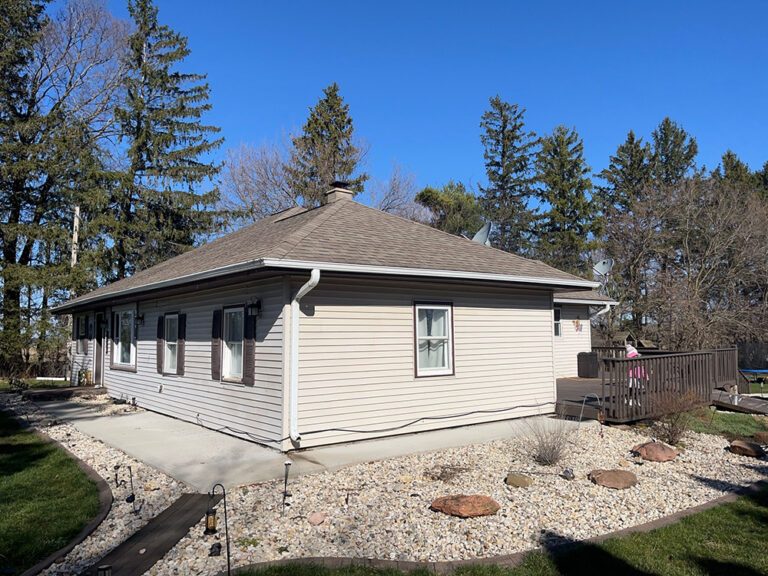
Late September through early November is the sweet spot in Dane, Rock and Green counties. Most shingle manufacturers specify an installation temperature range where the factory adhesive strip softens and bonds, and most roof sealants list a minimum application temperature in the 40-50 degree range. Work done in that fall window seals on its own. Once we get consistent freezing nights and snow cover, a lot of repairs become temporary until spring.
Get My Free Estimate →- The four ways a Wisconsin winter actually breaks a roof
- What you can safely do yourself, and what needs a pro
- Should you rake snow off the roof?
- Metal roofs, sliding snow and snow guards
- You see a ceiling stain or a drip in January. Do this first.
- Who dries out the insulation and drywall, and is mold a real worry?
- Renting, a condo, or a shared roof? Know who owns the eave ice
- Repair or replace, and what winter prep costs
- The insurance reality on ice dams and winter leaks
- Why fall work seals and winter work does not
- Vetting whoever you hire, permits included
- Book the free inspection while the weather still cooperates
- FAQs
Here is the short list, and you can do most of it this weekend: clear the gutters and downspouts, scan the roof from the ground for missing or lifted shingles, trim branches that overhang the roof, and take a flashlight into the attic to look for daylight, frost or wet sheathing. Then get any flashing, sealant or soft-decking problem repaired before the first hard freeze.
That last step is the one people put off. A flashing or sealant repair in October usually runs a few hundred dollars. The same gap in January is water running down the inside of a wall, stained drywall, wet insulation, and a crew working off a ladder in a snowstorm.
Winter in Dane, Rock and Green counties does not damage roofs the way a July hailstorm does. It finds the weak spots you already have and pries them open every time the temperature crosses 32 degrees.
The four ways a Wisconsin winter actually breaks a roof
Skip the generic checklist for a minute. Winter has its own short list of failure modes, and they explain why a roof that looked fine in October leaks in January.
1. Ice dams, which are really a heat-loss problem
Snow on your roof melts from underneath when warm air leaks out of your living space into the attic. That meltwater runs down to the eave, which is cold because there is no heated space beneath it, and refreezes. The ridge of ice grows, water pools behind it, and it backs up under the shingles and into the house.
Shingles shed running water. They do not hold standing water. That is why an ice dam leak shows up on an otherwise healthy roof.
The real fix is air sealing the attic floor, getting insulation to depth, and making sure soffit intake and ridge exhaust are both open so the deck stays cold. Ice and water shield at the eaves is the backup layer.
Heat cables are not a scam, but they are a last resort, not a first move. On a cathedral ceiling with no attic to seal, or a dormer eave with no soffit intake, a properly installed cable run is a legitimate way to keep a drainage path open. On a normal vented attic, cables just pay to melt snow while the actual cause sits above your bedroom ceiling. Our Wisconsin ice dam guide walks through causes, prevention and the insurance side in detail.
The house style that gives us the most trouble around here is the postwar Cape Cod, the ones all over Madison's near west and east sides and in the older parts of Stoughton and Monroe. Knee-wall attics, almost no soffit venting, a bath fan dumping into the attic instead of outside. Those homes dam up at the same eave every single winter, and the fix is usually inside the attic, not on the shingles.
2. Freeze-thaw working on flashing and sealant
Every metal-to-shingle joint is a place water wants in: chimney, step flashing along dormer walls, plumbing vents, furnace flues, skylights, valleys. Those joints depend on properly lapped metal, and often on a bead of sealant that is 10 or 15 years old.
Water gets into a hairline crack, freezes, expands, and makes the crack bigger. Then it thaws and does it again. A south-facing slope that thaws in afternoon sun and refreezes overnight takes far more of those swings than the north side of the same house. What we can tell you is what we see when we open these roofs up in spring: cracked caulk lines that were intact in October.
Old sealant at a chimney is the single most common winter leak we get called about. Cheap in October, miserable in February.
3. Gutters packed with frozen leaves
Oaks and silver maples around here drop late, often into early November. Clean your gutters in mid-October and you may get to do it twice.
Wet leaves freeze into a solid plug. Meltwater then has nowhere to go, so it overflows at the back of the trough, runs down behind the fascia, into the soffit and onto the top of your wall. That means rotted fascia, stained soffit and wet insulation in the outer few feet of the attic.
The tell is icicles hanging off the front edge of the gutter. Get the gutters cleaned and the downspouts flushed after the leaves are down, not before.
Gutter guards are worth it on houses under heavy tree cover, and they cut cleanings way down. They do not prevent ice. Ice forms in the trough and on top of the guard either way, so treat guards as a maintenance convenience, not ice dam prevention.
4. Snow load on a deck that was already weak
A properly built roof in south-central Wisconsin handles our snow without drama. Design ground snow load for our region generally sits in the 30 pounds-per-square-foot neighborhood, and your local building inspector can tell you the exact figure used in your jurisdiction. Worth knowing: Wisconsin's Uniform Dwelling Code has applied to one- and two-family homes built since June 1, 1980. If your house is older than that, it was framed to whatever the local rules were at the time, which in some townships was not much.
The roofs that get in trouble are the compromised ones: decking softened by an old slow leak, three layers of shingles adding dead weight, or a low-slope porch or addition where drifting snow piles against a wall.
Warning signs from the ground: a ridge line that looks wavy, a visible sag between rafters, interior doors that suddenly stick in winter. If a roofer steps on your deck and it flexes or feels spongy, that is rotted sheathing and it should not carry a February snowpack.
What you can safely do yourself, and what needs a pro
Be honest about the ladder. Cold shingles are brittle, frost on a roof is invisible until you are standing on it, and a ladder foot on frozen ground slides. If the job requires both hands and a roof, hand it off.
Safe from the ground or a stable ladder:
- Scan the roof with binoculars for missing, curled, cracked or lifted shingles, and shiny nail heads that have backed out.
- Look at the flashing around the chimney and dormers for rust, gaps or crumbling caulk.
- Check gutters for sag, separated seams and loose spikes. Confirm every downspout discharges away from the foundation.
- Trim branches that touch or overhang the roof. Ice loading drops limbs, and constant abrasion strips granules.
- Look for piles of granules where downspouts splash out.
Do this inside, it tells you more than the roof does: take a flashlight into the attic on a cold, clear day. You are looking for pinholes of daylight, dark staining on the underside of the sheathing, matted or discolored insulation, frost on nail tips, and soffit vents buried under pushed-in insulation. Frost on the underside of the deck means warm, moist air is getting up there. That is your ice dam warning shot.
Leave to a professional: anything requiring you to walk the roof, flashing and valley work, chimney counterflashing, skylight curbs, decking checks, verifying ice and water shield coverage, and correcting attic ventilation and intake/exhaust balance, which is more involved than screwing on another vent.
For the full year-round routine instead of the winter-specific version, our roof maintenance checklist covers the spring and summer items.
Not sure whether what you see from the driveway is a real problem? That is exactly what a free inspection is for. Call (608) 909-9109 and we will get up there, take photos and tell you straight.
Should you rake snow off the roof?
Usually not, and never the whole roof. The reason to rake is ice dam prevention at the eave, not weight.
If you do rake:
- Work from the ground with an extension-pole roof rake. No ladders in ice or snow.
- Clear only the bottom 3-4 feet above the eave, which is where dams form.
- Use a plastic blade, not metal, and pull straight down. Do not scrape sideways across the shingles.
- Never chip at an ice dam with a hammer, chisel, hatchet or shovel. We have replaced a lot of decking punched through by a homeowner going after ice.
When weight is worth a call: two feet or more of heavy, wet snow, deep drifting on a low-slope section, or any sag, creaking or door-sticking.
Metal roofs, sliding snow and snow guards
Metal handles winter well, with one tradeoff most homeowners do not hear about until it happens. Once sun warms the panel, the whole snowpack releases at once and comes off in slabs. That is great for shedding load and rough on whatever is below: an entry door, a walkway, a deck, a parked car, the gas meter, the AC condenser.
Snow guards or a snow retention rail hold the pack in place so it melts and drains instead of avalanching. On standing seam and metal roofing we plan retention over doors and traffic areas as part of the design, not as an afterthought.
And metal does not make you ice-dam-proof. The cause is heat loss into the attic. A poorly vented attic under a metal roof still dams at the eave.
You see a ceiling stain or a drip in January. Do this first.
Containment comes before the phone call, because you can lose a ceiling in an hour.
- Move furniture, electronics and rugs out from underneath. Put down plastic and a bucket.
- Shut off the breaker to any light fixture, can light or ceiling fan in the wet area. Water and fixtures do not mix.
- If the drywall is bulging or sagging with trapped water, poke a small relief hole at the lowest point of the bulge with a screwdriver and catch the drainage in a bucket. A controlled hole you patch later beats a ceiling that lets go all at once.
- Photograph everything, the stain, the bulge, the icicles and ice at the eave outside, before you clean up. That documentation is what your claim rests on.
- Rake the bottom 3-4 feet of that eave from the ground if you can do it safely.
- Call us and call your insurance agent.
We run 24-hour emergency response and we can tarp, seal and stop active water from getting into your ceiling. Be realistic about a countywide ice event, though. When houses from Verona to Janesville are leaking the same week, every roofer in the county is triaging, and active water into a living space and structural risk go to the front of the line. That is one more argument for handling flashing in October.
Who dries out the insulation and drywall, and is mold a real worry?
Two different trades, and knowing that saves you time. We stop the water and fix the roof, the flashing, the gutters, the ventilation. Interior drying, wet insulation removal and drywall work belong to a water mitigation or restoration company, and your insurance carrier often has preferred vendors they will dispatch quickly.
Do not let wet fiberglass sit. Soaked insulation loses most of its R value, stays wet for weeks against cold sheathing, and keeps feeding the heat-loss problem that caused the dam. It comes out, the cavity dries, new insulation goes in.
Mold needs moisture and time, and the usual rule of thumb is that growth can start within a couple of days on wet organic material like paper-faced drywall. A drip you caught in a bucket on day one and dried out is typically not a remediation job. Water that ran behind a wall for three weeks while you were in Florida often is. If drywall stayed wet and smells musty, get a remediation assessment rather than painting over it.
Want a straight answer on your roof?
We'll inspect it, document everything, and tell you honestly what you're looking at, even if the answer is patch it for now. No pressure.
Repair or replace, and what winter prep costs
Rough thresholds you can apply yourself:
- Repair if the roof is under roughly 15 years old and the trouble is localized: one pipe boot, one chimney flashing, one valley, a handful of wind-lifted shingles.
- Plan for replacement if 3-tab shingles are past about 20 years, architectural shingles past about 25-30, there are multiple layers, granule loss is widespread with the fiberglass mat showing, shingles crack when flexed, or you have leaks in three or more separate places.
- Replace now if the decking is soft. Soft sheathing under snow is not a wait-and-see item.
- When the repair estimate approaches about a third of the replacement cost, replacement is the better dollar.
Ballparks from what we typically see in the Madison area, ranges and not quotes: gutter cleaning and downspout flush about $150-$400; cracked pipe boot about $200-$500; chimney flashing reseal a few hundred dollars, full step-and-counterflashing rebuild roughly $800-$2,000; localized shingle repair about $300-$900; decking commonly $100-$200 per sheet; attic air sealing and insulation top-up roughly $1,500-$4,500. A full asphalt shingle roof replacement on a typical single-family home commonly lands around $9,000-$18,000, higher for steep pitch, complex rooflines, multiple layers or metal.
If a replacement lands on you in October and the money is not there, say so when we come out. There are usually paths: a solid repair to get you through winter with a spring tear-off on the calendar, an insurance claim if storm damage is the cause, or financing.
The insurance reality on ice dams and winter leaks
Many Wisconsin policies cover the sudden interior water damage an ice dam causes, subject to your deductible. What they usually do not cover is the cause: worn shingles, missing ice and water shield or an underventilated attic get treated as maintenance.
Deductibles here commonly run $1,000-$2,500, and some Wisconsin carriers now apply a separate percentage-based wind and hail deductible. Look for the wind/hail deductible line on your declarations page, not just the all-peril number, before you assume a small claim is worth filing. A $1,800 repair against a $2,500 deductible is an out-of-pocket job.
Wind and hail is a different path, and that is where we help most: we meet your adjuster on-site and document everything so nothing legitimate gets missed.
Why fall work seals and winter work does not
Most shingle manufacturers specify an installation temperature range where the factory adhesive strip softens and bonds in the sun. Repair in mild fall weather and the tabs weld down within days. Do the same work at 25 degrees and those tabs may not seal until March, which means a January wind can peel them back. We hand-seal in cold weather, but that is a workaround, not the same thing. Roofing sealants have a floor too, generally a minimum application temperature in the 40-50 degree range on the label.
Vetting whoever you hire, permits included
The first big ice or wind event brings door-knockers. Before you sign anything:
- Wisconsin credential. Permitted work on one- and two-family homes requires a dwelling contractor credential through Wisconsin DSPS. The state has consolidated its dwelling contractor credentialing in recent years, so ask for the current credential number and verify it yourself on the DSPS license lookup rather than taking a business card's word for it.
- Permits. Requirements are local, not statewide, and they differ between Madison, Sun Prairie, Verona and the surrounding townships. Ask who pulls the permit and whether the fee is in the price. If someone says no permit is needed, call your building inspector and confirm.
- Insurance and workers' comp. Ask for certificates and have the carrier send them directly. An uninsured worker hurt on your roof becomes your problem.
- Two warranties, in writing. The manufacturer covers materials, the contractor covers workmanship. Ours is written into the proposal with a stated term, and we will tell you that term on the phone before you ever schedule. As a GAF Master Elite contractor we can also offer GAF's top system warranty, which includes 25 years of workmanship coverage backed by GAF itself, so the installation is covered even if the installer disappears.
- Red flags. Out-of-state plates, no local office, cash deposit up front, pressure to sign an "authorization" on the spot, or an offer to cover your deductible. That last one is not a favor, it is insurance fraud.
We have been doing roofing, siding, gutters and windows across south-central Wisconsin since 1979. This is a market where reputation is the only real credential, and ours is on Google, Birdeye, Angi and HomeAdvisor.
Book the free inspection while the weather still cooperates
Here is exactly what happens. We get on the roof, because decking condition, nail patterns and flashing laps cannot be judged from the ground. We check shingle sealing and granule loss, every penetration and transition, chimney counterflashing, step flashing behind dormers, valley metal, pipe boots (those rubber collars crack around year 12-15 and cause a lot of mystery ceiling stains), deck feel underfoot, eave detail and ice and water shield coverage, gutters, drip edge and fascia, then the attic for ventilation balance, insulation depth and air leaks at bath fans and can lights.
You get photos and a plain-English answer in one of three buckets: you are fine for several more winters, here is one specific repair, or here is why this roof is at the end of its life and what replacement involves. You get that either way, at no cost, and deciding on your own timeline is normal.
Call Buckshot Exteriors at (608) 909-9109 or reach us through our contact page to schedule a free roof inspection. No pitch, no pressure, no cost to find out what your roof is actually dealing with before the snow shows up.
Get a straight answer on your Madison roof
Wisconsin storm season and insurance non-renewal letters do not wait. Get a free, no-obligation inspection and an honest assessment of exactly what your roof needs, even if the answer is to wait.