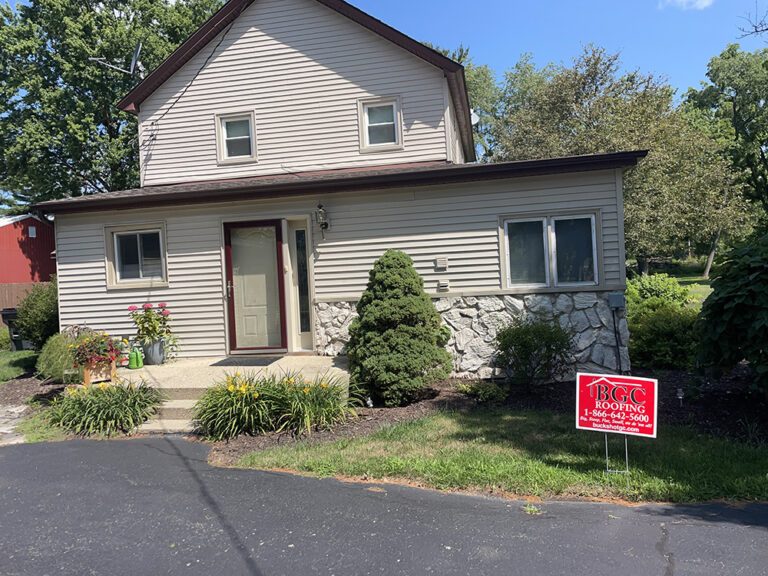
Usually you shouldn't. Most vinyl was never designed to be painted, and painting it commonly voids the manufacturer's finish warranty. Dark colors are the bigger danger: vinyl absorbs heat and can warp, buckle or oil-can across a whole wall. A few paint makers now sell vinyl-safe coatings, but they restrict you to an approved palette with a published minimum light reflectance value (LRV), and they do nothing for vinyl that's already brittle, cracked or chalky. Read your warranty terms before you buy a single gallon.
Get My Free Estimate →- The substrate test: the only thing that actually decides it
- Which siding materials actually take paint
- Pressure washing, and that green north wall
- The honest cost comparison
- Color, sheen and how fast it'll fade here
- Timing: when to paint in Wisconsin
- If you've had hail or wind, settle the claim before you paint
- The middle path: repair the bad sections, paint the rest
- Can I just paint it myself?
- What a fair written estimate should itemize
- Get an honest read before you spend anything
- FAQs
Short answer: paint your siding if the material underneath is sound, dry and just faded or dated. Replace it if the substrate itself is failing, because paint over rotten or swollen siding is a two-year cover-up on a twenty-year problem.
That's the whole decision in one sentence. Everything else is figuring out which camp your house is in, and you can do most of that yourself in twenty minutes with your thumb and a flashlight.
Here's how we walk through it with homeowners around Madison, Verona, Janesville, Monroe and the rest of south-central Wisconsin.
The substrate test: the only thing that actually decides it
Paint is a coating. It protects and it colors. It does not add strength, it does not dry out wet wood, and it does not glue delaminated fibers back together.
So before you get a single painting quote, test the material. Do this from the ground and a step ladder only. The two courses right above grade, the area behind and below downspouts, under window sills and anywhere near hose bibs and deck ledgers tell you almost everything. Use binoculars for upper walls and leave the two-story gables to someone with the right equipment.
- Press test. Push firmly with your thumb every few feet along the lower walls. Sound siding feels rigid. If it gives, feels spongy, or your thumb leaves a dent, that board is done.
- Probe the suspects. A small screwdriver into a suspicious spot tells you fast. If it sinks in with light pressure, that's rot, not weathering.
- Look for swelling and delamination. On older hardboard (the pressed-fiber siding common on 1970s-1990s builds), bottom edges swell, layers separate like a wet paperback, and nail heads mushroom. Once hardboard drinks water, it never goes back.
- Check the caulk joints and trim. Open joints at butt seams, window trim and corner boards are how water gets behind everything. Failed caulk alone is fixable. Failed caulk plus soft trim means water has been getting in a while.
- Read the fade pattern. Even, all-over fading on a south or west wall is normal Wisconsin UV. Patchy fading, dark streaking below joints, or one elevation that looks nothing like the others is usually a moisture story, not a sun story.
- Go inside. Check drywall and baseboards on the interior side of any wall that concerned you. Staining, soft trim or a musty closet changes the conversation entirely.
The pattern we run into constantly on 1980s hardboard homes: three walls press-test rock solid, then the north elevation under a gutter run that's been overflowing for years is soft from the bottom course up about three feet. That house doesn't need a full re-side. It needs that elevation replaced, the gutter fixed, and the whole house painted so the color reads as one house.
Older aluminum-sided homes are often the opposite story. Chalky, dated, oxidized to a dull pastel, but the metal itself is sound. Wash, bonding primer, two coats, and it looks like a different house for a fraction of a re-side.
If the siding passes the press test everywhere and your only complaint is "it looks tired," paint is a legitimate and much cheaper fix. If it fails in multiple places on multiple walls, paint is money you'll spend twice. For the deeper checklist, see our guide to the signs your siding needs replacement.
One safety stop first if your home predates 1978
Two hazards live in that housing stock, and there's a lot of it in Madison, Janesville and Monroe.
Asbestos-cement siding. Those brittle, cement-like shingles (often 12x24 with a wavy or scalloped bottom edge) can contain asbestos. Do not sand, grind, power wash, cut or break them, and don't scrape flaking paint off them. Have the material tested before any prep. Handling and disposal is specialized work with its own rules, and a weekend sander is exactly the wrong tool.
Lead paint. Contractors are legally required to follow EPA lead-safe practices on pre-1978 homes. As an owner working on your own place you're technically exempt, but the dust risk is identical, so containment, wet scraping methods and thorough cleanup still matter, especially with kids around or a vegetable garden below that wall.
Which siding materials actually take paint
Wood siding: paints reliably
Cedar, redwood, pine lap and shakes all take paint well, and repainting is simply part of owning wood siding here. Prep is everything: scrape, sand, spot-prime bare wood, replace any board that failed the press test, then two coats. Skip the prep and you'll be back on the ladder in four years.
Fiber cement: repainting is normal, with one catch
Fiber cement holds paint well because it's dimensionally stable, and repainting later in its life is an expected maintenance cycle, not a failure. The catch is the factory finish. Pre-finished fiber cement typically carries its own finish warranty (commonly 15 years), and field painting over that finish usually reduces or voids it. If you're repainting anyway, the factory coating needs to be sound, clean and well-adhered first, and the finish coat should be a quality 100% acrylic exterior paint. Pull your product literature and read the finish warranty language before you commit, because the dollars on the line are real.
New fiber cement and engineered wood: if you bought pre-finished, leave it alone. If you bought primed-only product, it must be painted, and most manufacturers want finish coats on within roughly 90 to 180 days of installation. The exact window is in the installation instructions, and blowing past it can affect coverage.
Vinyl: usually a no
Vinyl wasn't designed to be painted. Two real risks. First, painting commonly voids the manufacturer's finish warranty. Second, heat: vinyl expands and contracts constantly, and dark paint absorbs heat, so going darker than the original color can produce warping, buckling and that wavy oil-canned look across a whole wall.
A few paint makers now sell vinyl-safe coatings formulated for that movement. They work, within limits: you're restricted to an approved palette with a published minimum light reflectance value (LRV), and nothing on that list is a deep charcoal. They also don't fix brittle, cracked or chalky vinyl. If your vinyl is 25 years old and chalks off on your palm, you want new siding.
Aluminum: paints well with real prep
Old aluminum takes paint nicely once the chalky oxidation is scrubbed off and a bonding primer goes down. Skip the wash and the prime and it peels off in sheets.
Older hardboard: press test before you spend a dollar
Modern engineered wood takes paint fine. The older hardboard it replaced often doesn't, because by now it has usually taken on moisture at the edges.
Material also drives how many years the wall realistically has left, which is worth knowing before you commit either way. Our breakdown of how long each siding material lasts is a good sanity check.
Pressure washing, and that green north wall
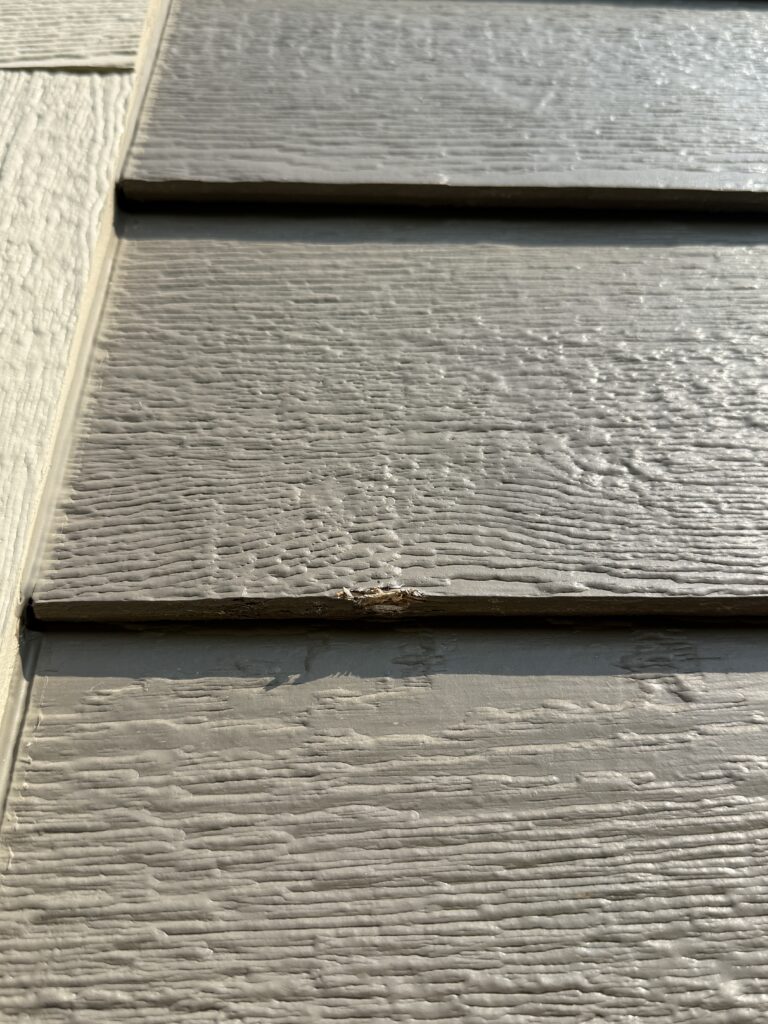
A soft wash on sound siding sometimes gets you most of the way there, and that's the cheapest good news in this article. High pressure is a different animal. Water aimed upward drives in behind the laps, where it sits against sheathing with no way to dry. On chalky vinyl it blasts the surface permanently blotchy. On soft hardboard or weathered wood it erodes fibers and opens seams. Low pressure plus a cleaning solution, aimed downward with the laps, is the right method.
As for recurring green or black staining, usually on the north and shaded elevations: paint alone doesn't solve it. Algae and mildew live on damp, shaded, poorly ventilated walls, and if you coat over live growth it bleeds back through within a season or two. You have to kill it with a proper mildew-killing wash, let the wall dry completely, use a paint with a mildewcide, then deal with the cause. Cut the shrubs back off the wall, fix the overflowing gutter, and re-slope the grade that keeps splashing that corner.
The honest cost comparison
Painting is cheaper. That's true, and it's why the question gets asked. What matters is what each option buys you.
Use per-square-foot numbers to sanity-check any quote, and remember that siding square footage (wall surface) drives the price, not your home's floor area. A 2,000 square foot two-story often has 1,800-2,800 square feet of wall.
- Professional repaint with real prep: roughly $1.50-$4.00 per square foot, so about $4,000-$10,000 on a typical two-story here.
- Vinyl re-side: roughly $5-$10 per square foot installed.
- Engineered wood (LP-type) re-side: roughly $8-$14 per square foot installed.
- Fiber cement re-side: roughly $10-$18 per square foot installed.
Which puts a full re-side commonly between about $12,000 and $45,000, moved by material, trim detail, how many gables and dormers you have, and whether sheathing repair turns up after tear-off. Those are market ranges, not quotes, and they move with material and labor pricing.
The trade-off:
- Paint buys years, not decades. On a well-prepped Wisconsin wall, plan on roughly 7-10 years, less on sun-beaten south and west elevations.
- Paint does nothing for a failing substrate. Water still gets in, rot still spreads, and now it's hidden behind a fresh coat.
- New siding buys decades, and it's your one chance to correct what's underneath.
If the siding is sound, paint wins, no contest. If it's failing, painting is a false economy that delays the same replacement while sheathing repair costs quietly grow. Condition also shows up when you sell or refinance, which we cover in our post on whether siding condition affects your home appraisal.
Not sure which camp your house is in? That's exactly what a free on-site look is for. Call (608) 909-9109 and we'll press-test the walls with you and tell you honestly whether paint will do.
Color, sheen and how fast it'll fade here
This is the second question everybody asks, and it matters more on Wisconsin walls than people expect.
- Dark colors fade faster, and they fade unevenly. Your south and west elevations take the UV beating, so a deep navy or charcoal will read noticeably lighter there in five or six years while the north wall still looks new. Deep reds and bright blues are the worst offenders because of pigment chemistry. Mid-tones and earth tones hold up best.
- Sheen. Flat hides surface imperfections and old chalk best, which makes it forgiving on weathered wood and hardboard, but it's harder to wash and holds dirt. Satin cleans easily and sheds water better, but it telegraphs every wave, patch and nail pop, and it does not sit well on a chalky substrate that wasn't scrubbed clean. Low-sheen or satin on the body with a semi-gloss on trim and doors is the combination that ages well on most homes.
- Vinyl-safe palettes. If you're using a vinyl-specific coating, you're stuck inside the manufacturer's approved color list and its minimum LRV. Pick the color from that list first, then design around it, not the other way around.
- Buy a quart and paint a 3x3 test patch on the actual wall, then look at it in morning and evening light before you commit. Color chips lie outdoors.
Timing: when to paint in Wisconsin
The realistic window is roughly late May through late September, with early October a gamble.
Most 100% acrylic exterior paints want air and surface temperatures above 50 degrees and rising, and the surface needs to be at least 5 degrees above the dew point. In practice that means heavy morning dew pushes the day's start to mid-morning, and cool September evenings shut you down earlier than you'd like. Some low-temp formulas go lower, but a cold, damp wall is how you get adhesion failure a year later.
The other end: don't paint a surface baking in direct sun. If the siding is too hot to hold your palm against, the paint skins over before it bonds. Chase the shade around the house.
Also give a pressure-washed wall real drying time, usually a couple of days of decent weather, before the first coat goes on. Wood and hardboard hold water longer than they look like they do.
Want a straight answer on your roof?
We'll inspect it, document everything, and tell you honestly what you're looking at, even if the answer is patch it for now. No pressure.
If you've had hail or wind, settle the claim before you paint
Storm damage changes the order of operations. Insurers generally pay for functional damage (cracked, punctured or blown-off siding, impact that compromised the weather barrier) and generally do not pay for fading, chalking or normal wear. Hail on siding often shows up as cracks and chips on the impacted elevation, and it can be subtle.
Do not repaint storm-damaged siding before the claim is resolved. Fresh paint fills and blurs exactly the evidence an adjuster needs to see. Get it documented first. We meet the adjuster on-site to walk the damage together, and our storm damage restoration page explains how that process runs in Dane County.
The middle path: repair the bad sections, paint the rest
This is the most under-used option and often the right one, especially on wood, engineered wood and aluminum homes where damage is localized: one splash-prone wall, the north side under a bad gutter run, a few courses behind a deck.
A partial repair reads as a clean repair when:
- The replacement matches the original profile, thickness and exposure (how much of each board shows).
- Seams land behind trim, at corner boards or at a natural break line, not randomly mid-wall.
- Flashing and house wrap get corrected at the repair, not just re-covered.
- The entire wall gets painted after, so the color is uniform.
It reads as an obvious patch job when profiles don't match, when only the new boards get painted, or when the patch dies mid-field with no trim to terminate it. Once you can count the patches from the curb, you've spent real money and hurt the house.
Rule of thumb: if you're chasing bad boards across three or four elevations, repair-and-paint stops penciling out and a full re-side is the better value. Repair, full replacement and insurance work are all laid out on our siding services page.
Can I just paint it myself?
Sometimes, yes. On a one-story ranch with sound siding, reachable walls and a couple of free weekends, a careful homeowner with a good roller can do a respectable job. The paint isn't the hard part.
Where DIY goes wrong:
- Height. Two-story gables, dormers and anything over a deck or a slope. Ladder work at that height is where people get hurt, and it's most of the labor cost for a reason.
- Prep discipline. Nearly every early paint failure we see traces back to skipped scraping, no primer on bare spots, or painting a damp wall.
- Masking and overspray. Spraying without proper masking puts a fine mist on windows, roofing, gutters, cars and shrubs. Tedious to mask well, expensive to fix.
- Hazardous materials. See the pre-1978 section above. Lead dust and asbestos-cement are not weekend problems.
Do the walk-around and the press test yourself. That part is free and useful. Then decide whether you're painting a reachable ranch or hiring the height.
What a fair written estimate should itemize
Whether you hire us or somebody else, a real estimate lets you compare bids apples to apples. Ask that it spell out:
- Prep scope: wash method and pressure, scraping and sanding extent, spot priming, what gets caulked.
- Number of coats, and whether primer is included or counted as one of them.
- Product name and line, not just "premium paint." Brands have three tiers; the line matters.
- Board replacement allowance: how many linear feet of bad siding and trim are included, and the price per foot beyond that. This is where low bids get made up later.
- Caulk type and where it's used. An elastomeric or high-grade urethane joint sealant behaves nothing like cheap painter's caulk.
- Warranty term, split between the manufacturer's material coverage and the contractor's workmanship coverage. Ask how long labor is covered and what voids it.
- Permits and HOA: a straight repaint usually needs no permit; siding replacement often does, and it varies by municipality across Dane, Rock and Green counties. Many newer subdivisions also require written color or architectural approval, which can add a couple of weeks.
Then ask the question nobody asks: will you be here to honor the warranty? Verify general liability and workers' compensation coverage before anyone leans a ladder on your house, and ask for the certificates. We're locally owned and have been working on Wisconsin exteriors since 1979, we're licensed and insured, and our customer reviews sit on Google, Birdeye, Angi and HomeAdvisor where anybody can read them. One clarification, since homeowners ask: our GAF Master Elite certification is a roofing credential, not a siding one. Siding manufacturers run their own separate training and warranty programs.
Get an honest read before you spend anything
You don't have to guess. We'll come out, press-test the walls, check caulk joints, trim, flashing and the interior side of anything that worries us, and tell you straight: paint it, repair and paint it, or replace it. If paint is enough, we'll say so, and we'll tell you what to prep if you want to roll it yourself.
The inspection is free, it takes about an hour, and there's no obligation and no hard sell. Nothing to lose by finding out.
Call (608) 909-9109 or reach out here to set up a free siding inspection anywhere in Dane, Rock or Green County. Worth an hour to avoid painting over a problem.
Get a straight answer on your Madison roof
Wisconsin storm season and insurance non-renewal letters do not wait. Get a free, no-obligation inspection and an honest assessment of exactly what your roof needs, even if the answer is to wait.