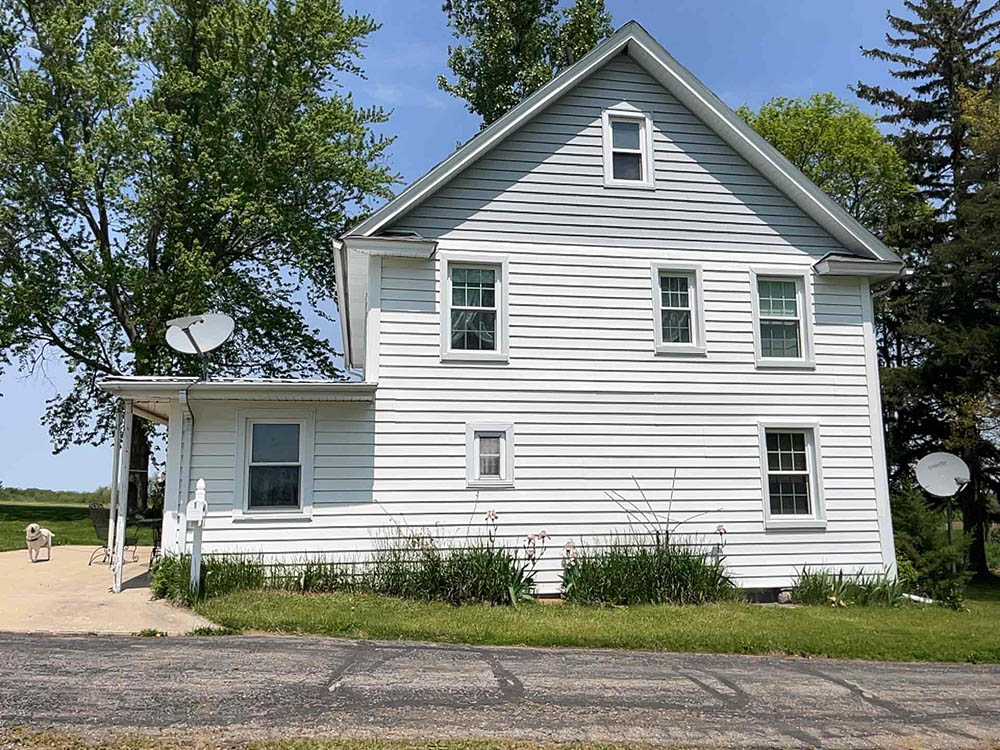
Across roughly 40 Dane County re-sides we priced and built in 2024-2025, fully installed James Hardie ColorPlus siding with trim ran about $14-$20 per square foot of wall area, or roughly $1,400-$2,000 per square (100 sq ft). A typical 1,600 sq ft ranch often lands between $22,000 and $36,000, and a larger two-story is commonly $35,000-$55,000. Jobs land near the top of that range when there are lots of windows and dormers, two-and-a-half stories, sheathing replacement, or asbestos and lead-paint handling on an older home.
Get My Free Estimate →- What fiber cement siding actually is, and which brand
- Do you actually need a full re-side?
- What moves your price up or down
- Financing, deposits, and when money is due
- Why fiber cement makes sense in south-central Wisconsin
- The honest downsides
- Fiber cement vs vinyl vs engineered wood in the Madison market
- Older Madison homes: asbestos, lead paint, historic districts and permits
- Tear-off, wet walls, and who pays for what we find
- ColorPlus vs field-painted
- The install details that decide whether it lasts
- Warranties and how to vet your installer
- Timeline, scheduling, and what living through it looks like
- Storm damage and the insurance parts nobody explains
- Maintenance and resale
- Two recent Dane County jobs
- Get a real number for your house
- FAQs
Fiber cement siding in Madison runs roughly $14-$20 per square foot of wall area installed, which is about $1,400-$2,000 per square (a "square" is 100 square feet). That range comes from roughly 40 Dane County re-sides we priced and built in 2024-2025, using James Hardie ColorPlus with trim. A typical 1,600 sq ft ranch usually lands between $22,000 and $36,000. A larger two-story is commonly $35,000-$55,000.
Before you spend that, two things are worth knowing: whether you actually need a full re-side, and which install details separate a 45-year wall from one that fails in eight.
Both are covered below, along with brand comparisons, older-Madison-home issues (asbestos, lead paint, historic district approval), warranties, financing terms, and how far out we are booking.
What fiber cement siding actually is, and which brand
Fiber cement is Portland cement, sand and cellulose fiber, pressed and cured into boards. Early versions used asbestos fiber; James Hardie commercialized the modern asbestos-free, cellulose formulation and still dominates the market, which is why everyone calls it "Hardie board."
Common forms:
- HardiePlank lap siding. The workhorse. 5-1/4" to 8-1/4" exposure, smooth or cedarmill woodgrain.
- HardieShingle. Cedar-shake look for gables, dormers and accent walls.
- HardiePanel with battens. The board-and-batten look you see all over Verona and Waunakee.
- HardieTrim. Corners, window casing, frieze. Thicker than the siding, same abuse tolerance.
Hardie is not the only fiber cement. Allura (Elementia) and Nichiha both make solid product, and Cemplank is Hardie's own value line. Allura tends to price a little under Hardie and offers some deeper profiles; Nichiha does panel systems that look sharp on modern builds. We install James Hardie for three practical reasons: climate-specific product (see HZ5 below), the widest ColorPlus palette and trim system so everything on the wall comes from one line, and local distribution, which matters a lot when you need three replacement planks in year nine. If you have your heart set on Allura or Nichiha, say so at the estimate and we will talk it through honestly.
One Hardie detail worth knowing: Wisconsin is HardieZone 5 (HZ5), product engineered for freeze-thaw cycling and wind-driven moisture. If a salesperson cannot tell you which zone you are in, that tells you something.
Do you actually need a full re-side?
Often, no. We would rather do a $900 repair than sell you a $30,000 job you do not need, so here is the honest triage.
Usually a repair:
- A handful of cracked or holed vinyl panels from one hail event or a thrown rock
- Failed caulk at windows, doors and trim with the siding itself still sound
- Localized rot at one window or one roof-to-wall junction, almost always a flashing problem
- Woodpecker holes on one gable
- One storm-hit elevation while the other three are fine
- Loose panels pulled at the nail hem after a straight-line wind event
Usually a full replacement:
- More than roughly a quarter of the wall area failing, or failure on three or four elevations
- Hardboard or Masonite siding swelling and delaminating along the bottom edges (that is water in the substrate, and it does not reverse)
- Paint that will not hold on wood siding after two or three repaints, which usually means moisture is coming from behind
- Soft or wet sheathing found in more than one spot
- Vinyl in a discontinued color where no matching panel exists, so any repair reads as a patch
We do repairs and single-elevation work in Madison and Dane County, not just whole-house jobs. Getting a straight opinion costs nothing, and we will put in writing which category your house falls into.
What moves your price up or down
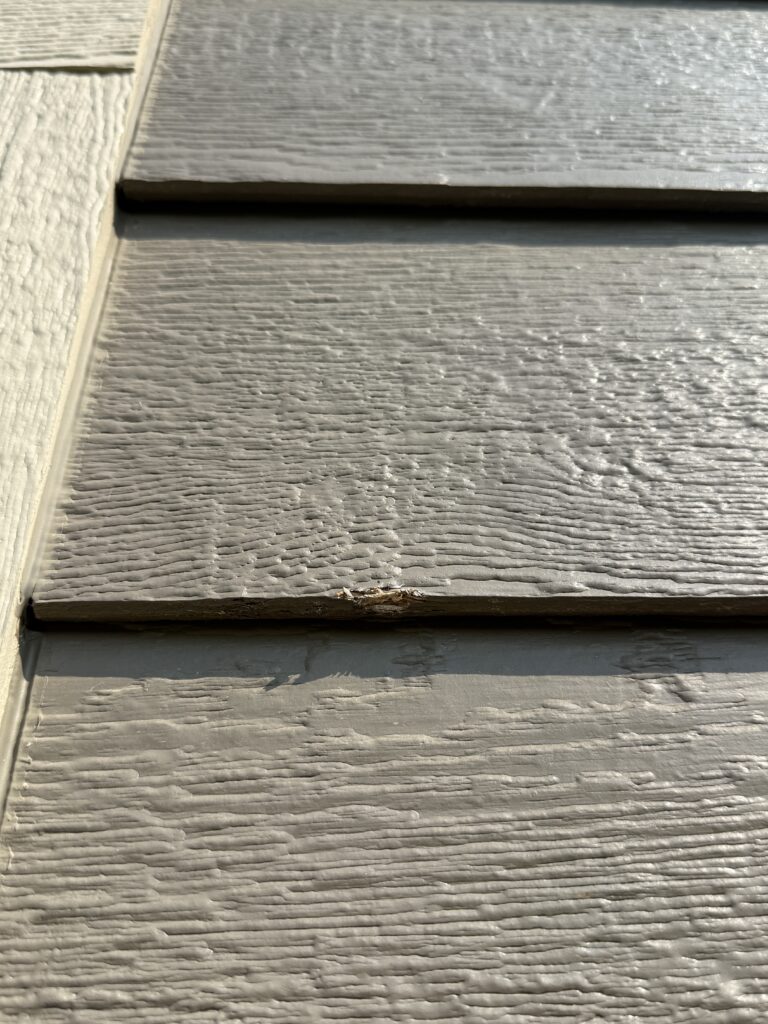
Two houses with identical square footage can quote $10,000 apart.
Pushes you toward $14/sq ft: simple one-story ranch, long uninterrupted walls, few windows, good sheathing, single existing layer, standard ColorPlus color, ground-level access all the way around.
Pushes you toward $20/sq ft and up: two-and-a-half stories or steep grade requiring extra staging, lots of windows and dormers (every opening is trim, flashing and cutting labor), HardieTrim wrapping every opening, mixed board-and-batten or shingle accents, two layers of old siding to tear off, rotted sheathing, asbestos or lead-paint handling.
Costs people forget to ask about: dumpster and disposal, new house wrap and flashings, soffit and fascia, gutter removal and reinstallation, permit, and rot repair found after tear-off. Get all of it named line by line. A quote that is one number and one sentence is a quote designed to grow later.
One or two elevations vs the whole house. Partial work is cheaper in total dollars but more expensive per square foot, usually 15-25 percent more, because setup, staging, delivery and mobilization do not shrink. If you are doing two elevations now and know the other two are next, price both scenarios. Doing all four while the staging is already up almost always beats two trips.
Financing, deposits, and when money is due
Fair question on a $22,000-$55,000 project, and here is the actual structure rather than a brush-off.
Financing is not in-house. Exterior contractors in this market, including us, work through third-party consumer lenders. What that typically looks like:
- Prequalification is a soft credit pull that does not affect your score. A hard pull happens only if you move to a full application.
- Terms commonly run 36 to 144 months. Longer terms mean a lower payment and more total interest. Do that math before you sign.
- Promotional options exist, usually a deferred-interest window (often 12 or 18 months) or a reduced-rate longer term. Read the deferred-interest language carefully: if any balance remains when the promo period ends, interest is typically charged back to day one. It is a great tool if you will actually pay it off, and an expensive one if you will not.
- Rates depend on your credit and the lender's current programs, so nobody can honestly quote you a rate before you apply. We will show you the exact program terms in writing before you sign anything.
Deposits and payment schedule. Nothing is due at the estimate visit. Our contracts are normally written with a deposit when materials are ordered, not when you first sign interest, and the balance due at completion after you walk the finished job with the foreman. On insurance work, the schedule follows the claim payments. Ask any contractor to write the schedule into the contract, and be skeptical of anyone wanting a large cash deposit before a single sheet of house wrap goes up.
Why fiber cement makes sense in south-central Wisconsin
Our climate attacks siding from two opposite directions, and that is what people miss.
Freeze-thaw stability. We can swing 50 degrees in 36 hours in March. Vinyl expands and contracts hard with that, which is why it hangs loose on its nails and why you see waves on south and west walls. Fiber cement is dimensionally stable. It fastens tight and stays flat.
It holds paint. Cedar and pine move with moisture, so paint cracks at joints and peels. Fiber cement barely moves, so a factory finish routinely goes 15 years or more.
Hail and impact. After a hail event we find cracked and holed vinyl all over Sun Prairie, Fitchburg and the west side. Vinyl gets brittle in cold and shatters. A stone that punches through vinyl usually just marks a Hardie board.
Woodpeckers. Not a joke here. If you back up to woods in Middleton, Cross Plains or out toward Cambridge, you know what pileated woodpeckers do to cedar and hollow vinyl. They do not drill cement.
Fire. Hardie fiber cement products are rated noncombustible per ASTM E136. That matters on tight isthmus lots and grill-side walls.
Rot and insects. No food value for carpenter ants or termites.
The honest downsides
It costs more. Roughly double vinyl installed. No way around it.
- It is heavier than vinyl or engineered wood. A 12-foot 8-1/4" HardiePlank runs about 16-20 pounds, roughly 2.3 lbs per square foot of coverage. That is two-man handling and more labor hours than vinyl, though it is not the 30-pound board some people imagine.
- Installation is unforgiving. Vinyl hides sloppiness. Fiber cement does not.
- You will repaint eventually. ColorPlus goes 15-plus years, but "never paint again" is not true of any siding.
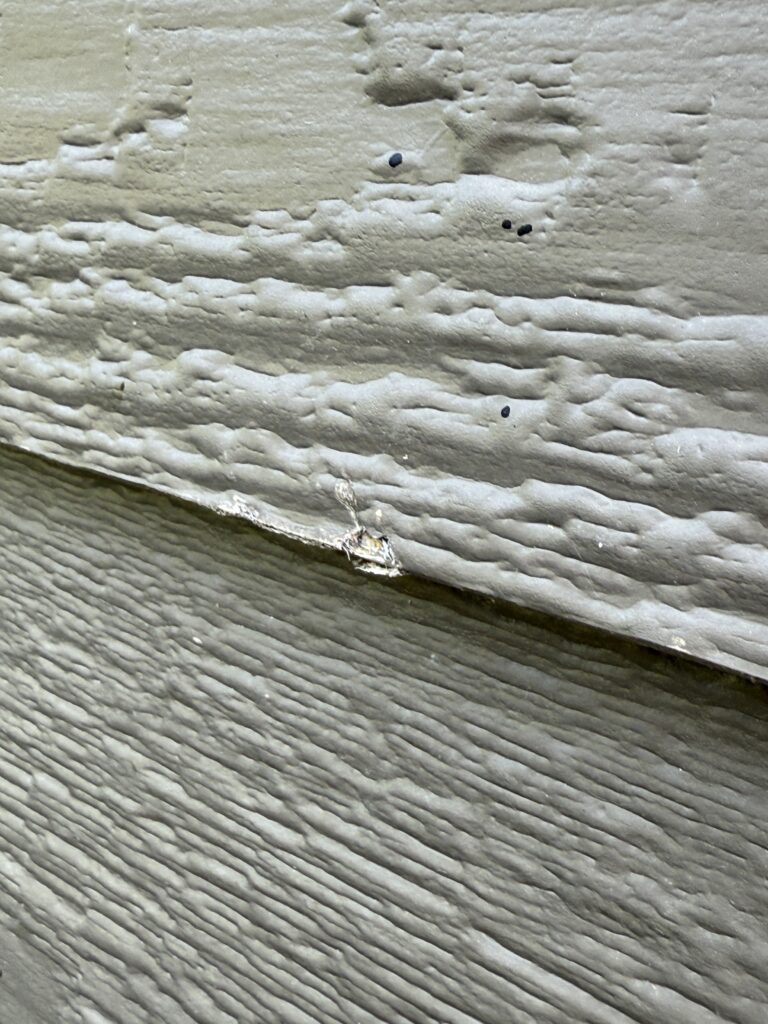
- It can crack. Not from typical Wisconsin hail, but a direct hit from very large stones, a ladder strike, or real structural movement from foundation settling can crack a plank. It cracks rather than dents.
- Plank replacement takes some care. Swapping a board means releasing fasteners in the course above, so it is not a homeowner Saturday project.
- Color matching years later is the real risk. ColorPlus shades do get discontinued. At install we tell every customer to keep the color code on file and store two or three spare planks plus a touch-up kit in the garage. Ten minutes of foresight saves a mismatched patch in year twelve.
- Cutting it makes silica dust. A crew doing it right uses shears or a dust-collecting saw and respirators. A crew cutting dry with a circular saw in a cloud of dust in your driveway is telling you how they do everything else.
Fiber cement vs vinyl vs engineered wood in the Madison market
Installed ranges we actually see around Dane County, per square foot of wall:
| Material | Installed cost/sq ft | Realistic service life |
|---|---|---|
| Vinyl (builder grade) | $6-$9 | 20-30 yrs, fades and cracks |
| Insulated vinyl | $9-$12 | 25-35 yrs |
| Engineered wood (LP SmartSide) | $11-$16 | 30-40 yrs, repaint ~10-15 yrs |
| Fiber cement (James Hardie) | $14-$20 | 40-50 yrs |
Vinyl is still right for plenty of houses: rentals, flips, or a home you plan to sell in three years. Engineered wood is a legitimate middle option, lighter and easier to cut, with the tradeoff that it is wood-based and depends on its coating holding.
Fiber cement earns its premium if you plan to stay, if you back up to trees, if you have already replaced hail-damaged vinyl once, or if you want a crisp painted-wood look on a Nakoma bungalow or a Maple Bluff colonial without scraping every seven years.
Not sure which tier fits your house and your timeline? Our estimator will price two or three options side by side. No charge, no pressure. See our full siding services and material options, or call our Madison office for a free estimate.
Older Madison homes: asbestos, lead paint, historic districts and permits
If your house predates 1978, read this twice. These are the surprise line items we find on near-east side, Schenk-Atwood, Nakoma and Monroe Street re-sides.
Asbestos-cement shingle siding was common on Madison homes built roughly 1930-1960. It looks like a thin, brittle gray or pastel shingle, often 12" x 24", sometimes with a wavy bottom edge. Intact, it is not hurting anybody. The hazard comes from breaking or sawing it. Two real paths: leave it and cover it (fur out over the shingles for a flat nail base, add a new water-resistive barrier and flashings, then side over it), or remove it through a contractor certified for asbestos handling with wetted removal, sealed disposal and landfill documentation. Either way it gets its own line on your estimate.
Lead paint. Any pre-1978 home may have it under old wood siding and on trim. Disturbing it triggers EPA and Wisconsin lead-safe (RRP) rules: certified firm, ground containment, no dry sanding, HEPA cleanup, verification wipe. It adds cost and days, and it is not optional.
Historic districts and HOAs. If you are inside a City of Madison local historic district (Mansion Hill, Third Lake Ridge, University Heights, First Settlement, Marquette Bungalows), changing exterior material or color generally requires a Certificate of Appropriateness from the Landmarks Commission. Substitute siding over original wood is not always approved, and color is reviewed too. That process takes weeks, not days, so it belongs at the front of your timeline. In newer subdivisions around Verona, Waunakee and Sun Prairie, the gatekeeper is usually an HOA architectural review committee, and they typically want a color sample and a written request.
Permits. Re-siding in Madison requires a building permit, and surrounding municipalities have their own thresholds. We pull permits as part of the job and schedule inspections. If a bidder tells you no permit is needed, ask them to put that in writing.
Tear-off, wet walls, and who pays for what we find
Full tear-off to the sheathing is the better job in almost every case. You get eyes on the wall, replace rotted sheathing, install fresh taped house wrap, and get correct flashing at every window, door and roof-to-wall transition. Going over existing siding is acceptable only when the substrate is flat, solid, dry and properly furred, and the flashings still get done right.
What if tear-off reveals a wet or moldy wall cavity? It happens, most often below a missing kick-out flashing or under a leaking window. Our process: stop, photograph it, show you, let it dry with fans if needed, replace compromised sheathing, and fix the source. Surface mold on sheathing is normally handled with removal and cleaning; if it is widespread into insulation and framing, that is a remediation contractor's job, and we will tell you so instead of covering it up.
Who pays should never be a surprise. We put a unit price for sheathing replacement on the estimate up front (commonly in the range of $85-$150 per 4x8 sheet installed), so the math is known before we start, and we get written approval before any work beyond the contract. If the damage traces back to a covered storm event, it can often be submitted as a claim supplement with photos.
While the walls are open, two upgrades are worth pricing: rain screen furring (thin vertical battens creating a drainage and drying gap, modest cost, meaningful longevity in a freeze-thaw climate) and continuous rigid foam (an inch of polyiso adds about R-6 and breaks thermal bridging through the studs). Be realistic on energy, though. Fiber cement itself has essentially no R-value. On an older Madison house the real savings come from air sealing the sheathing, taping the wrap, and dense-packing empty stud cavities while you have access.
Want a straight answer on your roof?
We'll inspect it, document everything, and tell you honestly what you're looking at, even if the answer is patch it for now. No pressure.
ColorPlus vs field-painted
Get the factory finish. ColorPlus Technology means color applied in a controlled plant, multiple coats, cured, with cut edges touched up on site from matching kits.
Field-painting primed board means a crew rolling paint on your wall in Wisconsin weather. Fall installs get short dry windows and heavy dew. Even done well, field paint will not match the adhesion of a baked finish, and you will be back on a ladder years sooner.
ColorPlus costs a bit more and locks you into the available palette, though the range is wide and dark colors hold up far better than they used to. Dark colors still lighten slightly over 15-plus years, and it shows most on a south or west wall.
The install details that decide whether it lasts
This is what should decide who you hire. Fiber cement is excellent installed correctly and a callback machine installed wrong. Product warranties do not cover installation error.
Water-resistive barrier first. House wrap over clean sheathing, lapped and taped correctly, rotted sheathing replaced. Siding shields the wall; the barrier and flashing keep water out.
Clearances crews skip:
- 6" minimum above grade, 2" above concrete steps, decks and driveways
- 1" to 2" clearance where siding meets a roofline, kept clear so water drains
- A 1/4" gap above horizontal flashing over windows and doors, left uncaulked so the wall can drain and dry
That last one is the most common mistake we find. A crew caulks the gap above window flashing because it "looks cleaner," and now the wall has no drainage path. Water sits, the board wicks, and two winters later you have swelling and finish failure.
Kick-out flashing where a roof edge meets a wall. Missing kick-outs are why we tear into so many rotted wall cavities behind otherwise fine siding.
Fastening. Blind-nailed through the top of the plank into studs at 16" or 24" on center, correct nail type and length, snug and never overdriven. Overdriven nails crush the board and admit water at every fastener.
Sealed cut edges. Every field cut gets the matching touch-up kit. Raw edges wick moisture.
Joints. Staggered, on studs, with joint flashing behind. Not caulked and hoped.
None of it is exotic. It is discipline. You can see how we detail these transitions in our recent siding and exterior projects.
Warranties and how to vet your installer
Product warranties, in plain numbers:
- HardiePlank lap siding: 30-year limited, transferable warranty on the substrate
- ColorPlus Technology finish: 15-year limited finish warranty (peeling, cracking, chipping)
- HardieTrim products: typically 15-year limited
Transferable matters if you sell. Keep your paperwork and color codes.
The other half is labor. A manufacturer warranty covers the board, not the crew. Get the workmanship warranty term written into the contract in plain language, and read what it excludes. Ours is spelled out on every estimate before you sign, not promised verbally in the driveway.
On credentials, straight answer: we are not going to wave a badge at you. We train our crews to the current James Hardie installation instructions and the HZ5 requirements for our climate, and our foremen keep the manual on the job. Ask any contractor to name the fastener spacing and the clearance at horizontal flashings. If they cannot, the manual is not on their truck either.
What to ask any siding contractor in Wisconsin:
- Are you registered with Wisconsin DSPS as a Dwelling Contractor with a certified Qualifier? (We are, and we will email you the credential.)
- Can I see current general liability and workers' compensation certificates sent directly from your insurer?
- Are the crews in-house or subcontracted, and who will actually be on my property? (Ours are our own crews, which is how we control the details above.)
- Are you lead-safe (RRP) certified for my pre-1978 home?
- Do you have a local address and phone I can walk into?
That last one matters most after a storm. When hail hits Dane County, out-of-state crews knock doors within days, want a signed "authorization to inspect" on the spot, push a contingency contract, and are gone before the first winter. An established local contractor will leave you a written estimate, pull permits under their own registration, and still answer the phone in three years. We have been at this in Madison since 1979, and our real reviews are on Google, Birdeye, Angi and HomeAdvisor.
Timeline, scheduling, and what living through it looks like
A 1,600 sq ft ranch: about 5-8 working days. A larger two-story with heavy trim: 2-3 weeks. Asbestos or lead handling, or significant sheathing replacement, adds days.
Lead time is seasonal. Late winter and early spring inquiries usually install about 4-8 weeks out. June through August, when storm work stacks up, it is more often 8-12 weeks, so a May call can genuinely mean a late-July start. Late fall and winter are the shortest wait, often 2-4 weeks. Special-order ColorPlus colors and trim can add a week or two on top of that, and historic district review adds more. If you want spring siding, call in February.
What the job looks like day to day:
- You do not need to be home. Most of our customers work through the whole job.
- Tarps over landscaping, plywood or a box over the A/C condenser.
- Magnet sweep of the driveway and lawn at the end of every day, and again at final cleanup.
- Cutting done with shears or dust-collecting saws, away from open windows.
- Nail-gun and saw noise during working hours. Keep pets inside, and expect a few crooked picture frames.
- Walls are open only during the working day. We do not leave sheathing exposed to an overnight forecast.
Storm damage and the insurance parts nobody explains
Hail and straight-line wind damage to siding is covered under most Wisconsin homeowners policies, and homeowners routinely miss it because they only look at the roof. Cracked vinyl on west and south elevations, panels pulled at the nail hem, dented aluminum, hail bruising on soft trim: it all counts.
The nuance that decides your out-of-pocket (we are contractors, not adjusters, so confirm with your declarations page or agent):
- Deductible. Many Wisconsin policies now carry a separate percentage wind and hail deductible, often 1-2 percent of dwelling coverage. On a $400,000 dwelling limit that is $4,000-$8,000, not the $1,000 you assumed.
- ACV vs RCV. ACV (actual cash value) pays the depreciated value now. RCV (replacement cost value) releases withheld depreciation after the work is completed and invoiced.
- Cosmetic damage exclusions. Some carriers now attach endorsements excluding damage that is cosmetic rather than functional. It shows up in hail claims and changes the conversation.
- Matching disputes. The common fight is whether the carrier pays to replace undamaged elevations so the house matches. Wisconsin has no bright-line rule, so it is argued case by case using line-of-sight and discontinued-product arguments. Photos win these.
- Upgrades are on you. Insurance restores what you had. If you had vinyl and want Hardie, the claim funds the vinyl-equivalent scope and you pay the difference. That is often the cheapest moment to make the jump.
We meet your adjuster on site and walk every elevation, because a 15-minute drive-by misses a lot. Here is how our storm damage restoration in Dane County process works, including 24-hour emergency response when a storm opens a wall.
Maintenance and resale
Maintenance is light, not zero:
- Rinse the walls once a year with a garden hose and soft brush. If you pressure wash, stay under 1,500 psi with a wide fan tip several feet back.
- Inspect sealant joints at windows, doors and trim every 2-3 years and re-caulk what has failed. Best 30 minutes you will spend on the house.
- Keep mulch and grade down off the boards, and keep sprinklers off the wall.
- Most "fading" in year six is dirt. Wash it before you assume the finish failed.
Resale. We are not going to quote you a national percentage. What we see on Madison-area resales is simpler: houses with fiber cement and real trim photograph well, inspectors write fewer siding items, and buyers read it as a house that was maintained. The 30-year transferable substrate warranty is also paperwork you can hand over at closing.
Two recent Dane County jobs
Middleton, October 2024. Cedar with woodpecker damage. Wooded lot, 1990s two-story, cedar lap painted three times and repeatedly drilled by pileated woodpeckers. Full tear-off, sheathing repair at two gable ends, new taped house wrap, HardiePlank cedarmill in ColorPlus with HardieTrim on every opening. Nine working days, contract in the mid-$40,000s. The homeowner's driver was not looks, it was never scraping cedar again.
Sun Prairie, August 2024 hail claim. Hail cracked vinyl on the west and south elevations, with roof damage on the same slopes. We met the adjuster on site and documented all four elevations. The approved scope covered the roof plus the two damaged siding elevations, which we would have sided in fiber cement for about $16,000. Wrapping all four elevations while the staging was already up came in near $27,000, versus roughly $34,000 to come back and do the other two in a few years. The homeowner paid the upgrade difference and did it once.
Photos from both are in our project gallery.
Get a real number for your house
Every fiber cement price online is a guess until somebody measures your walls, counts your windows, checks your sheathing, and looks at how the siding meets your roof and grade. That part is free, and there is no pressure attached to it.
Here is exactly what happens when you call. We set a time that works for you. An estimator walks the full exterior, measures, takes photos, checks for asbestos shingles or pre-1978 lead paint, and looks at your flashing and grade conditions. You get a written estimate naming material, trim, house wrap, flashing details, disposal, any abatement, the sheathing unit price, the payment schedule and the workmanship warranty term. Nobody sits at your kitchen table pushing a "today only" price, because we do not have one. And if a repair or a different material is the smarter buy for your situation, we will say so, even though it is a smaller ticket for us.
Call our Madison office at the number at the top of this page, or request a free siding estimate online. We serve Madison, Middleton, Verona, Sun Prairie, Waunakee, Fitchburg, Stoughton, Oregon and the rest of Dane County.
Get a straight answer on your Madison roof
Wisconsin storm season and insurance non-renewal letters do not wait. Get a free, no-obligation inspection and an honest assessment of exactly what your roof needs, even if the answer is to wait.