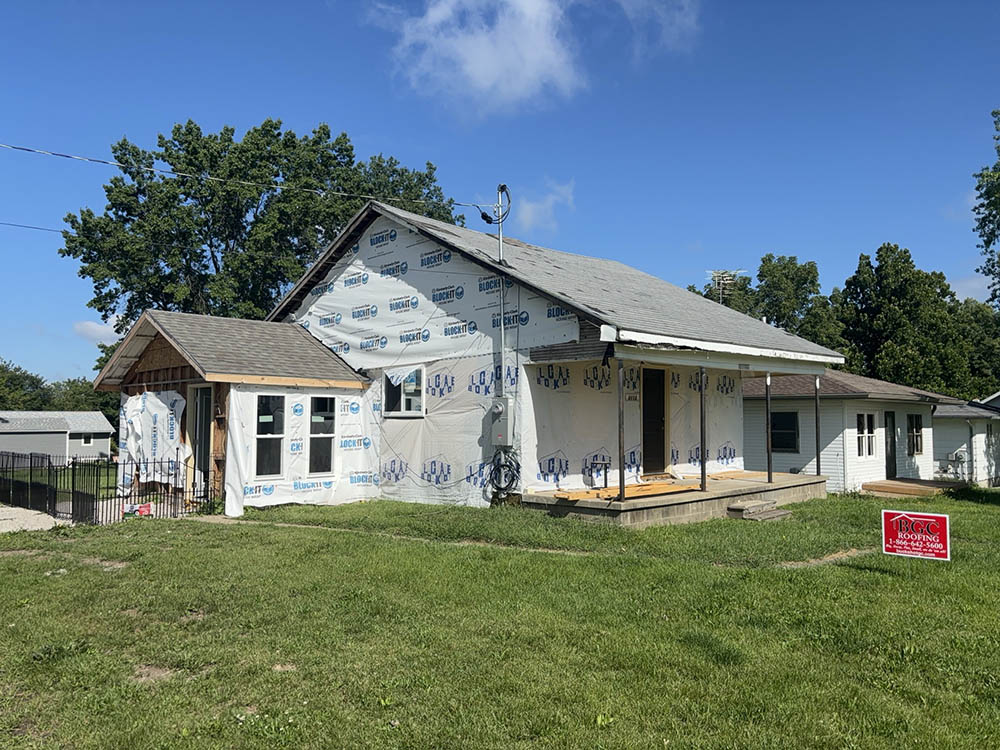
In south-central Wisconsin, mid-grade vinyl with a full tear-off commonly runs about $5-$9 per square foot installed, insulated (foam-backed) vinyl about $8-$13, and steel siding about $11-$18. On a typical two-story home with 1,800-2,200 square feet of wall area, that is roughly $11,000-$20,000 for vinyl versus $20,000-$38,000 for steel. Those are current market ranges, not a quote. Steel is a commodity, so material pricing moves, and trim-heavy houses land at the top of the range.
Get My Free Estimate →- What steel and vinyl siding actually cost installed here
- Steel vs vinyl: the honest comparison
- What Wisconsin hail actually does to each one
- Oil canning: the steel complaint nobody warns you about
- Dark colors and Wisconsin sun
- The metal worries: rust, noise, lightning
- Color matching and repainting years down the road
- Real-world maintenance in this climate
- Energy efficiency: will either one lower your heating bill?
- Installation and code: where siding jobs actually fail
- Lifespan and warranties: read the paperwork
- Permits, HOAs and historic districts
- What about fiber cement?
- Insurance and impact resistance
- Resale: payback or over-improvement?
- How the project actually runs
- So is the steel upgrade worth it?
- Why trust our read on it
- The easiest next step
- FAQs
Short answer: steel siding holds up better than vinyl in a hail-prone climate like ours, but it costs roughly one and a half to two and a half times as much installed, and it has one cosmetic weakness vinyl does not have in small hail. Steel dents. Vinyl cracks.
Which one you should buy comes down to three things: how long you plan to own the house, how much storm exposure your walls actually get, and whether a dimple you can see in low afternoon light would bother you.
Let's walk through it the way we would standing in your driveway.
What steel and vinyl siding actually cost installed here
Here are current market ranges for a full tear-off re-side in south-central Wisconsin, including housewrap, trim and labor. These move with material pricing and they are not a quote, but they will keep you from getting blindsided:
- Mid-grade vinyl: about $5-$9 per square foot installed
- Insulated (foam-backed) vinyl: about $8-$13 per square foot
- Steel siding: about $11-$18 per square foot
On a typical two-story home in Madison, Janesville or Monroe with 1,800-2,200 square feet of wall area, that is roughly $11,000-$20,000 in vinyl and roughly $20,000-$38,000 in steel. Trim drives the spread more than people expect. A simple ranch with two gables prices near the bottom; a house with dormers, bay windows, cedar-wrapped columns and a lot of cut-up rooflines prices near the top.
Our vinyl siding cost breakdown for Wisconsin goes deeper on the vinyl side, grade by grade, if you want to nail that number down first.
Steel vs vinyl: the honest comparison
Modern steel siding is a formed steel panel with a baked-on factory finish. Most residential steel siding lands around 28 gauge (roughly 0.015 inch thick), with heavier 26 gauge (roughly 0.018 inch) available in some panel and trim profiles. Lower gauge number means thicker steel and better dent resistance, so if you are paying the premium, ask which gauge you are getting.
It is not the flimsy aluminum siding a lot of 1960s and 70s houses around here still wear. Old aluminum is a soft metal that dents from a stray softball and chalks white as the coating gives up. Steel of the same thickness is several times stiffer.
Vinyl siding is extruded PVC, and it is the most-installed siding in Wisconsin for good reason: strong value, huge color and profile selection, no painting ever. Our vinyl siding page covers the grades and profiles in depth.
Where they genuinely differ:
- Upfront cost. Vinyl wins clearly.
- Impact resistance. Steel wins. It does not crack, shatter or blow apart. It dents.
- Cold-weather brittleness. Steel wins. Vinyl gets brittle below zero, which is not hypothetical in Dane County in January.
- Color retention. Steel with a quality baked finish usually holds color better over decades. Dark vinyl on a south or west wall can fade noticeably.
- Cosmetic repair. Vinyl wins. A cracked panel unzips out and a new one goes in cheaply.
- Selection. Vinyl wins on sheer variety of colors, profiles, shakes and scallops.
- Fire. Steel is non-combustible. Vinyl melts from a nearby grill or a neighbor's fire.
- Flatness. Vinyl wins. Steel can show oil canning (more on that below).
What Wisconsin hail actually does to each one
Our hail season runs roughly April through September, and south-central Wisconsin catches its share. What we find on walls after a storm is predictable.
Vinyl takes hail two ways. Pea to marble-size stones on a warm July afternoon often do nothing. The same storm during a cold snap, or bigger stones driven by high wind, produces cracks, punched holes and panels ripped off the nail hem. The cracks are what matter, because water gets behind the panel and into the sheathing. We have opened walls where nobody noticed cracked siding for two seasons and found black, soft OSB underneath.
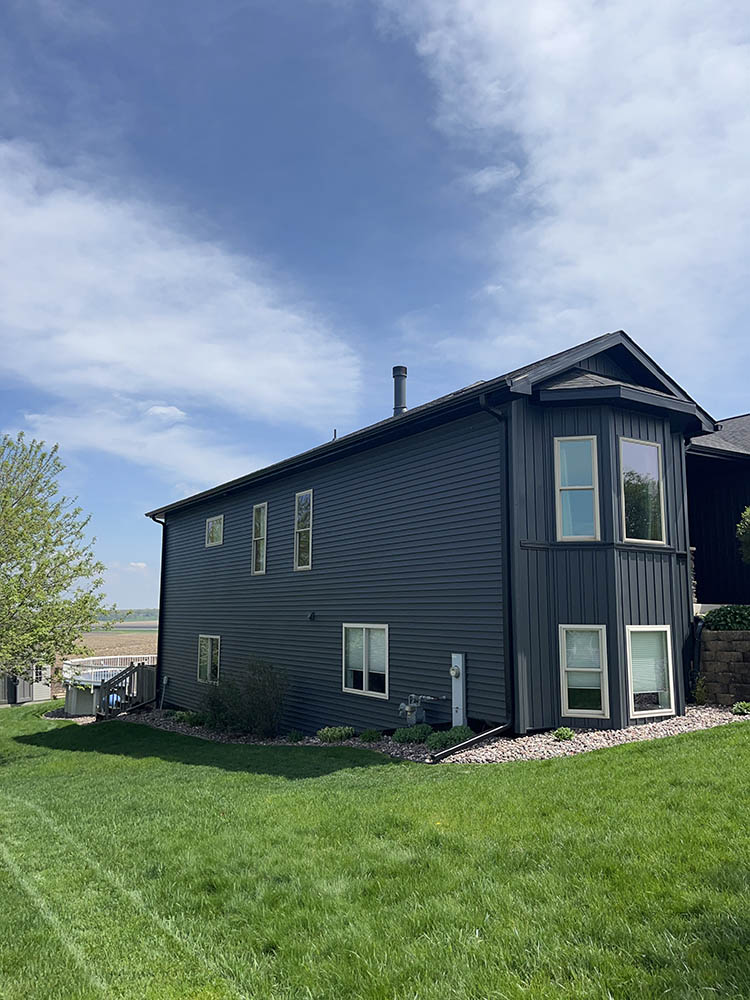
Steel takes hail as dents. The panel stays sealed and keeps doing its job, but you can see the bruise. On a wood-grain or heavily textured profile, small dents largely disappear. On a smooth flat-face panel they show, and raking sunlight makes them show more.
That is the tradeoff most articles skip. Steel is the better performer and the worse-looking loser. Vinyl either shrugs off a storm entirely or fails in a way that threatens the structure behind it.
Can a dent be pulled, or does the panel come off?
Usually the panel comes off. Siding steel is thin, formed and locked into the course below, so there is no practical way to pull a dent from behind. Shallow dimples in textured panels get left alone. Obvious dents in flat panels get replaced, working down from above, one panel or one course at a time.
Oil canning: the steel complaint nobody warns you about
If you research steel siding for more than an hour, you will run into oil canning, so let's deal with it honestly.
Oil canning is a faint waviness or "ripple" visible in the flat area of a metal panel, usually only in low-angle morning or evening light. It is not a manufacturing defect and it is not a failure. It is inherent to light-gauge formed metal: the steel has internal stresses from coiling and roll-forming, and any wide, flat, unbroken surface will show some of it.
You cannot eliminate it. You can minimize it:
- Pick a textured or narrower profile. Wood-grain embossing, ribs, striations and narrower panel faces break up the flat and hide waviness. Wide smooth flat-face panels are the worst offender.
- Install over a flat plane. Wavy old sheathing telegraphs straight through metal. Flattening the substrate, or adding a rigid foam layer, helps.
- Fasten correctly. Over-driving fasteners or pinning a panel so it cannot move with temperature creates the waviness rather than relieving it.
If perfectly flat walls matter to you, either choose a textured steel profile or stick with vinyl. Anyone selling you smooth flat-face steel without mentioning oil canning is not being straight with you.
Dark colors and Wisconsin sun
This one surprises people. Dark colors behave very differently in the two materials.
Dark vinyl absorbs heat, and heat is vinyl's enemy. Cheaper dark vinyl can warp, sag or wave on a south or west elevation. The bigger issue we see is reflected glare: modern low-E window glass can bow slightly and focus sunlight onto a neighboring wall or your own ell, and that concentrated heat will distort vinyl siding into a melted-looking ripple. Premium dark vinyl uses heat-reflective pigments and a more rigid substrate to resist it, but no vinyl is immune, and manufacturer warranties often exclude distortion from reflected or concentrated heat.
Dark steel does not distort from heat, period. What matters on steel is the finish chemistry. Standard siding finishes are silicone-modified polyester (SMP), which performs well. Premium PVDF finishes (Kynar 500 or Hylar 5000 are the familiar trade names) hold dark and vivid colors longer against UV fade. If you want a deep charcoal, black or barn red that still looks right in twenty years, steel with a PVDF finish is the most reliable path.
Not sure which direction fits your house? We will come out, look at the walls you cannot read from the ground, and price both options side by side. Free, no pressure. Call (608) 909-9109.
The metal worries: rust, noise, lightning
Will it rust or streak?
Not on the flat of the panel. Steel siding carries a metallic coating over the base steel, a baked-on finish on the face and a backer coat on the hidden side. Rust needs bare steel and water together, and those layers keep them apart.
The real exposure is anywhere the coating is broken: field-cut edges, deep scratches, ladder gouges. Good crews touch up cuts as they go and keep panels up off wet concrete and mulch. Watch the bottom course, where a string trimmer throws rock.
Is it loud? Does metal attract lightning?
No on both counts. A steel wall panel is fastened over sheathing and housewrap with insulation and drywall inside. That assembly is nothing like a bare barn roof over open rafters, and rain or ordinary hail on it is not noticeably louder inside than on vinyl.
Metal does not attract lightning either. Lightning takes the tallest, most direct path to ground, not your cladding.
Color matching and repainting years down the road
Steel is the more forgiving material long term. It can be repainted with a properly prepped acrylic or direct-to-metal coating, suppliers can usually mix color-matched touch-up, and trim coil can be custom bent to match even after a panel profile is discontinued.
Vinyl is the tougher one. It fades, so a brand-new replacement panel rarely matches a fifteen-year-old wall. It can be painted only with vinyl-safe paint, and going darker than the original color invites the heat distortion problem above and generally voids the warranty.
Either way, ask your contractor to leave you a few extra panels and a can of touch-up. Storing four panels in the garage rafters solves a problem that is genuinely annoying a decade later.
Real-world maintenance in this climate
Neither material needs paint. That is the point of both. But "maintenance-free" is marketing, so here is what actually comes up.
Mold, mildew and green algae on shaded walls
This is the most common siding complaint we hear in Wisconsin, and it has nothing to do with product quality. North and heavily shaded walls stay damp, and algae and mildew grow on any surface, including steel.
Vinyl's textured, wood-grain surface gives that growth more to hold onto, and deep grain patterns are harder to rinse clean. Steel's finish is generally smoother and sheds a soft wash more easily.
Cleaning either one: a garden hose, a soft-bristle brush and a mild detergent or an oxygenated cleaner, working bottom to top and rinsing top to bottom. Skip the pressure washer. On vinyl, high pressure drives water up behind the panels and into the wall. On steel, abrasive pads and harsh cleaners can damage the finish and start you down the rust path. Plan on a wash every couple of years on shaded elevations, either material.
Woodpeckers, wasps and mice
Woodpeckers drum on hollow cladding because it is loud, and vinyl (especially over a hollow cavity) is a favorite. They can punch through vinyl and into foam backing. Steel they will drum on and give up. Neither material is food for carpenter bees or termites, unlike wood trim.
Wasps and mice are an installation-detail problem, not a material problem. They get in at unsealed penetrations, gaps behind J-channel, open starter strips and unflashed utility boxes. The fix is the same either way: seal penetrations properly, use manufactured trim rather than field-improvised gaps, and keep mulch a few inches below the bottom of the siding so rodents do not have a ramp.
Energy efficiency: will either one lower your heating bill?
By itself, no. Bare vinyl and bare steel both add essentially zero R-value. Anyone who tells you a siding panel will cut your January gas bill is selling, not explaining.
What helps is the layer behind the panel:
- Insulated (foam-backed) vinyl. Contoured EPS laminated to the panel, typically adding a couple of R-value points plus real rigidity, which makes it quieter and harder to crack.
- Continuous rigid foam under steel or standard vinyl. Half-inch to one-inch foam board over the sheathing does the same job and breaks thermal bridging through every stud.
Key point: insulation is a separate decision from material. On a 1950s Verona or Mount Horeb house with little wall insulation, adding that continuous layer while the siding is off usually does more for winter comfort than the panel you choose. Ask for it as a priced option.
Installation and code: where siding jobs actually fail
Both materials move with temperature, and both fail if a crew nails them like plywood.
Vinyl expands and contracts a lot along its length. A 12-foot panel can move a quarter inch or more between a February morning and a July afternoon. Nail in the center of the slot, leave the fastener head about a dime's thickness off the nail hem so the panel can slide, and leave clearance at J-channels and corner posts. Nail it tight and it buckles into waves in summer and splits at the fastener holes in deep cold. Those long horizontal ripples you see on some houses are installation, not a defect.
Steel moves less but is unforgiving in different ways: cut edges need attention, fastening has to follow the tested pattern, and sloppy trim work telegraphs. Metal does not hide a crooked line.
Code matters here too. One- and two-family homes in Wisconsin fall under the state's Uniform Dwelling Code (Wis. Admin. Code SPS 320-325), which requires exterior wall coverings to be installed per the manufacturer's instructions and to resist the design wind loads for your site. On the IRC and ASCE 7 wind maps, most of southern Wisconsin sits at a 115 mph ultimate design wind speed (Vult) for a standard home, which is what fastener type, spacing and edge and corner detailing get designed to. Your local inspector is the final word, and we pull the permit and confirm it. Open west-facing walls on rural Rock and Green county acreage see the worst of that wind, and that is exactly where we find vinyl blown off houses that were nailed too loose or spaced too wide.
Neither material waterproofs your house on its own. Housewrap, window and door flashing, and kickout flashing where a roof edge meets a wall are what keep water out. If a bidder wants to hang new siding over questionable sheathing without looking behind it, get another bid. Our siding services page walks through what a proper wall assembly includes.
Want a straight answer on your roof?
We'll inspect it, document everything, and tell you honestly what you're looking at, even if the answer is patch it for now. No pressure.
Lifespan and warranties: read the paperwork
Quality vinyl installed correctly gives you decades of service, with fading and cracked panels being the practical end of its good looks. Steel with a solid baked finish generally outlasts it and holds color longer. We break down expected service life material by material in our guide to how long siding lasts.
Vinyl warranties are usually written as "lifetime limited." A common structure looks like this: full coverage against manufacturing defects for the original owner, often with full non-prorated coverage for the first 5-10 years, then a prorated schedule that declines each year, plus one transfer to a second owner capped at something like 10 years from the original install or 2 years after the sale. Fade coverage is usually a separate, shorter term. Look for those three numbers on the paperwork: non-prorated period, proration schedule, transfer terms.
Steel warranties focus on the finish instead, with separate terms for chalk and fade (often stated as a maximum allowable color change measured in Hunter units) and for film integrity like cracking, peeling and chipping.
Two things homeowners miss. First, neither warranty covers hail dents or wind damage. That is your homeowners policy. Second, the warranty that gets used most is the installer's labor warranty, because a material warranty is worthless if the panel was fastened wrong. Get labor coverage in writing, in the contract.
Permits, HOAs and historic districts
Do not skip this step, especially for a material or color change.
- Permits. Most municipalities here, Madison included, require a building permit for a siding replacement. A licensed contractor pulls it. If a bidder suggests skipping the permit, that tells you something.
- Subdivision covenants and HOAs. Many newer Sun Prairie, Verona, Waunakee and Janesville subdivisions require architectural committee approval for a color or material change. Get it in writing before material is ordered, because siding is a special order and restocking is expensive.
- Historic districts and landmarks. If your home is in a local historic district (Madison's Mansion Hill, Third Lake Ridge and Marquette Bungalows districts, Janesville's Courthouse Hill, older Beloit neighborhoods), exterior material changes generally require review by the local landmarks or historic preservation commission. Metal cladding is often the hardest sell in those districts. Find out before you shop colors.
What about fiber cement?
It belongs in the conversation. Fiber cement and engineered wood products sit between vinyl and steel on price, give you a genuine wood look, hold paint well and resist impact better than vinyl.
The tradeoffs: weight, cut dust that requires proper handling, and paint. Large hail can crack or chip fiber cement, and unlike steel it does not just dent. Factory-finished board is excellent, but field-painted or repainted fiber cement in our freeze-thaw cycles typically wants a repaint roughly every 10-15 years, plus periodic caulk maintenance at butt joints and trim.
If the lowest lifetime maintenance is your goal, steel and vinyl both beat it. If the look is what you want, fiber cement is a legitimate third bid.
Insurance and impact resistance
Some carriers view impact-resistant exterior materials favorably, in the same general way many credit Class 4 impact-rated roofing. Do not buy steel expecting a premium discount. Ask your agent in writing, for your carrier and your policy, before it factors into the decision.
What matters more is what happens after a storm. Siding damage gets missed on claims constantly because adjusters focus on the roof, and cracked vinyl on a shaded north wall is easy to walk past. We meet the adjuster on-site and document the walls along with the roof, because the deductible you are paying should cover everything the storm actually hit. If you already suspect wind or hail damage, start with our storm damage restoration process before you shop materials.
Resale: payback or over-improvement?
We are not going to hand you a payback percentage, because the honest answer depends on your block. What we can tell you is what we consistently see from appraisers and buyers in this market: they price condition and what they will not have to fix. No rot, no visible damage, clean trim lines, a material they recognize as maintenance-free. Appraisers generally credit condition and quality of installation more than brand or material, and steel does not automatically appraise higher than well-installed vinyl.
Can you over-improve? Yes. If every house on your street is mid-grade vinyl and you put premium steel on a modest home in a modest price band, you probably will not see that premium back at closing. Where steel earns its money is for the owner who is staying: you buy siding once, you stop thinking about hail, and the color holds for decades. Buy steel for yourself, not for a hypothetical buyer.
How the project actually runs
A single-family re-side in Dane, Rock or Green county typically takes several days to a couple of weeks depending on size, trim complexity and weather. Crews work elevation by elevation.
Siding is a tear-off job, not a layover. Old siding comes off so we can see and correct what is behind it: new housewrap, proper window and door flashing, and any needed sheathing repair.
Rotten sheathing does show up, especially under old siding with failed flashing. We do not want it to be a surprise either, so we walk the exposed wall with you, show you the bad area, and price the repair by the square foot before anybody swings a hammer. You approve it in writing. Cleanup runs daily, including a magnet pass for fasteners in the yard and drive. If you have kids or dogs, tell us at the estimate.
Stepping up to steel is real money, and most people do not write one check for a whole exterior. Financing options are available, and if a storm claim is involved, insurance proceeds plus your deductible often cover a large share.
So is the steel upgrade worth it?
Steel makes sense when:
- You are staying long-term and want to buy siding once.
- Your walls have high storm exposure: open west and south elevations, no tree cover, rural acreage.
- You want the lowest long-term maintenance and the best dark-color retention.
- You want non-combustible cladding, or a clean modern profile vinyl cannot copy.
Vinyl remains the sensible choice when:
- Budget is the binding constraint and you want the most wall covered for the money.
- You may sell within a few years, or premium steel would over-improve your block.
- You want a specific color, a shake or scallop accent, or the widest style selection.
- Perfectly flat walls matter to you and oil canning would nag at you.
- Your walls are sheltered by mature trees or neighboring homes.
For a lot of houses around here, good vinyl installed right is the correct answer. If you are leaning metal, our aluminum and steel siding page covers the gauges, profiles and finishes we install.
Why trust our read on it
Fair question to ask any contractor. Buckshot Exteriors is family owned and has been working in this area since 1979. We hold Wisconsin DSPS Dwelling Contractor Certification and Dwelling Contractor Qualifier credentials, we carry general liability and workers compensation coverage, and we will show you the certificates. On the roofing side we hold manufacturer certification as a GAF Master Elite contractor, a credential you earn and keep rather than buy.
You can read what local homeowners have written about us on our customer reviews page, and we are glad to give you addresses of finished work in your area so you can drive by before you sign anything.

The easiest next step
You do not have to decide from a blog post. You need someone to measure your house, look at what is behind the existing siding, and price steel and vinyl against each other on your actual walls with your actual trim.
That is a free on-site estimate, and it costs you nothing to find out. No pitch, no pressure. If your current siding has good years left in it, we will tell you that too, and we have told plenty of people exactly that.
Call Buckshot Exteriors at (608) 909-9109, or reach out here and we will set a time that works.
Get a straight answer on your Madison roof
Wisconsin storm season and insurance non-renewal letters do not wait. Get a free, no-obligation inspection and an honest assessment of exactly what your roof needs, even if the answer is to wait.