
Installed, most Madison-area board-and-batten projects run $7-$18 per square foot of wall area, with the middle of the market at $10-$15. Vinyl is roughly $7-$11, engineered wood like LP SmartSide about $10-$15, and fiber cement like James Hardie about $13-$18. A typical 2,000 sq ft two-story here has roughly 2,000-2,400 sq ft of actual wall (gables included), so a full wrap usually lands between $22,000 and $36,000, and can reach the low $40,000s in fiber cement with a heavy trim package. Accent-only projects generally run $3,000-$9,000.
Get My Free Estimate →- Board and batten siding cost per square foot in the Madison area
- What board and batten actually is
- Why board and batten costs more to install than lap siding
- Material by material: what holds up in Wisconsin
- Choosing color and style before you commit
- Accent vs. whole house: where the smart money goes
- What is under the old siding, and what abatement really costs
- How this handles Wisconsin freeze-thaw
- Who is on your house, and what happens to your yard
- Timeline, lead times, and winter installs
- What your estimate must itemize (how to compare three bids)
- Payment, deposits, and financing
- Storm damage, insurance, and spotting a storm chaser
- Curb appeal and resale in the Dane County market
- Get a real number for your house
- FAQs
Straight answer: in Madison and Dane County, installed board and batten siding cost runs $7-$18 per square foot of wall area, and most projects land in the middle at $10-$15. Vinyl sits at the bottom, engineered wood like LP SmartSide in the middle, and fiber cement like James Hardie at the top.
Those are real ranges, not teaser pricing. Below is where the money goes, how long each material actually lasts here (not just what the warranty says), and the stuff most cost articles skip: lead times, cleanup, who is standing on your ladder, and what is hiding under the siding on an older Madison house.
Board and batten siding cost per square foot in the Madison area
Here is the per-square-foot math, installed, including tear-off, housewrap, trim and labor.
| Material | Installed cost per sq ft |
|---|---|
| Vinyl vertical panel | $7-$11 |
| Engineered wood (LP SmartSide) | $10-$15 |
| Fiber cement (James Hardie) | $13-$18 |
| Real cedar or pine | $12-$20+ |
What pushes a job to the top or bottom of each band: stories (staging a two-story gable costs real money), corner count (a house with eight corners eats trim and labor; a simple box does not), gable access and roof pitch, batten spacing, how much trim you wrap (window and door surrounds, frieze board, corner boards), how many layers come off, and how much sheathing repair we find. A simple one-story ranch in Vinyl lands near $7. A cut-up two-story with dormers and full trim wraps lands near $11. Same product, different house.
Now the whole-house number, because square footage confuses people. A 2,000 square foot two-story in Fitchburg or Sun Prairie usually has roughly 2,000-2,400 square feet of actual wall area once you count gables and subtract windows and doors.
- At $10-$15/sq ft (engineered wood): roughly $22,000-$36,000
- Fiber cement with heavy trim and multiple gables: into the low $40,000s
- Vinyl on a simple box: sometimes under $20,000
Accent work (front gables, a porch wall, dormers, a two-story entry) usually runs 15-25 percent of a full wrap, so about $3,000-$9,000.
What board and batten actually is
Board and batten is vertical siding: wide flat boards or panels running up and down the wall, with narrow strips (the battens) covering the seams. It started as rough-sawn barn siding. Today it is the signature look of modern farmhouse, usually white or deep charcoal with black windows.
The look lives or dies on two details:
- Batten spacing. Most homeowners want battens every 12 or 16 inches. Wider spacing (20-24 inches) reads more barn-like and costs less in labor. Tighter spacing reads more refined and costs more.
- Batten depth. A batten standing proud of the wall a full inch throws a real shadow. A shallow batten molded into a vinyl panel throws almost none. From the curb, that shadow line is the entire effect.
That is why two board-and-batten houses at the same square footage can look completely different.
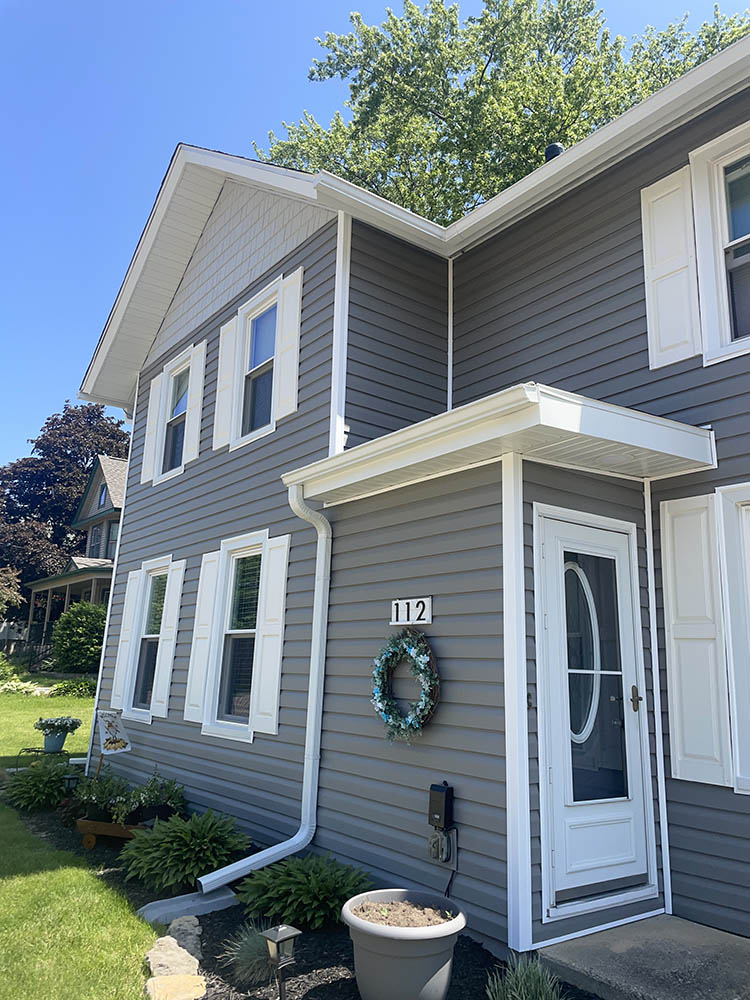
Why board and batten costs more to install than lap siding
Because you install the wall twice. Panels go up first, then every batten gets laid out, snapped to a chalk line, plumbed and fastened individually.
At 16-inch spacing you are adding dozens of extra pieces per elevation. Every one has to be dead plumb, because a batten that drifts a half inch over a two-story run is visible from the street. Add more cuts around windows, more butt joints to flash, more caulk lines.
Practical effect: the same wall in board-and-batten typically costs 20-40 percent more in labor than lap siding in the same material. Material cost is similar. Labor is what moves.
Two cost drivers specific to older homes in Madison, Monona, Middleton and Stoughton:
- Furring or a nail base. Older sheathing sometimes needs horizontal furring added so vertical panels have something solid to hit.
- Substrate surprises. Once the old siding is off we sometimes find rotted sheathing, no housewrap at all, or 1970s foam board with no drainage plane. That gets fixed before new siding goes on, and it shows up as a line item, not a surprise invoice.
Material by material: what holds up in Wisconsin
Expected service life, honestly
Warranty length is not lifespan. This is the table that answers "is the fiber cement premium worth it over 30 years."
| Material | Realistic life in WI | Maintenance cycle | Later cost |
|---|---|---|---|
| Vinyl | 20-35 years | Wash annually | Fading and brittleness are the end; not really repaintable |
| Engineered wood (LP SmartSide) | 30-40+ years | Repaint every 10-15 years | Full exterior repaint often $5,000-$12,000 |
| Fiber cement (James Hardie) | 40-50+ years | Refresh or repaint around year 15-20 | Same repaint cost, but far less often |
| Cedar / pine | 20-40 years | Restain every 5-8 years | Two to four times the repaint cycles |
Engineered wood (LP SmartSide): the value pick for most homes
Roughly $10-$15/sq ft installed. Treated wood-strand product, factory primed or pre-finished. This is what goes on most of our board-and-batten projects in south-central Wisconsin.
- True panel plus separate batten trim, so you get a deep, crisp shadow line.
- Far more impact tolerant than vinyl or fiber cement. Hail and line drives dent it instead of cracking it.
- Cuts and fastens like wood, so crews move faster, which offsets some of the batten labor.
- Lighter than fiber cement, which matters on two-story gables.
The catch: it is wood based. Cut ends must be sealed and it needs repainting eventually. Bottom edges sitting in snow fail early, which is a detailing problem, not a product problem.
Fiber cement (James Hardie): the premium, longest-lived option
Roughly $13-$18/sq ft installed. Cement, sand and cellulose. Will not rot, will not burn, will not feed insects, and factory finishes hold color a very long time. On a wall with brutal west sun, it is the most stable finish you can buy.
Wisconsin honesty:
- It is heavy and brittle to handle, so installation quality matters enormously. Nails driven too deep, missed clearances or unflashed joints will fail in freeze-thaw.
- It absorbs a little moisture, so clearances are not optional. Off the roof, off the ground, off the deck surface. Cheap installers ignore that and you get spalling along the bottom edge within five winters.
- Cutting it is slow, dusty work. That is part of the higher installed number.
Vinyl board and batten: the budget option with real tradeoffs
Roughly $7-$11/sq ft installed. Modern vertical vinyl is much better than the 1990s product. For a garage, a rental or a small accent, it is defensible.
- The batten is molded in, so the shadow line is shallow.
- Deep colors are limited and can fade unevenly on south and west walls.
- Vinyl gets brittle below zero. A shovel handle or January hail cracks it instead of denting it.
- Repairs mean matching a color that may be discontinued in five years.
Real wood (cedar, pine): beautiful, high maintenance
Roughly $12-$20+/sq ft installed. Nothing looks like stained cedar, and on a lake place or a rural property going for authentic barn character it is the right call. But Wisconsin humidity swings move real wood. Battens cup and fasteners work loose.
What about aluminum?
You still see vertical aluminum panels on mid-century Madison homes. It does not rot, but it dents from hail and the finish chalks with age. Most homeowners replacing aluminum move to engineered wood or fiber cement.
If you want to see how these materials look on real Wisconsin houses before you commit, our siding page covers the full lineup we install, and there are finished local jobs in our recent projects. Homeowner feedback on our siding work is on Google, Birdeye, Angi and HomeAdvisor if you want to read what neighbors say before you call.
Pests, woodpeckers, and mold behind the old siding
Two Wisconsin-specific worries worth naming.
Pests and woodpeckers. Fiber cement will not feed insects and woodpeckers do not drill it. Engineered wood is treated with a zinc borate that resists termites and fungal decay, and we rarely see woodpecker damage on it unless there is already a cavity or a wasp nest behind the wall attracting them. Cedar is the vulnerable one. Whatever the material, the real fix is sealing gaps at soffits, gable vents, utility penetrations and the bottom starter so nothing has a way in.
Mold and wet sheathing. On tear-offs we regularly find dark, damp OSB under bathroom and kitchen walls, under second-story window corners, and anywhere a roof meets a wall without kick-out flashing. If it is surface mold on sound sheathing, it gets treated and dried. If it is soft, it gets cut out and replaced. Either way we photograph it, show you, and price it before we cover it back up. Nobody should be sealing wet sheathing behind new siding.
Not sure which material fits your house or your budget? We will measure the actual elevations and hand you side-by-side numbers for vinyl, engineered wood and fiber cement. Free, no pressure, no obligation. Call Buckshot Exteriors and ask for a siding estimate.
Choosing color and style before you commit
This is a look-driven product, so we do not ask you to pick from a two-inch chip. You get physical samples of the actual panel and batten profile to hold against your roof and stone. We can put a rendering of your own photographed elevation in front of you so you can see white versus greige versus charcoal on your house, not a stock house.
On larger projects we can also mock up a section on the wall, a few feet of panel and battens in the real color, and leave it for a couple days so you see it at 7 a.m. and at sunset. Colors read completely differently under Wisconsin overcast than they do in a showroom. Deep charcoal and black on a full south or west exposure get hot, so ask about factory finishes rated for dark colors.
Accent vs. whole house: where the smart money goes
Most Wisconsin homeowners who want this look do it as an accent, and it is usually the better financial call.
- Board-and-batten on the front gables only, lap on the field walls.
- Board-and-batten on a two-story entry bump-out or porch wall.
- Board-and-batten on dormers and the garage front.
- Full board-and-batten on the front elevation, lap on the sides and back.
One critical detail: the transition between vertical and horizontal siding needs a properly flashed trim band, usually a horizontal trim board with metal Z-flashing behind it. Caulk alone at that joint leaks within three to five Wisconsin winters. It is the most common defect we find on other contractors' board-and-batten accents.
What is under the old siding, and what abatement really costs
Vertical siding is the worst candidate for a layover. Panels need a flat, plumb nail base and old lap siding is neither.
On pre-1978 homes, especially on the isthmus and the near east side, tear-off has two cost implications:
- Asbestos-cement siding. Common from the 1940s into the early 1960s. It gets sampled and lab tested first. If it is positive, removal and disposal are performed by a licensed Wisconsin asbestos abatement contractor and passed through to you at their cost, with their written scope attached to our estimate. On a typical Madison house that has landed anywhere from about $3,000 to $8,000, but square footage, condition and lab results drive it, so we do not guess at it in the contract.
- Lead paint. Any home built before 1978 falls under the EPA Renovation, Repair and Painting rule. Certified containment and cleanup add labor and disposal cost.
Neither is a reason to walk away from the project. It is a reason to get it into the estimate up front instead of finding out on day three.
How this handles Wisconsin freeze-thaw
Vertical siding sheds water well by nature. Water runs straight down instead of sitting on laps, and sheet ice slides off. The failure points are all horizontal.
- Window and door heads. Head flashing, not caulk.
- Roof-to-wall intersections. Kick-out flashing so water goes into the gutter instead of behind the siding. Missing kick-outs are the single most common cause of wall rot we find on tear-offs in this area.
- The bottom course. Several inches off grade, above typical snow line, with a starter and a drainage path. Siding buried in a drift for three months is wet for three months.
- Behind the siding. Weather-resistive barrier, taped seams, ideally a rainscreen gap so water has a drying path.
While the walls are open, an inch of rigid exterior foam adds roughly R-5 to R-6 and breaks thermal bridging through the studs. New taped housewrap and proper window flashing is the piece that actually cuts drafts.
Want a straight answer on your roof?
We'll inspect it, document everything, and tell you honestly what you're looking at, even if the answer is patch it for now. No pressure.
Who is on your house, and what happens to your yard
Our siding work is run by our own crews, not sold and handed off to whoever bid lowest that week. There is a crew lead on site every day and one project manager who is your single point of contact from estimate to final walkthrough. You get that name and cell number before day one, and you get a daily heads-up on what is happening tomorrow. If a licensed specialty trade is needed (abatement, an electrician), we tell you who and why in advance.
Protection and cleanup, specifically:
- Shrubs and beds get tarped, the A/C condenser gets covered so cutting debris does not pack the coil, and glass gets protected before tear-off starts.
- The dumpster goes on the driveway on plywood so it does not mark or crack the concrete, or on the street with a permit if the drive will not take it.
- Every working day ends with a magnetic nail sweep over the drive, walkways and lawn, and a hand pick of trim scraps and housewrap.
- All debris leaves in our dumpster. We haul it. Nothing sits in your yard over the weekend.
You do not need to be home. Tear-off is loud and fiber cement cutting is dusty, so plan around dogs, naps and anyone working from home on that side of the house.
Timeline, lead times, and winter installs
A crew of three to five is typical. Full-wrap board-and-batten on an average two-story runs about 5-10 working days. An accent gable or porch wall is usually 2-4 days. Add time for asbestos or lead work, sheathing repair, or historic review.
Lead times matter more than people expect. Standard vinyl and primed engineered wood are usually in stock or a week or two out. James Hardie ColorPlus and specialty or dark factory colors commonly run several weeks from order, and custom-bent trim metal adds time on top. In peak season (May through September) our schedule is often booked several weeks out. If you want the job done by Labor Day, get measured and pick your color in early spring. That single decision is what slips summer projects.
Your house is never left open. We tear off and dry in one elevation at a time, and the wall is wrapped before the crew leaves. Rain, high wind and hard cold add days, and we would rather tell you that than rush a flashing detail.
Winter: engineered wood and fiber cement install fine in the cold. Vinyl turns brittle below roughly 40 degrees and needs larger expansion allowances. Sealants have minimum application temperatures and field painting waits for spring. Off-season scheduling is often faster to book.
What your estimate must itemize (how to compare three bids)
Most siding bids are one page and one number, which makes them impossible to compare. Ask every bidder for these lines. If two estimates differ by $6,000, the answer is almost always hiding here.
- The weather-resistive barrier by brand and product, plus seam tape. "Housewrap" is not a spec.
- Flashing details called out individually: window and door head flashing, kick-out flashing at roof-to-wall, Z-flashing at any vertical-to-horizontal transition.
- Batten dimension and spacing in inches, and whether the batten is a separate trim piece or molded into the panel.
- The trim package: corner boards, window and door wraps, frieze, soffit and fascia, and whether it is included or extra.
- Sheathing repair: an allowance plus a unit price per sheet, so a bad wall does not become a blank check.
- Tear-off and disposal, dumpster included, plus lead or asbestos handling if applicable.
- Permit pulled by whom.
- Workmanship warranty term in years, in the contract, not "we stand behind our work."
- Payment schedule and what triggers each payment.
- Wisconsin dwelling contractor certification number and a certificate of insurance sent directly from their agent.
Payment, deposits, and financing
We do not ask you to pay for the job up front. Materials get ordered and payments follow the work on a milestone schedule you see in writing before you sign.
If you would rather spread the cost, we can set you up with third-party financing. Most of those lenders start with a soft-pull prequalification, which shows your rate and term without touching your credit score; a hard pull only happens if you decide to move forward. Rate, term, monthly payment and any fees are disclosed in writing, not verbally. Nobody here is compensated for talking you into a loan, and plenty of our customers just write checks on the milestone schedule. Either is fine with us.
Storm damage, insurance, and spotting a storm chaser
If your existing siding took hail or wind damage, insurance pays to restore it to like kind and quality. It will not fund a style upgrade on its own, but it does cover tear-off, wrap and labor for the damaged portion, which makes it the cheapest possible moment to upgrade materials and pay the difference.
Your deductible is your responsibility. Wisconsin does not permit a contractor to absorb or rebate it. Anyone offering to "eat the deductible" is proposing insurance fraud with your name on the claim.
We are among the siding contractors that work with insurance and we meet your adjuster on-site to document every damaged elevation. Adjusters miss west-wall hail bruising and wind-lifted panels constantly. Being there with them changes the number.
Curb appeal and resale in the Dane County market
Board-and-batten photographs extremely well, and in neighborhoods full of similar 1990s builds, a board-and-batten front elevation with black windows makes a house stand out from the curb. On resale return, do not take a contractor's word for a percentage. Look up the current Remodeling Cost vs. Value Report figures for the East North Central region, which covers Wisconsin, and use those.
Colors that do well here: bright white with black trim, greige, deep charcoal and dark green.
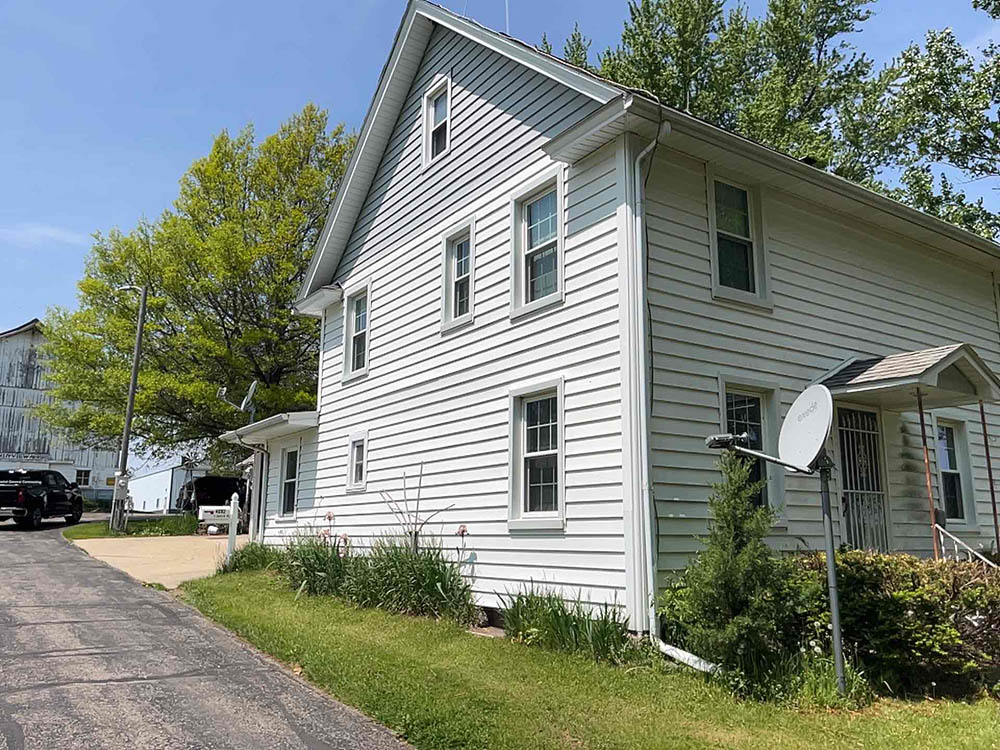
Get a real number for your house
Ranges are useful for budgeting. Your house needs a measurement, because corners, gables and stories set the price, not square footage.
Buckshot Exteriors has been family owned and running exterior work since 1979, out of Madison, WI and Centerville, IA. Ask us for our Wisconsin dwelling contractor certification number, our certificate of insurance and addresses of Dane County siding jobs you can drive past. We will hand all three over before you sign anything. That is the kind of proof worth checking on any contractor.
When you call, we come out, walk the house with you, talk honestly about what is likely behind the current siding, and give you written options for vinyl, engineered wood and fiber cement so you can see exactly what each choice costs to install and to own. If the right answer is "your siding has ten good years left, wait," we will say that.
The inspection and estimate are free, there is no obligation, and nobody will lean on you to sign. Call us or request your free siding estimate, and we will show you what board-and-batten would look like on your house and what it would actually cost.
Get a straight answer on your Madison roof
Wisconsin storm season and insurance non-renewal letters do not wait. Get a free, no-obligation inspection and an honest assessment of exactly what your roof needs, even if the answer is to wait.