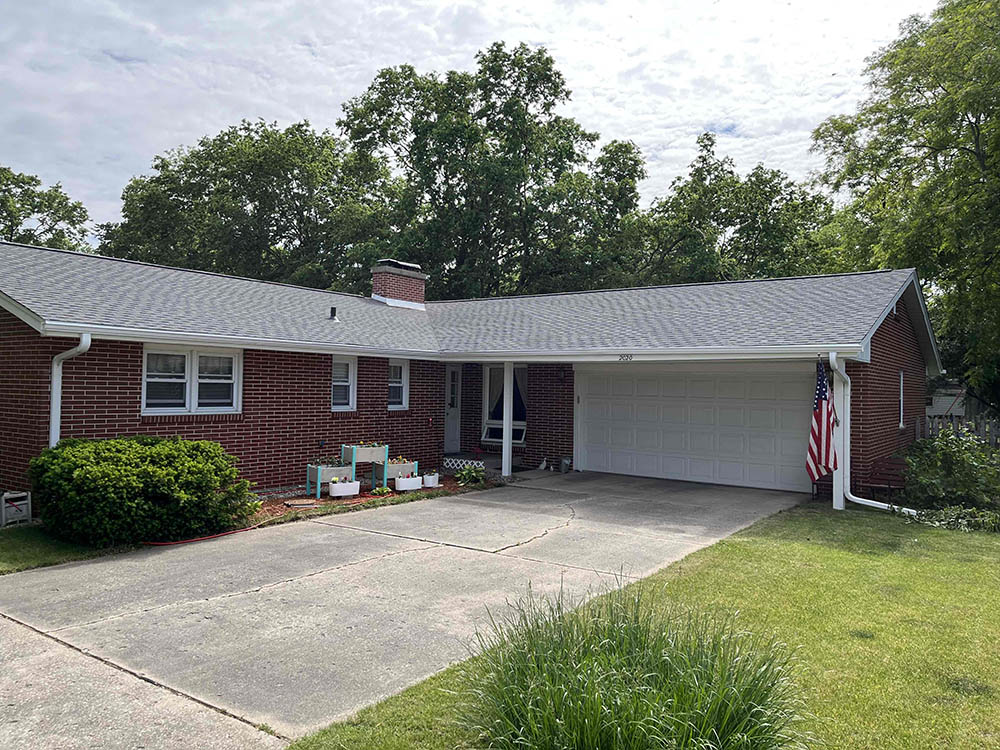
Someone should be reachable by phone to approve the written quote we text you, but you do not have to stand in the yard. We can tarp with nobody home if you have approved the scope and price. We do not need to be inside for the tarp itself. Attic access helps us trace where the water is actually entering, and interior photos matter for your claim, so if you are there, we will take five minutes to look.
Get My Free Estimate →- What to Do in the First Hour (Before Anyone Climbs Anything)
- What Emergency Roof Tarping Actually Is
- What It Costs, the After-Hours Question, and How Fast We Can Be There
- Who Pays for the Tarp, What If It Comes In Under Your Deductible, and What If It Is Denied
- Why Your Policy Expects You to Tarp
- The Free Tarp That Costs You the Whole Claim, and What Wisconsin Law Says
- What Happens After the Tarp, and How Long It Takes
- Call Us. It Costs Nothing to Find Out.
- FAQs
If water is coming into your house right now, here is the short version: stay off the roof, contain the water inside, photograph everything before anyone touches it, and call for an emergency tarp. A tarp is not a repair. It is a dam that buys you weeks so the insurance claim and the real repair can happen without your ceilings coming down.
Buckshot Exteriors has been family-owned since 1979, with offices in Madison, WI and Centerville, IA, and we run 24-hour emergency storm response across Dane County: Madison, Sun Prairie, Middleton, Verona, Fitchburg, Waunakee, Stoughton and Oregon.
If you need someone out tonight, call. If you just need to know what to do in the next hour, keep reading.
What to Do in the First Hour (Before Anyone Climbs Anything)
Protect people, then belongings, then document. In that order.
1. Get everyone away from the wet area. Water in a ceiling finds light fixtures and outlets. If a ceiling is bulging or sagging, treat it as a load about to let go and clear the room. If water is near a panel or an outlet, kill that circuit at the breaker.
2. Do not go on the roof. We have carried a homeowner's ladder back down twice already this season, and both times the guy was one rung from a slope with soft decking under it. A roof that just took 70 mph gusts or golf-ball hail has spongy sheathing, slick granules and torn flashing you cannot see from a ladder.
3. Move what you can. Furniture, rugs, electronics, boxes in the attic or the upstairs closet. Anything not wet yet is something you do not have to replace.
4. Contain and route the water. Buckets and totes under the active drips. If drywall is holding a bulge of water, relieving it with a small poked hole over a bucket is more controlled than letting the whole panel drop. Two rules, because people skim straight to this step: kill the breaker for that room first, and never poke near a ceiling fan, recessed can or fixture box. There is a junction box up there.
5. Photograph and video everything, before any repair. Wide shots of the room, close-ups of stains and active dripping, wet insulation, ruined belongings, plus anything visible from the ground outside. Once a tarp goes on or a ceiling gets cut out, your adjuster is looking at your photos, not the damage.
6. Call your insurer and open the claim. You do not need to know the extent of the damage. You need a claim number and a date of loss.
7. Call a local roofer for the tarp, and keep the invoice.
Not sure whether your leak is a tonight emergency or a tomorrow-morning problem? Call and describe what you are seeing. We will tell you straight, no charge either way.
What Emergency Roof Tarping Actually Is
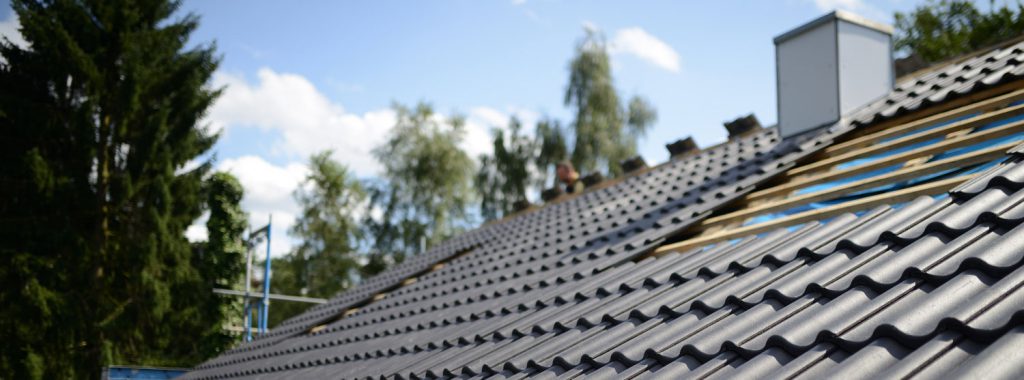
Emergency tarping is a temporary waterproof membrane mechanically fastened over the damaged roof section so water sheds off the house instead of into it. Done right, it holds for weeks to a few months. Done wrong, it holds until the next gust.
A professional tarp job
- Heavy reinforced poly, not a hardware-store picnic tarp, lapped well past the damage and over the ridge when the situation calls for it.
- Edges wrapped around furring strips (1x3 or 1x4) and screwed through the tarp into solid decking. Sandwiching the tarp between wood and deck is what keeps Wisconsin wind from getting a lip underneath and peeling it.
- Every fastener penetration sealed with roof cement or butyl so the tarp does not become the new leak.
- Water deliberately routed off the eave or into a gutter, not dumped into a valley, against a wall, or onto a lower roof.
- Vents, chimneys and skylights worked around, not blindly covered.
A DIY blue tarp
- Draped over the ridge, corners weighted with bricks or old tires.
- No fasteners, so wind lifts it and rain drives sideways underneath.
- Water ponding in the sags (a hundred pounds of water pulls the whole thing loose).
- Usually installed by someone standing exactly where the decking is compromised.
What a tarp will not do
It will not make your roof watertight in a 60 mph crossflow. Wind can still find an edge, and driving rain at a bad angle can work a seam. If a tarp we installed starts leaking, call us and we come back and re-secure it at no charge, because we build them to be re-tightened. If a tree is through the roof, the opening needs a structural cover, not fabric. Blown-out windows need board-up. Saturated insulation should come out and standing water needs extraction before mold gets going, which brings up the clock nobody mentions: on wet drywall paper and fiberglass in a warm house, mold can start colonizing in roughly 24 to 48 hours. Most policies treat remediation as part of a covered sudden water loss, but many carry a mold sublimit ($5,000 or $10,000 caps are common) and can exclude it if they decide you sat on it. Another reason the tarp date matters.
What It Costs, the After-Hours Question, and How Fast We Can Be There
Emergency tarping is priced on square footage covered, roof pitch, story height, access, and whether we have to cross the ridge. There is a trip minimum in the low hundreds even if the work takes 30 minutes, and overnight, Sunday and holiday call-outs carry an after-hours premium. You get the number in writing, texted to your phone, before a ladder comes off the truck. If you say no, we pack up and you owe nothing.
On speed: inside Madison and the near suburbs, a normal night is usually a one to three hour arrival. After a countywide storm, we work the list by severity, open decking with active interior water first, and we will give you a real window instead of a fake one. We do not climb during active lightning or high wind; if that is what is happening, we will coach you through containing water inside until it passes.
Who Pays for the Tarp, What If It Comes In Under Your Deductible, and What If It Is Denied
We invoice you, the homeowner, for emergency mitigation, and we write that invoice with photos attached so it drops straight into your claim file. When the loss is covered, tarping is normally paid as part of the claim and typically applies against your deductible rather than sitting outside it. Confirm that with your adjuster, because some Wisconsin policies carry a percentage-of-dwelling wind or hail deductible instead of a flat amount (1% on a $400,000 dwelling is $4,000, which surprises people).
Now the outcome nobody warns homeowners about: the estimate can land under your deductible. A marginal 50 mph wind event lifts a dozen shingles, the repair scope comes in at $1,800, your deductible is $2,500, and the carrier owes zero. It happens often after borderline storms. You still owe the mitigation invoice in that case, and it is fair to ask whether filing at all was worth it, because a closed no-pay claim still shows up on your loss history. This is why we tell you what we are seeing before the adjuster ever shows up. If we think the damage is a repair that will not clear your deductible, we say so and quote you the repair directly.
If the carrier denies the loss outright, the mitigation cost stays with you, and we will talk payment arrangements or financing rather than leave you under a tarp all winter. For scale on the bigger decision: asphalt shingle roof replacement on a typical Madison two-story of roughly 22 to 28 squares of architectural shingle commonly lands somewhere around $12,000 to $22,000 depending on pitch, tear-off layers, decking condition, ventilation work and shingle grade. That is a range, not a quote. Nobody can price your roof from a phone call.

Why Your Policy Expects You to Tarp
Your policy obligates you to prevent further damage after a covered loss. That is the duty-to-mitigate language. If your roof opens up and you do nothing through three weeks of rain, an adjuster can reasonably argue the ruined hardwood and the mold were avoidable. Tarping is not spending money your insurer resents. It is doing what the contract requires.
Practical points for a Wisconsin claim:
- Report promptly and keep every receipt. Tarping, board-up, extraction, fans, even totes and towels.
- Know whether you have ACV or RCV. Actual Cash Value pays depreciated value only. Replacement Cost Value releases the held-back depreciation once the work is completed and invoiced. Check your declarations page under Coverage A rather than assuming.
- Watch the deadlines. Wisconsin gives some grace on late notice (Wis. Stat. 631.81), but your policy still sets a proof-of-loss window (often 60 days after the carrier requests it) and a suit-limitation clause capping how long you have to take action after the date of loss. Waiting hurts you twice: it burns the clock and it lets the carrier argue your damage came from some other storm.
- The tarp does not replace the inspection. Hail and wind damage usually runs past the leak, to slopes that are not dripping yet, plus gutters, fascia, window screens and siding, which are the line items most commonly missed.
When your adjuster comes out, we are on the roof with them. That single habit catches more missed damage than anything else we do, because we are pointing at bruised shingles, lifted nails and torn seals while the estimate is being written, not arguing three weeks later. More on how we handle hail and storm damage restoration in Dane County.
If the scope gets lowballed
Request a re-inspection. Have your contractor submit a supplement with photos, measurements and code citations for anything omitted (ice-and-water shield at the eaves, drip edge, ventilation). Ask for a second adjuster or engineer review. Your policy may include an appraisal clause. You can also file a complaint with the Wisconsin Office of the Commissioner of Insurance. Most disputes we see resolve at the supplement stage, with documentation, not drama.
Two real Madison tarp calls
After the June 15, 2022 wind event that ran across southern Wisconsin, we tarped a two-story off Old Sauk Road on the west side the same evening: two sections of shingles peeled to the deck on the west slope, ridge vent gone, water into an upstairs closet. The carrier's first estimate covered one slope. A supplement with slope-by-slope photos and measurements got the full replacement approved on RCV, plus a gutter run and the interior drywall.
Different flavor of emergency: a duplex near Schenk-Atwood in January 2024, ice damming behind a plugged gutter, water running down the interior of an exterior wall. That one needed steam and ice removal, temporary flashing at the eave, and insulation pulled before mold set in. Fix there was ventilation and ice-and-water shield at replacement, not just a tarp. More of our work is on our recent projects page.
Want a straight answer on your roof?
We'll inspect it, document everything, and tell you honestly what you're looking at, even if the answer is patch it for now. No pressure.
The Free Tarp That Costs You the Whole Claim, and What Wisconsin Law Says
After a big Dane County hail run, out-of-state crews are knocking doors inside 48 hours. Some are fine. Some run a specific play: free emergency tarp, then a clipboard.
Know the two documents. A contingency agreement says you will hire that contractor if the claim is approved. Those are common and legitimate here, though read the cancellation terms. An assignment of benefits hands your insurance proceeds and your right to negotiate to the contractor. Do not sign one at your kitchen table in a rainstorm.
Wisconsin gives you real, enforceable guardrails. Use them:
- The deductible pitch is illegal. Under Wis. Stat. 100.65, a residential contractor cannot advertise or offer to pay, waive, absorb or rebate all or part of your insurance deductible. "We'll eat your deductible" is both a crime and insurance fraud you would be a party to. The same statute requires written notice of your right to cancel the contract within a set window if your insurer denies the claim in whole or in part.
- Ask for the Dwelling Contractor credential. Wisconsin requires a Dwelling Contractor certification for the business and a Dwelling Contractor Qualifier credential held by a person at that company. Ask for the numbers and look them up on the DSPS license lookup.
- A Madison reroof needs a City of Madison building permit, pulled by the contractor. A crew that says a permit is not necessary is telling you they cannot pull one.
- Ask for a local physical address and how long they have worked in Wisconsin, then confirm it is a building and not a mailbox.
- Ask who does the labor: employees, or a crew subbed out last week. Nobody credible needs a signature in the first ten minutes.
What Happens After the Tarp, and How Long It Takes
- Full inspection. Every slope: hail bruising, creased shingles, granule loss, vents, pipe boots, gutters, fascia, siding, screens. Photos and measurements.
- Adjuster meeting. We walk it with them and reconcile line items.
- Repair or replace. Isolated wind damage on a newer roof is often a legitimate repair. Widespread bruising, multiple slopes, or a roof past 18-20 years usually means replacement, with tear-off, ice-and-water shield at the eaves, drip edge and real ventilation.
- Permanent work. Architectural shingles are the default in this market. Class-4 impact-rated shingles are worth pricing if you are hail-weary.
- Interior repairs, then tarp removal.
Honest timeline: tarp same day or next day, inspection within a few days, adjuster anywhere from three days to two-plus weeks after a large storm, approval a few days to a few weeks, then material and crew scheduling. Most Madison storm jobs run roughly 4 to 10 weeks from tarp to finished roof, longer when the tarp goes on in December and shingles wait for spring. The tarp is what makes waiting your turn safe instead of expensive.

Call Us. It Costs Nothing to Find Out.
If your roof is open right now, call and we will get you in the emergency queue with a real arrival window and a written price before we climb. If the drip has stopped and you are just wondering whether the storm hurt your roof, call for a free, no-pressure inspection. We will walk it, take photos, and tell you honestly whether you have a claim, a repair, or nothing to worry about yet, including if the damage looks like it will land under your deductible. No pitch, no signature at the table, no cost to find out.
Buckshot Exteriors, family-owned since 1979, Madison, WI and Centerville, IA. We will be here next winter and the one after, which is the whole point of hiring local. Reach us any time through our contact page or by phone, 24 hours a day for storm emergencies.
Get the water out of your house first. We will handle the rest.
Get a straight answer on your Madison roof
Wisconsin storm season and insurance non-renewal letters do not wait. Get a free, no-obligation inspection and an honest assessment of exactly what your roof needs, even if the answer is to wait.