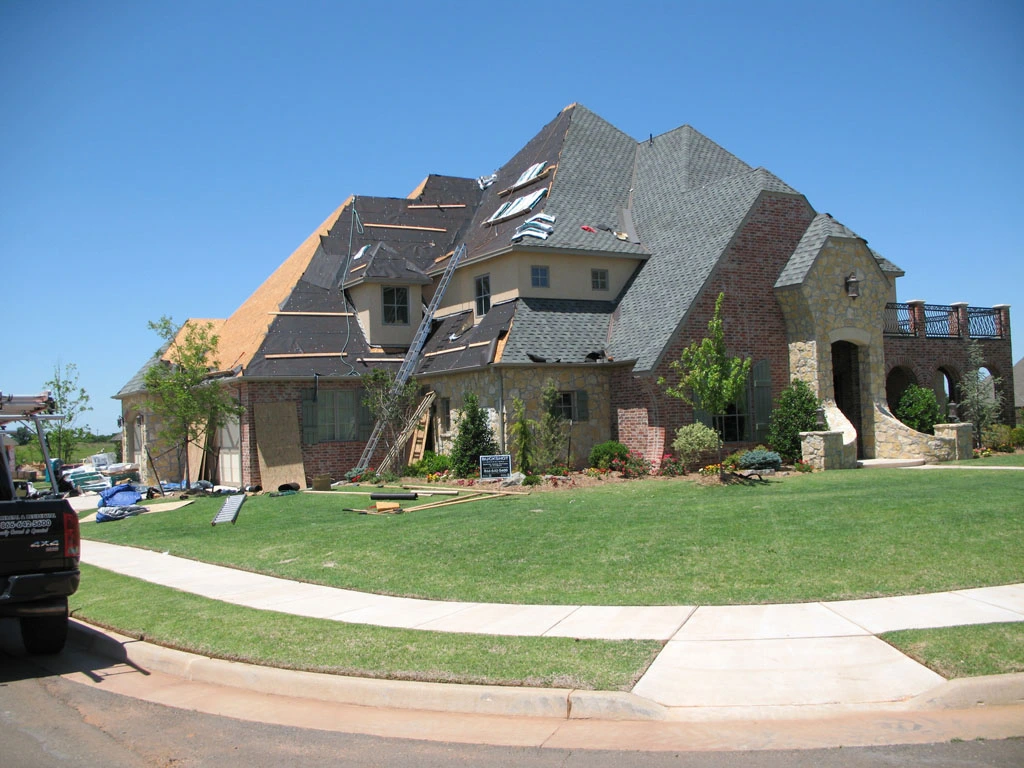
For a standard asphalt shingle roof on a 1,500-2,500 sq ft home in south-central Wisconsin, most homeowners pay somewhere in the $8,000-$18,000 range. Larger homes, steeper pitches, premium materials, or multiple tear-off layers push that number higher. Every roof is different; the only honest answer comes from a free on-site estimate.
Get My Free Estimate →- The Real Price Range for a Wisconsin Roof Replacement in 2026
- Roof Replacement Cost by House Size
- What Actually Moves the Price Up or Down
- Storm Damage: When Insurance Covers the Cost
- How to Evaluate a Roofing Estimate
- Choosing the Right Shingle for a Wisconsin Roof
- The Bottom Line on Wisconsin Roof Replacement Cost
- FAQs
Your roof held up through another Wisconsin winter. Ice dams, freeze-thaw cycles, that one week in February when it didn't get above zero, and now you're standing in the attic with a flashlight, wondering if it's time.
Maybe a contractor knocked on your door after the last hailstorm. Maybe your shingles are curling and your gutters are full of granules. Either way, you want a straight answer: what does a roof replacement actually cost in Wisconsin right now?
Here's the honest version: no bait-and-switch numbers, no fake guarantees.
The Real Price Range for a Wisconsin Roof Replacement in 2026
There is no single "average" number that applies to every home. Anyone who quotes you a price without seeing your roof is guessing.
That said, here's what most south-central Wisconsin homeowners pay for a full roof replacement in 2026:
- Small home (under 1,500 sq ft, simple gable roof): roughly $7,000-$11,000
- Mid-size home (1,500-2,500 sq ft, moderate pitch): roughly $10,000-$18,000
- Larger or more complex home (2,500+ sq ft, steep pitch, multiple valleys): $17,000-$30,000+
These are installed costs: materials, labor, tear-off, disposal, and standard underlayment. They're not guarantees. Material prices, labor availability, and fuel costs have all shifted over the past few years, and your specific roof will have its own variables.
If your quote comes in significantly below these ranges, ask questions. Low bids usually mean something is getting cut, often the underlayment quality, the ventilation work, or the decking repairs that should happen once the old shingles are off.
Roof replacement cost by home size (Madison, 2026)
| Home | Roof size | Typical total |
|---|---|---|
| Small ranch / bungalow | 14-18 squares | $9,000-$13,000 |
| Average two-story | 18-26 squares | $12,000-$18,000 |
| Large or complex (steep) | 26+ squares | $17,000-$25,000+ |
Cost by roofing material (average Madison home, installed)
| Material | Lifespan | Typical total |
|---|---|---|
| Architectural asphalt (standard) | 25-30 yrs | $12,000-$18,000 |
| Impact-resistant (Class 4) | 30+ yrs | $15,000-$22,000 |
| Standing-seam metal | 40-50 yrs | $25,000-$45,000 |
Common add-on costs
| Item | Typical cost |
|---|---|
| Extra tear-off layer | $500-$1,500 |
| Decking replacement | $50-$80 per sheet |
| New flashing & pipe boots | $300-$700 |
| Seamless gutters | $1,000-$2,500 |
Typical Madison-area 2026 ranges. Your exact price depends on an on-site inspection. A new asphalt shingle roof recoups about 61% of its cost at resale on average (2024 Remodeling Cost vs. Value Report).
Quick roof replacement cost estimator
Get a ballpark in 20 seconds. For an exact figure, book a free on-site inspection.
Roof Replacement Cost by House Size
The question most people actually type is "how much to replace a roof on a 1,500 square foot house?" The catch is that your home's square footage is floor area, and a roof is priced by roof area, measured in squares (one square = 100 square feet of roof surface). Here is how to get from one to the other.
Step 1: Use the footprint, not the total floor area. A single-story ranch's roof covers all of its floor area. A two-story home with the same square footage stacks half of it upstairs, so its roof covers roughly half as much. Porch roofs, garages and additions add area on top.
Step 2: Account for pitch. A sloped roof has more surface than the flat footprint under it. The math is fixed: a 4/12 pitch adds about 5%, a 6/12 adds about 12%, an 8/12 about 20%, a 10/12 about 30%, and a 12/12 about 41%. Our guide to roof pitch explains how slope changes materials, cost and safety.
Step 3: Add the overhangs. Eaves and rakes extend past the walls, which commonly adds roughly another 10% of roof surface.
Here's what that works out to for a single-story home with a moderate pitch (4/12 to 8/12):
| House size (single story) | Approximate roof size | Where it usually lands in the ranges above |
|---|---|---|
| 1,200 sq ft | about 14-16 squares | Small-home range |
| 1,500 sq ft | about 17-20 squares | Top of the small-home range or low end of mid-size |
| 1,800 sq ft | about 21-24 squares | Mid-size range |
| 2,000 sq ft | about 23-26 squares | Mid-size range |
| 2,200 sq ft | about 26-29 squares | Mid-size range |
| 2,500 sq ft | about 29-33 squares | Upper mid-size, into the larger-home range |
For a two-story home, start from about half those roof sizes, then add any porch or garage roofs. A steep roof, lots of hips, valleys and dormers, or two layers to tear off all push a home toward the higher end of its range regardless of size.
Treat this as a way to sanity-check a bid, not a quote. A contractor should measure your actual roof, and an itemized estimate should show the number of squares. If two bids for the same house list very different square counts, ask each contractor how they measured. Our guide to reading a roofing estimate line by line shows what to look for.
What Actually Moves the Price Up or Down
1. Roof Size (Squares)
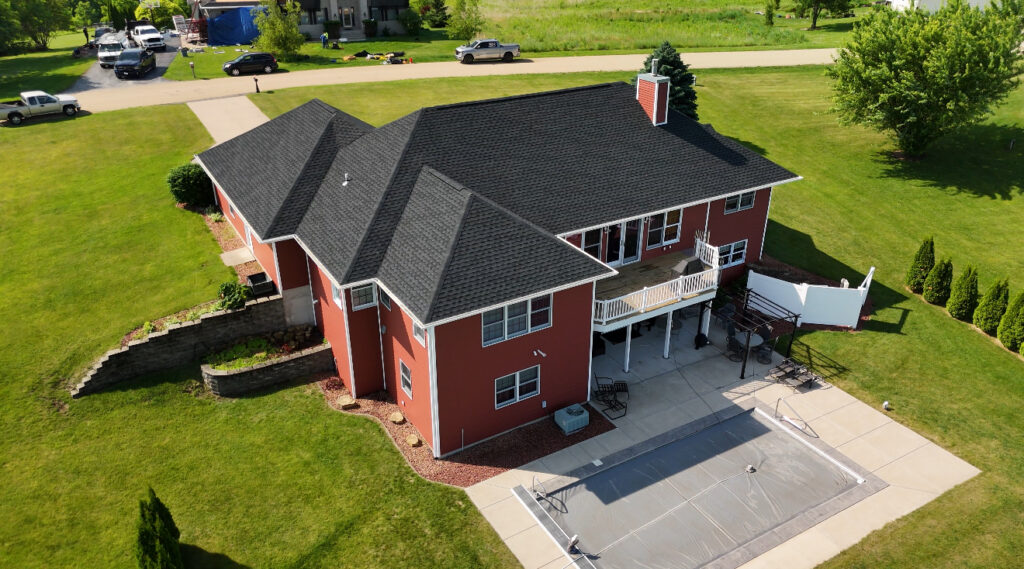
Roofers measure in squares, and your roof surface is almost always larger than your home's footprint because of pitch and overhang, as shown above. A 2,000 sq ft single-story house might have 22-28 squares of actual roof.
More squares means more materials and more labor. Simple math, but homeowners are often surprised by the difference.
2. Pitch (Steepness)
A low-slope ranch is fast and safe to work on. A steep Victorian or a two-story colonial with a 10/12 or 12/12 pitch takes more time, more safety equipment, and more physical effort. Expect a labor surcharge on steeper roofs. It's not contractors padding the bill; it's the reality of the work.
3. Material Choice
Architectural (dimensional) asphalt shingles are the most common choice in Wisconsin: good performance, reasonable cost, and they hold up well against our freeze-thaw cycles.
Premium asphalt shingles (impact-resistant, Class 4) cost more upfront but can lower your homeowner's insurance premium with some insurers and handle hail better. Worth asking your insurance agent about before you choose.
Metal roofing (standing seam or metal shingles) runs two to three times the cost of asphalt but can last several decades and sheds Wisconsin snow well. If you're planning to stay in your home long-term, the math often works out.
Cedar shake and slate are beautiful and long-lasting but significantly more expensive and harder to find qualified installers for. Not common in south-central Wisconsin, but available.
4. Number of Tear-Off Layers
If your home already has two layers of shingles (common in older Wisconsin homes), you're looking at a full tear-off, because codes generally don't allow a third layer. Even with just one existing layer, a complete tear-off is usually the better choice: once the old shingles are off, the decking can actually be inspected, and rotted or soft spots get replaced before the new roof goes on. Our comparison of roof overlay vs tear-off covers the trade-offs.
Tear-off and disposal adds cost depending on the number of layers and the size of the roof, but it's money well spent.
5. Decking Condition
Old Wisconsin homes sometimes have board sheathing (1x6 planks) instead of plywood or OSB. If it's solid, it can stay. If it's rotted, cupped, or damaged, it needs to go. Decking repairs are usually priced per sheet or per board, so ask for that unit price up front, because surprises do happen once tear-off starts. More on when roof decking needs replacing.
6. Ventilation and Underlayment
A roof that's not properly ventilated will fail early. In Wisconsin, attic heat and moisture cause ice dams, mold, and premature shingle failure. A good contractor will assess your ridge venting, soffit venting, and attic airflow as part of the job, not as an afterthought.
The same goes for ice and water shield. Wisconsin code requires an ice barrier at the eaves, and quality contractors often run it further, especially in valleys and around chimneys and skylights. If a bid skips this or uses the cheapest possible underlayment, that's a red flag.
Storm Damage: When Insurance Covers the Cost
If you've had a hailstorm or significant wind event in the last year or two, your roof replacement might be partially or fully covered by your homeowner's insurance. Hail damage isn't always obvious from the ground: it shows up as bruised or cracked shingles, damaged ridge caps, and dented metal on vents and flashing.
We meet your insurance adjuster on site to document hail and wind damage. Adjusters aren't trying to cheat you, but they're often working fast and covering a lot of ground, and having a contractor there who knows what to document can make a real difference in what gets approved.
If you've had recent storm activity in your area, it's worth getting your roof looked at before you file, or before your policy's reporting deadline passes. See our storm damage services for south-central Wisconsin.
Want a straight answer on your roof?
We'll inspect it, document everything, and tell you honestly what you're looking at, even if the answer is patch it for now. No pressure.
How to Evaluate a Roofing Estimate
Get it in writing. Every line item (materials, labor, tear-off, disposal, underlayment, decking allowance, cleanup) should be spelled out, along with the number of squares. If a contractor hands you a single number on a sticky note, walk away.
Compare apples to apples. One bid might use a standard architectural shingle; another might spec an impact-resistant product. Make sure you know what you're comparing.
Check how long they've been around. Storm chasers, out-of-state contractors who flood into areas after a big hail event, are real. Some take deposits and disappear, or do work that fails within a few years. A contractor who has been doing business locally for decades has a reputation to protect.
Buckshot Exteriors has been locally owned and operated since 1979, with offices in Madison, WI and Centerville, IA. You can read what our neighbors have said about working with us on our customer reviews page.
Not sure if your roof needs repair or full replacement? We offer free, no-pressure on-site inspections across south-central Wisconsin.
Free on-site inspection · Family-owned since 1979Choosing the Right Shingle for a Wisconsin Roof
For most homeowners, architectural asphalt shingles hit the sweet spot of cost, performance, and longevity. Check the wind rating on the product: shingles are rated under ASTM D3161 (up to Class F, a 110 mph test) or ASTM D7158 (up to Class H, a 150 mph test). If hail is a concern in your area, and in Wisconsin it should be, ask about impact-resistant options too.
We offer GAF roofing products as part of our residential roofing services. GAF is one of the most widely used shingle manufacturers in North America, and its warranty programs are worth understanding before you sign.
As a GAF Master Elite contractor, we can offer enhanced GAF warranty options that many contractors can't. That matters when you're making a long-term investment in your home.
The Bottom Line on Wisconsin Roof Replacement Cost
There's no honest way to give you a firm price without seeing your roof. Anyone who tells you otherwise is guessing, or selling.
What we can tell you is this: a quality roof replacement in south-central Wisconsin is a significant investment, and it's one worth doing right. The difference between a roof that lasts 15 years and one that lasts 30 often comes down to the underlayment, the ventilation, the decking work, and whether the crew actually knew what they were doing.
If you're ready to get a real number for your home, reach out for a free inspection and estimate. No pressure, no sales pitch. Contact us here or call (608) 909-9109.
- A price dramatically lower than every other bid (corners are getting cut somewhere)
- Pressure to sign on the spot, or a "today only" discount
- A request to sign over your insurance claim (Assignment of Benefits)
- An offer to "waive your deductible" (that is insurance fraud, and it puts you at risk)
- No written, itemized estimate, or no proof of insurance
- A large upfront payment (more than 30%) before any work begins
Get a straight answer on your Madison roof
Wisconsin storm season and insurance non-renewal letters do not wait. Get a free, no-obligation inspection and an honest assessment of exactly what your roof needs, even if the answer is to wait.