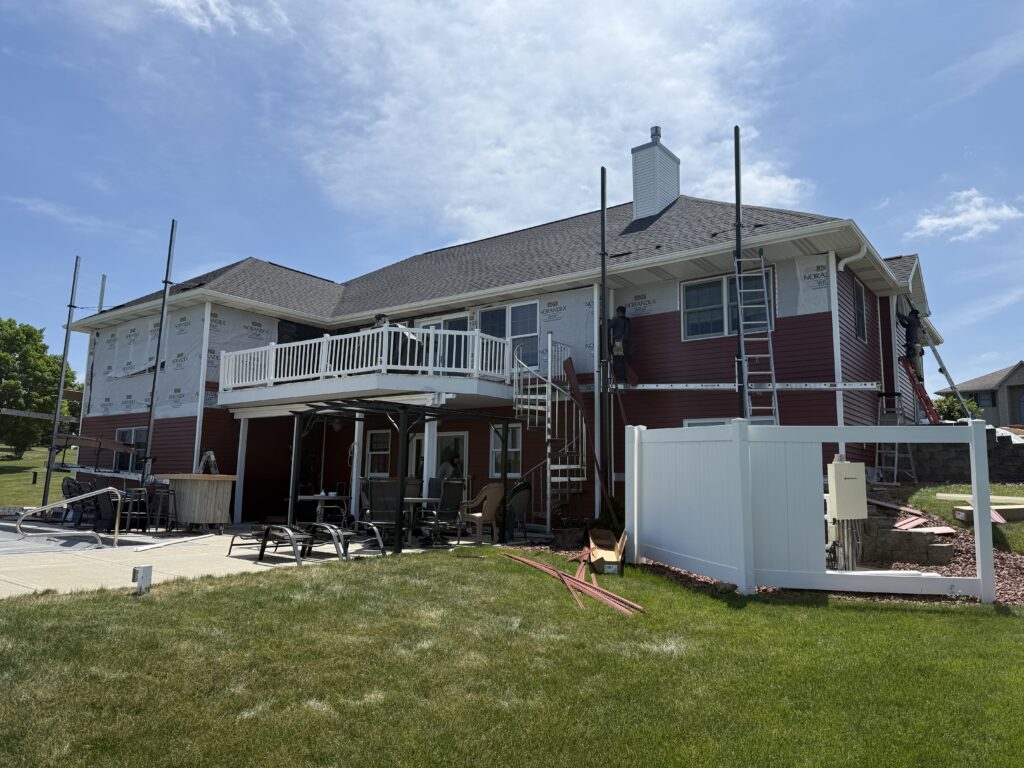
Rub a panel with your thumb. If chalky white powder comes off on your hand, the baked enamel finish has oxidized and there is nothing solid left for new paint to grip. Add dents that will not pop out, discontinued profiles you cannot match, and repaint cycles that keep getting shorter, and replacement becomes the cheaper long-term answer. A quality whole-house repaint is not cheap, and it does not add housewrap, insulation or flashing.
Get My Free Estimate →- How to tell your aluminum siding is finished
- What is under your aluminum siding
- Why we tear off instead of siding over the aluminum
- Replacement cost in Wisconsin: your five real options
- Hail, insurance, and whether a claim will hurt you
- Permits, historic districts and HOA covenants
- Can you install siding in a Wisconsin winter, and how soon can we start?
- Licensing, insurance, financing and deposits
- What the project actually looks like, and living through it
- Should you do siding and roof together?
- If you cannot do it this year
- Get a free estimate on your aluminum siding replacement
- FAQs
Rub your aluminum siding with your thumb. If white chalk comes off on your hand, the finish is done. That is oxidation, the baked enamel breaking down after 30, 40, sometimes 50-plus Wisconsin winters. You can repaint and buy a few years. You cannot restore it.
We get this call constantly in Madison, Sun Prairie, Middleton, Verona and Stoughton. Solid 1960s-80s house, aluminum wrap, faded unevenly on the south and west walls, hail dents nobody can pop out, last paint job already flaking at the seams.
Here is the straight version: how to tell it is finished, what is hiding underneath (including lead paint), what to replace it with in this climate, what it really costs, who has to approve it, and when we can actually get to it.
How to tell your aluminum siding is finished
Five signs. Three or more and you are replacing, not repairing.
Chalking. The thumb test. Once the pigment powders off, the panel has no protection and no fixable color.
Dents you cannot undo. Aluminum is soft. Hail dents it, ladders dent it, a snowblower throws a rock and dents it. It does not spring back like vinyl and you cannot fill it like wood.
A shrinking repaint cycle. First repaint lasted 12 years. Second lasted seven. The third started peeling in three.
Discontinued profiles. This is what kills partial repairs. Most aluminum siding manufacturers exited the residential market decades ago, and the lock and butt geometry on those old panels is obsolete, so new panels will not lock into your existing courses. Even when someone sources a close match, 50-plus years of fading means it will never blend.
Loose, rattling or creased panels. Wind works the nail hem loose. Once a panel unlocks from the course below, water reaches whatever is behind it, and on these houses that is wood.
Why power-washing and repainting will not fix chalking
Chalk is a loose powder that keeps forming under whatever film you put over it. Even a good bonding primer is being asked to stick to a surface that is still breaking down. Aluminum also moves a lot with temperature, so paint fails first at seams, laps and nail hems, exactly where water gets in.
Paint also does not fix dents, does not add housewrap, does not add insulation, and does not solve the discontinued-panel problem. Pay for a whole-house repaint twice and you have spent a real chunk of new siding money with nothing permanent to show for it.
When your aluminum is actually worth keeping
We will tell you to leave it alone when it deserves to stay. Aluminum is non-combustible, light, does not rot, does not feed insects, and plenty of it is still tight and locked after 50 years.
If the panels are tight, the finish still has some gloss, dents are limited to spots you can live with, and the walls behind them are dry, keep it and repaint on a long cycle. Chalking by itself is cosmetic. Loose panels over 1960s building paper are not.
What is under your aluminum siding
Original wood, usually. On the pre-1980 Madison-area houses we open up, it is almost always cedar or fir lap siding, sometimes shakes, occasionally board sheathing with felt paper and little else. Aluminum was sold as the permanent cure for painting wood, so crews went right over it.
That usually gives you a solid nail base. It also means five things you need settled before you sign anything.
Lead paint
On a pre-1978 home, assume that wood is coated with lead-based paint. Disturbing it triggers the EPA Renovation, Repair and Painting rule and Wisconsin's lead-safe renovation requirements. We test with swabs or send a sample, or we presume lead and work accordingly: plastic ground containment, no dry sanding, no open flame, wet methods, HEPA vacuum cleanup, verification wipe at the end. Kids, pets and vegetable beds stay clear of the work zone during the day. Ask any bidder to show you their lead-safe renovation certification. If they look confused, that is your answer.
Asbestos
Under older layers, mostly on pre-1960 houses, you can find cement-asbestos board siding or shingles. That material is typically non-friable, meaning the fibers are locked in cement and are not a hazard until someone cuts, snaps or sands it, which is exactly what a tear-off does. In Wisconsin, disturbing asbestos-containing siding on a home generally requires certified handling under Department of Health Services rules, and an accredited inspector samples it for lab confirmation first.
Practically: sampling is a few hundred dollars and a couple of days for lab results. Certified abatement of a siding field adds cost and typically a day or three to the schedule before we can start. The job absolutely can still proceed. What we will not do is bust it up with a pry bar and pretend we did not see it.
No real weather barrier, hidden rot, thin insulation
Building paper from 1958 is not a weather-resistive barrier anymore. Residing is your one chance to install modern housewrap and detail it correctly at windows and doors.
Rot is the wild card. Wherever a gutter overflowed or a window leaked, the wood is probably soft. On a 1968 ranch we residled off Cottage Grove Road, 22 squares, we found roughly 40 lineal feet of punky cedar under the north gutter line and nothing anywhere else. That is a typical result. Anyone promising zero rot repair on a 60-year-old house sight unseen is guessing.
So handle it with numbers, not hope: we write a rot allowance plus a unit price (per lineal foot of siding board, per sheet of sheathing) into the contract. If we exceed the allowance, we stop, photograph it, show you, and get a signed change order before we continue. No end-of-job surprises.
Wall insulation is the other opportunity. Dense-pack blown-in cellulose is far cheaper while the walls are open.
We pull a panel at the free estimate specifically to look at all of this. Five minutes, and it is the difference between a real number and a fantasy number.
Why we tear off instead of siding over the aluminum
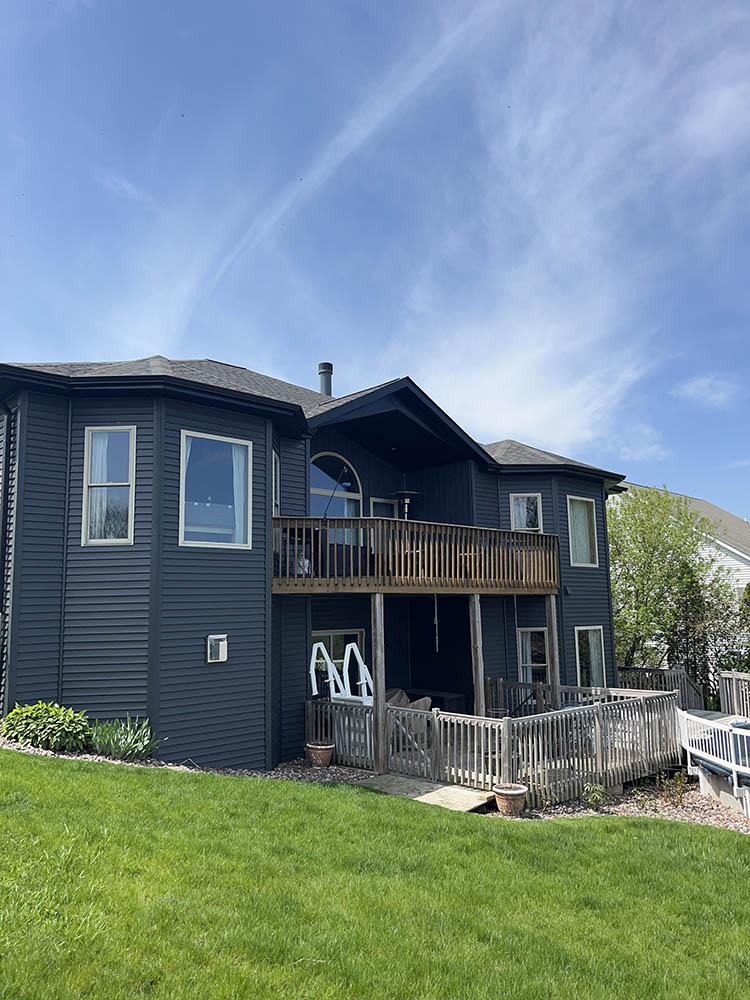
We tear off. Every time. Some crews will hang new vinyl straight over old aluminum to save a day of labor, and it looks fine for about a year.
Here is why we do not: you never see the rot, you never get to install a proper weather barrier, the old aluminum traps moisture against the wood, fasteners have to reach solid wood through an extra layer, and window and door depths get so buried that flashing details become impossible to do correctly. It also hides the exact damage an insurance adjuster needs to see. The aluminum we pull off gets recycled, which offsets a little disposal cost.
Replacement cost in Wisconsin: your five real options
Siding is priced per square, meaning 100 square feet of wall. An average Madison two-story runs 20-35 squares, a ranch 15-25. Whole-house projects on these homes commonly land between $15,000 and $40,000 installed.
Treat the ranges below as Madison-area planning numbers and get a dated written quote. Our siding installation and replacement work covers all of these, because different houses and different budgets honestly land in different places.
Standard vinyl: roughly $500-$800 per square installed
The value play, and a legitimate one. Modern vinyl is not 1990s vinyl. Look for .044 inch thickness or heavier and a full nail hem. Color runs through the panel, so scratches do not show white. Never needs paint, handles freeze-thaw fine, fastest install. Downsides: no insulation value, thin panels look wavy over uneven old walls, and it can crack if struck hard in deep cold.
Insulated vinyl: roughly $800-$1,200 per square installed
Vinyl with contoured rigid foam laminated to the back. In our climate this is often the sweet spot. The foam adds roughly R-2 to R-3 of continuous insulation over the studs, makes the panel far more rigid so it lays flat over wavy old wood, and kills wind rattle.
LP SmartSide engineered wood: roughly $1,000-$1,500 per square installed
Treated engineered wood strand. It reads like real painted wood siding, which is why it works on Madison's older neighborhoods and on Craftsman and farmhouse styles. Cuts and fastens like lumber, takes paint beautifully, handles impact far better than vinyl, and comes in 16-foot lengths for fewer seams.
Steel siding: roughly $1,100-$1,900 per square installed
The most direct apples-to-apples successor to aluminum, and the reason it belongs on this list is hail. Steel is substantially harder than aluminum, so the pea-to-nickel hail that permanently pocks an aluminum wall usually leaves steel alone. It will not burn, will not rot, and holds color well with modern coatings.
Honest downsides: it is premium-priced, dent-resistant is not dent-proof (large stones and baseball-size hail will still mark it), broad flat panels can show oil-canning (a subtle waviness in the flat of the panel) especially on sunlit walls, cut edges and scratches need proper touch-up or they will rust, and the pool of crews around Madison who install it well is smaller than for vinyl. If hail resistance is your top priority and budget allows, ask us to price it next to fiber cement.
James Hardie fiber cement: roughly $1,300-$1,900 per square installed
Premium. Cement, sand and cellulose. Will not burn, will not rot, shrugs off hail that dents aluminum and cracks vinyl. Hardie builds region-specific product for freeze-thaw climates like ours. Installed correctly with proper clearances and flashing it is a 40-plus year exterior. Installed wrong, panels jammed tight to the roofline and nails overdriven, it fails early. This is the product where crew skill matters most, so ask who is actually swinging the hammer.
Be realistic about the heating bill
New siding is not primarily an insulation upgrade, and any salesperson who tells you it will slash your gas bill is overselling. R-2 to R-3 of continuous foam behind insulated vinyl reduces thermal bridging through the studs and takes the drafty chill off exterior walls. You will feel it in January. You will not see your heating bill cut in half.
The real energy money on a 1960s Wisconsin house is dense-pack cellulose in empty stud cavities, attic insulation and air sealing, and that is exactly why we bring it up while the walls are open, when it is cheapest to do. Focus on Energy, Wisconsin's utility efficiency program, offers incentives for insulation and air sealing work through participating contractors, so it is worth asking about before you finalize scope.
"Vinyl looks cheap on my older Madison home"
Sometimes it does, and it is usually the trim, not the panel. What makes vinyl look right on a 1920s bungalow or a 1960s colonial:
- Real trim boards. Composite or PVC 5/4 corner boards and window casing instead of J-channel everywhere.
- Heavier gauge with an insulated backer, so walls read flat instead of wavy.
- Dutch lap or a wider 6-7 inch exposure to match the original wood reveal, not skinny double-4.
- Low-gloss, muted colors. Shine is what makes vinyl look plastic.
- Cedar-look shakes in the gables to break up the field.
Not sure which lane your house belongs in? Call us. We will walk the house, pull a panel, and give you honest numbers on two or three options. Free, no pressure. If standard vinyl is the smart call on your house, we will say so.
Hail, insurance, and whether a claim will hurt you
Aluminum is the most hail-visible siding material there is. Because it dents permanently, an adjuster can count impacts on a wall the same way they count bruises on shingles. That works in your favor.
- Cosmetic versus functional. Some carriers try to call siding dents cosmetic. Creased panels, panels pulled off the nail hem, holes at the butt edge and torn window wraps are functional damage, and documenting them properly changes outcomes.
- Matching is a real argument. Your profile is discontinued and obsolete, so "just replace the damaged panels" is not physically possible. That supports full elevation or whole-house replacement.
- One storm hits everything. Hail that dents siding almost always bruised shingles and dented gutters, soffit and fascia. Scope it as one event.
- ACV versus RCV. Most policies pay actual cash value first (replacement cost minus depreciation), then release the remaining replacement cost value after the work is completed and invoiced. You pay your deductible. Know which you have before you file.
- Deadlines are real. Policies require prompt notice of loss and contain a contractual time limit for filing suit, with minimums set by Wisconsin statute (see Wis. Stat. ch. 631). Do not take a number off the internet for your policy. Pull your declarations page and policy conditions, or call your agent, and get the actual dates in writing.
On premiums: weather losses are usually catastrophe-coded rather than at-fault, so one documented hail claim rarely causes non-renewal by itself. Multiple claims can affect eligibility, and rates can rise across a region after a bad storm season whether you file or not. Ask your agent point blank whether a weather loss is chargeable, then compare that to writing a $25,000 check yourself.
We handle a lot of hail and storm damage restoration in Dane County, and we meet your insurance adjuster on-site so damage gets documented while we are standing there together. If the damage is minor and does not justify a claim, we will tell you that too.
Permits, historic districts and HOA covenants
Residing normally requires a building permit, and we pull it. Requirements differ between the City of Madison, Fitchburg, Middleton, Sun Prairie and the surrounding towns, so we confirm before we start.
Historic review. If your home is in a City of Madison local historic district (Mansion Hill, Third Lake Ridge, First Settlement, University Heights, Marquette Bungalows) or is a designated Madison landmark, changing siding material requires Landmarks Commission review and approval before work begins. Those reviews look hard at material, exposure width, trim profiles and whether original wood should be repaired instead of covered. Vinyl frequently does not clear that bar; fiber cement and engineered wood often do. Sitting inside a National Register district alone usually does not trigger local review, but local designation does.
HOAs and deed restrictions. This catches people in the newer subdivisions around Sun Prairie, Verona, Waunakee and DeForest. Recorded covenants often require written approval from an architectural control committee for both material and color, and some allow 30 days to respond. Nobody at the city will warn you about that. Pull your covenants early, and pick your color while the review clock runs, not after.
Can you install siding in a Wisconsin winter, and how soon can we start?
Winter installs are possible with the right material and the right adjustments, but the best windows are spring and fall.
- Vinyl in deep cold turns brittle. It chips at the saw, cracks at the nail hem, and it has to be hung with larger clearances at trim and corner posts because those panels will expand several fractions of an inch as they warm in April. A crew that nails vinyl tight in February leaves you buckled walls in July.
- Steel handles cold better than vinyl, but cut edges and touch-up paint still need reasonable temperatures.
- Fiber cement, caulk and paint are the real limits. Most sealants and coatings need roughly 40 degrees and rising to cure. That pushes Hardie, painted trim and field touch-up into roughly April through November here.
- Site conditions matter too. Frozen ground is actually good for staging; a January thaw that turns your yard into soup is not.
Scheduling, honestly. In a normal spring or summer we are typically booking a few weeks out for residing. After a significant hail event moves across Dane County, the entire local market backs up and lead times stretch, sometimes into months, because every reputable crew is committed. If your siding is failing but the house is dry, getting on the schedule in winter for early-season work is the smart move. If panels are loose and water is getting in, tell us that on the phone, because emergency stabilization is different from a scheduled project.
Want a straight answer on your roof?
We'll inspect it, document everything, and tell you honestly what you're looking at, even if the answer is patch it for now. No pressure.
Licensing, insurance, financing and deposits
Credentials. In Wisconsin, residential work requiring a building permit runs under a Dwelling Contractor Certification held by the business, with an individual holding a Dwelling Contractor Qualifier credential, both registered with the Wisconsin Department of Safety and Professional Services (DSPS). Ask us for our certification numbers and we will give them to you; ask any bidder for theirs and verify them on the DSPS lookup. We carry general liability and Wisconsin workers' compensation, and we will have our agent send you a certificate of insurance with the actual limits on it before work starts. Do not accept a photocopy from the contractor. Have it come from the insurer.
On manufacturer training, we are GAF Master Elite certified on the roofing side, and we will tell you exactly which siding manufacturer programs our crews hold rather than implying more than we have.
Financing, in plain terms. We do not lend money. Financing on a project this size runs through a third-party lender, requires a credit application and approval, and typically comes as an unsecured home improvement loan with terms in the 5-15 year range. Rate depends on your credit, not on us.
Two cautions worth more than any sales pitch. First, promotional "no interest if paid in full" plans are real, but many are deferred-interest products: miss the payoff window and interest can be charged back to day one. Read that box before you sign. Second, do not choose a contractor by monthly payment. A low payment usually just means a longer term. Compare total project price and APR. If you have equity, a HELOC or home equity loan through your own bank or credit union is often the cheapest money available for a $15,000-$40,000 project.
Insurance jobs work differently: the carrier's ACV check typically funds the start, and the RCV balance follows completion and invoicing.
Deposits. We do not ask for a large cash deposit up front. A reasonable deposit to order material, progress payments tied to work actually completed, balance due when the job passes your final walk-through. Anybody demanding a big cash payment or a signed-over insurance check before material is ordered is a risk, no matter how good the price sounds.
What the project actually looks like, and living through it
Most Dane County homes run 5 to 12 working days. Vinyl is faster, fiber cement slower, rot repair adds days, and Wisconsin weather votes too.
- Walk-through and panel pull. Measure, look underneath, check gutters, soffit, fascia, window wraps, grade and roof lines.
- Setup and protection. Plywood under the dumpster or trailer, tarps and ground containment, shrubs tied back, AC condenser covered and kept clear, window wells protected.
- Tear-off, under lead-safe practices on pre-1978 homes. Aluminum goes out for recycling.
- Inspect and repair. Now we see the real condition of the wood. If the number moves, you hear it here, priced against the unit rates already in your contract.
- Housewrap and flashing. Full weather-resistive barrier, taped seams, proper flashing at windows, doors and wall-to-roof transitions. Invisible when we are done, and the step cheap bids skip.
- Optional insulation while the walls are open.
- Siding, trim and details. Corners, trim boards, soffit and fascia if included.
- Cleanup. Magnet sweep for nails, haul everything, final walk with you.
We do not open more wall than we can close in a day, and we do not leave a house sitting in plastic over a weekend.
Do you have to move out? No. Nobody comes inside, water and power stay on, and you do not need to be home, just reachable by phone for decisions. Work hours are roughly 8 a.m. to 4:30 p.m., and yes, it is loud. Take pictures and mirrors off exterior walls, because hammering can shake a frame or pop a drywall nail. Pets are happiest indoors. We will need most of the driveway for the trailer and material, so plan to park at the curb, and we will tell your neighbors what to expect if the staging crowds a property line. Tell us up front about a baby's nap schedule or a third-shift sleeper; we can often sequence walls around it.
Fixtures. Everything on the wall comes off and goes back properly: lights and doorbells on new mounting blocks, hose bibs blocked and sealed, new dryer vent and bath fan hoods (the old ones are usually cracked), shutters reinstalled or replaced, house numbers and mailbox remounted. Satellite dishes come off and go back on, but signal realignment is a call to your provider. Old gutters usually get bent during removal, so we will talk honestly about whether yours are worth reusing while the staging is already up.
Should you do siding and roof together?
If your roof is within a few years of the end of its life, doing both at once saves real money and prevents a real problem. Same staging, one dumpster, one mobilization, one crew protecting your landscaping instead of two.
More importantly, step flashing and kickout flashing at wall-to-roof transitions get done once, correctly, with the wall open. When one is installed years after the other, those transitions get patched around instead of integrated, and that is a top-three leak location on Wisconsin homes. If you are already weighing asphalt shingle roof replacement in Madison, have us price both and compare.
On resale, national cost-versus-value studies consistently rank new siding among the higher-recouping exterior projects, and we will not quote a percentage because it changes yearly. What we can tell you from this market: faded, chalking, dented aluminum shows up in every listing photo and every buyer's repair-credit request.
If you cannot do it this year
Triage it, do not ignore it. Chalking can wait. Loose, creased or unlocked panels over 1960s building paper cannot, because wind-driven rain and ice-dam melt get behind them and into wood you cannot see. Rot spreads slowly and quietly, and rot repair is the line item that blows up budgets later.
Cheap moves to buy one more winter: refasten or replace loose panels, clean and repair gutters so they stop dumping on the walls, seal failed caulk at window wraps, keep grade and mulch down off the siding. And if you had storm damage, get it documented now while it is clearly tied to a storm date, because that claim window does not reopen.

Get a free estimate on your aluminum siding replacement
There is nothing to lose by finding out. We come out, pull a panel to see what is actually under your aluminum, flag lead paint and rot risk, measure the house, look at the roof and gutters while we are on the ladder, check whether your parcel needs historic or HOA review, and give you honest numbers on two or three options with rot unit pricing spelled out. Free, no obligation, no kitchen-table pressure close. If your siding has three good years left, we will tell you that and leave.
Buckshot Exteriors has been family-owned since 1979, working out of Madison, WI and Centerville, IA, and most of the aluminum we take off is older than our company. You can read what your neighbors say in our customer reviews on Google, Birdeye, Angi and HomeAdvisor, and you are welcome to ask for addresses of recent residing jobs nearby so you can drive by and inspect the corners and window details yourself.
Call today for your free, no-pressure siding inspection and estimate, or reach out through our contact page. We serve Madison, Sun Prairie, Middleton, Verona, Waunakee, Stoughton, Fitchburg and all of south-central Wisconsin. And when a storm tears panels loose after hours, our 24-hour emergency line means a live person takes your call and we get a crew out to secure the opening, tarp or board up the damage, and stop water from getting into the walls before we ever talk about a full project.
Get a straight answer on your Madison roof
Wisconsin storm season and insurance non-renewal letters do not wait. Get a free, no-obligation inspection and an honest assessment of exactly what your roof needs, even if the answer is to wait.