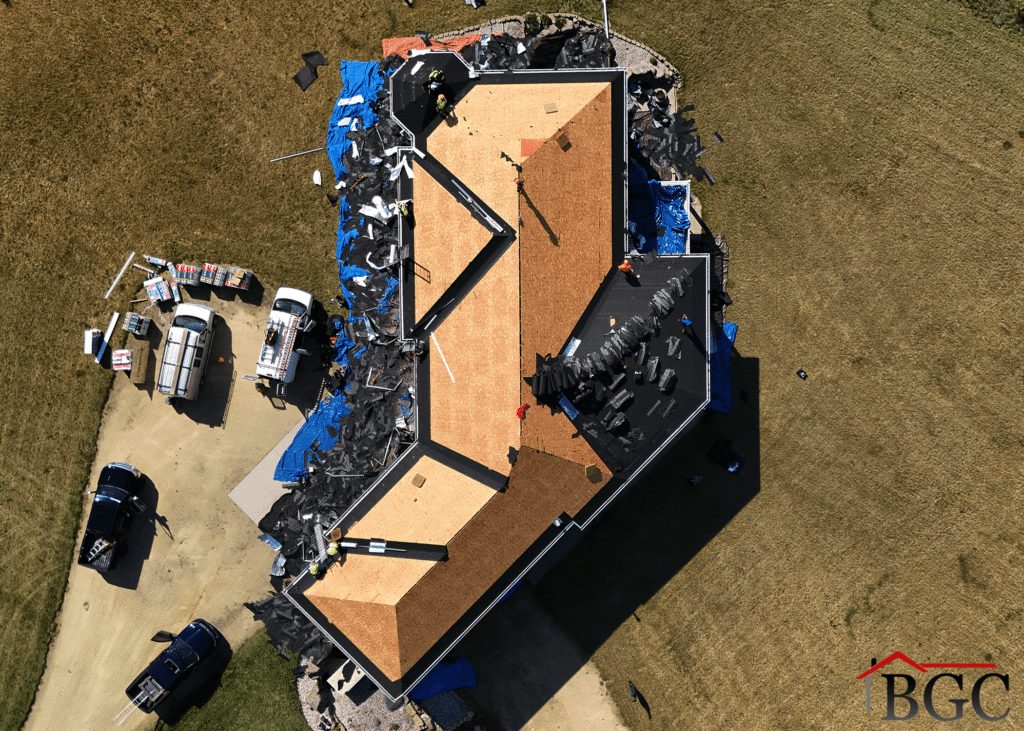
It is a separate deductible that applies only to wind and hail losses, set as a percentage of your dwelling coverage limit (Coverage A) instead of a flat dollar amount. Percentages of this type are often described as ranging from roughly 1 to 5 percent. Plenty of policies still use a flat dollar wind and hail deductible, so read your own declarations page before you assume either way.
Get My Free Estimate →- How a wind and hail deductible percentage is calculated
- Two deductibles: wind and hail vs all other perils
- Where to find your wind and hail deductible
- How the deductible gets applied to your payout
- Is it worth filing at all?
- What if you cannot cover the deductible?
- The red flag: a contractor who offers to cover your deductible
- Plan ahead: ask whether you can switch to a flat deductible
- Get the damage sized up first, for free
- FAQs
Many homeowners policies carry a separate deductible just for wind and hail, and on many of them it is written as a percentage of your dwelling coverage limit rather than a flat dollar amount. That means the deductible you remember from a burst pipe or a kitchen fire may have nothing to do with what you would owe on a hail-damaged roof.
Whether a percentage applies to you depends on your carrier and your policy form. When one does, the dollar figure is often bigger than people expect, and many homeowners first learn the number after a storm, with a claim already open. Let's fix that now, while nothing is on the radar.
How a wind and hail deductible percentage is calculated
A wind and hail deductible percentage is figured off your dwelling coverage limit, usually labeled Coverage A on the declarations page. Not off the cost of the repair, and not off your home's market value.
Dwelling coverage is the amount your insurer would pay to rebuild the structure. As that limit rises, a percentage deductible rises right along with it. Percentages of this type are often described as ranging from roughly 1 to 5 percent.
An illustration of the math only, not a prediction of anyone's policy:
- Home with $300,000 of dwelling coverage
- 1 percent deductible = $3,000
- 2 percent deductible = $6,000
- 5 percent deductible = $15,000
Same house, same storm, same roof. Only the percentage printed on the policy changed.
Two deductibles: wind and hail vs all other perils
Policies built this way list two separate deductibles. The all other perils deductible covers things like fire, water damage and theft. It is usually a flat dollar amount and often the smaller of the two.
The wind and hail deductible applies only when the cause of loss is wind or hail. That is the one written as a percentage on some forms, and it is often the larger number.
Cause of loss also decides which deductible applies, so it is worth understanding how insurers tell wind damage from hail damage before an adjuster ever climbs your ladder.

Where to find your wind and hail deductible
Start with your declarations page, the summary at the front of the policy packet or in your carrier's online portal. Find the deductible section. If your policy uses a split structure, wind and hail is usually broken out on its own line.
If it shows only a percentage, do not do the math yourself and call it settled. Ask your agent this exact question:
"What is my wind and hail deductible in dollars today, based on my current dwelling limit?"
Get the answer by email, and ask for the all other perils number while you have them. If you cannot get a straight answer, your state insurance regulator takes consumer questions about homeowners policies. In Wisconsin that is the Office of the Commissioner of Insurance.
Why the dollar amount can quietly rise
Many carriers raise dwelling limits at renewal to keep pace with rebuilding costs, sometimes through an inflation guard provision. If your deductible is a percentage, it climbs with the limit, and nobody necessarily calls to tell you. The percentage on the page looks identical while the dollars behind it are not what they were a few renewals ago. That is exactly why the question has to be "in dollars today."
Per storm or per policy year?
This varies by policy, and it is worth confirming in writing. Some wind and hail deductibles apply per occurrence, so two separate storms in one year each trigger one. Others apply once per policy year. In a rough summer, that difference is real money.
How the deductible gets applied to your payout
Your deductible is subtracted from the covered loss, never added on top. If the covered scope of repair comes in under your deductible, there is no payment to collect and you pay for the work yourself either way.
On a replacement cost (RCV) policy, money typically arrives in stages: a first payment based on actual cash value, which is the depreciated value of the roof, then the withheld depreciation after the work is finished and documented. Your deductible comes off that first payment, which is why the opening check can look alarmingly small on a fully approved roof replacement.
On an actual cash value (ACV) policy, depreciation is not reimbursed, so you absorb the deductible plus the depreciated amount. That one distinction can swing your out-of-pocket more than almost anything else, so read up on how ACV and RCV policies release payment.
One storm, one deductible, across the whole exterior
Hail rarely stops at the roof. Gutters, downspouts, vent caps and AC condenser fins are often hit, and siding on the storm-facing side can crack or dent. Generally one storm is one occurrence, so all of it should be documented and settled together under one deductible rather than split into separate claims. Policies and carriers vary, so confirm with your agent, and make sure detached buildings like a garage or shed are walked too.
When only the roof gets scoped, you pay your full deductible for a partial repair and the damaged siding stays damaged. That is one reason to have someone who handles hail and storm damage across the full exterior meet the adjuster on site.
If the adjuster's scope still comes in short, there is a process for asking for a revision backed by documentation. If the carrier will not move, that is the point to learn whether a public adjuster or a contractor should step in first.
Endorsements that change what you actually pay
Read the endorsement pages, not just the declarations page:
- Roof payment schedule. Some policies settle older roofs on an age-based schedule, so an older roof can pay a fraction of replacement cost even when the damage is covered.
- Cosmetic damage exclusion. Excludes damage that affects appearance but not function. It matters most on metal roofing and metal siding, where hail dents without breaching the panel.
- ACV-only roof settlement. Some policies carve the roof out of replacement cost while the rest of the dwelling stays RCV.
- Ordinance or law coverage. Re-roofing can bring current code requirements into play, and a base policy may pay to replace what was there rather than upgrade it. Codes and policy language both vary, so ask whether this coverage is on your policy and at what limit.
Not sure what the last storm actually did up there? Call (608) 909-9109 for a free, no-pressure on-site inspection. It costs nothing to find out.
Is it worth filing at all?
Do it in order. Get your deductible in dollars from your agent, get a free on-site inspection to size the real scope of the damage, then compare the two. If the covered repair clearly exceeds the deductible, filing usually makes sense. If it is one wind-lifted slope on an otherwise sound roof, a claim may pay nothing once the deductible comes off.
Also ask your agent how a claim could affect your coverage or pricing at renewal. Insurers treat claims differently, so get the answer for your carrier in writing rather than relying on a general rule.
If you move forward, sequence matters. Our walkthrough of how to file a roof insurance claim in Wisconsin covers the order: document, file, meet the adjuster, agree on scope, then build.
Want a straight answer on your roof?
We'll inspect it, document everything, and tell you honestly what you're looking at, even if the answer is patch it for now. No pressure.
What if you cannot cover the deductible?
Say so up front, before any contract is signed. There are legitimate ways to handle it:
- Ask whether the deductible can be paid on a schedule tied to project milestones instead of all at once.
- Ask about financing and what the terms actually are.
- Ask whether the work can be phased, with the roof first since it keeps water out, and siding and gutters later.
What nobody can legitimately do is make the deductible disappear.
The red flag: a contractor who offers to cover your deductible
If a contractor offers to waive, absorb or rebate your deductible, walk away. Doing so misstates the real cost of the loss to your insurer, and that can amount to insurance fraud and put the homeowner in it too. It shows up in disguises: "we bill insurance for the full amount and you pay nothing," or "we add a line item and credit it back." Different packaging, same problem.
One related point worth knowing: you pick your contractor, not your insurer. A preferred vendor list is a convenience, not a requirement unless your specific policy says otherwise.
Plan ahead: ask whether you can switch to a flat deductible
You are not necessarily stuck with a percentage. On many forms a homeowner can request a different deductible structure, including a flat dollar wind and hail deductible, though availability depends on the carrier, the form and your claim history.
Three questions to put to your agent before renewal:
- What deductible options are available on my form, including flat dollar wind and hail amounts, and what is the premium difference for each?
- Can the change be made now, or only at renewal?
- Which roof endorsements apply to me, specifically any roof payment schedule, cosmetic exclusion or ACV-only roof language?
Expect the trade-off to run in the usual direction: a lower deductible generally means a higher premium. Once you know your figure, treat it as a planned expense and set money aside. Policies vary by insurer, and your declarations page governs over anything you read online.
Get the damage sized up first, for free
You cannot make a smart call on a claim until you know two numbers: your deductible in dollars, and the real scope of the damage. Your agent gives you the first. A free on-site inspection gives you the second.
Buckshot Exteriors has been family-owned and working on roofs, siding and gutters since 1979, and we meet your insurance adjuster on site to document hail and wind damage. Call (608) 909-9109, and if you want to see what hail damage assessment and repair involves before you pick up the phone, start there. We also run 24-hour emergency response when water is already coming in.
Get a straight answer on your Madison roof
Wisconsin storm season and insurance non-renewal letters do not wait. Get a free, no-obligation inspection and an honest assessment of exactly what your roof needs, even if the answer is to wait.