
Most Madison-area homes land between $1,400 and $4,200 for a full seamless aluminum gutter and downspout replacement. Single-story ranches with simple rooflines sit at the low end; two-story homes with lots of corners, 6-inch gutters, or guards added sit at the high end. Pricing is built per linear foot installed (roughly $8-$14 for 5-inch aluminum and $10-$18 for 6-inch), so the only way to get a real number is a quick on-site measure.
Get My Free Estimate →- How seamless gutters are priced
- Do you actually need new gutters, or just a repair?
- What actually moves your gutter installation cost
- Aluminum, steel, or copper, and how long they last here
- Why seamless beats sectional here, and what DIY really saves
- Should gutters go on at the same time as the roof?
- Gutter guards: what they cost with new gutter versus a national retrofit
- Ice dams, heat cable, and what it really costs
- Where the water goes: extensions, buried lines, and Madison practice
- What a complete quote should itemize
- Storm damage and the insurance reality
- What it costs to skip it
- Get a real number for your house, free
- FAQs
Most Madison homes run $1,400 to $4,200 for a complete seamless gutter and downspout replacement. A single-story ranch with a simple roofline often lands at $1,400-$2,300. A two-story with a lot of corners, 6-inch gutters, and guards is where you cross $4,000.
Gutters are priced per linear foot installed, not per house. So your number depends on how many feet of roof edge you have, how high off the ground it is, and what we find behind the old gutters when we pull them off.
Here is how that price gets built, so you can read any quote you get in Madison, Sun Prairie, Verona, or Stoughton and tell whether it is fair.
How seamless gutters are priced
Seamless gutter is formed in your driveway. We run a coil of aluminum through a portable machine and cut one continuous piece per run, so a 42-foot side of the house is one 42-foot gutter with no joints in the middle.
The installed per-foot price covers material, machine time, hidden hangers, sealed end caps, corner miters, and the labor to hang it at proper pitch. Downspouts are priced separately.
Typical south-central Wisconsin ranges, installed:
- 5-inch seamless aluminum: about $8-$14 per linear foot
- 6-inch seamless aluminum: about $10-$18 per linear foot
- Steel (galvanized or galvalume): about $12-$22 per linear foot
- Copper: about $30-$50+ per linear foot
- Downspouts: roughly $8-$16 per foot, or about $70-$180 per drop
- Old gutter tear-off and disposal: about $1-$2 per linear foot
- Micro-mesh guards installed with new gutter: about $6-$15 per linear foot
Those are working ranges from what we quote around here, not a promise. To ballpark your own house: a typical Madison ranch has 150-180 linear feet of gutter. A two-story colonial usually runs 200-260 feet.
Do you actually need new gutters, or just a repair?
Walk your house during the next steady rain and after it dries. If one or two of these show up in one spot, you are looking at a repair. If four or more show up in different places, replacement is the honest answer.
- Sagging between hangers. A gutter that dips in the middle of a run is holding standing water and has lost pitch.
- Gutter pulling away from the fascia. You can see daylight behind the back of the trough, or the front edge has rolled outward.
- Spike heads backing out. Those old nails with the sleeve behind them work loose every freeze-thaw cycle. If you can see the heads standing proud, the fastening system is done.
- Peeling paint or dark staining on the fascia and siding behind the trough. That is water running behind the gutter, not through it.
- Standing water 24 hours after the rain stops. Bad pitch or a low spot. Mosquitoes love it, hangers do not.
- Drips at every seam, end cap, or miter. One leaking joint is a reseal. Six leaking joints means the sealant is at the end of its life everywhere.
- A mud trench or eroded mulch line under the eave. Water is overflowing or missing the trough entirely.
What repairs actually cost
- Reseal seams, miters, and end caps: about $150-$350 on a typical service call
- Re-hang and re-pitch a sagging run with screwed hidden hangers: about $200-$500 per run
- Replace one damaged section: roughly $10-$18 per foot with a minimum charge
- Add, reroute, or lengthen a downspout: about $150-$350 per drop
- Clean out a clogged system on a ranch: commonly $150-$300
Simple rule of thumb: once the repairs you need on one house add past $700-$900, and the gutter is 20-plus years old, put that money toward seamless replacement instead.
What actually moves your gutter installation cost
House height and access
Biggest swing after footage. A one-story run a crew reaches off a 24-foot ladder is straightforward. A three-story gable end over a deck, a walkout grade, or landscaping we cannot set ladders in means longer setup, more fall protection, sometimes a lift. Second-story and higher work carries a real labor premium per foot. Anyone quoting your two-story the same as your neighbor's ranch either has not looked at the house or plans to rush it.
5-inch versus 6-inch
A 6-inch gutter has about 40% more cross-sectional capacity than a 5-inch, and a 3x4 downspout carries roughly twice the water a 2x3 does. The upcharge is usually $2-$4 more per foot installed.
Go bigger when you have a steep roof (water arrives with velocity), long uninterrupted planes, a valley dumping into one spot, or a history of water shooting past the front lip in a July downpour.
We did a Verona ranch a couple of seasons back where the homeowner had replaced the same 5-inch section twice and still had a mud trench under the front window. The gutter was not the problem. A valley off two roof planes was emptying into 5-inch trough with a single 2x3 drop. We ran 6-inch with a 3x4 on that elevation only and left 5-inch everywhere else. No overflow since.
Corners and downspouts
Every inside and outside miter is a hand-sealed joint and a labor step. Every downspout means straps, an outlet cut, and elbows. A boxy house with four corners and three drops is cheap per foot. A house with bump-outs, a bay window, and nine corners is not, even at the same footage.
Fascia repair found underneath, and how change orders work
This is the line nobody budgets for, and it comes up constantly here. Old spike-and-ferrule gutters that have overflowed for a few winters soak the fascia board behind them. Pull the gutter and the wood is soft, black, or gone.
You cannot hang new gutter on rotten fascia. The hangers will not hold and it sags by the second spring. Homeowners around Dane County commonly tell us they have been quoted anywhere from $800 to $3,000 or more once several boards and a stretch of sub-fascia are involved. Treat that as reported experience, not a published statistic, and get it in writing.
Here is our process, because you deserve to know it before a crew is on your house. If we find rot, we stop, take photos, measure the affected footage, and price it as a written change order. You approve it by signature, email, or text. No additional work happens and no additional dollar gets charged without that approval.
If you decline the repair, we do not quietly screw new gutter to punky wood. We will hang the sound elevations, document the bad section with photos, and leave it for whenever you are ready. When rot has traveled into the soffit or up behind the siding, our siding and exterior trim crews fix it properly instead of hiding it.
Aluminum, steel, or copper, and how long they last here
Aluminum goes on the large majority of Wisconsin homes. It will not rust, baked-on colors hold up, and it forms cleanly on the seamless machine. Ask for .032 gauge instead of thinner .027 builder coil. The upcharge is small and it survives ladder pressure, ice load, and a hail season without denting like a soda can. Expect 20-plus years, often 25-30 when it is hung on screwed hidden hangers and drains properly.
Steel is stronger and takes ice and branch impact better. It typically matches or beats aluminum for service life, but it rusts at any cut or scratch once the coating wears. It earns its keep on heavy snow-slide elevations and commercial-style runs.
Copper lasts generations and runs three to five times aluminum. It belongs on historic homes near the Capitol and on craftsman restorations. It is a design choice, not a performance requirement.
What actually shortens gutter life in Wisconsin: ice load pulling hangers, ladders leaned on the front lip (the single most common damage we see), chronic overflow from clogs or undersizing, and spike-and-ferrule fasteners working loose through freeze-thaw.
Why seamless beats sectional here, and what DIY really saves
Freeze-thaw is the whole answer. Dane County crosses the freezing line dozens of times between November and April. Sectional gutter joins every 10 feet with a lapped, sealed joint. Water sits there, freezes, expands, and works the seam open. Sealant goes brittle in the cold and lets go. Within a few winters you have a dozen slow drips running down your fascia.
Fair question: can you just buy sectional at the big-box store and do it yourself? You can. Materials for a 160-foot ranch (10-foot lengths, corners, outlets, hangers, sealant, downspouts, elbows) usually run somewhere around $500-$900, plus a full weekend on a ladder. A pro seamless install on that same house might be $1,600-$2,000. So the real gap is often $800-$1,200, and for that you trade roughly 16 sealed field joints for zero, plus proper pitch and someone who owns the warranty.
Not sure whether you need replacement or just a reseal and a longer downspout run? Call for a free look. We will tell you straight, no charge, no pressure either way.
Should gutters go on at the same time as the roof?
If your roof is due within the next year or two, do the gutters with the roof or right after it, never right before.
Reason is the eave detail. Drip edge and apron flashing get installed as part of the new roof, and they need to sit behind the back edge of the gutter so water leaving the shingles lands in the trough instead of behind it. Ice-and-water shield along the eave goes down in that same sequence. If brand new gutters are already hanging, roofers have to work over and around them, and tear-off debris, ladders, and shingle bundles are hard on a fresh trough.
Does bundling save money? Some. You pay one mobilization instead of two, one disposal run, one crew scheduling. Realistically that is a modest few hundred dollars on an average house, not half the job. The real value is that one contractor owns the whole eave, so nobody points at anybody else when water shows up in the wrong place. That is how we handle it on residential roofing projects that include gutters.
Gutter guards: what they cost with new gutter versus a national retrofit
Plan on cleaning unguarded gutters twice a year around here, late spring after the maple seeds and catkins, late fall after the oaks finally drop.
Guards reduce that work. They do not erase it. Good micro-mesh keeps leaves, seeds, and needles out of the trough so you are rinsing and checking outlets instead of scooping handfuls. Fine shingle grit and pollen still film the mesh over time.
Now the objection everyone in Madison has, because the ads are everywhere. You got a national gutter-guard quote for $2,000-$6,000 on your existing gutters. Should you take it?
- Micro-mesh installed at the same time as new seamless gutter typically runs $6-$15 per linear foot, so about $1,000-$2,400 on a 160-foot ranch, on top of brand new gutter that is pitched and hung correctly.
- A standalone retrofit puts a premium guard on top of a trough that may be 20 years old, out of pitch, and hanging on loose spikes. You are buying the best part last.
- The "lifetime clog-free" guarantee usually covers the guard clogging, and that is it. Read what is excluded: downspout clogs, overflow from ice or undersized gutter, fascia damage, and the labor to come out. Many are non-transferable or prorated on sale of the home, and any service typically requires you to schedule and be present.
If your gutters are sound and correctly pitched, a guard is a reasonable add. If they sag, leak, and back up, guards on top of that just make an expensive problem harder to reach.
Want a straight answer on your roof?
We'll inspect it, document everything, and tell you honestly what you're looking at, even if the answer is patch it for now. No pressure.
Ice dams, heat cable, and what it really costs
Gutters do not cause ice dams. Attic heat loss and weak ventilation do. But an ice-packed, undersized gutter pulls hangers and tears fascia, so sizing, pitch, and hanger spacing matter. Common spec is hangers every 24 inches. On snow-slide areas, long north-facing eaves, and 6-inch runs, we tighten that to 16-18 inches.
Heat cable treats the symptom. Self-regulating cable at the eaves and in the downspout typically runs roughly $12-$25 per linear foot installed, so a 40-foot problem eave often lands around $500-$1,200, plus $300-$700 if an electrician has to run a dedicated GFCI circuit. It also runs on your power bill all winter.
The honest caveat: heat cable installed wrong is worse than none. Clips fastened through shingles, cable stapled down, or runs laid under courses can void a shingle manufacturer warranty and can damage the coating on metal roofing. Use manufacturer-approved clips, keep penetrations out of the field, and if you are fighting ice every February, have the attic ventilation and insulation looked at in the same visit.
Where the water goes: extensions, buried lines, and Madison practice
A perfect gutter that dumps two feet from the foundation has just relocated the problem. Extensions should carry water 4-6 feet away, farther on flat lots and clay soil, which describes a lot of Dane County.
Options and what they cost:
- Downspout extensions and splash blocks: usually $25-$100 per drop, the cheapest insurance you can buy
- Hinged or roll-out extensions: similar cost, easier to mow around
- Buried drainage tie-in: rigid smooth-wall pipe (not flexible corrugated, which silts up and crushes) trenched from the downspout to a pop-up emitter out in the yard, commonly $300-$800 per downspout for a short run, more like $15-$35 per foot for longer runs, and more if we hit rock, roots, or a sidewalk
One Wisconsin-specific warning on buried lines: shallow pipe freezes. A buried run that discharges uphill or sits flat will ice off in January and back water up at the foundation exactly when you need it working. Pitch it continuously, daylight it if the grade allows, and expect a winter freeze-off on emitter-style systems.
On where you are allowed to send it: in Madison and most Dane County municipalities, roof downspouts are meant to discharge to grade, away from the foundation. Downspouts are not supposed to be tied into the sanitary sewer, and any connection to a storm line is a city-approval conversation, not something a gutter crew should decide in your driveway. If your house has an old buried tie-in of unknown destination, we will tell you what we see and point you to the city before anybody connects anything new.
What a complete quote should itemize
If a quote is one line and one number, ask for the breakdown. A real estimate shows:
- Linear feet of gutter by size, material, and gauge
- Number of downspouts, size (2x3 or 3x4), and total footage
- Count of inside and outside corners
- Tear-off and disposal of existing gutters
- Fascia inspection plus unit pricing if rot is found, and the change-order process
- Hanger type and spacing (screwed hidden hangers, not spikes)
- Color and finish
- Guard type and footage, if included
- Extensions, splash blocks, or buried drainage, priced separately
- Written workmanship warranty term, plus the manufacturer coil finish warranty
On warranty: ours is a written workmanship warranty with the term printed on your estimate, covering our labor, hangers, pitch, and seals. Separately, the aluminum coil carries a manufacturer finish warranty against chipping, peeling, and cracking of the paint (commonly 20 years or more). Finish warranties do not cover dents, ice damage, or hail. That is an insurance matter.
We are licensed and insured, and the people on your house are our own crews. Ask for the certificate of insurance and we will hand it over before we start.
Timeline and how you pay
Most Madison homes are a one-day job with a two or three-person crew. Larger two-story homes, or homes adding guards and fascia work, can run into a second day.
We need driveway space for the seamless machine, ladder access, and an exterior outlet. Old gutter, spikes, and screws leave with us the same day, and we run a magnet along the drip line and beds before we go.
Gutter replacement typically does not require a permit in Madison, but if you are in a local historic district (Mansion Hill, Third Lake Ridge, University Heights and others), a change in material or color can require review. We flag that at the estimate instead of letting you find out afterward.
Lead time is longest in spring, fall, and the weeks right after a hail event. Winter is often the shortest wait. Aluminum coil runs fine in the cold; we just use low-temperature sealant and work around ice at the eaves. No deposit is required for the estimate, and on a job this size we do not ask for large money up front. Your payment schedule is printed on the estimate.
Storm damage and the insurance reality
Hail and straight-line wind bend gutter faces, tear downspouts loose, and pull hangers, and that damage is often covered. Three honest caveats before you file:
- Your deductible applies. Some Wisconsin policies carry a separate percentage-based wind and hail deductible, which on a gutter-only loss can exceed the repair cost.
- Cosmetic-only dents are frequently denied, and some policies carry a cosmetic damage exclusion outright.
- Gutters are most often paid as part of a roof claim, since the same storm that dented the gutters usually bruised the shingles.
We handle storm damage restoration in Dane County and meet your adjuster on-site to document all of it, gutters included, so the scope reflects what is actually damaged.
What it costs to skip it
Gutters are the cheapest water management you will ever buy, and what they prevent is not cheap. Fascia and soffit rot spreads board to board. Constant drip lines stain and swell siding. Mulch beds trench out, stoops settle, and overflow refreezing on a front step is a fall waiting to happen.
The expensive one is the basement. Homeowners in this area regularly tell us that interior drain tile and sump work, once water has been sheeting against a foundation for years, was quoted well into five figures. Again, that is what local homeowners report to us, not a published figure. Either way, it makes a $60 downspout extension look like the best money in the house.
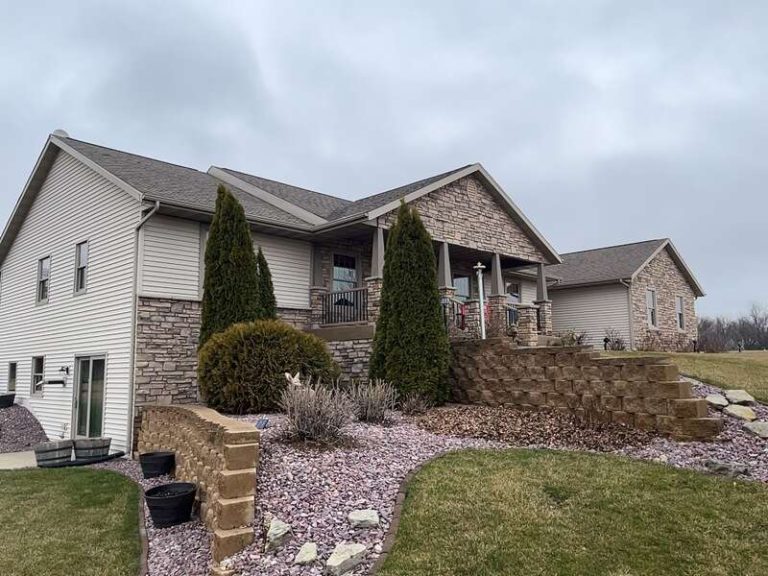
Get a real number for your house, free
Ranges help you plan. They are not a quote. The only way to know your gutter installation cost is to have someone measure the footage, count the corners, check the fascia, and look at where the water goes after it leaves the downspout.
That is exactly what our free estimate is. We measure, look behind the existing gutters for rot, talk through 5-inch versus 6-inch for your roofline, and leave you an itemized written price with the warranty term and payment schedule on it. Nothing to pay, nothing to sign, and no salesperson circling back three times. If a reseal and a longer extension solve your problem, we will say so and quote that instead.
Buckshot Exteriors has been working on roofs, siding, and gutters in south-central Wisconsin since 1979. You do not have to take our word for it, you can read what local homeowners say in our customer reviews on Google, Birdeye, Angi, and HomeAdvisor.
Request your free gutter estimate or give us a call, and we will get someone out, usually within a few days. If a storm just came through and water is already getting where it should not, say so when you call. We run 24-hour emergency storm response for exactly that.
Get a straight answer on your Madison roof
Wisconsin storm season and insurance non-renewal letters do not wait. Get a free, no-obligation inspection and an honest assessment of exactly what your roof needs, even if the answer is to wait.