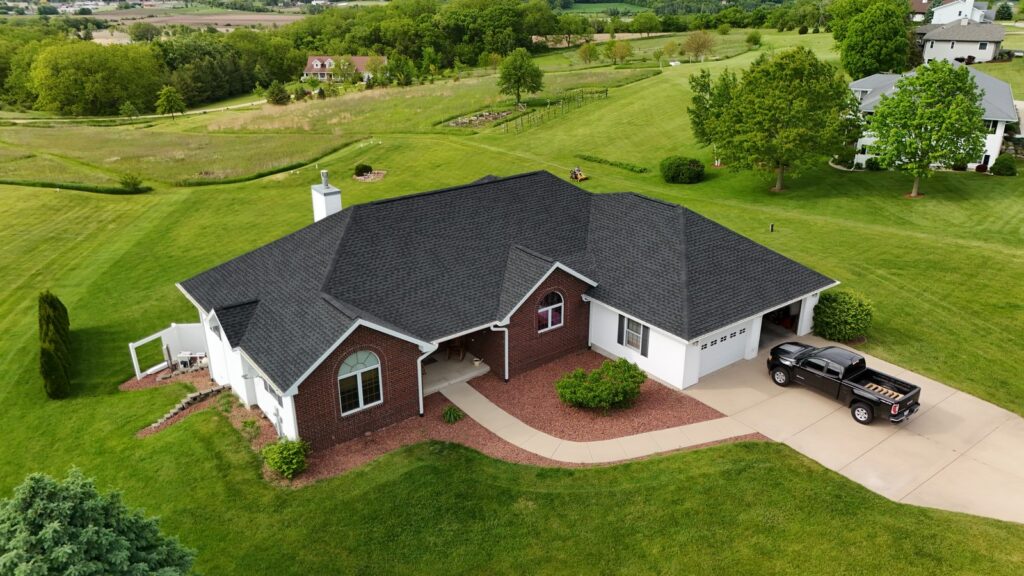
Most single-family asphalt shingle roof replacements in Dubuque land in the $9,000-$16,000 range for architectural shingles on a typical walkable roof. Steep bluffside homes, two or three stories, multiple tear-off layers, or slate and cedar replacement can run well past $20,000. Pitch, height, access, decking condition and how many layers come off are what move the number, so any honest price comes after somebody actually gets on the roof. More detail is in our Iowa roof replacement cost guide.
Get My Free Estimate →- What roof replacement and siding cost in Dubuque
- Roof-over vs. tear-off: why we won't nail a second layer on
- If the insurance check plus your deductible still isn't enough
- Why Dubuque roofs wear out faster than the brochure says
- Hail and wind claims: what to look for, and what to do if you get denied
- The estimate, the price, and what happens if we find bad decking
- Repair or replace?
- Siding contractors in Dubuque, IA: "maintenance-free" and insulated, compared honestly
- How long the job takes, and what happens to your yard
- Warranties, in plain terms
- How to choose a roofing contractor in Dubuque
- What happens when you call us
- FAQs
Short answer up front: most asphalt shingle roof replacements in Dubuque run about $9,000-$16,000, and a full siding job on an average two-story runs roughly $12,000-$32,000 depending on material. Steep bluffside homes, two existing layers of shingles, and slate or cedar replacements go higher.
That's an honest range, not a quote. What follows is the rest of what we'd tell you standing in your driveway: why Dubuque roofs and siding fail the way they do, why a roof-over is usually a bad deal, how a hail claim actually plays out, what happens if we find rotten decking after the price is signed, and how to tell a real contractor from a truck with a magnet sign.
We're family-owned, running since 1979, working out of Centerville, IA and Madison, WI. Dubuque sits squarely in the river-valley territory we've been climbing around on for decades.
What roof replacement and siding cost in Dubuque
Typical installed ranges we see on Dubuque-area homes. Your house may land outside them, and anybody quoting off satellite images alone is guessing.
Roofing (tear-off and replace, typical 1,800-2,400 sq ft home):
- Architectural shingles (30-year laminated, today's standard): about $9,000-$16,000
- Class-4 impact-resistant shingles: add roughly 10-20%
- Exposed-fastener steel panel (26-29 gauge, screws through the face): about $14,000-$22,000
- Standing seam metal (24-gauge, concealed clips, Kynar finish): about $25,000-$40,000+
- Steep, three-story, or two layers of old shingles to remove: expect the high end or above
- Decking replacement: commonly $75-$110 per 4x8 sheet installed, including disposal
On metal, that spread isn't random. What moves it is panel gauge (24-gauge costs more than 29 and dents less), whether fasteners are exposed or hidden behind clips, panel width and profile, and the finish. A cut-up Dubuque roof with five valleys, three dormers and a chimney needs far more hand-formed flashing than a simple gable, and metal labor is where that shows up. Our metal roofing page walks through the systems.
Decking matters more than people expect. A 20-square roof is about 63 sheets. Replacing 15 bad sheets adds roughly $1,100-$1,650. A full re-deck over old 1x6 board can add $4,500-$7,000.
On Class-4 shingles: some carriers give a wind/hail premium credit, some don't, and the amount varies by company. Ask your agent for the actual number in writing before you count on the upgrade paying for itself.
Siding (whole house, tear-off included):
- Standard vinyl: about $12,000-$20,000
- Insulated vinyl: roughly 15-25% more than standard vinyl
- Steel or engineered wood (LP SmartSide type): about $18,000-$32,000
- Fiber cement: usually the top of that range or beyond, because of labor
- Fascia, soffit and gutters as a package: commonly $3,000-$8,000 depending on linear footage and stories
For a deeper breakdown of what drives the roof number in this state, see our Iowa roof replacement cost guide.
Three things push Dubuque prices above the national averages you read online: pitch, height and access. A 1990s ranch in Asbury or out toward Key West is a different job than a Fenelon-area or Cathedral District Victorian where the crew works off a 10/12 pitch with nowhere to park a dumpster.
Roof-over vs. tear-off: why we won't nail a second layer on
Somebody has probably offered you a cheaper "roof-over," meaning new shingles nailed right over the old ones. Iowa's residential code, which Dubuque enforces, allows a recover only in limited situations and caps a roof at two total layers of asphalt shingles. It also prohibits a recover when the existing shingles are water-soaked, buckled or curled, or when the deck can't be verified as sound. Verify what your specific roof needs with City of Dubuque Building Services when you pull the permit.
Legal isn't the same as smart. Here's why we don't sell them:
- You never see the decking. Every rotten sheet stays in the roof, under the new shingles.
- You can't add ice-and-water shield at the eaves and valleys, which is exactly what a Dubuque roof needs.
- Old flashing usually stays too, and flashing is where these houses leak.
- The new shingles telegraph every ridge and cupped tab underneath.
- Manufacturer system warranties (the enhanced tiers) generally require a full tear-off.
- Two layers means the next roof costs more to remove, and adds weight to a 100-year-old rafter system.
On an insurance-paid storm job, the carrier pays for a full tear-off anyway. If a contractor is pitching a recover on approved storm work, ask where the tear-off money is going.
If the insurance check plus your deductible still isn't enough
This is the question people are embarrassed to ask, so we'll answer it plainly. You have more options than "write a check for the whole thing."
- Financing. We work through third-party lenders. Prequalification is normally a soft credit pull, so checking doesn't ding your score. Terms commonly run 5-12 years; on a $13,000 roof that usually pencils out somewhere in the $140-$200 a month neighborhood depending on rate and term. Some lenders run promotional deferred-interest windows (12-18 months, no interest if the balance is paid in full). Read that box carefully, because deferred means if you miss the window the accrued interest lands on the balance. The lender sets your rate, not us, and we won't bring financing up at your table unless you do.
- Phase the work. Roof this year, siding in a year or two. That's the normal order anyway, because the roof is what keeps water out.
- Repair to buy a season. A legitimate repair on a roof with life left can buy 2-5 years and get you to a better budget year.
- Fix the damaged elevation only. On a wind or hail claim, sometimes only one or two slopes or one wall are involved.
- Trim the scope, not the system. Standard architectural shingles instead of a designer line saves real money. Skipping ice-and-water shield or flashing doesn't save anything, it just moves the cost to later.
Why Dubuque roofs wear out faster than the brochure says
Four things about this river valley beat up exteriors.
Freeze-thaw cycling. We cross 32 degrees constantly from December through March. Water gets into a hairline crack, a nail hole or a step flashing seam, freezes, expands, widens the gap. Do that a hundred times a winter and a small defect becomes a leak.
Ice dams on steep, older roofs. Much of Dubuque's housing stock predates anyone caring about attic ventilation. Heat escapes, melts snow mid-roof, water refreezes at the cold eave and backs up under the shingles. Pre-1990s roofs usually have no ice-and-water shield membrane at the eaves, so that water lands in your soffit, plaster or knee wall.
Wind off the bluffs. Ridge and hip shingles and the windward slope take the worst of it. Old three-tab creases and lifts long before the field looks bad.
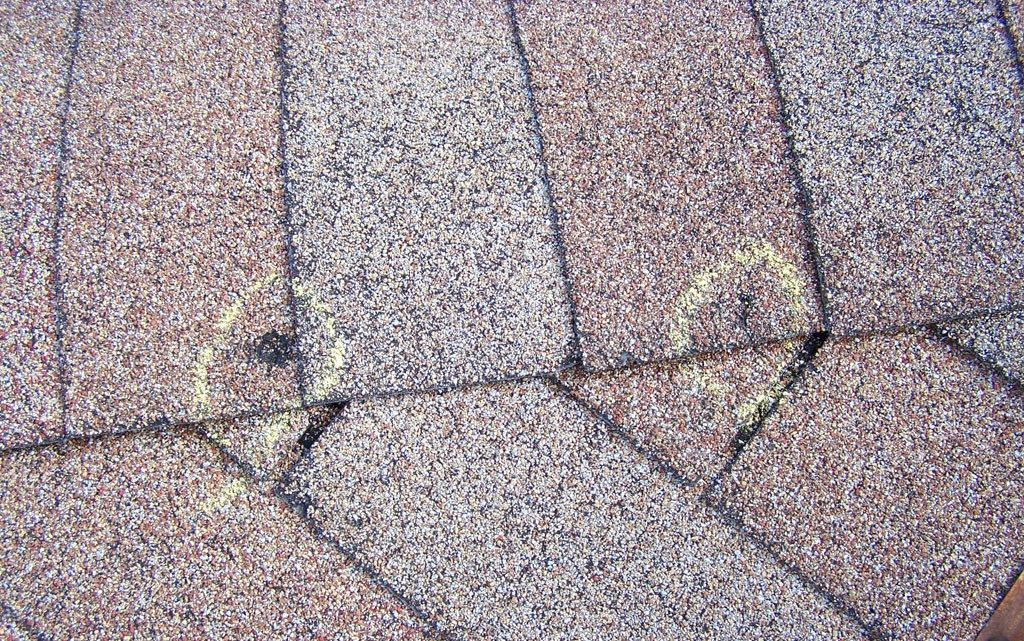
Hail. Eastern Iowa gets hit, often in ways you can't see from the ground. Hail bruises asphalt: the mat fractures under the granules and the shingle looks fine for a year or two while it quietly stops being waterproof.
Add the Dubuque geometry problem. Hillside homes have valleys, dormers, cross-gables and low-slope porch roofs tied into steep main roofs. Every transition is where a lazy install leaks.
Chimneys and skylights: the leak nobody quotes
On the century-old cross-gable houses in Langworthy, Jackson Park and the W. 11th Street area, the leak is usually not the shingles. It's the chimney.
Correct masonry chimney flashing is step flashing woven into the courses plus counterflashing cut or ground into a mortar joint and sealed. What we find instead, over and over, is roofing cement smeared against brick. Tar has a service life of a few winters here, then it cracks and the freeze-thaw takes over. Wide chimneys on a steep slope also need a cricket (a small framed diverter behind the stack) so snowmelt doesn't pond against the brick.
While we're up there we look at the crown and the mortar joints too. A spalling crown or open joints will dump water into the chase no matter how good the flashing is, and that's masonry work, not roofing. We'll tell you which one you have.
Skylights are the other one. Curb-mount and deck-mount units are flashed with a manufacturer kit, not caulk, and the factory seals and gaskets typically have 15-25 years in them. If your skylight is as old as the roof coming off, replace it during the reroof. Reflashing an original 1990s unit and hoping is the single most common callback we see on other people's work.
Hail and wind claims: what to look for, and what to do if you get denied
Walk the property from the ground first. You're looking for evidence, not for roof damage:
- Dents in gutters, downspouts, window wrap or the top of the AC condenser
- Dings or holes in window screens
- Splatter marks on the deck, fence or painted siding
- Granules at downspout outlets
- Vinyl siding cracked or chipped on the storm-facing wall
- Shingle tabs in the yard, or shingles creased along a horizontal line
Soft metals are the tell, and adjusters use them the same way. Dimpled gutters and window wrap mean hail big enough to bruise shingles was in your yard.
How the claim runs:
- Report the loss to your carrier. Policies have reporting deadlines, and most carriers want it promptly after the storm date, so don't sit on it for a year.
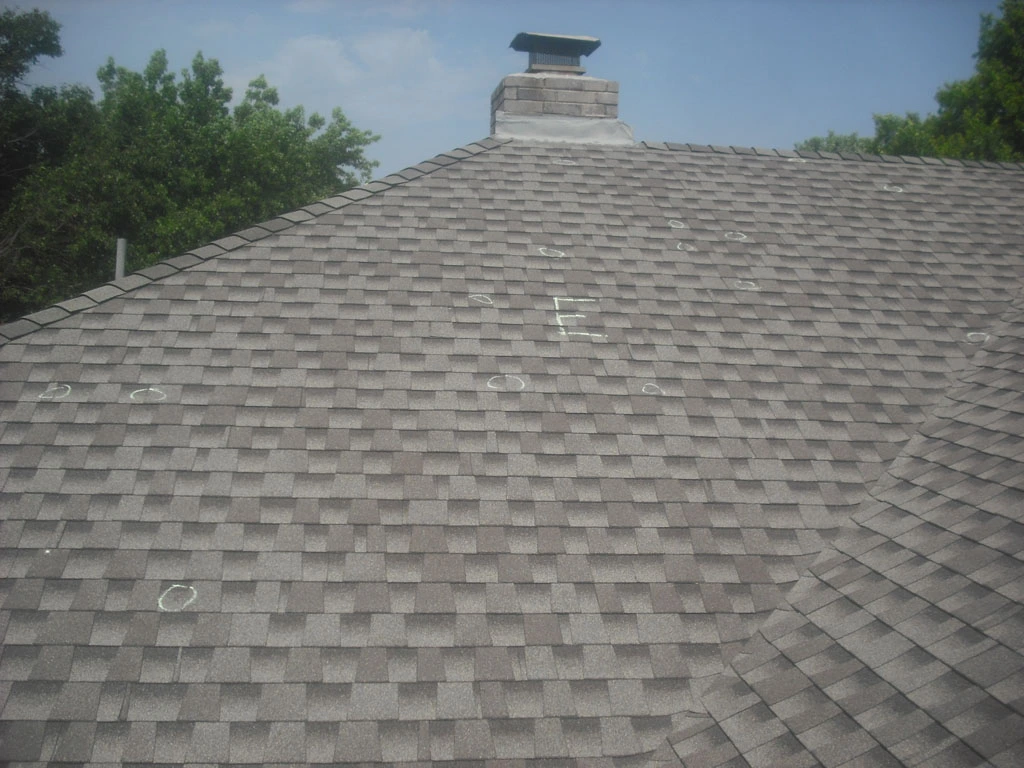
- The adjuster inspects, chalks a 10x10 test square per slope, and counts hits.
- If enough hits per square are documented, they approve replacement and write an itemized estimate.
- They pay in stages. The first check is ACV (actual cash value): the estimate minus depreciation minus your deductible. Once the work is done and invoiced, an RCV policy releases the withheld depreciation. An ACV-only policy doesn't.
- You pay your deductible. Always. That's your share of the loss.
If the claim is denied or only partly approved, you're not out of options:
- Request a reinspection with your contractor present. A second set of eyes on the same slope changes outcomes more often than people think.
- File a supplement for items the first estimate missed: drip edge, ice-and-water shield required by current code, ridge vent, chimney flashing, detached garage, gutter aprons.
- Read your policy's appraisal clause. Most policies have a process for resolving a disagreement over the amount of loss.
- The Iowa Insurance Division takes consumer complaints if a carrier isn't dealing straight.
One important line: in Iowa, negotiating a claim on your behalf is licensed public adjuster work. We document damage, meet your adjuster on the roof, and provide our own line-item estimate. The negotiating is yours, or a licensed public adjuster's. Anybody promising to "handle your whole claim" for you should be asked what license they hold.
Our hail and storm damage restoration team walks the whole envelope with the adjuster: slopes, gutters, fascia, soffit, siding, screens, and the detached garage everybody forgets.
Not sure you even have damage? Get a free inspection before you call your insurance company. No charge, no obligation, and you'll know whether there's a claim worth filing.
The estimate, the price, and what happens if we find bad decking
You'll normally have a written proposal within a business day or two of the inspection, and we'll tell you at the visit exactly when to expect it. Insurance jobs take a little longer, because we're matching the adjuster's scope line by line so nothing gets left off.
The price on that proposal is fixed for everything we can see. Shingles, underlayment, flashing, labor, dumpster, permit, cleanup. Those don't move.
The only thing that can change is what's under the old shingles, and that's why the per-sheet decking price is written into the contract before you sign. It isn't a number we invent on day two.
Here's the process when we find rot:
- Tear-off stops in that area. The foreman photographs it and counts the bad sheets.
- He shows you (or texts you the photos and the count) with the dollar figure straight off your contract.
- Nothing gets installed until you approve it. A text reply is fine; we keep it in the file.
No verbal "we'll settle up at the end." If somebody won't put a per-sheet decking price on the proposal, that's how tear-off horror stories start.
Repair or replace?
Repair makes sense when the damage is localized (a flashing detail, a pipe boot, a few wind-lifted shingles), the field shingles are still pliable, and there's enough life left to justify the trip. A good repair on a 12-year-old roof buys real time.
Repair is throwing money away when shingles are brittle, granule loss is widespread, or you're on your fourth patch. You can't feather new shingles into a mat that cracks when you lift it.
Architectural shingles in eastern Iowa realistically give 20-30 years, closer to 20-25 with poor attic ventilation (which describes a lot of older Dubuque attics). Metal goes 40-60. Vinyl siding, 25-40. Sometimes the right answer is a targeted roof repair, not a replacement, and we say so.
Want a straight answer on your roof?
We'll inspect it, document everything, and tell you honestly what you're looking at, even if the answer is patch it for now. No pressure.
Siding contractors in Dubuque, IA: "maintenance-free" and insulated, compared honestly
Vinyl is the value pick, and today's product beats the 1980s stuff badly. Look for panel thickness of at least .044 inch, full backing, and a real color-fade warranty. On a house with heavy trim detail, quality lives in the accessories and how tight the crew works around windows, not in the panel.
Insulated vinyl bonds contoured foam to the back of each panel. It lies flatter, resists dents, sounds solid, adds about R-2 to R-3. On an older Dubuque house with empty wall cavities, dense-packing insulation while the siding is off does more for your gas bill than the foam behind the panel.
Steel and engineered wood cost more and earn it if hail worries you or you want a crisp lap-board look on a historic-style home. Steel handles hail better than vinyl. Engineered wood takes paint and throws a deeper shadow line.
Fiber cement is durable and paintable, but heavy and labor-intensive, which is where the cost sits.
Nothing is truly maintenance-free. What "maintenance-free siding" honestly means is no more scraping and repainting every 7-10 years. You'll still rinse it and keep caulk joints and flashing sound.
If your home is in the Cathedral, Jackson Park, Langworthy, W. 11th Street or Old Main district, or is a designated landmark, exterior material changes may require review by Dubuque's Historic Preservation Commission before work starts. Don't let anybody wrap a district house in vinyl without checking first. Our siding services page covers materials in more detail.
Fascia, soffit and gutters: the parts everybody skips
This is where most Dubuque exterior problems actually start. Paint fails on wood fascia, the board takes on water, gutter fasteners lose their grip, water sheets behind the gutter, and now the rafter tails and the top of the wall are wet.
- Replace rotten fascia. Don't wrap aluminum over soft wood. Wrapped rot is hidden rot.
- Use vented soffit and make sure the attic intake path is open. Insulation stuffed into the eaves kills airflow and creates the ice dams above.
- Size gutters to the roof. Steep, large-area roofs here often want 6-inch gutters and extra downspouts, not standard 5-inch.
How long the job takes, and what happens to your yard
An average Dubuque roof is a 1-2 day job, tear-off to cleanup. Steep, cut-up, three-story or multi-layer roofs run 3-4 days. Siding is 3-7 days for a typical house, up to two weeks on a large or heavily trimmed one. Lead time after signing is usually 2-6 weeks depending on season and material, longer right after a big hail event when every supplier and crew in the region is backed up.
We won't tear off into rain. If a system moves in mid-job, the crew dries in what's open with underlayment and membrane and comes back. Nobody leaves your decking exposed overnight.
On hillside lots with no staging area we plan dumpster placement before day one, sometimes with a street placement permit, sometimes with a dump trailer because the drive is too narrow. Plywood goes under the container so it doesn't crack your driveway. Shrubs, AC units and decks get tarped. We run a magnetic nail sweep at the end of every day, not just the last day, and again before the final walk. There's a foreman on your job the whole time and you'll know his name.
Warranties, in plain terms
Two separate things, and people mix them up.
The manufacturer warranty covers materials. As a GAF Master Elite contractor we can register GAF's enhanced system warranties, including the top-tier Golden Pledge, which adds GAF-backed workmanship coverage on top of the shingle coverage. Those enhanced tiers require a full system (underlayment, starter, ridge cap, ventilation), which is one reason we quote systems instead of just shingles, and another reason a roof-over doesn't qualify.
Our workmanship warranty covers our labor, and the term is written on your proposal in plain language before you sign. Any contractor who won't put the term on paper is telling you something.
How to choose a roofing contractor in Dubuque
Five questions and most bad options eliminate themselves.
- What's your Iowa contractor registration number? Under Iowa Code Chapter 91C, anyone earning more than $2,000 a year from construction work must register with the Iowa Division of Labor, and out-of-state contractors must also file a $25,000 surety bond. You can look up a registration on the Iowa Division of Labor site. Iowa does not license roofers as a separate trade, so understand what registration is: a filing, not a competency test. Nobody checked whether the crew can flash a chimney. Registration plus current insurance is the floor you verify, then you judge quality by references, photos and how specific their scope of work is.
- Can I see general liability and workers comp certificates, sent directly from your agency? If an uninsured worker is hurt on your roof, that can land on your homeowners policy.
- Who pulls the permit? The contractor should, in their own name, through City of Dubuque Building Services.
- What exactly is in the price? Ice-and-water shield at eaves and valleys, synthetic underlayment, starter strip, factory ridge cap (not cut-up three-tabs), new pipe boots, new step and counterflashing at walls and chimneys, drip edge, and decking priced per sheet. "Full tear-off, new shingles" is not a scope of work.
- Where will you be in five years? Storm-chasing crews follow hail across the Midwest and disappear. A workmanship warranty is only as good as the company behind it.
Two hard red flags. Anyone offering to waive, absorb or "work around" your deductible is asking you to take part in insurance fraud. Anyone wanting a large check before materials are on site deserves a no.
Read reviews on more than one platform. Ours are on Google, Birdeye, Angi and HomeAdvisor, and patterns across platforms tell you more than a single rating. One we heard on a job near Jackson Park, from a homeowner who'd already paid twice for the same leak:
> "Two other guys just caulked our porch roof and it leaked again both times. Buckshot's foreman walked me up and showed me the flashing was never there. Photos of everything, the decking cost was already in the contract, and they cleaned up better than I expected." - Beth, Jackson Park area
Are we actually local to Dubuque?
Fair question, and we'd rather answer it than have you wonder. We don't have a storefront on Main Street. Our offices are in Centerville, IA and Madison, WI, both permanent, both with our name on the building, both there long before this hail season. Dubuque is inside our regular eastern-Iowa and southwest-Wisconsin service area, we've worked river-valley houses for years, and our crews are our people, not a subcontracted convoy that showed up after a storm.
Practically: materials and dumpsters come from local suppliers and haulers, and we answer the phone in January, not just in July. That's the part storm chasers can't fake.
What happens when you call us
You get a real inspection, not a sales pitch. We get on the roof when it's safe, photograph what we find, check the attic side when it matters, look at siding, fascia, soffit, chimney flashing and gutters, then sit down and show you the pictures.
Then one of three things is true: you have storm damage worth filing on, you have a repair that buys real time, or your roof is fine and you should call us again in a few years. We'll tell you which. No charge either way, and no financing conversation unless you bring it up.
Waiting does cost something, and it's worth being straight about. A small leak becomes rotted decking in a season or two, and re-decking a roof that didn't need it last year is real money at $75-$110 a sheet. On hail claims, your policy has reporting deadlines, and a bruised shingle doesn't un-bruise itself.
Call Buckshot Exteriors for a free, no-pressure Dubuque roofing or siding inspection. Tell us what you're seeing, or what the storm did to your street, and we'll come look. You can also reach us here if you'd rather send photos first. Family-owned since 1979, and we're still the ones picking up the phone.
Get a straight answer on your Madison roof
Wisconsin storm season and insurance non-renewal letters do not wait. Get a free, no-obligation inspection and an honest assessment of exactly what your roof needs, even if the answer is to wait.