Under the International Residential Code, yes. Section M1501.1 says exhaust air must go outdoors and may not be exhausted into an attic, soffit, ridge vent or crawl space. Local codes and the age of the house matter, so your building department can confirm what applies.
Get My Free Estimate →- Why a bathroom fan should not vent into the attic
- What the building code says
- Signs your bathroom fan vents into the attic
- How to check the duct in your attic
- Why venting through the soffit or a roof vent falls short
- How a bathroom fan vent is fixed
- After the fix: getting the most from the fan
- Get your bath fan and attic checked
- FAQs
A bathroom fan that vents into the attic moves the moisture from every shower into the coldest part of the house. In a Wisconsin winter, that moisture freezes on the underside of the roof deck, then melts and drips through the ceiling.
The fix is a sealed, insulated duct that runs from the fan to a roof cap or wall cap. Buckshot does this work as part of our attic ventilation and residential roofing service, and this guide shows you how to check your own fan first.
Why a bathroom fan should not vent into the attic
A bathroom fan's only job is to carry warm, wet air out of the house. When the duct ends in the attic, that air spreads under a roof deck that sits below freezing for much of the winter.
The moisture turns to frost on the roofing nails and the sheathing. On the first sunny thaw, the frost melts all at once and drips onto the insulation, which homeowners often describe as rain in the attic. Our guide to frost in the attic explains that cycle in detail.
Over several winters, the damage adds up:
- Water stains on the ceiling around the fan and along the bathroom wall
- Wet, matted insulation that holds less heat, which feeds ice dams at the eaves
- Mold and dark stains on the sheathing above the bathroom
- Rusted nails and soft, delaminating roof decking
Soft decking cannot hold nails well, so it is replaced before the next roof goes on. Our guide to roof decking explains how roofers find and replace it.
What the building code says
The International Residential Code, the model code most American house codes are built on, covers this in section M1501.1. It says air from every mechanical exhaust system must be discharged to the outdoors, and it may not be exhausted into an attic, soffit, ridge vent or crawl space.
States and cities adopt their own versions of the code, and many older houses were built before today's rules. Your local building department can tell you what applies to your home, and home inspectors commonly flag a fan venting into the attic in their reports.
Signs your bathroom fan vents into the attic
Start outside, then look in the attic on a cold morning. These signs point to a fan that dumps its air into the attic.
- No vent cap on the roof or the wall near the bathroom
- Frost or ice on the nails and the underside of the roof deck near the fan
- Water dripping from the fan grille, or a ceiling stain around it after a thaw
- A dark patch on the sheathing directly above the bathroom
- Damp or matted insulation around the fan housing
- A mirror that stays fogged with the fan running, which can mean a crushed or blocked duct
How to check the duct in your attic
Step only on the ceiling joists or on boards laid across them, because the drywall between them will not hold your weight. Find the fan housing above the bathroom ceiling, then follow the duct to its end.
| What you find | What it means |
|---|---|
| The duct ends in the insulation or the open attic | The fan vents into the attic |
| The duct points at a roof vent but is not connected | Much of the moist air still stays in the attic |
| The duct has slipped off its roof cap or wall cap | The fan has been venting into the attic, often for years |
| The duct ends at the soffit | Moist air can be pulled straight back in through the soffit vents |
| The duct is crushed, sagging or uninsulated | Air moves poorly, and water can condense inside the duct |
| The duct is connected, sealed, insulated and ends at a cap | The fan is set up correctly |
Take photos of what you find. They help whoever fixes the vent, and they help if a ceiling stain becomes an insurance question later.
Found a fan duct ending in your attic? Our attic and roof inspection is free, and we will show you where the moisture is going and what it has already damaged.
Free on-site inspection · Family-owned since 1979Why venting through the soffit or a roof vent falls short
Soffit vents are the intake half of an attic's ventilation, so they pull outside air into the attic. Moist air released under the eave is often drawn right back in, which is why the model code lists soffits. Our guide to vented and solid soffits explains that intake.
A duct aimed at a ridge vent or a box vent has the same problem. Those vents exhaust the attic slowly, while the fan pushes a burst of wet air that spreads out before it can leave.
Want a straight answer on your roof?
We'll inspect it, document everything, and tell you honestly what you're looking at, even if the answer is patch it for now. No pressure.
How a bathroom fan vent is fixed
A proper fix carries the air all the way outside and repairs whatever the moisture has already damaged. Our crews work through it in this order.
- Pick the outlet. A roof cap close to the fan keeps the duct short. A wall cap on a nearby gable works when the run to the wall is shorter.
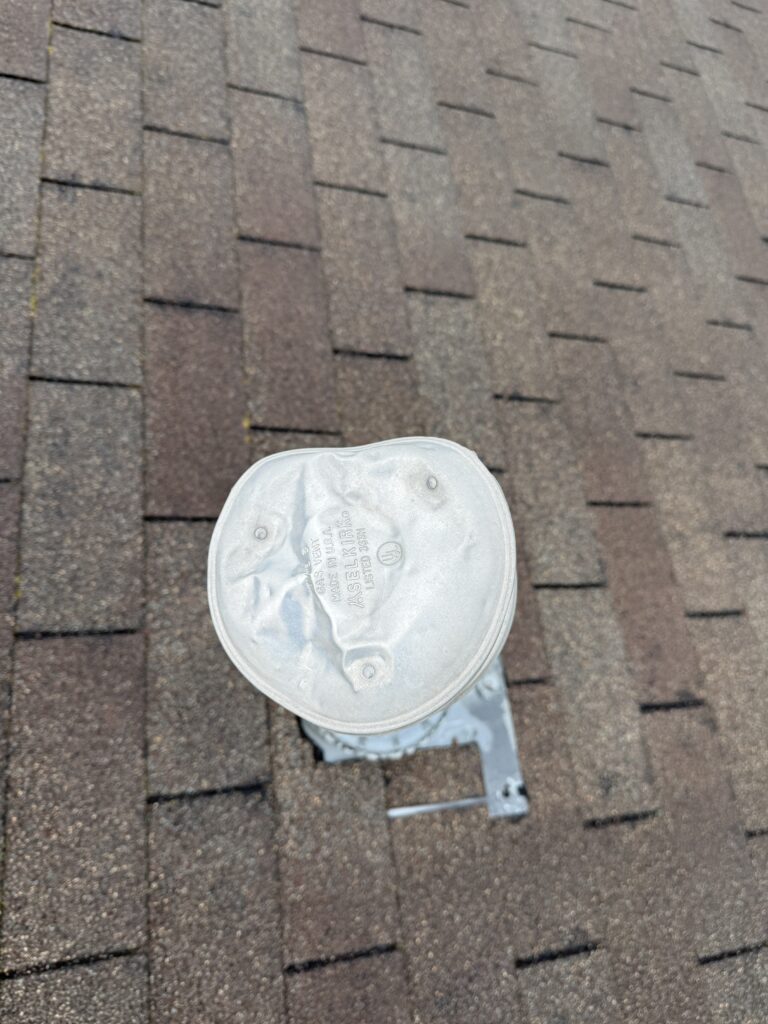
- Install the cap. A roof cap is set into the shingles and flashed like any other roof vent, and it has a damper that closes when the fan is off. Our guide to roof vent leaks shows why that flashing matters.
- Run the duct. The duct is insulated, as short and straight as possible, and connected at both ends with clamps and foil tape. Insulation keeps the warm air from condensing inside the duct in a cold attic.
- Seal around the fan. Gaps between the fan housing and the ceiling let warm air leak into the attic, so they are sealed.
- Repair the damage. Wet insulation is replaced, and soft or moldy roof decking is cut out and replaced.
- Check the attic ventilation. Intake at the soffits and exhaust at the ridge are balanced, so the attic dries on its own. Our guide to ridge vents and box vents explains how that balance is sized.
If your roof is due for replacement, the roof cap goes in with the new shingles, and the decking is checked across the whole roof at the same time.
After the fix: getting the most from the fan
Run the fan during every shower and leave it on until the mirror clears. Short runs leave moisture in the bathroom that ends up in the walls and ceiling.
Look in the attic again during the first cold snap after the fix. Clean, dry nails and sheathing around the fan mean the moisture is going outside. If a ceiling stain stays wet, our guide to ceiling water stains helps you trace it.
Get your bath fan and attic checked
Buckshot Exteriors is family-owned, has served homeowners since 1979, and has offices in Madison, Wisconsin and Centerville, Iowa. Our own crews install roof caps, run and seal fan ducts, replace damaged decking and balance attic ventilation.
Call (608) 909-9109 to schedule a free attic and roof inspection, or send us a message and we will set a time. If you would rather check first, look in the attic on the next cold morning and photograph what you find.
Get a straight answer on your Madison roof
Wisconsin storm season and insurance non-renewal letters do not wait. Get a free, no-obligation inspection and an honest assessment of exactly what your roof needs, even if the answer is to wait.