
No. Hail maps and hail reports show where hail was detected or reported across a wide area. They don't tell you what size stone hit your block, which direction it came from, or whether your shingles and siding took functional damage. Treat the map as a reason to look closely, not as proof either way.
Get My Free Estimate →- Start with soft metals, not the roof
- Then check your siding, especially the storm-facing walls
- Look at the roof from the ground
- Photograph spatter marks before they fade
- How big does the hail have to be?
- When to call an adjuster after a hail storm
- Be careful who knocks on your door
- If water is coming in right now
- Get a straight answer before you file
- FAQs
If you just pulled up a hail map and saw a dot sitting over Waterloo, here is the straight answer: that map only proves hail fell somewhere near you. Whether your roof, siding and gutters actually got hurt takes a close look at your house.
Hail is a regular part of spring and summer storm season in the Cedar Valley, and damage often runs in narrow streaks. The same storm can hit one street hard and leave the next block alone.
Siding is usually the first damage a homeowner can actually see, because it sits at eye level and you don't need a ladder to find it. So start there, and walk your house the way an experienced eye would. Most of this takes about twenty minutes from the ground with your phone in your hand.
Start with soft metals, not the roof
Check the soft metal first: gutters, downspouts, roof vents, metal flashings, the fins on your air conditioner condenser, metal fascia, even the mailbox.
Soft metal is the cheapest hail gauge you own. Round dents there tell you the stones that hit your property were big enough to matter, and that changes how hard you look at everything else.
- Round or oval dents on the top edge and face of gutters, and on the sides of downspouts
- Dings in the metal hoods on roof vents
- Flattened or pocked fins on the A/C condenser, worst on the storm-facing side
- Dents in metal garage door panels and steel entry doors
- Bent drip edge and gutter apron
One caution: dented metal doesn't automatically mean your shingles are finished, and clean metal doesn't always mean the roof is fine. Soft metals are an indicator, not a verdict.
Then check your siding, especially the storm-facing walls
Walk all four sides. Look at each wall straight on, then from a sharp angle with the light raking across it. That second look is how you find damage you would otherwise miss.
Vinyl siding
Vinyl cracks and punches rather than dents.
- Hairline cracks, half-moon chips and clean round holes in the panels
- Damage concentrated on one or two elevations, usually the side the storm came from
- Panels knocked loose at the bottom lock
Temperature matters. Vinyl turns brittle when it is cold, so hail early in the season can crack siding that the same stones might bounce off in summer. Age matters just as much: vinyl that has been in the sun for decades cracks at hail sizes newer siding handles. We go deeper on that in our guide to hail damage on siding.
Steel, aluminum and trim
Metal siding dents. Sight down the wall from a corner to pick up the dimples. Check window wraps, corner posts, soffit and garage door trim too, since aluminum wrap shows hail readily. If you have metal siding or a metal roof, read the section below on cosmetic damage before you assume dents are covered.
Fiber cement, stucco and brick
Fiber cement chips, leaving small craters with lighter color showing through. Stucco pocks and cracks. On brick homes the brick itself usually survives, so shift your attention to mortar joints, windows and the roof.
If only one wall is damaged
Ask about matching before anything gets ordered. Siding colors get discontinued and old panels fade, so a new panel next to weathered siding rarely disappears. How an insurer handles that depends on your policy wording and the adjuster, so get the conversation on the record early instead of discovering it on install day.
Windows, screens and everything at eye level
- Torn, dimpled or punched window screens
- Chipped glass, broken seals, cracked vinyl window frames
- Dents in deck trim, shed skirting and detached garage metal
- Shredded leaves and stripped plants under one wall, which tell you the storm's direction
Look at the roof from the ground
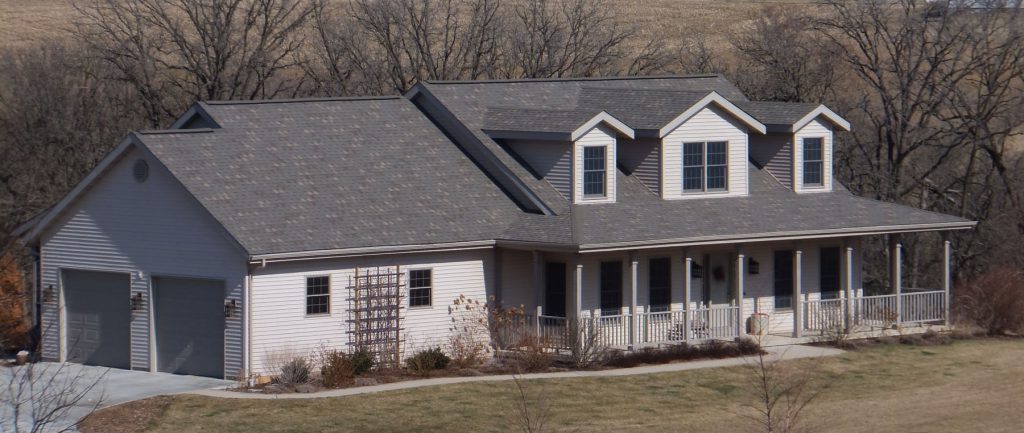
Stay off the roof. Binoculars or a zoomed phone photo from the driveway and the back yard will tell you plenty.
- Dark spots or bruises where granules were knocked off and the mat shows through
- Scuffed ridge caps and hips, which take hail hardest
- Granules collecting in gutters, at downspout outlets, and washed into the driveway
- Dented pipe boots, cracked plastic vent covers, damaged skylight flashing
- Lifted, creased or missing shingles, which point to wind rather than hail
Granule loss is the one people misread. A few granules after a hard rain is normal shedding on a newer roof. Piles at one downspout plus visible bruising on the storm-facing slope is a different story, and confirming true hail bruising takes hands on the shingle. Our photo walkthrough on how to spot hail damage on your roof shows what that looks like up close.
A general pattern worth knowing before you draw conclusions from the driveway: with wind-driven hail, one or two sides of the roof can take the beating while the rest looks untouched from the ground. A front slope that reads clean tells you nothing about the back slope.
Photograph spatter marks before they fade
Hail leaves spatter marks: clean spots where a stone knocked dirt and oxidation off a grimy surface. Check gutter tops, the electric meter, deck boards, painted downspouts, fence rails and the driveway. Those marks help show that hail hit your property, and they wash away within weeks of normal weather.
Photograph them now. Wide shot first so the house is identifiable, then close up. Do the same for every dent and crack, and write down the storm date.
How big does the hail have to be?
The National Weather Service calls hail 1 inch across (quarter size) or larger severe, and damage to an average asphalt roof becomes much more likely around that size.
Smaller is not automatically harmless. Smaller stones driven by strong wind can still crack cold vinyl, dent soft metals and bruise older shingles that have lost their flexibility. Age, pitch, wind direction and the number of impacts all feed into it, which is why what size hail damages a roof never has one clean answer.
Not sure what you are looking at? A free, no-pressure on-site inspection settles it. Call (608) 909-9109.

Want a straight answer on your roof?
We'll inspect it, document everything, and tell you honestly what you're looking at, even if the answer is patch it for now. No pressure.
When to call an adjuster after a hail storm
Get an inspection first, then file. Order matters.
A free contractor inspection is not a claim. Filing a claim, and with some insurers even an inquiry, can go on your loss history, so it makes sense to know you have real damage before you make that call. Don't wait too long, though: your policy sets its own deadline for reporting damage, and the evidence fades.
Three things to check before you call it in
- Turn your wind and hail deductible into a dollar figure. Many policies use a percentage of dwelling coverage for wind and hail instead of a flat amount. Our explainer on percentage wind and hail deductibles walks through the math.
- Find out whether your roof is covered at replacement cost or actual cash value. Actual cash value subtracts depreciation for age, and on an older roof that shrinks the payout a lot.
- Look for a cosmetic damage exclusion. Some policies don't pay for dents that mark the surface but don't affect function, and these clauses most often affect metal roofs, metal siding and metal trim. If you have steel or aluminum anywhere on the house, ask your agent plainly whether that clause is on your policy.
The full sequence from first call to final payment is laid out in our breakdown of the insurance claim process.
What the adjuster will do on your roof
Adjusters commonly mark a 10 by 10 foot test square on each roof slope and count the hail hits inside it, then cross-check against your soft metals and siding. How many hits an insurer treats as enough for a full replacement varies by insurer, so no one should quote you a single number as a universal rule. What they are judging is functional damage: a hit that fractured the shingle or exposed the mat, not just a cosmetic mark.
Have your contractor meet the adjuster on site
This is the most useful thing you can do. We meet your insurance adjuster at the house to document the hail damage, so every slope plus the siding, gutters, window wraps and detached garage get recorded, not just the obvious front-slope damage. A roof can have four, six or more planes, and hail doesn't hit them equally. That documentation is the core of our hail damage work, and you can see what else we handle on our Waterloo, Iowa service page.
If the claim is denied or only partly approved
You are not stuck with the first answer. Request the adjuster's report and photos in writing, then consider a reinspection with your contractor present, a supplement for damage found during tear-off, or the appraisal provision many policies contain. A public adjuster, who works for you for a percentage of the settlement, is another option on a large loss; confirm they are licensed in Iowa and get the fee in writing. If the process stalls, Iowa's state insurance regulator accepts consumer complaints about claim handling.
If the damage is real but under your deductible
Get a free written estimate so you are comparing a real number to your deductible, fix the active failure points first (punched pipe boots, torn flashing, split vent hoods), and phase the rest if you need to, since cracked siding is usually not an active leak.
Be careful who knocks on your door
After a hail event, out-of-town crews often work neighborhoods door to door. Some are legitimate; some are gone before the first leak shows up.
- Ask for a local physical business address, not just a cell number
- Ask for written proof of liability and workers' compensation insurance
- Ask for proof of state contractor registration and verify it yourself
- Never sign a contract, an authorization to repair, or anything assigning your insurance claim on the spot
If someone offers you a "free roof" by waiving or rebating your deductible, end the conversation. An offer like that can amount to insurance fraud, and it is your name on the claim. Take a day to think. Any honest company will wait. For more questions to ask, see our guide to roofing and gutter companies in Waterloo.
If water is coming in right now
Active water is the one thing that can't wait. Call (608) 909-9109, our 24-hour storm line, and get temporary protection on the opening. Inside, move furniture and electronics clear, set out buckets, and if a ceiling is sagging, cut power to that room at the breaker and stay away from fixtures. Photograph everything before you cover or clean it, keep every receipt, and don't climb a wet roof to tarp it yourself.

Get a straight answer before you file
The inspection is free and there is no obligation. If your roof and siding came through fine, you'll hear that. If there is real damage, you'll know what filing would actually involve before you make the call.
Buckshot Exteriors is family-owned and has been doing exterior work since 1979, with offices in Centerville, Iowa and Madison, Wisconsin. We handle roofing, siding, gutters, windows and doors, so you get a read on the whole exterior, and our storm and hail damage restoration team meets adjusters on site.
Call (608) 909-9109 for a free inspection. Do it while the spatter marks are still there.
Get a straight answer on your Madison roof
Wisconsin storm season and insurance non-renewal letters do not wait. Get a free, no-obligation inspection and an honest assessment of exactly what your roof needs, even if the answer is to wait.