
Yes - it can affect your deductible, your payout, and even whether your claim is approved. Many Wisconsin policies now carry a separate, higher deductible for hail damage. Wind damage may fall under your standard deductible. The classification affects real money.
Get My Free Estimate →- Why the Wind vs. Hail Distinction Matters to Your Insurer
- What Wind Damage Looks Like
- What Hail Damage Looks Like
- How Adjusters Document Each Type
- Get Your Own Inspection First - Before the Adjuster Arrives
- Watch Out for Storm Chasers
- Wind and Hail Together: The Most Common Scenario
- What to Do Right Now If You Think You Have Storm Damage
- FAQs
A storm rolls through Dane, Rock, or Green County. You walk outside the next morning and something just looks off - a few shingles in the yard, maybe some dents in the gutters, a neighbor already on the phone with their insurance company. You're not sure what you're dealing with or where to start.
Here's the first thing to understand: how your damage gets classified matters more than most homeowners realize. Wind damage and hail damage are covered differently, documented differently, and - in a lot of Wisconsin policies - come with different deductibles. Getting that classification wrong, or letting someone else get it wrong on your behalf, can cost you thousands.
This article walks you through exactly how insurers tell the two apart, what their adjusters are looking for on your roof, and how to protect yourself through the process.
Why the Wind vs. Hail Distinction Matters to Your Insurer
Insurance companies aren't just being picky when they ask whether damage came from wind or hail. It's a coverage and liability question.
In Wisconsin, many homeowner policies - especially those written or renewed in the last five to ten years - now include a separate wind and hail deductible. This is often calculated as a percentage of your home's insured value rather than a flat dollar amount. On a $300,000 home, a 2% wind/hail deductible means you're absorbing the first $6,000 out of pocket before your insurer pays a dime.
Some policies separate wind and hail into two different deductibles. Others lump them together. You need to read your declarations page carefully - or have your agent walk you through it - before you assume anything.
The classification also matters for claim history. Multiple hail claims in a short period can affect your renewability or premiums. Knowing exactly what you're filing, and why, gives you a cleaner record.
What Wind Damage Looks Like
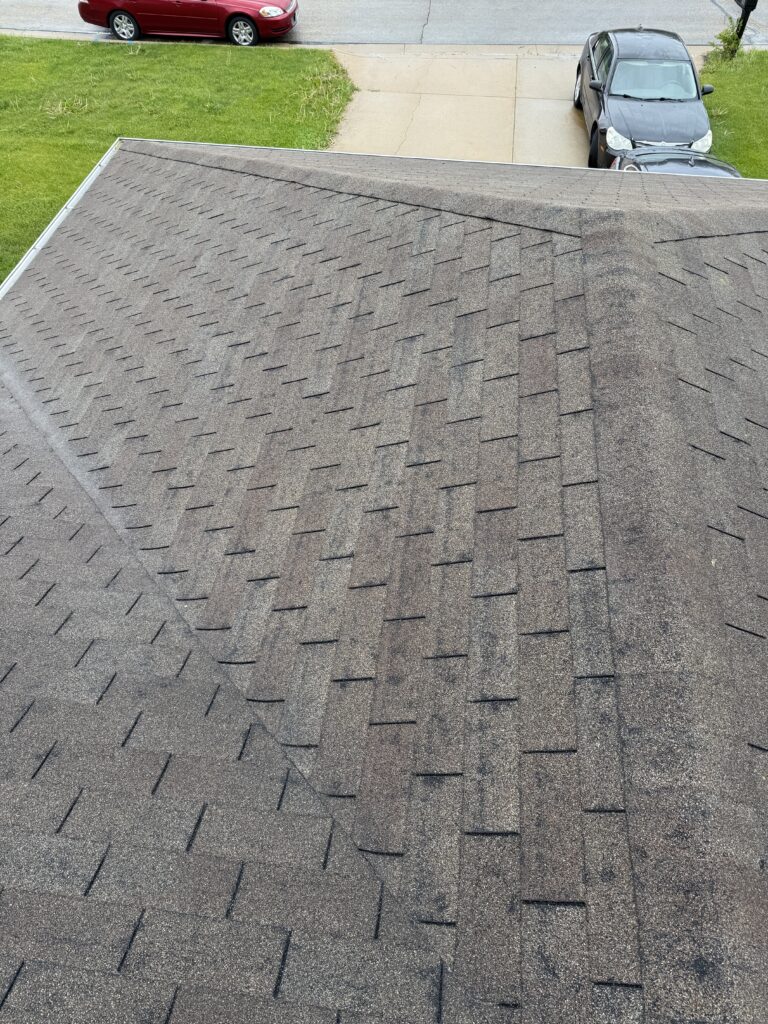
Wind damage tends to be directional and mechanical. It tears, lifts, and strips. On a roof, here's what adjusters are trained to spot:
- Missing shingles - often in clusters, usually on the windward face of the roof
- Lifted or creased shingles - the adhesive seal strip breaks and shingles fold back, crease, then re-seal in a compromised position
- Exposed fasteners or torn flashing - wind gets under edges and pulls
- Damage concentrated on one slope - because wind comes from a direction
- Tree limb or debris impact - punctures, gouges, crushed decking
One thing adjusters look for with wind: a pattern. If shingles are missing or damaged on the north-facing slope but the south-facing slope is untouched, that's consistent with a directional wind event. Random scatter across all slopes raises questions.
Wind damage is also more visible from the ground, which is both good and bad. It's easier to notice, but it also means you might spot the dramatic stuff and miss the subtler damage that adds up over time.
What Hail Damage Looks Like
Hail damage is different in character - and honestly, it's harder for an untrained eye to catch.
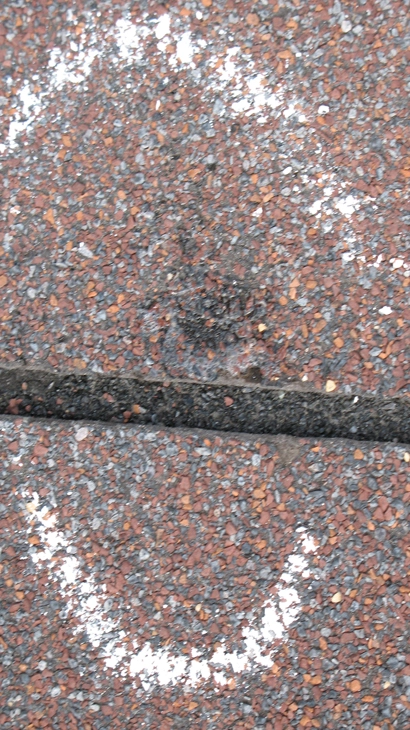
On asphalt shingles, fresh hail hits look like small circular impact craters where the granules have been knocked loose. The dark fiberglass mat underneath shows through. Run your hand across it and you'll feel the divot. These marks are random in pattern - hail falls somewhat vertically and hits wherever it hits, so you'll see impacts scattered across all roof slopes.
Key signs adjusters document for hail:
- Granule loss in circular patterns - distinct from normal wear, which tends to be uniform
- Soft-metal damage - dents on gutters, downspouts, AC condenser fins, roof vents, and flashing. This is often the best evidence of a hail event because metal doesn't lie.
- Bruising on the mat - sometimes you can feel a soft spot even if the granule loss isn't obvious yet
- Cracked or split shingles - from large hail, though this is less common with modern fiberglass shingles
Here's something important: hail damage often doesn't leak right away. The granules are your shingles' UV protection and weathering layer. Once they're gone, the mat degrades faster, and you might not see a leak for another year or two. By then, your claim window may have closed.
This is exactly why a professional inspection matters - not just to document the damage, but to catch the damage that's there before it becomes a leak.
How Adjusters Document Each Type
A thorough adjuster will use a chalk grid method on your roof - dividing the surface into sections and counting impacts per square foot. For hail, they're typically looking for a minimum number of impacts per 10-square-foot test square (the threshold varies by insurer and shingle type).
They'll also check your soft metals. Gutters and downspouts are particularly useful because they show the size of hailstones and the density of the storm. A good adjuster photographs these carefully.
For wind, they're measuring shingle adhesion, documenting missing tabs, checking for creasing and seal failure. They may pull up a corner of a shingle to check whether the seal strip is intact.
Here's the problem: adjusters are human, they're busy, and they're working for the insurance company. That's not a conspiracy - it's just reality. An adjuster who spends 20 minutes on a roof in a hurry will miss things. A contractor who knows what to look for, and who is standing right there with documentation in hand, changes the dynamic.
Get Your Own Inspection First - Before the Adjuster Arrives
This is the single most important piece of advice in this article.
Before you call your insurance company to schedule an adjuster visit, get a contractor up on that roof. A contractor who works storm claims regularly knows exactly what adjusters look for and can document everything - photos, measurements, soft-metal impacts, granule loss - before anything gets disturbed.
Then, when the adjuster comes out, have your contractor there. On the roof. Walking it together.
At Buckshot Exteriors, we do this routinely. We meet your adjuster on-site, point out what we've documented, and make sure nothing gets overlooked. We've been doing this work in south-central Wisconsin since 1979 - we know how these inspections go, and we know how to make sure your claim reflects the actual damage to your home.
Check out what our customers say about working with us through the claims process.
Want a straight answer on your roof?
We'll inspect it, document everything, and tell you honestly what you're looking at, even if the answer is patch it for now. No pressure.
Watch Out for Storm Chasers
After any significant storm in Dane, Rock, or Green County, the out-of-state trucks start showing up. Contractors who follow the weather, knock on doors, and pressure homeowners to sign paperwork before they've had a chance to think.
Some red flags to watch for:
- Pressure to sign an Assignment of Benefits (AOB) form immediately - this transfers your claim rights to the contractor, and you lose control of the process
- Offers to waive your deductible - this is insurance fraud in Wisconsin, full stop
- No local address, no verifiable license, no permanent presence in the area
- Vague or verbal-only estimates - nothing in writing until after you've signed something
- "We'll handle everything with your insurance" with no explanation of what that means
A legitimate local contractor will give you a written estimate, explain the process clearly, and never pressure you to sign anything on the spot. They'll still be here six months from now if there's a warranty issue.
Wind and Hail Together: The Most Common Scenario
Most significant storms in south-central Wisconsin bring both. A line of severe thunderstorms typically delivers wind gusts and hail at the same time. Your roof may have directional wind damage on one slope and hail impacts across all four.
A good contractor documents both, separately and thoroughly. A good adjuster accounts for both. The goal is a complete, accurate claim - not a padded one, and not an incomplete one.
If you're not sure what hit your roof, or you think you might have damage but can't see anything obvious from the ground, that's exactly when to call. A professional residential roofing inspection takes the guesswork out of it.

What to Do Right Now If You Think You Have Storm Damage
- Don't go on the roof yourself - it's dangerous and you may disturb evidence
- Document what you can from the ground - photos of the yard, gutters, any visible damage
- Call a local contractor for a free inspection before you call your insurer
- Review your policy's declarations page - know your deductible and your coverage before the adjuster arrives
- Don't sign anything from a door-to-door contractor
The sooner you act, the better your documentation and the cleaner your claim.
If you're in Dane, Rock, or Green County and you've had a storm come through recently - or even if you're not sure when the damage happened - we're here to help. Our team at Buckshot Exteriors has been handling storm damage claims across south-central Wisconsin for over four decades. We'll get on your roof, document everything, and be there with you when the adjuster shows up.
Contact us today for a free inspection. No pressure, no obligation - just an honest look at what you're dealing with and a straight answer about what comes next.
Get a straight answer on your Madison roof
Wisconsin storm season and insurance non-renewal letters do not wait. Get a free, no-obligation inspection and an honest assessment of exactly what your roof needs, even if the answer is to wait.