No, as long as the crew installs to cold-weather spec. Shingle manufacturers permit winter installation. The differences are hand-sealing shingles that will not self-seal in the cold, careful handling so shingles do not crack, and pressing ice-and-water membrane onto a clean, dry, frost-free deck so it actually bonds. A crew that skips those steps leaves you problems in any season.
Get My Free Estimate →- Can shingles be installed in cold weather? Yes, with a different procedure
- What a competent winter crew does differently
- What a real January job in Madison looks like
- What it costs, and how the money works
- Winter scheduling: lead time, permits, and the blizzard contingency
- Who is actually on your roof, and how to verify us
- Insurance mechanics: deductible, holdback and timing
- Ice dams and gutters this winter: what to do right now
- When waiting until spring actually is the right call
- What a winter job is like to live through
- Get a straight answer before the next thaw
- FAQs
Yes. Roofs get replaced in Wisconsin in December, January and February, and they always have. If a contractor told you to "just wait until spring," that may be honest advice for your specific roof, or it may mean their crews are booked and nobody wants a cold job.
Here is what matters more than the calendar: a failing roof does not pause for winter. Freeze-thaw cycles, ice dams and wind-driven snow are harder on a compromised roof than a July thunderstorm is.
So the real question is not "can it be done in winter." It is "does my roof need to come off now, and does this crew know how to shingle in the cold?" Below is the straight answer, including real Madison-area numbers.
Can shingles be installed in cold weather? Yes, with a different procedure
Asphalt shingle manufacturers permit cold-weather installation. They require a different method, and that method is printed in their installation instructions.
Below roughly 40F, two things change about the shingle.
The sealant strip stops self-sealing. Architectural shingles have a factory adhesive strip that softens with sun and heat and bonds each course to the one below it. That bond is what makes the roof wind resistant. In the cold, the strip stays firm. It melts in and seals on its own once we get a run of sunny 50F days, but until then the shingles are held by nails.
The shingle gets brittle. Cold asphalt does not flex. Bend a cold shingle the way you would casually bend a warm one and it cracks along the fold. Cut it with a dull blade and the edge fractures instead of slicing clean. Drop a bundle on a frozen deck and you can crack shingles inside the wrapper.
Neither of those is a reason to skip a roof you need. They are reasons to hire a crew that adjusts.
Roof replacement cost by home size (Madison, 2026)
| Home | Roof size | Typical total |
|---|---|---|
| Small ranch / bungalow | 14-18 squares | $9,000-$13,000 |
| Average two-story | 18-26 squares | $12,000-$18,000 |
| Large or complex (steep) | 26+ squares | $17,000-$25,000+ |
Cost by roofing material (average Madison home, installed)
| Material | Lifespan | Typical total |
|---|---|---|
| Architectural asphalt (standard) | 25-30 yrs | $12,000-$18,000 |
| Impact-resistant (Class 4) | 30+ yrs | $15,000-$22,000 |
| Standing-seam metal | 40-50 yrs | $25,000-$45,000 |
Common add-on costs
| Item | Typical cost |
|---|---|
| Extra tear-off layer | $500-$1,500 |
| Decking replacement | $50-$80 per sheet |
| New flashing & pipe boots | $300-$700 |
| Seamless gutters | $1,000-$2,500 |
Typical Madison-area 2026 ranges. Your exact price depends on an on-site inspection. A new asphalt shingle roof recoups about 61% of its cost at resale on average (2024 Remodeling Cost vs. Value Report).
Quick roof replacement cost estimator
Get a ballpark in 20 seconds. For an exact figure, book a free on-site inspection.
What a competent winter crew does differently
Ask any bidder about this list. If they cannot answer in plain language, that tells you plenty.
- Hand-sealing. Every course gets manual dabs of asphalt roof cement under the tabs, at the spot size and placement the manufacturer specifies. Not a random smear, and not so much that it telegraphs through the shingle. This is the clearest tell of a real winter install.
- Warm shingles, staged in small batches. Bundles kept in a heated trailer or indoors and carried up as needed, not left frozen on the deck all morning. Warm shingles cut clean and lie flat.
- Sharp blades, changed constantly. Cold asphalt eats blades, and a dull blade means fractured cuts at valleys, vents and rakes.
- Real ice-and-water shield adhesion. Self-adhering membrane at eaves and valleys needs a clean, dry, frost-free deck. Cold slows adhesion, so it gets warmed, rolled and pressed, and in some conditions primed. Membrane laid down cold and never bonded is worse than useless, because water travels underneath it.
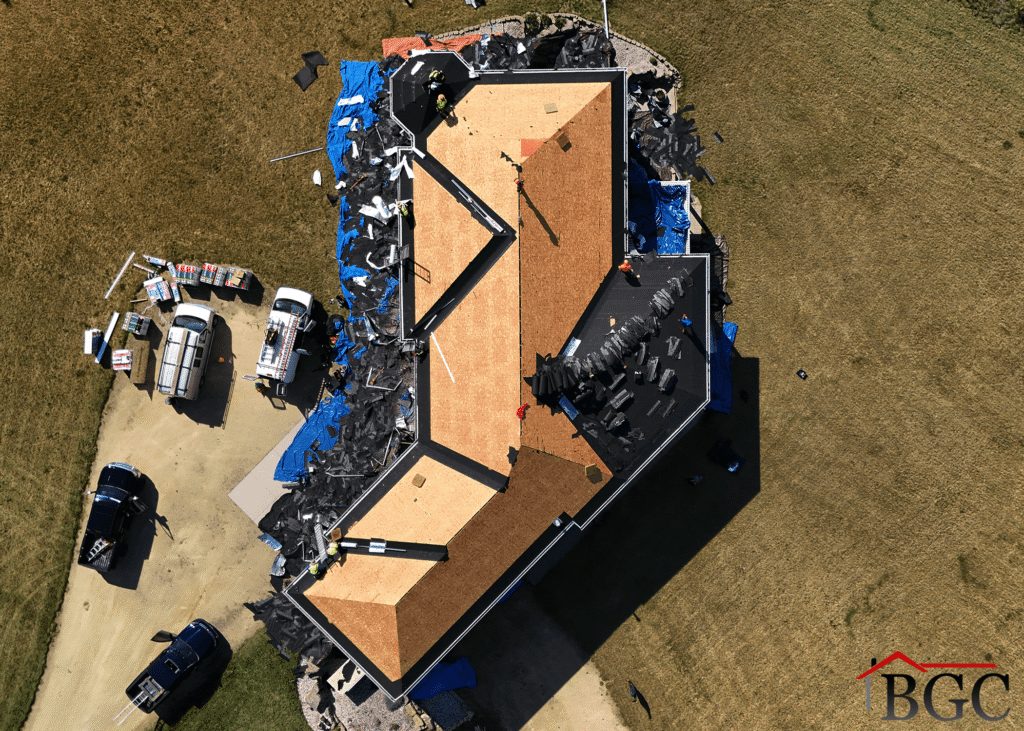
- Section-by-section tear-off. Open only what can be dried in and shingled that day.
- Nail gun pressure checked by hand. Cold, hard shingles and stiff decking change how a nail seats. Overdriven nails cut the shingle mat, underdriven nails hold the next course off the deck.
- Frost and snow removal before anyone climbs. Frost on an 8/12 pitch is a genuine hazard. Safety slows the day, and it should.
The warranty question, answered straight
A correctly installed winter roof carries the same material warranty term and the same expected service life as a July install. Cold weather does not shorten either one. Bad installation does, in any month.
The condition is hand-sealing. GAF's shingle application instructions include a cold-weather section that calls for hand-sealing with asphalt plastic cement when shingles are applied in cool temperatures, and the spec sheet for your specific shingle (printed on the bundle wrapper and posted at gaf.com) gives the temperature threshold, dab size and placement. Ask your contractor to hand you that page. Then ask for the cold-weather procedure to be written into your contract.
During the pre-seal window, the nailing pattern plus those hand-seal dabs hold the roof. Once you get a few consecutive sunny days in the 50s, usually March or April here, the factory strip melts in and takes over. South slopes seal first, north slopes last. As a GAF Master Elite certified contractor, we document that hand-sealing step as part of the install, which is exactly what protects your warranty later.
Also plan for daylight. Madison gets a little over nine hours in late December, and useful roofing light is less. A roof that runs one long day in September may take a day and a half to two days in January. Not worse. Longer.
What a real January job in Madison looks like
Here is an actual job, address withheld, so you know we are not talking in theory.
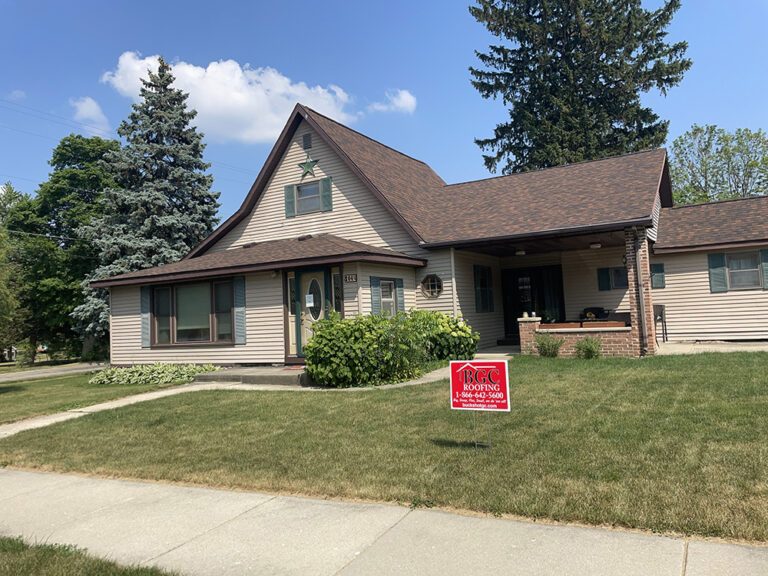
A 1970s ranch on Madison's west side, 22 squares, one layer of three-tab, called in mid-January with a ceiling stain in a back bedroom. It was 24F at tear-off with three inches of old snow on the roof.
The crew shoveled and swept the north slope, tore off about eight squares, and found four sheets of 7/16 decking soft at the eave where an ice dam had been backing water under the old felt for years. Those sheets were replaced, ice-and-water shield ran up from the eave and was rolled hard to bond, then synthetic underlayment, then architectural shingles hand-sealed course by course. That slope was buttoned up before dark. The south slope went on the next day, with a new ridge vent and soffit baffles cut in so the intake was not smothered by insulation.
Two days, one dumpster on frozen ground with no ruts, and the homeowner kept the photo report of the rotted decking for her records.
What it costs, and how the money works
For architectural shingles on a typical Madison-area home, honest ranges look like this:
- Simple ranch, 16-20 squares, one layer, walkable pitch: roughly $8,500-$13,000
- Average two-story, 22-28 squares: roughly $11,000-$18,000
- Steep, cut-up or multi-layer roofs, or ones needing significant decking: $18,000-$32,000 and up
Those are ranges, not quotes. Your number comes off a measured estimate. What drives it up: pitch above about 7/12 (roof jacks, slower work, more labor), two or three layers to tear off and haul, decking replacement, skylights, chimney and wall flashing, wider ice-and-water coverage, and Class 4 impact-resistant shingles, which typically add in the neighborhood of 15-25 percent but can earn an insurance discount.
We do not price winter jobs higher. Winter takes a bit longer per square, and material pricing moves for reasons nobody in this industry controls, so we lock your price in the signed contract and it does not change if the market does.
Deposit and payment schedule
This is where homeowners get burned, so be specific with every bidder.
Reasonable in Wisconsin looks like: nothing before a signed contract with a scope of work attached, a deposit tied to material order (commonly 10-30 percent, and often zero on an insurance job where the carrier's first check funds materials), a draw when material is delivered or the tear-off is complete, and the balance only after final cleanup and any municipal inspection. Nobody should ask for half the job in cash before a truck rolls.
Ask what happens to your deposit if weather stalls the job for three weeks. The right answer, and the one we put in writing: the deposit stays applied to your materials, the price does not change, and if you cancel before material is ordered you get it back. Also ask about lien waivers from the supplier, because that is your protection that the shingles on your roof are actually paid for. If cash flow is the issue, we will tell you exactly what financing is available when we measure, not after you sign.
Not sure whether what you are seeing is urgent or can hold? Call us. We will come look and tell you straight, no cost and no pressure either way.
Winter scheduling: lead time, permits, and the blizzard contingency
Winter lead time in Dane County is usually days to about two weeks, versus several weeks once hail season fills the calendar. That availability is the genuine upside of a January job. You also get our senior crew instead of whoever is left in July.
If a storm moves in mid-job, the contingency is simple and you should demand it in writing. We only strip what can be dried in that day. Any open slope gets underlayment and ice-and-water down, then tarped and mechanically fastened before the crew leaves, and we return on the next workable day. Bare decking never sits overnight, and it never sits over a weekend.
Permits do not slow winter down. Most Dane County municipalities, Madison included, require a building permit for a tear-off re-roof, and we pull it as part of the job. Permits are issued year round through the city's online portal. If your municipality inspects the ice-and-water shield or replaced decking, we schedule it and meet the inspector.
Who is actually on your roof, and how to verify us
Ask every bidder one question: are the installers your W-2 employees or a subcontracted crew? Either can be fine. What is not fine is a workers comp certificate for the office staff while an uninsured sub crew is on your roof, which is the number one hidden risk in a storm-chaser winter market. Ask for a certificate of general liability and workers comp sent directly from the agent, naming the entity whose people will actually be installing. Ask who the on-site foreman is and whether anyone in charge speaks with you daily. We will tell you exactly who is coming and get you the certificate for that crew.
Also verify:
- State credentials. Wisconsin requires a Dwelling Contractor registration and a Dwelling Contractor Qualifier certification through DSPS for work like this. Both are searchable at dsps.wi.gov.
- Manufacturer credential. Ask for our GAF Master Elite ID and check it on GAF's contractor lookup. That certification requires licensing, insurance and a documented track record.
- Real local proof. Read our customer reviews and look us up independently on Google, Birdeye, Angi, HomeAdvisor and the BBB. Then ask for addresses of Dane County roofs we installed in January or February so you can drive by, plus homeowner references from those specific jobs.
- Written warranty terms. Workmanship warranty length and what it covers, in the contract, not a verbal "we stand behind our work."
Our inspection is not a look from the driveway. It includes the attic (staining, frost on nail heads, compressed insulation, blocked soffits), a probe of soft decking, flashing and pipe boots, gutter and eave condition, and a walk of the field where conditions allow. You get a written photo report emailed to you and yours to keep. If you are filing a claim, that file goes straight into your claim documentation.

Want a straight answer on your roof?
We'll inspect it, document everything, and tell you honestly what you're looking at, even if the answer is patch it for now. No pressure.
Insurance mechanics: deductible, holdback and timing
If a storm caused the damage, here is how the money moves.
You pay your deductible. If your policy uses a percentage deductible, increasingly common on wind and hail endorsements, it is a percentage of your dwelling coverage rather than of the roof, so on a $400,000 dwelling a 1 percent deductible is $4,000. Check your declarations page.
Most policies are replacement cost value (RCV), which means the carrier pays actual cash value (ACV) first, holds back depreciation, and releases that holdback when the work is done and invoiced. That is a real argument for finishing in winter: completing the job releases the holdback now instead of in June. If your policy is ACV only, you keep the depreciation and the gap comes out of pocket.
On timing, do not rely on generalities. Policies require prompt notice of a loss and reasonable steps to prevent further damage. Some Wisconsin property policies limit the time to file suit to as little as 12 months from the date of loss, so read your policy's suit-limitation clause, and if you are anywhere near that window, talk to your agent or an attorney now. Separately, delay gives the carrier a fair argument that your damage came from months of ice and water rather than from the August storm, and that is a much harder fight than filing on time.
If the adjuster's scope comes in short, that is normal and fixable. We supplement with photos, measurements and line items, and we meet your adjuster on the roof so everyone is looking at the same shingles. That is standard on our hail and storm damage restoration work in Dane County, and it does not wait for warm weather.
One Wisconsin note: Wisconsin law prohibits a contractor from paying, waiving, rebating or absorbing all or part of your insurance deductible as an inducement to sign. If you want to verify it before you sign anything, the Office of the Commissioner of Insurance (oci.wi.gov) and DSPS both publish homeowner guidance on storm-repair contracts. Anyone offering to "eat the deductible" is telling you what kind of company they are.
Ice dams and gutters this winter: what to do right now
A new roof manages the water. It does not remove the ice already on your eaves, and it does not fix the cause.
Ice dams start inside your house. Warm air leaks into the attic through can lights, top plates, bath fan penetrations, plumbing chases and the attic hatch. That heat warms the deck, snow melts, water runs to the cold overhang and refreezes into a dam. Then it backs up and finds any weakness.
If water is coming in now, do not wait for the roof. Removal should be done with low-pressure steam. Never a hammer, chisel, ice pick or bagged salt, all of which tear shingle mats, crack gutter seams and void warranties. We run 24-hour emergency response through the winter, so call and we will tell you what your situation actually needs and get the right equipment on it.
Heat cable is a band-aid, not a fix. It works only when it is run in a proper zig-zag at the eave and continued through the gutter and down the downspout so the meltwater has somewhere to go. Gutters that are crushed, pitched wrong or full of frozen debris make dams worse, and gutter work is often better handled with the roof so the drip edge, ice-and-water shield and gutter hangers all line up.
The permanent fix is attic air sealing and insulation. We handle the roof side, including ventilation, baffles and venting bath fans through the roof instead of into the attic, and we will tell you honestly when the real problem is 6 inches of settled 1975 fiberglass. Focus on Energy incentives often help with attic air sealing in Wisconsin.
When waiting until spring actually is the right call
We would rather tell you to wait than sell you a roof you do not need this month. Wait if:
- The wear is cosmetic and the roof is sound. Some granule loss, mild fading, a couple lifted tabs we can spot repair. Dry deck, clean attic, no staining? A 17-year-old roof can make it to April.
- You have one localized problem. A cracked pipe boot, failed step flashing at a chimney, a small blown-off section. Targeted roof repair in winter is routine and buys you time to plan.
- You are mid-claim and the scope is not settled. Get the paperwork right first.
- You want a specialty system. Some metal panel, tile and low-slope membrane systems have real temperature restrictions. We will tell you if yours does.
Do not wait if you have an active leak, wet insulation, spongy or sagging decking, daylight through the deck, or a slope that already blew off. A leak fixed in November is usually shingles and a few sheets of decking. The same leak in March can add insulation, drywall, paint and sometimes mold remediation.
What a winter job is like to live through
The house stays warm. The attic is between you and the work. You will hear it, so cover attic-stored items and take pictures off top-floor walls.
- You do not need to be home, but be reachable. If we open the deck and find rot, we send a photo and get your okay before adding sheets.
- Stake your shrubs before the first big snow. We cannot see what is buried.
- Frozen ground is an advantage. Dumpsters and loaded trucks that would rut an April lawn sit on solid ground in January.
- Cleanup is harder in snow, and we will say so. Magnet sweeps daily and at completion, plus a return pass after the melt. Get that in writing.
Get a straight answer before the next thaw
If you are staring at a questionable roof in Madison, Sun Prairie, Verona, Middleton or anywhere in Dane County, find out what you are actually dealing with before winter decides for you. It costs nothing to know, and we are not going to sit at your table pushing a contract. Plenty of the homeowners we look at in December get told the roof is fine until spring.
Buckshot Exteriors has been locally owned and operated since 1979. Roofing, siding, gutters, windows and doors, 24-hour emergency storm response all winter, and we meet your insurance adjuster on the roof to document hail and wind damage with you.
Call for a free, no-pressure inspection, or request one here. For a decision in the $8,500-$32,000 range, you deserve to see the photos, the numbers and the cold-weather procedure before you commit to anything, so ask about our Madison roof replacement process and we will walk you through it step by step.
- A price dramatically lower than every other bid (corners are getting cut somewhere)
- Pressure to sign on the spot, or a "today only" discount
- A request to sign over your insurance claim (Assignment of Benefits)
- An offer to "waive your deductible" (that is insurance fraud, and it puts you at risk)
- No written, itemized estimate, or no proof of insurance
- A large upfront payment (more than 30%) before any work begins
Get a straight answer on your Madison roof
Wisconsin storm season and insurance non-renewal letters do not wait. Get a free, no-obligation inspection and an honest assessment of exactly what your roof needs, even if the answer is to wait.