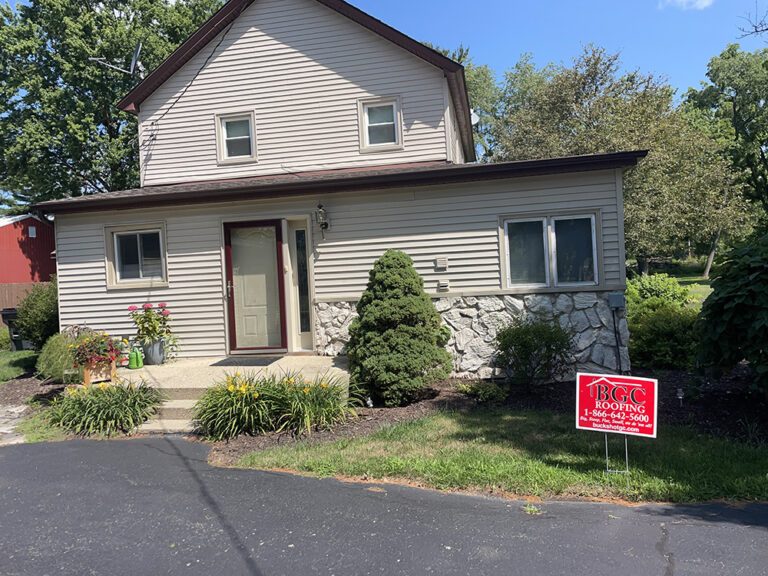
Most Dane County municipalities, including Sun Prairie, Verona and Middleton, require a building permit for re-siding, and the details vary by town. Your contractor should pull it under their own certification, not ask you to pull it as a homeowner. To pull a permit on a one- or two-family home in Wisconsin, a contractor needs a DSPS Dwelling Contractor Certification plus a certified Dwelling Contractor Qualifier. If a salesperson says 'no permit needed' without calling your building department, treat that as a red flag.
Get My Free Estimate →- Siding contractor in Sun Prairie, WI, and the towns around Madison
- What a siding contractor actually does, and how that differs from a remodeler
- How to vet a siding contractor in Dane County
- What siding actually costs around Madison
- Deposits, payment and financing, plainly
- Repair, replace, or side over the old?
- Hail, wind and insurance claims on siding
- Can siding go on in a Wisconsin winter?
- Picking a color you will not regret
- What living through the job is really like
- Get a free, no-pressure siding estimate in your town
- FAQs
Looking for a siding contractor in Sun Prairie, Verona, Middleton or one of the smaller Dane County towns? Yes, we work in your town, the on-site estimate is free, and you do not have to settle for a company that treats your address as a road trip.
We are Buckshot Exteriors, family-owned since 1979. Siding is something we do every week, alongside roofing, gutters and windows.
Most people searching this way are not shopping for fun. A storm came through, a panel is flapping, a corner is chalky, or you finally looked hard at the north wall and saw dark green-black streaks.
On that last one: streaking on a shaded elevation is almost always algae and mildew, not failure. North walls and tree-shaded walls stay damp through our humid summers, and that growth usually comes off with a proper low-pressure soft wash. What actually means the siding is finished is chalking (white powder on your palm), brittleness (a panel cracks under thumb pressure instead of flexing), open butt joints, or soft sheathing behind it. Those are different problems with different price tags.
Below is what a real siding contractor does, how to vet one in Wisconsin, what it costs here, and how to tell repair from replacement.
Siding contractor in Sun Prairie, WI, and the towns around Madison
We cover south-central Wisconsin, not just the city limits. If you are in one of these towns, we come out and measure, free.
Sun Prairie
Sun Prairie has two different siding problems on the same map. The older east side has 1950s and 1960s ranches, often with original wood or 1970s aluminum over it. That is where lead-safe tear-off practices and rot under old window openings come into play.
The 1990s and 2000s subdivisions are the other half. The original builder-grade vinyl there is now chalky and brittle, and the job we see most often on those homes looks like this: tear off, find two or three soft sheets of OSB under a bay window or bathroom window, new house wrap and window flashing, then insulated vinyl or engineered wood with new corners, trim and soffit.
Cottage Grove, DeForest, Waunakee, Windsor and Marshall
Same generation of housing, same story. Late-90s through mid-2000s two-stories reaching the end of their original vinyl, larger wall areas (which widens the cost swing between materials), hail exposure on the east and north side of the county, and architectural committees in newer subdivisions that need to approve color and profile before material is ordered. Custom colors are non-returnable, so that approval comes first.
Verona, Middleton, Fitchburg and Oregon
Verona and Middleton homes often mix stone, board-and-batten accents and multiple elevations, so matching profiles and colors on an addition matters as much as the weather barrier. Fitchburg and Oregon run heavier on ranches and split-levels, where insulated siding makes a noticeable comfort difference on the windward wall.
Stoughton, Monona and McFarland
Older housing stock, and older stock means original wood fighting repeated freeze-thaw swings from late fall through spring, painted surfaces that may contain lead, and sometimes two layers to remove. McFarland and Monona also have lake-adjacent homes where wind exposure is genuinely worse than a few blocks inland.
Not on the list? We also work throughout Columbia, Rock, Jefferson, Sauk and Iowa counties. Here is our Madison-area siding page for the regional overview.
What a siding contractor actually does, and how that differs from a remodeler
A siding contractor installs the wall as a water-management system, not as a surface. A general remodeler can hang panels. A siding crew is judged on what is behind them.
The real scope:
- Tear-off, then inspection of the sheathing (the plywood or OSB under the siding) for soft spots and rot
- New house wrap, lapped shingle-style so water runs out and not in
- Flashing at windows, doors, deck ledgers and roof-to-wall transitions, including kickout flashing
- Correct fastening. On vinyl that means nails snug, not tight, because a Sun Prairie wall goes from well below zero in January to hot enough to cook on in July and the panels have to move
- Trim, corner posts, soffit and fascia so the envelope is actually closed
- Gutter removal and reinstall, often gutter replacement while the walls are open
The failures we get called to fix are almost never the siding product. They are nail-tight panels that buckled in the first hot week, a missing kickout that dumped roof water into a wall cavity for six years, and house wrap lapped upside down. Those are install mistakes, and install mistakes are exactly what a material warranty will not pay for.
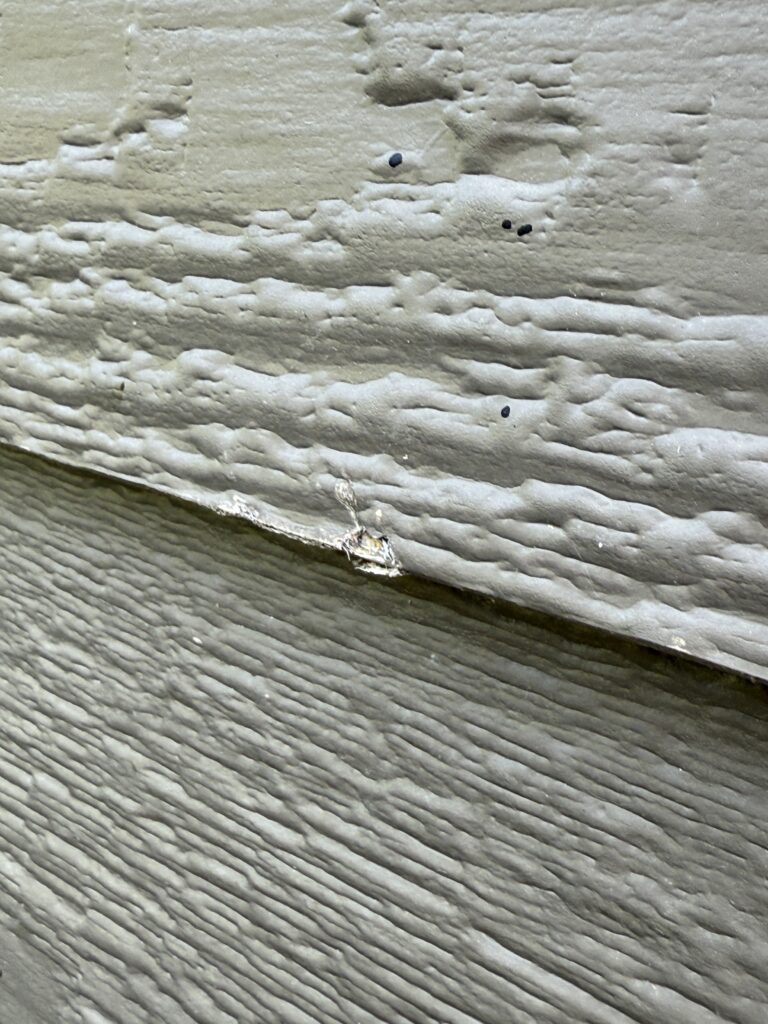
How to vet a siding contractor in Dane County
Credentials you can verify
Wisconsin does not license siding trades the way it licenses electrical or plumbing. But any contractor pulling a permit on a one- or two-family home needs a DSPS Dwelling Contractor Certification and a certified Dwelling Contractor Qualifier. Ask for the certification number and look it up yourself on the DSPS credential search.
Then: ask for a certificate of insurance sent directly from their agent, not a PDF forwarded from a phone. Confirm general liability and workers' compensation are current. Ask for the physical shop address and check that it is a building, not a mail drop or suite number at a UPS Store.
Our own credentials, and the pictures to go with them
We install vinyl, insulated vinyl, engineered wood (LP SmartSide) and fiber cement (James Hardie), and our crews are trained on the lines we sell. We are happy to hand you the current manufacturer documentation at the estimate instead of asking you to take our word for it. On the roofing side we are GAF Master Elite certified, which is a credential you can verify with the manufacturer.
For workmanship, look at recent projects and read the unfiltered reviews on Google, Birdeye and Angi, or start with our customer reviews page. Photos of local walls and neighbors willing to talk beat any brochure.
The permit question
Most Dane County municipalities require a permit to re-side, and your contractor should pull it under their own certification. If a salesperson says no permit is needed without calling your building department, or asks you to pull it as the homeowner, both are warning signs. A homeowner-pulled permit quietly shifts code responsibility onto you.
Pre-1978 homes and lead paint
If your home was built before 1978 and painted surfaces will be disturbed, siding tear-off falls under the EPA Renovation, Repair and Painting rule. That means an EPA Lead-Safe Certified Firm, ground containment, HEPA cleanup and cleaning verification, unless the surfaces are tested and confirmed lead-free. Ask for the firm certification number. This is a real line item on older Stoughton, Monona and east Sun Prairie homes.
Own crews, and a written scope
Ask flat out who will be on your house. We staff our own siding crews, and when a specialty trade is involved we name them and verify their coverage. If a company cannot tell you who is physically doing the work, nobody owns the quality.
The proposal should name manufacturer and product line, profile and panel thickness, the house wrap, whether trim and soffit are included, how many squares of wall, and a per-sheet price for replacing bad sheathing. That last item is normal and fair, because nobody knows what is behind old siding until it comes off.
One local warning: after hail rolls through Dane County, out-of-state door knockers show up fast. Some are fine. Many will be in another state when your panels buckle next summer. And never sign a contingency agreement or assignment of claim benefits before an adjuster has written a scope and you have a real price to compare.
Not sure whether you are looking at a repair, a claim, or a full replacement? Have us look. The estimate is free, there is no obligation, and if you have another five years in what you have, we will say so.
What siding actually costs around Madison
Ballpark installed pricing in south-central Wisconsin, materials and labor, standard tear-off included:
- Standard vinyl: roughly $6-$10 per square foot
- Insulated vinyl: roughly $9-$14 per square foot
- Engineered wood (LP SmartSide): roughly $10-$16 per square foot
- Fiber cement (James Hardie): roughly $13-$20 per square foot
On a typical Dane County two-story with 1,800-2,400 square feet of wall, that commonly lands between $16,000 and $40,000. Ranges, not quotes. Our siding cost breakdown goes deeper.
What moves the number: wall height and access, trim complexity (every window, dormer and gable return adds cutting and flashing time, so two homes with identical square footage can be thousands apart), rotted sheathing, extra layers to tear off, lead-safe containment on pre-1978 homes, and added insulation.
Will insulated siding lower my heating bill?
Some, and not enough to pay for itself. Insulated vinyl typically adds about R-2 to R-3.5 to the wall and, more usefully, breaks the thermal bridging over your studs. That shows up as fewer cold streaks on the wall, less draft feel and a quieter house.
Treat it as a comfort and durability upgrade with a firmer panel that resists dents, not an energy-savings investment. If a salesperson tells you the utility savings will cover the job, walk.
How do you know you are not being upsold?
Ask any contractor to price two materials on the same written scope. Vinyl or insulated vinyl usually wins on straightforward ranches and two-stories where you want low maintenance per dollar. Fiber cement and engineered wood earn their premium when you want thick profiles, wide trim, or a specific architectural look. If a bidder will only quote the expensive option, or the discount evaporates unless you sign tonight, you have your answer.
Deposits, payment and financing, plainly
Never pay in full up front. A modest deposit to order material is normal, commonly 10% to a third depending on material and custom colors, with the balance due at completion after you walk the job with the crew lead.
Financing here runs through third-party lenders, not us. Practically, that means we can run a prequalification that is usually a soft credit pull, the lender sets the rate and term, and options generally range from short no-interest promotional plans to longer fixed-rate installment loans with no prepayment penalty.
The honest warning on promotional deferred-interest plans: if the balance is not paid off inside the promo window, interest can be charged back to day one. They work great if you have a plan to clear it and they hurt if you do not. Ask for the APR, the term, the monthly payment and the promo expiration in writing before you sign, from us or anyone else.
Repair, replace, or side over the old?
Repair when damage is isolated, surrounding panels are still flexible, and a color match exists. Replace when panels have gone brittle, hail has bruised whole elevations, or there is moisture in the wall.
Simple test: press a panel away from the damaged area. If old vinyl cracks under thumb pressure, it will crack again when a crew tries to unzip it for a patch. Our siding repair page covers smaller fixes and siding replacement covers the full job.
Siding over the old is almost never the shortcut it looks like. It hides the rot you needed to find, skips the new weather barrier and window flashing where leaks start, buries fasteners in old material instead of solid sheathing, and telegraphs every wave underneath. Some manufacturers restrict it outright.

Want a straight answer on your roof?
We'll inspect it, document everything, and tell you honestly what you're looking at, even if the answer is patch it for now. No pressure.
Hail, wind and insurance claims on siding
Hail cracks and punches vinyl, especially older brittle panels, and dents aluminum and steel. Wind pulls panels off at the nail hem, usually starting at corners and gables. Both are typically covered, subject to your policy, your deductible and exclusions.
Read the exclusions. Some Wisconsin policies carry cosmetic damage exclusions that limit payment for hail dents on metal siding and trim, and some apply a percentage wind-hail deductible instead of a flat dollar amount. Hand us your declarations page and we will read it with you.
A few things worth knowing:
- You pay your deductible. Always. Anyone offering to absorb it is describing insurance fraud.
- ACV vs RCV. Replacement-cost policies pay actual cash value first, then release withheld depreciation after the work is completed and invoiced. Actual-cash-value policies never release it.
- Matching. Claims stall here constantly. A discontinued color on one damaged elevation will never blend with 15-year-old faded panels next to it, and that argument is won with documentation on site.
- Deadlines. Most policies require prompt notice. Filing a year later is how a good claim gets denied as wear and tear.
We are one of the siding contractors that work with insurance in this market, which in practice means photographing every elevation, writing the scope in the estimating software adjusters use, and meeting your adjuster at the wall. Our storm damage restoration team handles the roof at the same time, since hail rarely hits siding and skips the shingles.
Can siding go on in a Wisconsin winter?
Yes, with adjustments. Vinyl stiffens and gets brittle in the cold, so panels need careful handling and slower cutting, and expansion gaps at trim are set wider when installing below roughly 40 degrees because those panels will grow in summer heat.
Caulks, sealants, house wrap tapes and field-applied paint mostly want temperatures around 40-50 degrees or higher, so on fiber cement we lean on factory-finished product in winter and hold field touch-up for spring. Frozen ground actually helps with staging and protects turf.
The decision rule we give people: if the wall is open, leaking or storm-damaged, do it now. If it is elective, book in fall or winter for an early-spring start so you are at the front of the schedule instead of waiting behind the June rush.
Picking a color you will not regret
Order a large sample and put it on your own wall, not on a kitchen counter. Look at it in morning light, at noon and at dusk, and look at it on the elevation it will actually live on, because a north wall reads several shades cooler and darker than the sunny south side.
Colors go darker and more saturated at full wall scale than they do on a chip. Manufacturer visualizers help you narrow it down, and we bring physical samples to compare against your roof, brick and trim. Get the HOA approval done at this stage, because special-order and custom colors are non-returnable once cut.
What living through the job is really like
Timeline: most single-family homes run about 4 to 10 working days on site. Wisconsin weather gets a vote.
- Hours and noise: crews typically start between 7 and 8 a.m. Expect hammering, saws and wall vibration. Take pictures and shelves off exterior walls before day one.
- Interior access: a standard re-side does not need us inside, other than the occasional power source or an exterior fixture and outlet. You can absolutely stay home and work from home, though the noisiest days are worth planning around.
- Pets and kids: keep pets in and away from doors while the crew moves ladders, and keep the work side of the yard clear. There will be cut-offs and fasteners until the end-of-day sweep.
- What comes off your walls: downspouts, exterior lights, house numbers, shutters, hose bib trim, AC line-set covers and satellite dishes. We remove and reset what we can. A dish sometimes needs your provider to re-aim it, and we tell you that up front rather than after.
- If it rains mid-tear-off: we only open as much wall as we can dry in the same day. House wrap and taped seams go on as we go, so the wall is water-shedding by quitting time and bare sheathing is never left overnight. If a squall shows up mid-wall, we stop, wrap and cover openings, then resume.
- Rot: if we find soft sheathing, you hear about it and see a photo before it gets covered up, at the per-sheet price already in your contract.
- Cleanup: magnet sweep, debris hauled, and a walkthrough with you before we leave.
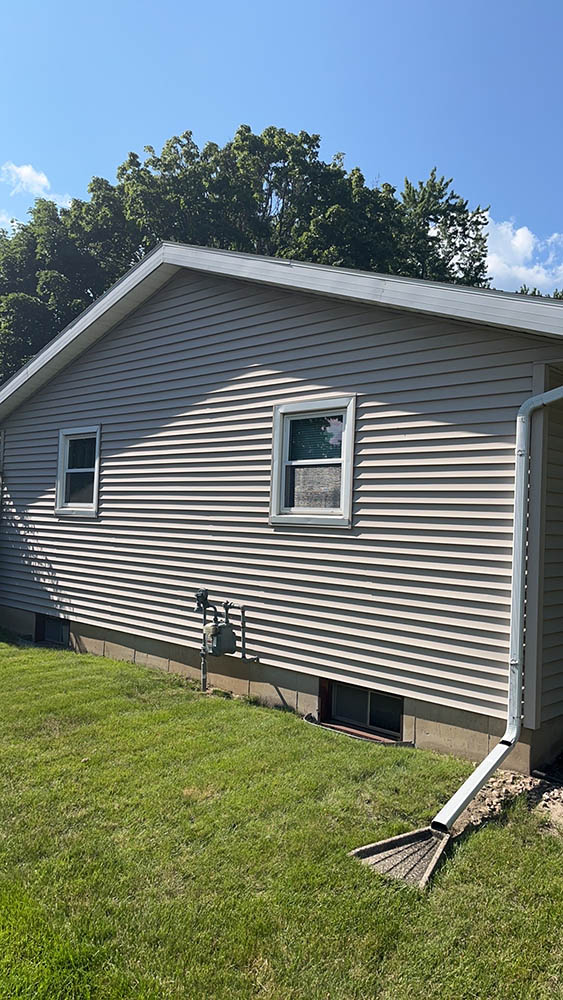
Get a free, no-pressure siding estimate in your town
You should not have to guess whether you are looking at a $900 repair or a $28,000 replacement, and you should not have to pay to find out. Have us come out, look at all four sides, and put in writing exactly what we see, including the option of doing nothing yet. Nobody is going to sit at your table until you sign something.
We are locally owned, we have been doing exteriors in south-central Wisconsin since 1979, and we handle roofing, siding, gutters and windows, so when a problem crosses trades you are not juggling three companies. If storm damage is involved, we document it and stand next to your adjuster at the wall.
Call Buckshot Exteriors at the number listed at the top of this page. Someone picks up during business hours, storm calls are covered 24 hours a day, and we will schedule your look right then. Or request your free on-site estimate online and we will get out to Sun Prairie, Verona, Middleton, Stoughton, Cottage Grove, DeForest, Waunakee, McFarland, Fitchburg, Oregon, Monona or Windsor. No cost, no pressure, and a straight answer about what your walls actually need.
Get a straight answer on your Madison roof
Wisconsin storm season and insurance non-renewal letters do not wait. Get a free, no-obligation inspection and an honest assessment of exactly what your roof needs, even if the answer is to wait.