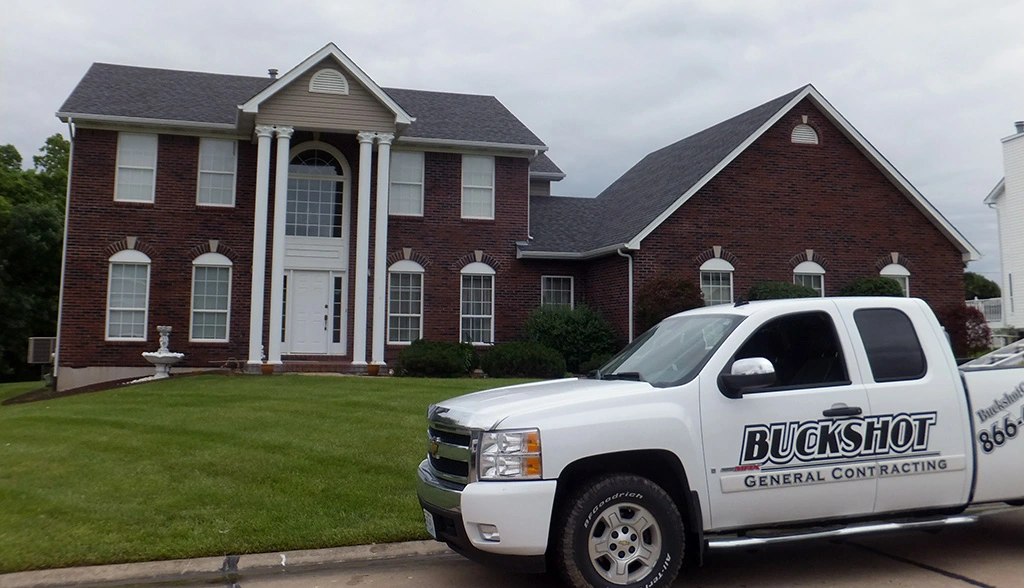
Usually yes, if they need replacing anyway. You pay for one mobilization instead of two, the crew is already working at the eaves, and the gutter apron, ice barrier and hangers get installed in the correct order. A standalone gutter job later carries its own setup and often a job minimum, so the same footage typically costs a few hundred dollars more than it would as an add-on.
Get My Free Estimate →- Should I replace gutters with a new roof? The short version
- Why the roof and the gutters are one system at the eave
- What happens to your existing gutter guards
- What it costs to add gutters to a roof job
- What combining the jobs actually saves
- When you should NOT replace your gutters with the roof
- Snow, ice and hangers: the Wisconsin part
- Decision signals you can spot from the ground
- Sizing, downspouts and where the water actually goes
- Timeline, payment and warranty
- If a storm is what started this conversation
- Get a straight answer before you decide
- FAQs
Short answer: not always. If your gutters are sound and only a few years old, a careful crew can work around them and you can keep them. But if they sag, leak at the seams, overflow in a normal downpour, or the fascia behind them is soft, replacing gutters with a new roof is cheaper and better work than doing it later.
The deciding factor is almost never the gutters themselves. It's the condition of the wood behind them, and whether the eave details get built in the right order.
Should I replace gutters with a new roof? The short version
Replace them with the roof if any of these are true:
- Gutters sag, pull away from the fascia, or have hangers backing out
- Seams or end caps drip, and the fascia below shows staining or peeling paint
- Water sheets over the front edge in an ordinary Wisconsin rain
- The system is undersized for the roof, or there are too few downspouts
- Fascia boards are spongy or cracked, or are already being replaced
- They took hail dents or wind damage in the same storm that killed the roof
Keep them if they're relatively new seamless aluminum, tight to solid fascia, correctly sized, and not leaking. That's a real answer, not a dodge. We tell homeowners to keep their gutters regularly.
The rest of this is the "why," plus numbers, because most people never get either one explained.
Why the roof and the gutters are one system at the eave
The last 12 inches of a roof is where roofing and gutters physically overlap. Every detail in that zone gets touched during a tear-off.
Gutter apron vs drip edge: the line item to check on your bid
This is the single detail most homeowners have never heard, and it matters.
Along the rakes (the sloped edges), you want rake drip edge, an L-shaped or T-style metal that kicks water off the edge. Along the eaves (the horizontal edge above the gutter), the right part is a gutter apron, a D-style flashing with a longer, curved lower leg that laps down into the back of the trough.
Standard L-style drip edge at the eave often does not reach into the gutter. Water then follows the underside of the metal, runs behind the gutter, and soaks the fascia. Peeling paint first, rot later, and eventually a gutter with nothing solid to hang from.
So read the bid. If it says "drip edge" with no distinction, ask specifically: what profile goes at the eave, and does it lap into the gutter? A contractor who can answer that in one sentence knows what they're doing.
If your gutters are due within a few years anyway, replacing them while that flashing is being set is the only way to guarantee the lap is correct.
Ice protection at the eaves
Wisconsin's Uniform Dwelling Code (SPS 321) is the state's own one- and two-family dwelling code, not a straight copy of the international residential code, and it requires ice protection at the eaves of a new roof. The widely used standard on our jobs is a self-adhering membrane (ice-and-water shield) running from the eave edge to at least 24 inches inside the interior face of the exterior wall. Ask any bidder to show you what they're installing and how far up.
Gutters don't cause ice dams. But a clogged or back-pitched gutter holds standing ice that keeps the eave cold and wet longer, which makes a marginal eave worse.
A gutter is only as sound as the board behind it
Hangers screw into the fascia. If the fascia is soft, no gutter stays straight, regardless of material.
And here's what blindsides people: tear-off day is when hidden fascia rot gets discovered. With the old shingles and eave metal gone, the top edge of the fascia is visible for the first time in 20 years. That's exactly where rot starts.
The pattern we see most often on 1960s-70s ranches around here: the north or shaded eave looks fine from the driveway, and once the old metal comes off there's 10-15 feet of punky fascia along one run. At roughly $10-$25 per linear foot for board replacement, that's a few hundred dollars of carpentry. The gutters have to come off either way. At that point, re-hanging dented 25-year-old aluminum on brand new wood is throwing good money after bad.
What happens to your existing gutter guards
Most guards have to come off for a tear-off, and many are not reusable.
Anything that slides under the first course of shingles or fastens to the roof deck (that includes a lot of helmet-style and reverse-curve systems) is physically in the way of a new shingle course. Screens and mesh panels that clip to the trough usually survive if they're removed carefully, but clips bend and mesh creases.
The bigger issue is the warranty. Several proprietary guard systems are sold with the condition that only that company services them. If another contractor pulls them off and puts them back, coverage can be gone.
So before roofing starts, call the guard company, ask whether they will remove and reset the guards around your roof date, and get the answer in writing. Homeowners get surprised by this one all the time, and it's completely avoidable with one phone call.
What it costs to add gutters to a roof job
Ballpark numbers for south-central Wisconsin so you're not walking into a bid blind:
- 5-inch seamless aluminum: roughly $9-$15 per linear foot installed
- 6-inch seamless aluminum: roughly $12-$20 per linear foot installed
- Fascia board replacement: roughly $10-$25 per linear foot
- Adding one downspout drop: commonly a few hundred dollars, more on a two-story
- Micro-mesh guards: typically adds several dollars per foot
A typical ranch with 150-200 feet of gutter often lands in the $1,500-$4,000 range for full seamless replacement. A larger two-story with 6-inch trough, 3x4 downspouts and guards runs higher. These are ranges that move with aluminum coil pricing, height and access, not a quote. Our gutter installation cost guide breaks it down further.
Not sure which camp your gutters fall into? A free, no-pressure look at the eaves settles it in about 20 minutes. Call (608) 909-9109 and we'll tell you straight, including "your gutters are fine, keep them."
What combining the jobs actually saves
The savings are logistical, not a discount gimmick. You pay for one mobilization instead of two: one trip, one setup, one dumpster, one stretch of driveway. A large share of gutter labor is simply getting up there safely, and on a combined job the access is already paid for.
Then there's sequencing. Ice barrier, gutter apron, starter course and hangers all get installed in the right order by crews who are coordinating with each other. And nobody hangs fresh aluminum only to drop 20 squares of old shingles past it next year.
The flip side is honest too: waiting is not a disaster. If you keep your gutters now and add them in three years, the extra cost is that second mobilization, and many contractors carry a job minimum on gutter-only work. Expect the same footage to run a few hundred dollars more than it would as an add-on. Just make sure the eave gets built gutter-ready today, with a proper gutter apron and sound fascia, so the future install is clean.
When you should NOT replace your gutters with the roof
Plenty of homeowners get told the gutters "have to" come off and be replaced. That isn't automatically true, and vague reasoning deserves a push back.
Keep them when they're relatively new seamless aluminum, tight to solid fascia, right-sized, and dry at the seams. In our experience, properly hung seamless aluminum that's kept clear and sits on dry fascia lasts a long time, and we regularly find older systems still tight and serviceable. There's no sense scrapping a good one.
Let's also be plain about tear-off damage: a competent roofer protects existing gutters. Dents are not an unavoidable cost of roofing. Protection means debris shields leaned over the gutter line where shingles are coming down, tarps and ground catch so bundles don't land in the trough, and a walk of every gutter run at final inspection with you present.
Ask any bidder two questions. If your crew damages my gutters, who pays? And who flushes the gutters and downspouts before you leave? The right answers are "we do," in writing. The same eave protection approach applies on every residential roofing job we run, whether you're keeping your gutters or replacing them.
There's also a middle path most homeowners never get offered: re-pitch one back-sloped run, re-hang sound gutters on new fascia, add a single downspout, replace only the one shot run, or reseal end caps and swap failed hangers. If a contractor jumps straight to "all new gutters" without checking pitch, hangers and downspout count, ask why.

Snow, ice and hangers: the Wisconsin part
Around here, gutters usually fail from ice load before they fail from age. A 5-inch trough full of frozen slush is heavy, and if the hangers are spaced too far apart or screwed into soft fascia, the run sags and then pulls loose.
That's why hanger detail matters more in our climate than in Kentucky. On a new install we favor hidden hangers with screws, spaced tighter than the bare-minimum 24 inches on many runs, and landed into the rafter tails where the framing allows. It costs a few dollars more per run and it's the difference between a gutter that survives February and one you're re-hanging in spring.
Roof type changes the math too. Steel and standing seam shed water and snow much faster than asphalt, which pushes most homes toward 6-inch trough and 3x4 downspouts, and snow comes off metal in sheets. If you're putting metal over a gutter, over a walkway, or over a back door, plan snow retention above the eave at the same time. One slide can strip a gutter run right off the fascia.
Want a straight answer on your roof?
We'll inspect it, document everything, and tell you honestly what you're looking at, even if the answer is patch it for now. No pressure.
Decision signals you can spot from the ground
Walk your house during or right after a hard rain. No ladder needed for most of this.
- Sagging or a wavy front edge. Hangers are pulling out of soft fascia.
- Gutter pulling away at the top. Water is getting behind it, usually an eave flashing problem.
- Drips at seams or end caps. Sectional gutters fail at joints first, which is why seamless gutters are the standard now.
- Overflow in ordinary rain. Clogged, back-pitched, or genuinely undersized.
- Splash-back staining on siding, or mulch blasted out of the beds. Downspout capacity or discharge problem.
- Peeling paint or dark streaks on fascia and soffit. Rot in progress, and the urgent one, because that water eventually reaches the wall.
Two or more of those plus a roof that's due, and combining the work is the obvious call.
Sizing, downspouts and where the water actually goes
If you're replacing anyway, replace with the right size. A 6-inch trough carries meaningfully more water than a 5-inch, and 3x4 downspouts move far more than 2x3. Downspout count matters as much as trough size: figure roughly one drop per 30-40 feet of run, and more on steep pitches and long runs. The full breakdown is in our 5-inch vs 6-inch gutters guide.
The part people skip is discharge. A perfect gutter that dumps at the foundation wall is a basement problem with a nice finish. Get water at least 6 feet away from the house, 10 if the lot allows, with extensions, a buried line to daylight, or a pop-up emitter. Check that the soil slopes away for the first several feet and that nobody has mulched a flat shelf against the foundation. A chronic overflow at one corner, fixed with one added 3x4 drop and a longer extension, is frequently the cheapest wet-basement repair on the market.
Aluminum, steel, copper and half-round
Seamless aluminum in .027 or .032 gauge is the right call on the large majority of homes here: it doesn't rust, it comes in a wide range of factory colors, and it's cost-effective. Match gutters to the fascia and trim rather than the shingles, and match downspouts to the siding so they disappear. Check a real color chip outside in daylight.
Galvanized steel is stiffer and tolerates ladder abuse and ice better, but it will eventually rust at the seams. Copper and half-round belong on older Madison-area homes where the architecture calls for it, Victorians, prairie-style, historic districts, and it is a significant premium. Worth it for the right house, hard to justify on a 1970s ranch. Materials, hangers, guards and discharge options are all laid out on our gutters page.
Timeline, payment and warranty
Adding gutters rarely stretches the project in a way you'd notice. Gutters are typically a half-day to one-day item, run after the roof is finished or after fascia repairs are done.
On money: in most cases gutters can ride on the same contract as the roof, which keeps it to one scope and one payment schedule, and financing options are commonly available on exterior work. Ask us what applies to your job, including any deposit, before you sign. Nobody should be guessing about that.
Warranties are separate. Roofing carries a manufacturer material warranty plus contractor workmanship; gutters carry a finish and material warranty on the coil plus workmanship on the hanging and sealing. Get both in writing with lengths spelled out. And know the boundary: keeping old gutters won't void a roof workmanship warranty, but no roof warranty covers damage caused by your existing gutter back-pitching water onto the fascia.
If a storm is what started this conversation
Hail and high wind hit roofs and gutters together. Aluminum dents easily, downspouts get crushed, and wind lifts whole runs off the fascia.
Adjusters look for specific evidence: directional hail hits on the gutter face and the downspout, bent or pulled hangers, and detachment consistent with wind uplift. Gutters get scoped light constantly because nobody documented them.
Three money points worth knowing before the adjuster arrives. Your deductible applies once to the storm claim, not separately per item. Most replacement cost policies pay actual cash value first with depreciation held back, then release the balance after the work is completed and invoiced. And some carriers carry cosmetic damage exclusions or matching limits that can cut payment for dents that don't leak.
That's exactly why we meet your adjuster on-site and walk the gutter line with them, not just the shingles. More on that on our storm damage restoration page, and the full scope of an asphalt shingle roof replacement is spelled out there.
Get a straight answer before you decide
You shouldn't have to guess whether your gutters are worth saving. It takes about 20 minutes. We check the fascia behind the gutter, the pitch, the hangers, how the old eave metal laps, your downspout count against your roof area, and where the water lands when it leaves.
Then we tell you what we'd do if it were our own house. Sometimes that's "replace both while we're here." Sometimes it's "your gutters have years left, we'll protect them and flush them out when we're done." Sometimes it's "add one drop, re-pitch that run, and extend the discharge." Either way you get it in writing, with the gutter line itemized so you can see exactly what you're paying for.
The inspection is free, there's no charge to find out, and nobody is going to sit at your kitchen table pressuring you. We're family-owned, working Dane, Rock, Green and the surrounding counties since 1979, and we'd rather give you an honest no than a bad yes.
Call (608) 909-9109 or request your free inspection here. If a storm just came through, we run 24-hour emergency response and can get you tarped and documented the same day.
Get a straight answer on your Madison roof
Wisconsin storm season and insurance non-renewal letters do not wait. Get a free, no-obligation inspection and an honest assessment of exactly what your roof needs, even if the answer is to wait.