
Aim for at least 6 feet, and closer to 10 feet in heavy clay soil (which most of Dane County has). Anything shorter than about 4 feet is basically watering your foundation. Extensions, buried lines to daylight, or a pop-up emitter all get you there. Before we pick a discharge point we check with the municipality, because where the water is allowed to go varies block to block in and around Madison.
Get My Free Estimate →- Start Here: What Gutter Drainage Failure Actually Looks Like
- The Six Real Causes (Not Just "Clogged Gutters")
- Why This Turns Into Expensive Damage in Wisconsin
- Fixes Ranked From Cheap to Major (With Real Madison-Area Costs)
- Where the Water Is Allowed to Go
- What You Can Check Yourself vs. When to Call
- Warranty, Crews, and Scheduling
- Season, Maintenance, and When Guards Are Actually Worth It
- Don't Wait for the Next Big Rain
- FAQs
If water is pooling next to your foundation or your basement smells damp after every hard rain, the fix usually starts at the roof edge, not in the basement. On most wet-basement calls we take, the water path starts up top: not enough gutter capacity, wrong pitch, too few downspouts, or water getting dumped 18 inches from the house instead of 10 feet away.
Here's the good news. Most gutter drainage solutions are cheap compared to what they prevent. We've seen homeowners quoted for interior drain tile when the actual cause was a couple of downspouts, so it's worth ruling out the cheap fix first.
Let's walk through what actually causes it, what to check yourself, what each real fix costs around Madison and Dane County, and how fast we can get to it.
Start Here: What Gutter Drainage Failure Actually Looks Like
Gutter drainage has failed when water isn't being carried from the roof edge to a point well away from your foundation. The symptoms are predictable:
- Water sheeting over the front lip of the gutter during heavy rain
- Standing water or a trench of eroded soil right below a downspout
- Mulch or landscape rock washed out in the same spot every summer
- Efflorescence (that chalky white crust) on interior basement walls
- A damp basement corner that always shows up on the same side of the house
- Sagging gutter sections still holding water days after the storm
- Giant icicle curtains at one corner every January
That last one matters more here than most places. A gutter holding standing water freezes solid and then acts like a dam at the eave. Water backs up under the shingles, and you get a ceiling stain in February from a drainage problem you ignored in July.
The Six Real Causes (Not Just "Clogged Gutters")
Clogs get all the blame. They're one cause out of six, and honestly not the one we find most often.
1. Undersized gutters
A standard 5-inch K-style gutter is fine for a modest roof with normal pitch. Put it on a big two-story with steep planes, or a long roof face with a valley dumping into it, and it can't move the volume. Water hits the trough, hydroplanes, and jumps the front edge. The gutter looks clean because it is clean. It's just too small.
Manufacturer figures generally put a 6-inch K-style trough at roughly 40 percent more cross-sectional capacity than 5-inch, and the real-world gain is bigger once you pair it with 3x4 downspouts instead of the skinny 2x3 (a 3x4 outlet has close to double the area). On steep or large roofs in this area, that upgrade alone ends chronic overflow.
2. Too few downspouts
This is the number one thing we find on 1990s and 2000s subdivisions around Sun Prairie, Fitchburg and Madison's west side. Builders ran the minimum. A workable rule: one downspout per 30-40 feet of gutter, and more on steep or large roof planes.
Real example. Spring 2023, a 1998 two-story off Mineral Point Road had 62 feet of gutter on one 2x3 drop, overflowing at the same corner every big rain, with seepage in the basement below it. We added two outlets, upsized the downspouts, and buried the extensions out to daylight at the low side of the yard. That corner has stayed dry through three seasons since, including the 2024 summer downpours. We photograph jobs like this, and you can see similar work on our recent projects page.
3. Wrong pitch (or none)
Gutters need a slight fall toward the outlet, roughly 1/4 inch per 10 feet. Too flat and water sits. Too steep and it races past the outlet. Pitch also drifts over time as hangers loosen, fascia softens, or an ice load pulls a run down. If you see a standing puddle in a dry gutter, the pitch is wrong right there.
4. Downspouts dumping at the foundation
The most damaging cause, and the cheapest to fix. A splash block that ends 12 inches from the wall does nothing in clay soil. Dane County soil holds water instead of absorbing it, so whatever leaves that downspout sits against the foundation wall and works toward the cove joint.
The math homeowners find sobering: one inch of rain on a 500 square foot roof section is about 300 gallons. Send all of that out one downspout at the wall and you're pressure-testing your basement.
5. Buried or collapsed underground lines
Plenty of Madison-area homes have downspouts tied into buried drain lines. Corrugated black pipe crushes under a driveway or a tree root, silt fills the low spots, and the daylight outlet disappears under twenty years of mulch and sod. Then the line backs up, water surfaces right at the house, or it backs up the downspout and overflows the gutter.
Summer 2022, on a 1960s ranch near Monona Drive, the homeowner had already replaced a sump pump chasing a wet wall. The buried line off the front downspout was crushed flat about eight feet out. We replaced that run with solid PVC and a cleanout, and the wall stopped weeping (still dry on a follow-up last year). If you have a buried line and don't know where it discharges, assume it's plugged until proven otherwise.
6. Grading that slopes toward the house
Your gutters can be perfect and you'll still get water in the basement if the ground falls toward the foundation. Backfill settles over decades. Fresh mulch gets piled higher every spring. You want roughly 6 inches of fall in the first 10 feet away from the wall.

Why This Turns Into Expensive Damage in Wisconsin
Bad drainage doesn't stay a gutter problem. Our freeze-thaw cycles accelerate everything.
Foundation and basement. Saturated clay against a wall expands when it freezes. That lateral pressure widens hairline cracks, and water follows.
Ice dams and roof rot. Standing water in a poorly pitched gutter freezes into a block at the eave, exactly where you don't want a dam. Backed-up meltwater gets under shingles and into the decking. That's how a drainage issue turns into a roof repair or asphalt shingle roof replacement conversation.
Worth saying plainly, because this is the next question every homeowner with an icicle curtain asks: gutters don't cause ice dams, heat loss does. If you get dams every January, the root cause is almost always attic insulation and ventilation letting warm air melt snow mid-roof so it refreezes at the cold eave. Heat cable is a band-aid that manages symptoms, not a fix. Correcting drainage plus air sealing, insulation depth and intake/exhaust ventilation is what actually ends it, and ice-and-water shield at the eaves is your backup when we do replace a roof.
Fascia, soffit and siding rot. Water spilling over the back of a gutter runs down behind it into the fascia and soffit. We've pulled gutters off Madison homes and found fascia soft enough to push a screwdriver through. From there it gets into the wall and becomes a siding repair too.
Concrete and hardscape. Water pooling under a stoop or driveway edge freezes, lifts, and cracks it. Then the slab tilts back toward the house and makes the drainage worse.
Fixes Ranked From Cheap to Major (With Real Madison-Area Costs)
Do these in order. Don't jump to the expensive fix before ruling out the cheap ones. These are typical ranges for our area, not quotes.
Tier 1: Clean and re-pitch, $150-$400. Half a day.
Clear the troughs and outlets, flush the downspouts, tighten or replace loose hangers, reset the pitch. If your overflow only shows up in fall or after a windstorm, this may be the whole answer.
Tier 2: Extensions, splash blocks and pop-up emitters, $50-$300 per downspout. A few hours.
Get the discharge 6-10 feet out. Options run from a hinged extension you flip up to mow, to a rigid extension tucked an inch under sod, to a pop-up emitter that stays hidden until water pressure lifts the lid. Cheapest high-value fix on this list.
Tier 3: Add downspouts and outlets, $200-$450 per drop. Usually same day.
If a long run has one downspout, add one. This also cuts ice loading in winter, because water leaves the trough before it can freeze in it.
Tier 4: Upsize to 6-inch gutters with 3x4 downspouts, about $12-$20 per linear foot installed. One day, sometimes two.
On a typical Madison two-story with 150-200 feet of gutter, that generally works out to roughly $2,000-$4,000 including downspouts. Steep or cut-up roofs, three-story access and heavier .032 aluminum land at the top of the range.
This is the permanent fix for chronic overflow. Seamless aluminum run on-site, hidden hangers screwed into solid fascia, outlets placed where the water actually concentrates. If you're already replacing worn-out 5-inch gutters, stepping up to 6-inch is a small percentage add for a big capacity gain.
Tier 5: Underground drain lines to daylight, about $15-$30 per linear foot. One to two days.
For homes where the grade won't allow surface discharge, or where you're moving water to a swale or a lower point in the yard. A 50-foot run to daylight commonly lands around $900-$1,800. Concrete cutting, rock, deep frost-line depth, or mature landscaping in the path pushes it higher.
We use solid PVC (not flexible corrugated), with cleanouts and a visible, protected outlet you can actually inspect. Expect a narrow trench line across the lawn and a day or two of a mini-excavator or trencher needing driveway access. We locate utilities before we dig, and we walk the path with you first and point out exactly which plantings are in the way.
On cleanup: we tarp the work area, haul our own debris, sweep and magnet the drive, and reset sod or mulch when the trench is closed. If a shrub or perennial we moved doesn't come back that season, we replace it. That's not a favor, it's on the estimate.
Tier 6: Regrading and swales
Sometimes the yard is the problem and no gutter work will save you. Regrading the first 10 feet around the foundation, or cutting a swale to redirect surface water, is the fix. That's usually an excavation scope, and we'll tell you straight if that's what you need rather than sell you gutters that won't solve it.
Not sure which tier your house needs? That's what a free inspection is for. We'll check pitch with a level, run water through the system, trace the discharge, and tell you the cheapest fix that will actually work. Call Buckshot Exteriors. No charge, no pressure.
Where the Water Is Allowed to Go
"Get it 10 feet away" has limits in town. Before we design a discharge point we call the municipality, because the City of Madison and surrounding villages regulate stormwater and erosion control by ordinance, and what's allowed varies by property. Tying into a storm sewer lateral, in particular, usually requires approval. If you're doing this yourself, a quick call to your city or village engineering or building inspection department will tell you what's permitted on your lot.
Two practical cautions from experience. First, dumping concentrated roof water across a public sidewalk creates a genuine ice hazard in a Wisconsin winter, and that's a liability you don't want. Second, we've seen plenty of neighbor disputes over a downspout aimed at the lot line. Wisconsin courts apply a "reasonable use" standard to surface water between properties, and we're not attorneys, so the short version is: don't solve your basement by flooding the guy next door.
Want a straight answer on your roof?
We'll inspect it, document everything, and tell you honestly what you're looking at, even if the answer is patch it for now. No pressure.
What You Can Check Yourself vs. When to Call
Stay on the ground for all of this. Wet gutters, wet ladders and steep grade around a foundation are how homeowners get hurt, and nothing on this list is worth a fall.
- Walk the perimeter during a hard rain. Five minutes with an umbrella tells you more than any report
- Look for eroded soil, splash marks on siding, and washed-out mulch under each downspout
- Find and clear every downspout outlet at ground level
- Measure how far your extensions actually carry water
- Check that soil and mulch slope away from the wall, not toward it
- Locate the daylight outlet on any buried line and make sure it's open
Call a contractor when:
- The work would put you on a ladder above the first story
- Gutters sag, pull away from the fascia, or the fascia feels soft
- A buried line backs up
- You see interior water and can't trace the source
- Overflow happens even when the gutters are clean (capacity or pitch, not maintenance)
- Hail or wind left gutters bent or downspouts separated at the seams. We handle storm damage restoration in Dane County and meet your adjuster on-site so gutters and downspouts get evaluated instead of skipped
"Can't I just do the extensions and downspouts myself?"
The extensions, yes. A 10-foot rigid extension and a splash block is $20-$40 in parts and a screwdriver. Do that this weekend and you may fix your problem for the price of lunch.
Where the line moves is value, not just safety. Cutting a new outlet in the bottom of a gutter, re-hanging a run to pitch, or strapping a downspout on a two-story means a ladder over concrete, sealant that has to hold for years, and a hole in your gutter you can't un-cut. Saving $250 there isn't a good trade. And DIY work on an existing gutter run will generally void whatever warranty is on it.
Warranty, Crews, and Scheduling
You should be asking this before you hand anyone a check for work in the thousands. Here are our answers, not generic advice.
- Warranty. Gutter labor carries a 2-year Buckshot workmanship warranty, written into your estimate, plus the manufacturer's coverage on the aluminum coil and finish. Bigger scopes such as full roof replacements carry longer workmanship terms, which is why we put the number on the paperwork per job instead of waving at it.
- Who shows up. Our own crews. Not a same-day sub crew we met that morning. Same faces you talked to at the estimate.
- Insurance and licensing. Ask any contractor for a certificate of general liability and workers compensation. We hand ours over before we start. If someone gets cagey about that, that's your answer.
- Lead time. Free inspections typically go on the calendar within a few business days, and storm calls get 24-hour response. Tier 1-3 work (cleaning, pitch, added downspouts, extensions) is commonly scheduled within one to two weeks. Trenching and buried lines are seasonal, and in the spring rush that work can be booked out several weeks, so early calls get earlier dates.
- Payment. For the larger tiers, ask about payment and financing options while we're out. We can also phase the work: discharge and outlets now, the full 6-inch upgrade next season.
We've been doing exteriors in south-central Wisconsin since 1979, and you'll find our reviews on Google, Birdeye, Angi and HomeAdvisor.
Season, Maintenance, and When Guards Are Actually Worth It
Cleaning, re-pitching, adding downspouts and running extensions can be done well into late fall and on mild winter days. Digging can't. Once the ground freezes, buried lines and regrading wait for thaw, which around here usually means an April start.
After the fix, plan on cleaning twice a year: once in late spring after the seeds and blossoms drop, once in late fall after the oaks finally let go (which in Dane County can be November).
On gutter guards, here's the honest read. They don't add capacity, correct pitch, or move water away from the house, so they are not a drainage fix. Cheap foam and plastic inserts can actually make things worse by shedding water over the front edge in a hard rain. Those run about $1-$4 per foot at the box store. Quality aluminum micro-mesh installed professionally usually runs about $6-$15 per foot.
When are guards worth it? Three cases. Heavy oak, pine or maple canopy directly over the roof. Three-story or steep runs where cleaning means hiring someone every time. And homeowners who physically shouldn't be on a ladder. In those situations good micro-mesh pays for itself. Just fix pitch, outlets and discharge first, then talk guards.
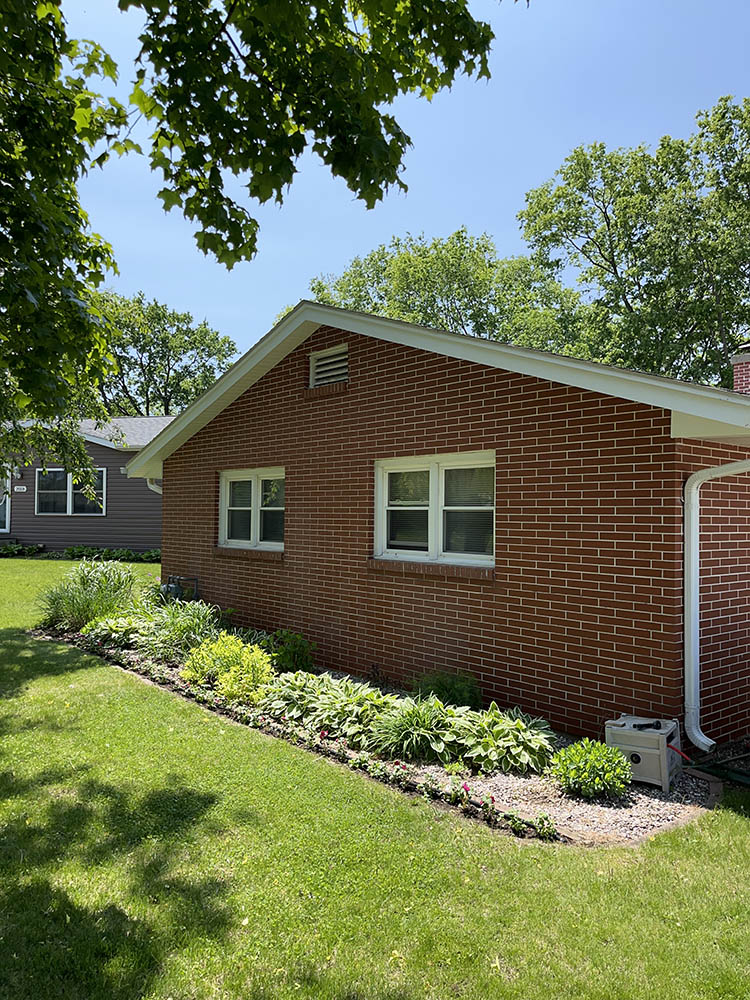
Don't Wait for the Next Big Rain
Gutter drainage problems never fix themselves, and here they get worse with every freeze-thaw cycle. The $300 fix in September becomes rotted decking and a stained ceiling by March, or a cracked foundation wall in a couple of years.
If you've got water where it shouldn't be, call Buckshot Exteriors for a free, no-pressure inspection. We'll come out, find the actual cause, and give you a written number for the smallest fix that solves it. It costs nothing to find out, and nobody is going to lean on you to sign anything that day. Reach out here and we'll get you on the calendar, usually within a few business days.
Since 1979, Wisconsin rain, ice and hail has taught us where water goes. Let's make sure it stops going into your basement.
Get a straight answer on your Madison roof
Wisconsin storm season and insurance non-renewal letters do not wait. Get a free, no-obligation inspection and an honest assessment of exactly what your roof needs, even if the answer is to wait.