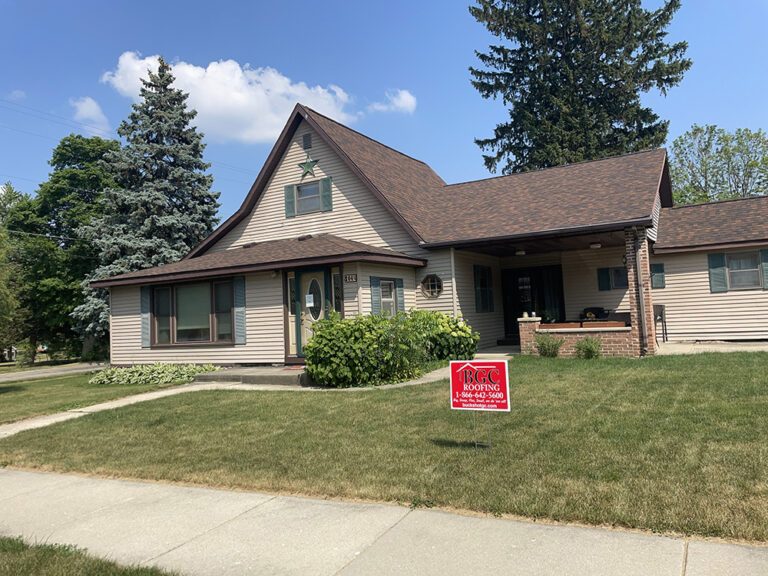
Ranges we commonly see in south-central Wisconsin, confirmed only after we measure: architectural asphalt shingle tear-off and replacement runs roughly $475-$700 per square (100 sq ft) installed. That puts a straightforward 1,800-2,200 sq ft one-story or ranch in the $9,000-$16,000 range, and a cut-up, steeper two-story with dormers, valleys and multiple layers at roughly $18,000-$30,000. Class 4 impact-rated shingles typically add 10-20%. Low-slope commercial tear-off with new insulation runs about $9-$15 per square foot, and a coating or restoration system on a sound roof about $3-$7. Your number depends on pitch, layers, decking and details.
Get My Free Estimate →- Commercial and light-industrial roofing in Marshall
- Residential roofing in Marshall: shingle replacement and repair
- Storm damage: wind and hail east of Madison
- What our free inspection actually covers
- Roof replacement cost in Marshall, WI, and how payment works
- What the install week looks like
- How to vet a roofing contractor before you sign
- Get eyes on your roof, free
- FAQs
If you're in Marshall and need a roofing contractor, start here: get a real on-site inspection before you spend a dollar, and hire the company that will still be around to honor the warranty. That holds whether you own a 1920s village home on a side street, a newer place out in one of the subdivisions, or a small commercial building with a flat roof that's been dripping into the back storage room.
We're Buckshot Exteriors. Family-owned since 1979, working out of Madison, and Marshall is right in our lane. Roofing, siding, gutters, windows, doors and storm restoration, residential and commercial.
Inspections are free. Call (608) 909-9109 and we'll come look.
Commercial and light-industrial roofing in Marshall
Most commercial buildings around Marshall have low-slope roofs, and low-slope roofs fail differently than shingles. They rarely fail across the whole field. They fail at the details: seams, curbs, pipe penetrations, drains, parapet walls and tired flashing.
That matters, because it means you may not need a full replacement. You need someone to tell you honestly which it is.
The membranes we work with
- EPDM (black rubber): tough, common on older buildings here, often 20-30 years old by now. Typical failures are shrinkage pulling at the perimeter, seam separation, and punctures from foot traffic or hail.
- TPO: the white single-ply on most newer light-industrial and retail roofs. Heat-welded seams are strong when done right and a headache when they aren't. Watch seams and cracking near mechanical curbs.
- Modified bitumen and built-up: layered asphalt systems. Durable, but blisters, ridging and open laps let water in.
- Fluid-applied coatings: a legitimate option when the existing membrane is sound and the insulation is dry. A coating over a wet roof is money burned. Coatings also need warm weather and cure time, so they're a May-through-September item here.
Repair, recover, or full tear-off?
Here's how we decide. Membrane generally intact and leaks trace to details: repair. Membrane worn out but insulation below is dry: a recover or coating system is often the smart financial move. Insulation saturated: it has to come off. Wet insulation keeps rotting the deck and destroys the R-value you're paying to heat all winter.
The typical call goes like this. A business owner has ceiling tiles staining in two spots and a leak that only shows up in a hard rain from the west. We get on the roof, find the field membrane in decent shape, then cut a 6-inch test square at the low spots and pull a core. Dry insulation and the leak path is a failed curb flashing at a rooftop unit plus a split seam: that's a repair, not a replacement. Wet, heavy core samples and the conversation changes. Either way, you see the core with your own eyes.
For budgeting, the ranges we see on small commercial and light-industrial work in Dane County: targeted repairs commonly $800-$4,000, restoration coatings roughly $3-$7 per square foot, and full tear-off with new insulation and membrane roughly $9-$15 per square foot depending on insulation thickness, tapered drainage, deck repair and rooftop equipment. Systems, warranties and phasing around your business hours are laid out on our commercial roofing page. Property managers: we can stage work so you aren't shutting down operations.
Residential roofing in Marshall: shingle replacement and repair
For homes, the two questions we hear most are "can this be repaired?" and "how long do I really have?" A targeted roof repair makes sense when the shingles still have granules and flexibility and the problem is localized: a failed pipe boot, lifted step flashing at a chimney, a few blown tabs, an ice-dam leak at the eave.
Replacement is the honest answer when granule loss is widespread, shingles are brittle and cracking, or you're on layer two or three with soft spots in the decking.
Marshall-specific realities:
- Older village homes often have plank decking, undersized or missing ventilation, and one or two previous layers. Tear-off turns up surprises, which is why a good estimate states the decking replacement price per sheet up front.
- Newer subdivision homes usually got builder-grade 3-tab or entry-level architectural shingles. Twenty years in, wind uplift along the rakes and ridge is common.
- Ice dams are a Wisconsin fact of life. Ice-and-water shield (a self-adhering waterproof membrane) at eaves and valleys, plus balanced intake and exhaust ventilation, is what actually prevents them. Heat cable is a band-aid.
Architectural shingles (laminated, dimensional) are the standard now for good reason: heavier, better wind ratings, longer warranties. If you've been hit by hail before, ask about Class 4 impact-rated shingles, which are lab-tested to resist impact. Some carriers offer a premium credit for them. Ask your agent for the exact credit in writing before you pay for the upgrade, because it varies a lot by company and it isn't guaranteed.
When metal is worth it
Standing seam metal is a good fit on simpler roof shapes, on houses that fight ice dams every February, and for owners planning to stay 20-plus years and be done with roofing. Expect roughly two to three times the cost of architectural shingles. Exposed-fastener ag panel is a different animal: much cheaper, and a sensible choice for the shops, pole barns and outbuildings common just outside the village, as long as you accept that fasteners and gaskets need periodic attention.
Roof-over versus full tear-off
Layering new shingles over old is legal in limited cases (two total layers max, and only over shingles that are flat, not curled or buckled), but we almost always recommend a full tear-off. Reasons:
- You can't inspect decking you never uncovered. Rot stays rot.
- An overlay adds weight and traps heat, which shortens the new shingles' life.
- New shingles telegraph every ridge and dip of the old ones.
- You lose access to the better manufacturer warranties, which require a proper deck and full system install.
If your home already has two layers (common on the older village houses), code requires a tear-off anyway.
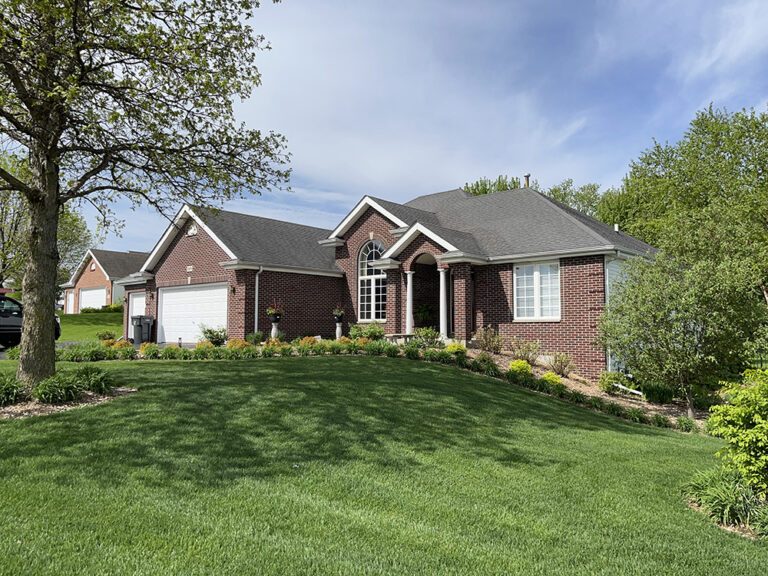
Storm damage: wind and hail east of Madison
Marshall sits on open ground east of Madison, and that exposure shows up on roofs. Straight-line wind rolls across farmland with nothing to slow it, and the pattern is creased shingles, lifted tabs on the windward slope, torn ridge cap and bent or detached gutters and drip edge.
Hail is sneakier. Here's the misconception that costs Marshall homeowners the most money: "my roof isn't leaking, so it's fine." Hail damage usually doesn't leak right away. What it does is bruise the mat under the granules and break the factory seal strips, so the shingle is now a loose flap waiting for the next 50 mph gust. You find out eight months later, in February, when water shows up on the ceiling.
What an adjuster looks for: granule loss with a soft, bruised mat underneath, random impact marks with no directional pattern, and spatter marks on soft metals like gutters, downspouts, vents and AC condenser fins. Those soft-metal hits are what dates the storm.
Your roof isn't the only claimable item
Hail and wind damage the whole exterior, and it's all property damage under the same claim. On the jobs we document, the scope items most often missed are drip edge, code-required ice-and-water shield, ridge vent, gutters and downspouts, aluminum window wraps and fascia trim, and the fins on the AC condenser. Dented siding counts too, and dented soft metals are frequently the evidence that proves the roof was hit.
Get all of it photographed at the same inspection. Going back to your carrier six months later to add gutters is a much harder conversation. If siding took hits, our siding crews work directly with insurance scopes, so the whole exterior is handled on one claim instead of two.
Claim timing, deductibles and what you'll actually pay
- Report promptly. Your policy requires prompt notice of loss. Separately, Wisconsin law and most property policies set a deadline for bringing suit on the policy itself. Those are two different clocks, and the notice-of-loss duty is the one that trips people up: insurers do deny late claims when the damage can no longer be tied to a specific storm date. Read your policy language and ask your agent if you're unsure.
- Wind and hail deductibles are sometimes separate, and some policies use a percentage of the dwelling value instead of a flat dollar amount. Know yours before you file.
- RCV vs ACV. Replacement cost value policies pay the depreciated amount first, then release the held-back depreciation once the work is completed and invoiced. Actual cash value policies don't release that second check, so your out-of-pocket is larger.
- The practical picture on an approved RCV claim: you pay your deductible, plus any upgrade you choose. The "check won't cover the job" panic almost always comes from comparing the first ACV check to the full price. That first check is a partial payment by design.
- Your deductible is yours. Wisconsin law bars a residential contractor from paying, waiving or rebating it, or advertising that they will. We also can't negotiate the claim for you, and state law says so plainly. What we can do is document everything and be on the roof with your adjuster.
The claim timeline, realistically
From report to roof on, plan on 6-12 weeks. An adjuster inspection is usually set within 3-14 days, though after a big regional hail event it can stretch to 3-6 weeks. A written scope and approval typically follows within a week or two of that inspection. Mortgage endorsement adds 1-3 weeks. Then scheduling, then the depreciation release a few weeks after we submit the final invoice and completion certificate.
The mortgage company step nobody warns you about
Your claim check will likely be made co-payable to you and your mortgage holder. That's standard: the lender has a financial interest in the house. You endorse the check and send it to their loss draft department, usually along with a signed contract, the adjuster's scope sheet, our W-9, and sometimes a certificate of completion.
Most lenders park the funds in escrow and release them in draws, a portion up front and the balance after the work is verified. Larger claims can trigger a lender-ordered inspection. This is the single most common cause of delay we see, so we prepare the packet your loss draft department wants and follow up with them. You shouldn't have to learn escrow paperwork to get your roof fixed.
If a claim gets denied or only partially approved, you're not out of options: request the written reasons, ask for a reinspection with a second adjuster, and let us meet them again with dated photos, chalked test squares and soft-metal evidence. If the dispute is about the dollar amount rather than coverage, most policies include an appraisal clause. That's the core of our storm damage restoration work in Dane County.
Not sure whether you have storm damage or just an old roof? That's exactly what a free inspection is for. Call (608) 909-9109. No obligation, no pressure.
What our free inspection actually covers
A real inspection runs 45 minutes to an hour and a half, and somebody gets on the roof. We check:
- Shingle or membrane condition: granule loss, bruising, creasing, seam integrity, blisters
- All flashing: chimney, step, sidewall, valleys, drip edge, curbs and penetrations
- Soft metals, gutters, window wraps and the AC condenser for hail spatter
- Attic on homes: daylight, moisture stains, wet insulation, frost, ventilation math
- Decking soundness underfoot and around penetrations
- Drainage on flat roofs: ponding, clogged drains, low spots
- Photos of everything, shown to you on a tablet or emailed
Then you get a written, line-item estimate with a repair-or-replace recommendation in plain English. If the roof has five good years left, we'll say so. We'd rather earn the job later than sell you something you don't need. Our customer reviews on Google, Birdeye, Angi and HomeAdvisor are worth reading before you decide, because they're written by neighbors, not by us.
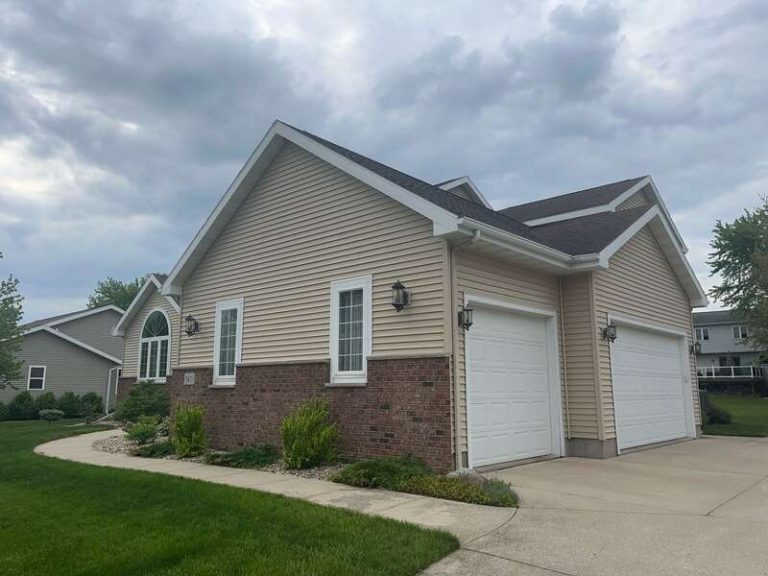
Roof replacement cost in Marshall, WI, and how payment works
Real numbers, with the honest caveat that these are ranges we see in south-central Wisconsin and your price is confirmed only after we measure the roof.
Architectural asphalt shingle roof replacement, full tear-off, typically runs $475-$700 per square (a square is 100 square feet of roof surface, not floor space). In practice:
- A straightforward 1,800-2,200 sq ft ranch or one-story, roughly 20-26 squares: $9,000-$16,000.
- A cut-up two-story with steeper pitch, dormers, multiple valleys, skylights or two existing layers: $18,000-$30,000.
- Class 4 impact-rated shingles: add roughly 10-20%.
- Standing seam metal: roughly $1,100-$1,800 per square installed.
- Decking replacement: priced per sheet, commonly $75-$150 installed, and only for what actually needs it.
What moves your number inside those bands: pitch and safety setup, number of tear-off layers and disposal, decking condition, material grade, and detail count (chimneys, skylights, dormers, low-slope tie-ins). On flat roofs it's membrane type, insulation thickness, tapered insulation for drainage, and deck condition.
Ask every bidder whether the number includes ice-and-water shield, new drip edge, new flashing (not reused), the permit, and full cleanup with a magnetic sweep. Cheap bids get cheap by skipping exactly those items.
On payment: a normal reroof needs either nothing down or a modest deposit to order materials, with the balance due at completion after you've seen the finished work. Nobody should be asking for half the job in cash up front. On insurance jobs the claim payments drive the schedule, with the depreciation check coming after completion.
If you're paying out of pocket, financing goes through third-party lenders, not us. The usual structures are a deferred-interest promotional plan (no interest if paid in full inside the promo window, full retroactive interest if you miss it) or a fixed-term installment loan at a set rate with a level monthly payment. Most run a soft pre-qualification first, which doesn't ding your credit, and you see the rate, term and exact monthly payment before you commit. Ask us to run the options next to your estimate so you're comparing real payments, not guesses.
Want a straight answer on your roof?
We'll inspect it, document everything, and tell you honestly what you're looking at, even if the answer is patch it for now. No pressure.
What the install week looks like
Most Marshall homes are a one-to-two day job. A 28-square two-story in one of the newer subdivisions, single layer, moderate pitch, is a classic two-day: tear-off and dry-in the first day, shingles, flashing, ridge vent and cleanup the second. Add widespread decking replacement, steep pitch or a lot of dormers and you're looking at three to four days. Commercial low-slope work depends on square footage, insulation and rooftop equipment, and we put a day count in the estimate.
You don't need to be home, but we do need the driveway for material delivery and the dump trailer, so move the cars. Before we start, we tarp shrubs and landscaping, put plywood over delicate plantings and the AC condenser, and protect and clear the gutters.
Inside, plan for noise. Vibration knocks pictures crooked, so take fragile wall items down, and put pets somewhere quiet, because nail guns overhead genuinely stress animals out. At the end, debris gets hauled, we run magnets over the drive, lawn and curb line, and we walk the job with you before you pay the balance.
On permits: reroofing on one and two family homes in Wisconsin generally requires a permit, with inspection handled by the local building inspection authority (small villages typically contract that service out). We pull the permit and coordinate the inspection so it isn't your errand.
How to vet a roofing contractor before you sign
The credential that actually exists in Wisconsin. Wisconsin doesn't license roofing as a standalone trade. What it does require is a DSPS Dwelling Contractor and Dwelling Contractor Qualifier credential to pull permits on one and two family homes, plus general liability and workers' compensation insurance. Ask for the certificates. Real contractors expect the question.
- Warranty in writing, both kinds. Manufacturer warranties cover materials. Workmanship warranties cover installation, and installation is where most leaks come from. Ours is a 10-year written workmanship warranty on full roof replacements, printed in the contract, and transferable if you sell. As a GAF Master Elite contractor we can also write GAF's enhanced system warranties, including Silver Pledge and Golden Pledge, which add GAF-backed workmanship coverage. Terms vary by shingle line, so we show you the actual certificate language.
- A local address and history. Storm-chasers show up after hail and disappear before the warranty matters. Anyone offering to "take care of" your deductible is one of them. We've been at this since 1979 and we're not hard to find.
- No pressure, no big deposit. If someone needs your signature today for "this week's pricing," walk away.
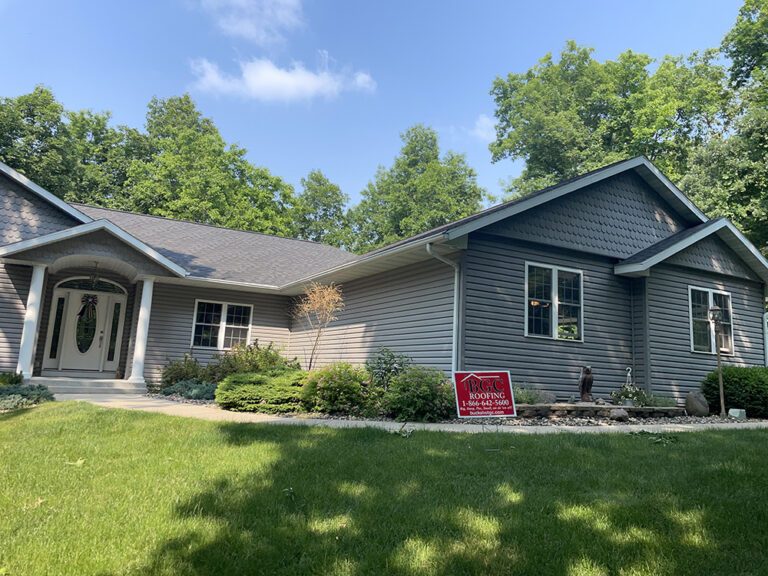
Get eyes on your roof, free
Whether it's a commercial flat roof staining ceiling tile, shingles you found in the yard after the last wind event, or a 22-year-old roof you know is near the end, the next step is small: let us get up there and tell you the truth.
The inspection is free, you get photos and a written line-item estimate, and nobody will lean on you to decide anything on the spot. If you have water coming in right now, say so when you call. We run 24-hour emergency storm response and can get the roof protected first and sort out the rest after.
Call Buckshot Exteriors at (608) 909-9109, or send a message through our contact page, and we'll get out to Marshall.
Get a straight answer on your Madison roof
Wisconsin storm season and insurance non-renewal letters do not wait. Get a free, no-obligation inspection and an honest assessment of exactly what your roof needs, even if the answer is to wait.