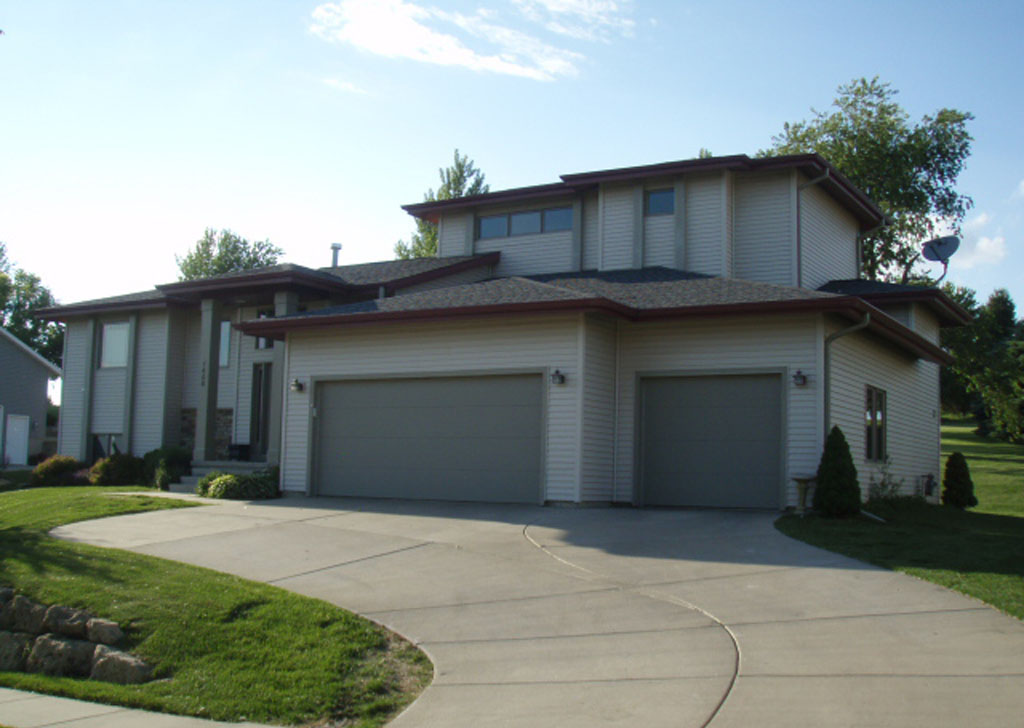
Most Madison homeowners pay somewhere between $9,000 and $22,000 for a full asphalt shingle replacement, depending on roof size, pitch, number of tear-off layers, and material grade. Steeper roofs, premium shingles, or rotted decking that needs replacing will push costs toward the higher end. The only way to get an accurate number for your specific home is a free on-site inspection - general estimates pulled from national averages can be off by thousands.
Get My Free Estimate →- What Does a Roof Replacement Actually Cost in Madison, WI?
- What About Insurance? The Real Story on Claims in Wisconsin
- Repair vs. Replace: How to Make the Call
- Insurance Non-Renewal: The Risk Nobody Talks About
- Does a New Roof Add Value When Selling?
- How to Find a Trustworthy Roofer in Madison, WI
- Assistance Programs for Wisconsin Homeowners
- You Deserve a Straight Answer - Not a Sales Pitch
- FAQs
Your roof is leaking, or a neighbor just got theirs replaced after the same storm, or you finally climbed up and looked - and now you're staring down one of the biggest home repair decisions you'll make. You want a straight answer on what this costs, whether insurance will actually help, and how to avoid getting burned by the wrong contractor.
We've been doing this in south-central Wisconsin since 1979. Here's what we'd tell our own neighbors.
What Does a Roof Replacement Actually Cost in Madison, WI?
Let's get the number out of the way first, with a real caveat: no honest contractor can quote you a final price without seeing your roof.
That said, here are realistic 2026 ranges for Madison-area homes:
- Small ranch or bungalow (1,200-1,600 sq ft footprint): $9,000-$13,000
- Average two-story home (1,600-2,400 sq ft footprint): $12,000-$18,000
- Larger or complex home (2,400+ sq ft, steep pitch, multiple valleys): $17,000-$25,000+
These assume standard architectural asphalt shingles, one layer of tear-off, and decking that's in decent shape. Several things can move that number up or down.
What Drives the Price Up (or Down)
Roof size and pitch. Contractors price by the "square" (100 sq ft). A steeper roof costs more per square - crews work slower, need different equipment, and take on more risk. A 12/12 pitch can add 20-30% over a walkable 4/12.
Number of layers. Wisconsin homes sometimes have two or even three layers of old shingles stacked up. Each layer of tear-off adds labor and disposal cost - typically $500-$1,500 extra depending on the job.
Decking condition. When we pull old shingles, we see what's underneath. Rotted, soft, or delaminated OSB or plywood has to be replaced before anything goes over it. We price it per sheet and show you what we found - no surprises mid-job.
Material choice. Standard 3-tab shingles are largely gone. Architectural (dimensional) shingles are the baseline now. Impact-resistant (Class 4) shingles cost more upfront but can lower your insurance premium and hold up better in Wisconsin hail seasons. Metal roofing runs higher but can last 40-50 years.
Flashing, vents, and accessories. Pipe boots, ridge vents, chimney flashing, and step flashing all need to be done right. Cutting corners here is exactly where cheap roofs fail first.
What Does Labor vs. Materials Actually Cost?
Homeowners ask this a lot, and it's a fair question. On a typical Madison asphalt shingle job, materials - shingles, underlayment, ice-and-water shield, nails, flashing, and accessories - run roughly 40-50% of the total. Labor, equipment, disposal, and overhead make up the rest.
That split matters because material costs are largely fixed by the market. When a quote is dramatically lower than others, it's almost always the labor and process getting cut - thinner crews, skipped underlayment, reused old flashing, no decking inspection. Those shortcuts don't show up until year three or four, usually after the contractor is long gone.
How Long Does a Roof Replacement Take?
For most Madison homes, one to two days. A straightforward ranch or two-story with one tear-off layer and clean decking is typically done in a single day. Larger homes, steep pitches, multiple layers, or decking repairs can stretch it to two days or occasionally three.
We schedule around Wisconsin weather, show up when we say we will, and clean up completely before we leave. You shouldn't have to take a week off work for this.
Why Does It Cost So Much Right Now?
Material costs jumped after 2020 and haven't fully come back down. Labor is tight in Madison - good crews are busy. Fuel, insurance, and disposal costs are all higher than they were five years ago.
When a quote seems shockingly low, that's the real warning sign. Either the contractor is skipping steps or they're planning to ask for more money once they're already on your roof. We see the aftermath of those jobs regularly.
Roof replacement cost by home size (Madison, 2026)
| Home | Roof size | Typical total |
|---|---|---|
| Small ranch / bungalow | 14-18 squares | $9,000-$13,000 |
| Average two-story | 18-26 squares | $12,000-$18,000 |
| Large or complex (steep) | 26+ squares | $17,000-$25,000+ |
Cost by roofing material (average Madison home, installed)
| Material | Lifespan | Typical total |
|---|---|---|
| Architectural asphalt (standard) | 25-30 yrs | $12,000-$18,000 |
| Impact-resistant (Class 4) | 30+ yrs | $15,000-$22,000 |
| Standing-seam metal | 40-50 yrs | $25,000-$45,000 |
Common add-on costs
| Item | Typical cost |
|---|---|
| Extra tear-off layer | $500-$1,500 |
| Decking replacement | $50-$80 per sheet |
| New flashing & pipe boots | $300-$700 |
| Seamless gutters | $1,000-$2,500 |
Typical Madison-area 2026 ranges. Your exact price depends on an on-site inspection. A new asphalt shingle roof recoups about 61% of its cost at resale on average (2024 Remodeling Cost vs. Value Report).
Quick roof replacement cost estimator
Get a ballpark in 20 seconds. For an exact figure, book a free on-site inspection.
What About Insurance? The Real Story on Claims in Wisconsin
This is where most homeowners get blindsided, so let's be direct.
What Insurance Does and Doesn't Cover
Insurance covers sudden, accidental damage - hail, wind, falling trees, fire. It does not cover wear and tear, age, or deferred maintenance. If your roof is failing because it's 25 years old and nobody maintained it, that's not a covered loss.
After a hail or wind event, coverage depends on your policy type, your roof's age, and what your adjuster documents. That last part matters more than most homeowners realize. If the adjuster misses damage - and it happens - you can end up with a partial settlement that doesn't reflect the real scope.
We meet your insurance adjuster on-site, point out every area of documented damage, and make sure nothing gets missed. That's not adversarial - it's just thorough. Learn more about how we handle storm damage claims.
ACV vs. RCV - This Could Cost You Thousands
Here's the misconception that costs Wisconsin homeowners the most money: assuming your policy pays full replacement cost.
Replacement Cost Value (RCV) means your insurer pays to replace your roof at today's material and labor prices, minus your deductible. That's the policy you want.
Actual Cash Value (ACV) means they pay replacement cost minus depreciation. A 15-year-old roof might be depreciated 40-50%. On a $16,000 replacement, that's a $6,400-$8,000 check - and you're on the hook for the rest, plus your deductible.
Many Wisconsin insurers have quietly shifted older roofs to ACV schedules. Pull out your declarations page right now and look for "ACV" or "roof schedule." If you're not sure what you're reading, we're happy to look at it with you.
The Deductible Surprise
Another painful one: percentage-of-value deductibles. Many policies no longer have a flat $1,000 deductible for wind and hail. Instead, they use 1-2% of your home's insured value. On a $350,000 home, that's a $3,500-$7,000 deductible - before insurance pays a single dollar.
Know your deductible before you file. If the damage estimate is close to your deductible amount, filing may not be worth it. A claim that pays out very little still goes on your loss history.
How to Actually Get Your Roof Replaced Through Insurance
The process isn't as complicated as it feels, but the order matters.
- Get a contractor inspection first. Before you call your insurer, have a trusted local roofer document the damage with photos and a written assessment. This gives you a baseline so you know what should be on the adjuster's scope.
- File your claim. Call your insurance company and report the damage. They'll assign an adjuster and schedule a visit.
- Have your contractor present at the adjuster inspection. This is the step most homeowners skip - and it's the most important one. We walk the adjuster through every area of damage so nothing gets overlooked.
- Review the adjuster's scope carefully. Compare it against your contractor's assessment. If items are missing, you can supplement the claim with documentation.
- Understand your payment structure. With RCV coverage, insurers typically issue an initial check (ACV portion), then a second check (depreciation holdback) once the work is complete. Don't be surprised when the first check doesn't cover everything.
- Choose your contractor and schedule the work. Get a written contract with a clear scope, timeline, and payment schedule before anything starts.
If this sounds like a lot to manage, that's exactly why having an experienced contractor in your corner matters. We've walked hundreds of Madison homeowners through this process.
Can You Get Your Roof Replaced Free Through Insurance?
Bluntly: rarely, and be suspicious of anyone who promises it. Even with RCV coverage, you owe your deductible. With ACV coverage, you may owe much more. Any contractor offering to "waive your deductible" is almost certainly inflating the claim - which is insurance fraud, and it puts you at legal risk, not just them.
What you can do is make sure every legitimate dollar of covered damage is documented and claimed. That's where having an experienced contractor in your corner matters.
Assignment of Benefits - Don't Sign It
If a contractor shows up after a storm and asks you to sign over your insurance rights (an "Assignment of Benefits" or AOB), walk away. You lose control of your own claim. Reputable contractors don't need that - they work with you and your insurer, not instead of you.
How Much Should You Pay Upfront?
On an insurance claim job, a reputable contractor typically asks for little to nothing upfront - your first insurance check usually funds the material deposit once work begins. On a non-insurance job, a reasonable deposit is 10-30% to cover materials. If someone asks for 50% or more before a single shingle is touched, that's a red flag. Full payment before the job is complete is never appropriate.
Repair vs. Replace: How to Make the Call
Repair makes sense when:
- Damage is isolated to a small, clearly defined area
- Your roof is under 15 years old and otherwise in good shape
- The repair won't void your remaining manufacturer warranty
Replacement makes sense when:
- Your roof is 20+ years old and showing widespread granule loss or brittleness
- You have multiple leak points or storm damage across a large portion of the surface
- Your insurer is threatening non-renewal over roof condition
- A home inspector has flagged the roof during a sale
One honest note: partial repairs on an aging roof can create more problems than they solve. Mismatched shingles, disturbed underlayment, and missed underlying damage are common outcomes. If you're close to the end of your roof's useful life, a repair is often just delaying an inevitable - and more expensive - conversation.
"Someone Already Looked at It and Said It Was Fine"
We hear this one regularly. The honest answer: it depends entirely on who looked and what they were looking for. A general handyman, a real estate agent, or even a roofer who only spent five minutes on the ground may miss hail bruising, granule displacement, or damaged flashing that's only visible up close. Hail damage in particular is easy to miss without knowing exactly what to look for.
If you have any reason to doubt that assessment - a recent storm, a neighbor's claim, or your own gut - a second opinion costs you nothing. We'll tell you honestly what we see, even if the answer is "it's fine for now."
If you're on the fence, a free inspection from a qualified residential roofing contractor gives you the information you need without any obligation to move forward.
Not sure if your damage justifies a full replacement? We'll come out, look at it honestly, and tell you what we actually think - even if the answer is "patch it for now." Contact us for a free inspection.
Insurance Non-Renewal: The Risk Nobody Talks About
Wisconsin insurers have become increasingly aggressive about non-renewing policies on homes with older roofs. If your roof is over 20 years old, you may receive a letter requiring an inspection - or simply a non-renewal notice.
This matters for two reasons. First, replacing a roof proactively keeps you in control of the timing and contractor choice. Second, if you're shopping for a new insurer with a 22-year-old roof, you may find very limited options or much higher premiums.
A documented, recently replaced roof with a manufacturer warranty is one of the cleanest things you can show a new insurer.
Does a New Roof Add Value When Selling?
Yes, meaningfully. In Wisconsin's climate, a failing roof is one of the most common reasons a home sale falls through or a buyer demands a price reduction. A new roof removes that objection entirely.
Realtors and home inspectors in the Madison market flag roof condition prominently. If you're planning to list in the next 12-18 months, a roof replacement is one of the highest-ROI improvements you can make. You may not recoup 100% of the cost in sale price, but you'll likely recoup it in fewer concessions and a faster close.
Want a straight answer on your roof?
We'll inspect it, document everything, and tell you honestly what you're looking at, even if the answer is patch it for now. No pressure.
How to Find a Trustworthy Roofer in Madison, WI
The Madison market gets flooded with out-of-state storm chasers after every significant hail or wind event. They're here for the claim money, not to stand behind their work five years from now.
Here's what to look for:
- Local, established business - not a P.O. box and a truck
- Verifiable insurance - ask for a certificate of insurance naming you as additionally insured
- Written, itemized estimate - not a one-line total
- No AOB requests - ever
- References and real reviews - check what our customers say and look for patterns, not just star counts
- Manufacturer authorization - this affects what warranty you actually receive
Get at least two or three estimates. Pricing that's dramatically lower than the others usually means something is being skipped.
"I Don't Have Time to Deal with All of This"
That's fair - most homeowners don't. A good contractor handles the heavy lifting: the adjuster coordination, the documentation, the scheduling, the cleanup. Your job is to make one phone call and show up for the adjuster visit. We take it from there.
- A price dramatically lower than every other bid (corners are getting cut somewhere)
- Pressure to sign on the spot, or a "today only" discount
- A request to sign over your insurance claim (Assignment of Benefits)
- An offer to "waive your deductible" (that is insurance fraud, and it puts you at risk)
- No written, itemized estimate, or no proof of insurance
- A large upfront payment (more than 30%) before any work begins
Assistance Programs for Wisconsin Homeowners
If cost is a genuine barrier, there are options worth exploring:
- WHEDA (Wisconsin Housing and Economic Development Authority) offers home repair loan programs for qualifying homeowners
- Dane County and some municipalities have weatherization and repair assistance programs
- 211 Wisconsin (just dial 2-1-1) connects you to local housing assistance resources in Dane County and beyond
- Wisconsin's Energy Assistance Program (WHEAP) helps with heating and energy costs - it's not a roof repair program, but weatherization assistance through that network sometimes includes attic and insulation work that overlaps with roof-related energy loss
- Some roofing contractors, including us, offer financing options for qualified homeowners
Don't let the cost conversation stop you from at least understanding what you're dealing with. A free inspection costs you nothing and gives you real information to work with.
You Deserve a Straight Answer - Not a Sales Pitch
We've been doing this in Madison and south-central Wisconsin since 1979. We're not chasing storms and moving on. We're your neighbors, and we'll be here when you call us five years from now.
If your roof is giving you any reason to worry - a leak, missing shingles, a recent storm, an insurance letter, or just the age of the thing - get a free, no-pressure inspection from our team. We'll tell you exactly what we see, what it means, and what your realistic options are. No obligation, no scare tactics, no pressure to sign anything on the spot.
Call us or reach out online. The inspection is free. The information is yours to keep.
Get a straight answer on your Madison roof
Wisconsin storm season and insurance non-renewal letters do not wait. Get a free, no-obligation inspection and an honest assessment of exactly what your roof needs, even if the answer is to wait.