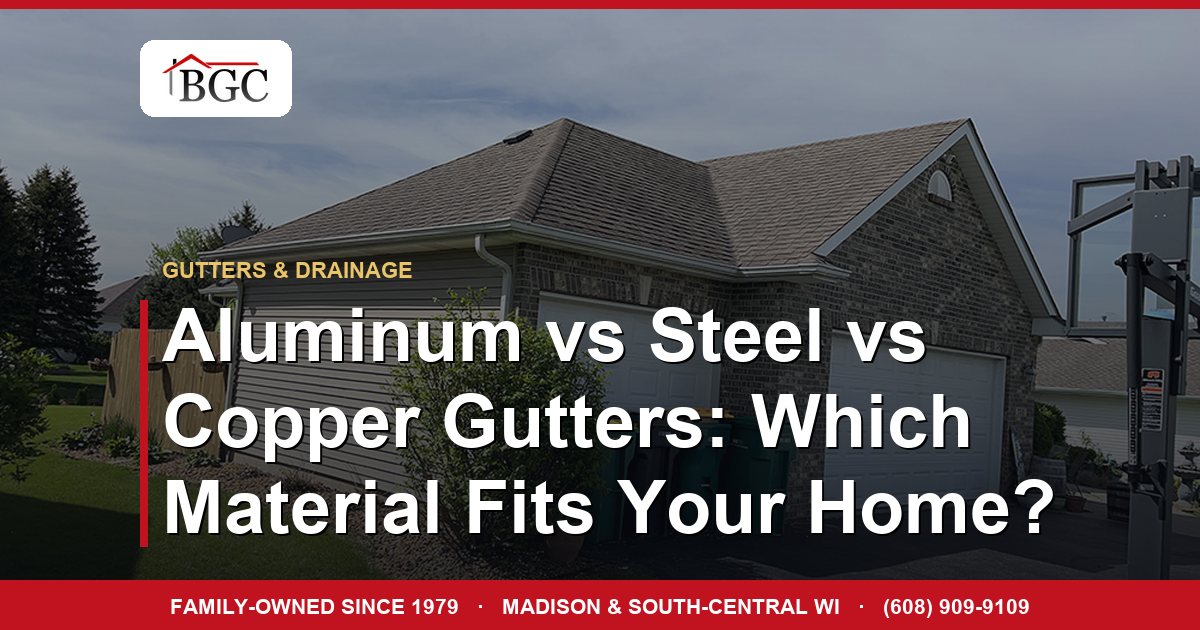
Seamless aluminum suits most homes because it does not rust and is affordable, especially in a heavier thickness with close hanger spacing. Steel is stronger under snow slides and falling limbs but can rust once its coating wears. Copper lasts the longest but costs far more, and vinyl can crack in the cold.
Get My Free Estimate →- Gutter materials compared
- Aluminum gutters in Wisconsin weather
- Steel gutters: strength vs rust
- Copper gutters: long life at a premium
- Why vinyl gutters struggle in Wisconsin
- What drives the cost difference
- Seamless vs sectional matters as much as material
- Hangers, fascia and what belongs in your quote
- Gutter size: 5-inch vs 6-inch
- Matching your roof and trim
- Maintenance by material
- How to choose a gutter material
- Getting new gutters installed
- FAQs
Seamless aluminum fits most Wisconsin homes. It is light, it does not rust, it can be formed into one continuous run on site, and it is the most affordable metal option.
Steel is the step up when strength matters more than weight, such as under heavy snow slides or falling limbs. Copper lasts the longest and suits high-end and historic homes, but it costs far more, and vinyl struggles in Wisconsin cold.
Gutter materials compared
| Material | Strengths | Weak points | Best for |
|---|---|---|---|
| Aluminum | Light, rust-free, formed seamless on site, many colors, most affordable metal | Dents from ladders and limbs, expands and contracts with temperature | Most homes and budgets |
| Galvanized steel | Stronger, resists sagging and dents from snow and branches | Rusts once its coating is scratched or wears, heavy to hang | Eaves that take snow slides or falling limbs |
| Stainless steel | Steel strength with much better rust resistance | Costs noticeably more than galvanized, heavy | Problem sections where rust keeps returning |
| Copper | Most durable and long-lived, resists moss and mildew, develops a patina | Often about twice the cost of aluminum or more, needs soldered joints, a theft target | Historic and high-end homes |
| Vinyl | Cheapest up front, easy for DIY | Can crack in cold and sag over time | Mild climates rather than Wisconsin |
Aluminum gutters in Wisconsin weather
Aluminum is the most common choice because it cannot rust. Freeze-thaw cycles are hard on protective coatings, and aluminum does not depend on one.
It is also light enough to form on site. A roll-forming machine turns a coil into one continuous trough the length of each eave, which is why most residential work uses seamless aluminum gutters.
The trade-off is softness. A ladder leaned on the front lip or a falling limb can dent it, and low eaves over driveways take the most knocks.
Aluminum also expands and contracts with temperature. On long runs, sealed end caps and the right fasteners matter more than most homeowners expect.
Thickness makes a real difference. Ask for the thickness in writing, because heavier aluminum resists dents and sagging better than thin budget coil.
Steel gutters: strength vs rust
Steel is the right choice when gutters take physical abuse as well as water. It resists sagging under heavy wet snow, handles ladder pressure better and holds its shape when a branch comes down.
Galvanized steel relies on a zinc coating to keep rust away. Once that coating is scratched by a ladder, scraped during cleaning or worn thin at a seam, rust can start, often first as orange streaks at inside corners and downspout outlets.
That is the main argument against steel in a wet, freeze-thaw climate. Stainless steel solves most of the rust problem but costs more, so it is often used on specific problem sections rather than a whole house.
Steel is also heavier, so hanger spacing and sound fascia have to be right before it goes up.
Why vinyl gutters struggle in Wisconsin
Vinyl's only real advantage is a low price. Cold makes it brittle, so joints can split and sections crack, and long runs tend to sag between hangers over time.
Replacing failed vinyl later with metal means paying for a second removal and a second install on the same eaves, which is worth weighing before choosing on price alone.
What drives the cost difference
The metal is only one part of the price. Aluminum is the least expensive metal, galvanized steel is a step up, stainless steel is higher, and copper sits in its own tier.
Total footage, number of stories, corner count, trough size, the number of downspouts and any rotten fascia behind the old gutters often move the price more than the metal. Soldered copper also takes more labor than aluminum.
Ask every bidder to itemize footage, material thickness, hanger type and spacing, and downspout count, so you can compare quotes on equal terms.
Not sure whether your gutters need replacing or just rehanging? Call (608) 909-9109 for a free on-site inspection.
Seamless vs sectional matters as much as material
A continuous seamless run leaks less than a sectional system, because joints are where gutters usually fail first. Every seam in a sectional gutter relies on sealant that shrinks and pulls over time.
Seamless gutters still have joints at corners, end caps and outlets, so workmanship still matters. Our guide to seamless vs sectional gutters covers the comparison in detail.
The best material will still fail if the slope is wrong or the hangers are too far apart, because water pools and ice pries at the trough. If your gutters are already pulling away from the house, the fix starts with the fascia and fasteners.
Want a straight answer on your roof?
We'll inspect it, document everything, and tell you honestly what you're looking at, even if the answer is patch it for now. No pressure.
Hangers, fascia and what belongs in your quote
Hangers and fascia decide how long a gutter holds its shape. Hidden hangers screwed through the trough into solid fascia hold far better than old spikes and ferrules that work loose as wood moves.
Closer hanger spacing helps gutters carry snow and ice without sagging, especially under eaves where snow slides off the roof. Ask for the spacing in writing, along with what happens if soft fascia turns up behind the old gutters.
Gutters, fascia, drip edge and the first course of shingles meet in the same few inches. Hangers should never be nailed through the roofing, and any drip edge lifted during the work should be refastened properly.
If the roof is near the end of its life, replacing gutters during a roof replacement avoids working on the same eaves twice.
Gutter size: 5-inch vs 6-inch
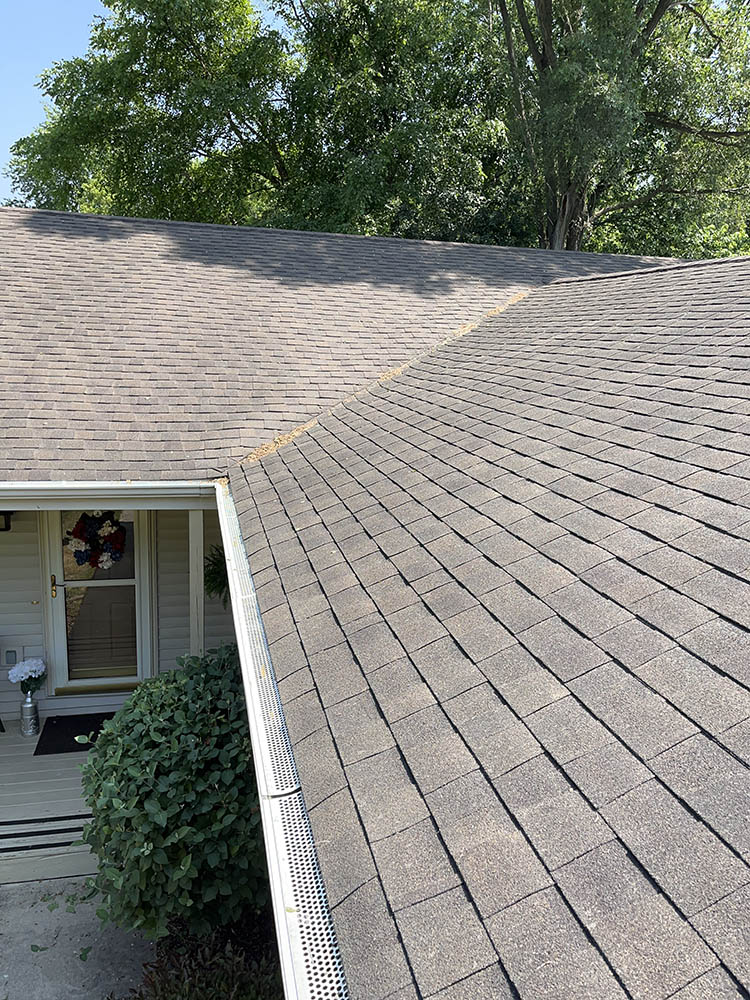
Gutter size can matter more than material on steep roofs with large drainage areas. A 6-inch trough carries more water than a 5-inch trough, and a 3x4-inch downspout has twice the opening of a standard 2x3-inch downspout.
Downspout count and placement do the other half of the work. Our guide to 5-inch vs 6-inch gutters explains when the upgrade is worth it.
Matching your roof and trim
Choose the gutter profile to suit the house first and the color to suit the trim second. K-style gutters suit most homes and carry more water for their size, while half-round gutters suit older homes and pair naturally with copper.
Matching the gutter color to the fascia makes it blend in, while matching it to the roof makes the roofline look more defined. Either works when it is a deliberate choice.
Maintenance by material
Every gutter needs regular cleaning, and twice a year, in late spring and after the fall leaf drop, is a common routine. Each material then has its own weak point to watch.
- Aluminum. Check sealant at end caps and corners, and keep ladders off the front lip.
- Galvanized steel. Look for scratched coating and touch up bare spots before rust starts.
- Stainless steel. Little upkeep beyond checking fasteners and fascia under its weight.
- Copper. Very little upkeep. Leave the patina alone and check soldered joints every few years.
Under heavy tree cover, gutter guards cut cleaning frequency, as covered in our guide to whether gutter guards are worth it. For eaves that ice up every winter, our guide to heated gutters explains where heat cables help.
How to choose a gutter material
Start with tree cover, snow and budget. Most homeowners land on heavier seamless aluminum, which meets the demands of a Wisconsin winter without paying for strength the house does not need.
Choose steel if snow slides onto the eaves, limbs come down often, or aluminum has already been crushed, and accept that you are trading rust risk for stiffness. Choose copper if the house has the architecture for it and you want the longest-lasting option.
Whatever you choose, the installation decides the result. Correct slope, close hanger spacing, enough downspouts and sound fascia matter as much as the metal.
Getting new gutters installed
A gutter replacement goes best when someone measures the eaves, checks the fascia and looks at where water lands before recommending a material. Buckshot Exteriors is family-owned and has worked on roofs and exteriors since 1979, with offices in Madison, WI and Centerville, IA.
Our free on-site inspection covers the gutters, fascia, roof edge and downspouts. Our seamless gutters page covers installation, and our gutters page covers the full system.
Call (608) 909-9109 to schedule a free inspection, and ask for footage, material, thickness and hanger spacing in writing so you can compare every bid fairly.
Get a straight answer on your Madison roof
Wisconsin storm season and insurance non-renewal letters do not wait. Get a free, no-obligation inspection and an honest assessment of exactly what your roof needs, even if the answer is to wait.