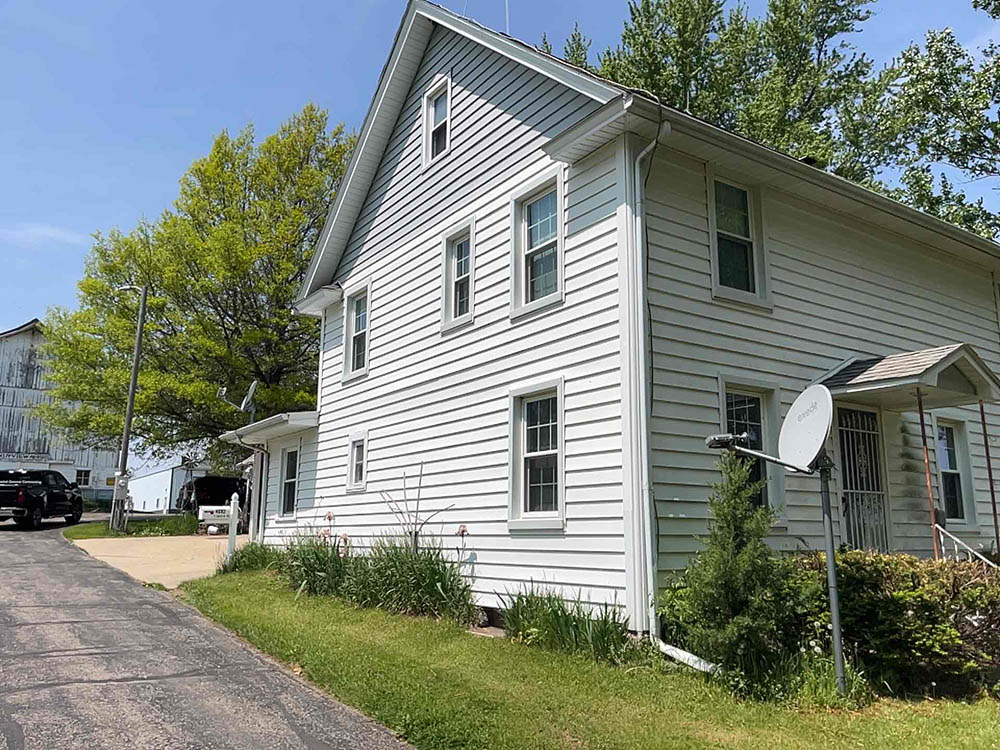
Installed cedar siding generally runs roughly $11-$20 per square foot of wall area depending on grade, profile and how cut-up the house is. On a home with about 2,000 square feet of wall area, that works out to roughly $22,000-$40,000. Clear-grade vertical-grain cedar and hand-staggered shingle siding sit at the top of that range, knotty lap siding at the bottom. Those are market ranges that move with lumber pricing, not a quote.
Get My Free Estimate →- What cedar siding costs in Wisconsin
- What cedar really costs over 20 years
- The real cedar siding options
- The finish decision: let it gray, stain it, or paint it
- How cedar holds up to Wisconsin weather
- Installation details that decide whether cedar lasts 20 years or 50
- Upgrades worth doing while the siding is off
- When to do the work in Wisconsin
- Timeline, disruption and lead paint on older homes
- Historic districts, HOAs and approvals
- Hail, wind and insurance on a cedar wall
- Repair, re-side, or side over the top?
- Warranties, payment and financing
- Is cedar the right call for your house?
- Get a straight answer on your cedar siding
- FAQs
Cedar siding costs more than vinyl and generally lands in the range of, or above, fiber cement: figure roughly $11-$20 per square foot of wall area installed in our market, depending on grade and profile. It gives you a natural wood look manufactured products still only approximate. And it asks for maintenance on a cycle measured in years, not decades.
That last part is the whole decision. Cedar rewards an owner willing to look after it and punishes one who is not.
Quick note on terms: this article is about cedar as a wall cladding (lap siding, shingle siding, shake-style panels). Cedar shake roofing is a different product and a different conversation.
What cedar siding costs in Wisconsin
At $11-$20 per square foot of wall area, a house with roughly 2,000 square feet of wall (a common number on a two-story in Dane County, not counting windows and doors) lands around $22,000-$40,000 installed. Grade, profile and how cut-up the house is move that number more than anything else.
Rough pecking order on price, lowest to highest:
- Knotty / #2 grade cedar bevel (clapboard) siding sits at the bottom of the cedar range.
- Clear-grade, vertical-grain cedar lap costs noticeably more. The raw material is harder to source and far more stable.
- Cedar shingle siding, especially hand-staggered coursing, is labor-heavy and usually the most expensive way to put cedar on a wall.
- Engineered cedar-look products generally land below real cedar and overlap with fiber cement.
Things that quietly add thousands: steep gables that need staging, lots of windows and doors (more trim, more cuts, more caulk joints), hidden rot found at tear-off, lead-safe work practices on older homes, and shop pre-finishing instead of brush-finishing on the wall.
For a side-by-side with vinyl, fiber cement, steel and LP-style engineered products, our siding cost guide breaks the ranges out by material so you can see where cedar sits before you commit.
Treat every number here as a market range. Lumber pricing moves, and nobody can quote your house without measuring it.
What cedar really costs over 20 years
This is the number most cedar articles skip. A professional wash, prep and recoat commonly runs somewhere between about $1.50 and $5 per square foot of wall area, and the spread is almost entirely prep.
- Low end (often under $2/sf): sound, previously semi-transparent-stained cedar that needs a soft wash, a few days to dry, spot priming and one maintenance coat. Single story, easy access.
- High end: scraping failed paint or solid stain, replacing and weaving in bad boards, re-caulking trim joints, lead-safe containment on a pre-1978 home, staging on tall gables.
On that 2,000 square foot wall, call it roughly $3,000-$10,000 a cycle. A stained cedar house will likely go through three or four cycles in 20 years, plus caulk and trim work along the way.
Honest comparison over the same 20 years: vinyl mostly needs washing. Fiber cement often needs one repaint. Cedar needs several. That is the real tradeoff, and it is a budgeting question, not a quality question.
The real cedar siding options
Solid cedar lap (clapboard / bevel) siding
The classic. Horizontal boards, each lapping the one below. Western red cedar is the common species here, in 1/2x6, 1/2x8 and wider.
Grade matters. Clear vertical-grain cedar holds a finish better and cups less than knotty flat-grain stock. On a south or west wall in full sun, that difference shows up within a few years.
Cedar shingle siding
Shorter sawn shingles installed in courses, often with a staggered butt pattern for texture. It is the look people picture on lake cottages and Craftsman bungalows, and it handles curved walls and odd geometry better than long boards. It also doubles your labor.
Shake-style panels and engineered look-alikes
Panelized shake products and engineered wood chase the cedar aesthetic with less upkeep. Pre-finished boards hold their coating longer than brush-finished cedar, and woodpeckers and carpenter bees are far less interested in them.
What you give up is grain, depth and repairability. Cedar can be swapped one board at a time. Some composites cannot be matched years later.
If you want to see how cedar gets detailed and finished on real homes here, our cedar and wood siding page covers the material options and the installation approach we use.
The finish decision: let it gray, stain it, or paint it
This single choice sets your maintenance cycle for the life of the wall, so make it on purpose.
Letting cedar weather naturally to silver-gray
This is a legitimate choice, not neglect, and it is what a lot of lake and cabin-style homes around here are going for. Bare cedar exposed to sun and rain turns tan, then silver-gray, over a few seasons.
What actually happens, honestly:
- The graying is uneven. South and west walls silver out first. Sheltered walls under deep eaves, porches and overhangs stay tan or blotchy for years.
- Mill glaze slows it down. New, smooth-planed cedar has a burnished surface that sheds water and weathers unevenly at first. Rough-sawn cedar grays more uniformly.
- Shaded walls get dirty, not silver. North and east elevations under trees go blackish-green with mildew instead of weathering into that clean patina.
- Bare wood still erodes. Sun and freeze-thaw slowly raise grain, open checks and wear the surface. Unfinished cedar lasts a long time, but it is not frozen in time.
Most important: going gray does not excuse water management. Bare cedar still needs back-sealing before install, a rainscreen gap, correct flashing and clearance at the bottom courses. If you want the gray look with less unevenness, some owners use a clear or gray-toned weathering stain, which steers the color rather than fighting it.
Semi-transparent stain vs solid stain vs paint
Semi-transparent stain soaks in, shows the grain, and fades rather than peels. That makes the recoat a wash-and-coat job rather than a scrape job. It is the shortest cycle but by far the easiest one to live with.
Solid stain behaves more like thin paint. It hides grain and color variation, holds color longer between coats, and eventually flakes at the worst-exposed spots.
Acrylic paint gives the longest stretch between coats and the widest color range. The catch is how it fails. Paint sits on top of the wood, so moisture coming from behind (siding that was never back-primed, a wall with no drying gap, splash-back at the bottom courses) pushes the film off in sheets. Peeling paint on cedar is usually a moisture problem wearing a paint costume.
And the question people wish they had asked sooner: you generally cannot go back from paint to stain. Stain needs to penetrate bare wood. Once paint is on, your realistic options are repaint, go to solid stain, or replace the siding. Chemical stripping or sanding a whole house to bare wood is possible and almost never worth what it costs. If you are at all unsure, start with stain.
Mildew, algae and green-black staining on shaded walls
That dark green or blackish film on your north and east walls is almost always mildew and algae, not rot and not failed finish. It is the cheapest problem on this whole page to fix.
The answer is usually washing, not refinishing. A low-pressure wash with an appropriate cleaner, rinsed well, takes it off. Never blast cedar with a pressure washer on a high tip. You will fuzz the wood, drive water behind the boards and tear up the finish you were trying to save.
If the finish still repels water after cleaning (droplets bead rather than soaking in), you bought yourself more years and skipped a recoat. If the wood darkens and drinks the water, it is time to coat.
While you are at it, cut back the shrubs and tree limbs crowding that wall. Airflow and a few hours of sun do more for a shaded elevation than any product.
How cedar holds up to Wisconsin weather
In our experience, properly installed and maintained cedar runs 30-40 years or more. Installed badly, it can be in trouble inside of 20. The material is rarely the problem. Water management is.
Splash-back rot at the bottom courses
This is the most common cedar failure we find, and it is almost always the lowest two or three courses. Snow piles against the wall for months. Mulch gets heaped over the bottom edge. Roof runoff hits bare ground and splashes back. Sprinklers soak the wall every other morning.
Cedar that stays damp rots from the back and bottom edge first, so it looks fine from the street right up until you press a screwdriver into it.
A pattern we see over and over on older shingle-sided homes in established Madison neighborhoods: the bottom three courses on the north and east walls are spongy behind the landscape beds, the sheathing below the windows is still sound, and the rest of the wall just needs prep and a fresh coat. Scope ends up being replace and weave in the low courses, correct the grade clearance, then refinish the whole elevation. That is a far smaller project than a full re-side, and homeowners are usually relieved when the probe comes back dry higher up.
Sun-facing elevations age faster
Your south and west walls need refinishing before your north and east walls do, and it is not close. UV breaks down the finish, the wood dries and checks, and coatings fail unevenly. Walls can be on their own cycles, and usually should be.
Freeze-thaw and trapped moisture
Our winters swing back and forth across freezing repeatedly through the season. Water that soaks into wood and then freezes opens checks and lifts finish. Ice dams send meltwater behind trim and fascia. If that moisture has no path to dry, the back side of the board goes first.
Woodpeckers and carpenter bees
Soft, real wood attracts both. Carpenter bees bore clean round holes in trim and siding edges, woodpeckers enlarge them hunting larvae, and you end up with open holes feeding water into the wall. Not a reason to avoid cedar. A reason to inspect once a year and fill holes before winter.
For realistic lifespans across cedar, vinyl, steel and fiber cement, see our guide on how long each siding material lasts.
Installation details that decide whether cedar lasts 20 years or 50
Cedar's lifespan is set on installation day.
Back-prime or back-seal all six sides. Every face, both edges, both ends, before the board goes on the wall, and every fresh cut gets sealed too. Cedar finished on the front only absorbs moisture from behind, cups, and pushes the finish off from the inside. This is the step budget crews skip because nobody can see it.
Stainless steel or hot-dip galvanized nails only. Cedar's natural tannins react with the wrong fastener and bleed black streaks down the wall. Bright or electro-galvanized nails will stain and eventually corrode. Ring-shank stainless costs a fraction of what a re-side costs.
Build a rainscreen. Furring strips or a drainage mat behind the siding create a ventilated gap so water that gets in can drain and the back of the board can dry. In our climate this is the single biggest longevity upgrade available on a wood wall.
Flash it like water is coming in, because it is. Window and door head flashing, kickout flashing where roof meets wall, proper step flashing. Caulk is a backup, not a water barrier.
Leave room to move. Nailing too tight, double-nailing laps, or face-nailing through two boards causes splits by the second winter.
Not sure whether your existing cedar was installed this way? That is exactly what a free on-site look is for. Call (608) 909-9109 and we will tell you what you are actually dealing with, including whether the wall can be refinished instead of replaced.
Upgrades worth doing while the siding is off
Tear-off is the one time your wall is open, and three upgrades are dramatically cheaper now than ever again.
Replace the water-resistive barrier (WRB). Old felt is often torn, shrunken or lapped wrong. New housewrap, properly shingled over flashings and integrated with the rainscreen, is the single biggest durability gain of the project.
Re-flash the windows. Most leaks we chase on older homes start at window heads and sills, not in the field of the siding. With the siding off we can add head flashing, sill pans and proper sealant joints so the window drains into the WRB instead of into your wall cavity.
Add continuous exterior insulation. A layer of rigid foam or mineral wool over the sheathing breaks thermal bridging through the studs, which is where a lot of heat leaves an older Wisconsin house. It is the one energy upgrade you cannot easily do from the inside, and it pairs naturally with the furring strips a cedar rainscreen already needs. It does change window and door trim depths, so it is a design decision we work out before the first board goes up, not an afterthought.
If you are already spending $25,000 on cladding, the incremental cost of better wall performance is small. Ask about it while you are getting quotes.
When to do the work in Wisconsin
Cedar can be installed through most of the year, but finishing it is the limiting factor. Most exterior stains and paints need sustained surface and air temperatures around 50 degrees and dry conditions to cure properly, which realistically puts field finishing between about May and September here.
So the scheduling logic goes like this:
- Spring and summer: install bare cedar, back-sealed, and finish it on the wall.
- Late fall: use factory or shop pre-finished material, or install back-sealed bare cedar and schedule the finish coat for spring. Bare cedar will not fall apart over one winter if it is back-sealed and detailed right, but do not let it go two.
- Re-staining an existing house: aim for late spring through early fall, and avoid coating a wall in blazing direct sun or when overnight temps drop into the 40s.

Want a straight answer on your roof?
We'll inspect it, document everything, and tell you honestly what you're looking at, even if the answer is patch it for now. No pressure.
Timeline, disruption and lead paint on older homes
A full re-side on a typical two-story usually runs in the neighborhood of one to two and a half weeks of on-site work, longer for shingle siding, complicated gables or significant rot repair. We work one elevation at a time, so the house is never fully stripped. Walls get dried in the same day they are opened, and we tarp and cover rather than leaving sheathing exposed overnight.
Expect staging or lifts on tall gables, plywood and tarps over landscaping and AC units, and a dumpster in the driveway. Cedar tear-off throws a lot of nails, so magnet sweeps happen daily.
If your house was built before 1978, lead paint matters. Much of Madison's and Dane County's housing stock predates that cutoff, and painted cedar on those homes frequently has lead layers underneath. Federal EPA Renovation, Repair and Painting (RRP) rules require an EPA-certified firm and contained work practices whenever painted surfaces are disturbed on pre-1978 homes: plastic containment, no uncontained power sanding or dry scraping, careful debris cleanup and disposal.
Ask any contractor bidding your older home for their EPA Lead-Safe firm certification number and proof of Wisconsin licensing and insurance before anyone opens up the siding. A legitimate contractor hands that over without being asked twice. If the answer is a blank look, keep shopping.
Historic districts, HOAs and approvals
Before you pick a material or a color, find out whether somebody else has a say.
The City of Madison has locally designated historic districts (Mansion Hill, Third Lake Ridge, First Settlement, University Heights and Marquette Bungalows). In those districts, exterior alterations visible from the street generally require a Certificate of Appropriateness from the Landmarks Commission, and original wood siding is often expected to be repaired or replaced in kind rather than swapped for vinyl or fiber cement. That can work in cedar's favor, since it may be the approvable option.
Worth knowing: being listed on the National Register of Historic Places by itself usually does not restrict what you do to your own house. Local landmark or district designation does. Those are two different things, and homeowners mix them up constantly.
Outside the historic districts, subdivision HOAs in Dane, Rock and Green counties sometimes limit material, profile and color. And re-siding may require a building permit depending on your municipality. Confirm all of that before material is ordered, not after.
Hail, wind and insurance on a cedar wall
Cedar is not immune to storms. Hail bruises, splits and cracks it, especially on older dried-out boards, and straight-line winds lift and snap courses and tear shingle siding off the wall. Wind and hail are typically covered perils, but whether your claim pays depends on your specific policy: your deductible, any separate wind/hail deductible or percentage deductible, and whether the policy carries a cosmetic-damage exclusion.
Three things to understand before you file:
- Matching and discontinued profiles. Cedar grades and profiles change over the years. If your original siding is no longer available, the argument becomes whether the carrier pays to replace a patch, a full elevation, or enough of the house for a reasonable match. That is worth documenting properly on day one.
- ACV vs RCV. ACV pays depreciated value now. RCV pays the full replacement cost, usually in two checks, with the depreciation released after the work is completed and invoiced. Wood siding depreciates, so the gap between the two can be large.
- Deadlines. Policies have time limits on reporting damage. Hail you ignore in July gets much harder to claim next spring.
We document damage on-site and meet your adjuster at the house so what gets written reflects what is actually on the wall. If your siding took a hit, start with our hail and storm damage restoration page.
Repair, re-side, or side over the top?
Rough rule of thumb we use when probing a wall: if the problems are confined to the bottom two or three courses, a few splash zones, failed caulk and tired finish, repair and refinish. Once roughly a quarter or more of the boards on an elevation are soft, cupped, split or badly checked, or once the sheathing behind them is wet, replacing that elevation usually costs less than chasing it board by board.
As for siding over existing cedar: we rarely recommend it. Lap cedar leaves an uneven nailing surface, the old boards hide rot you need to see, and covering wood traps moisture against it. Tear-off is what lets us correct the WRB, replace bad sheathing and add the rainscreen gap that buys you decades.
Warranties, payment and financing
Two separate warranties, and homeowners mix them up constantly.
Workmanship / labor covers the installation itself. Ask for the term spelled out on the written proposal in years, in plain language, along with exactly what it covers and what voids it, before you sign anything. Typical exclusions on any wood siding warranty: storm and impact damage, failure to maintain the finish on the manufacturer's schedule, moisture damage from gutters or grading nobody touched, and other trades cutting into the wall afterward. If a contractor will not put their term and exclusions in writing, that tells you something.
Material and finish comes from the manufacturer. Factory pre-finished cedar typically carries a coating warranty for a defined term in years, with fine print requiring specified maintenance and often specified recoat products. Shop-applied or field-applied stain is generally covered only by the coating manufacturer's product warranty, which is narrower. Refinishing it yourself does not usually affect a labor warranty, but using a non-approved coating over a factory finish can void the finish warranty, so read the recoat instructions before buying stain at the hardware store.
Paying for it. A project in the $20,000-$40,000 range is real money, and almost nobody writes one check. Options we walk through at the kitchen table include monthly-payment financing through outside lenders (we are not a bank, so approval and rates come from them, and we will never quote you a rate we cannot honor), a staged payment structure tied to progress rather than one large payment up front, and coordination of insurance proceeds if this is a storm claim, so the carrier's two-check RCV process lines up with our work schedule instead of fighting it.
Is cedar the right call for your house?
Cedar is worth the premium when the house earns it. Craftsman bungalows, lake and cabin-style homes, older architecturally distinct houses in Madison's established neighborhoods, anything where vinyl would visibly cheapen the elevation. On those homes cedar does real work for curb appeal, and buyers notice.
It is the wrong call if you do not want the commitment. If scheduling a refinish every few years makes you tired just reading about it, a pre-finished engineered or fiber cement product with cedar texture will make you happier in year eight. No shame in that, and we will tell you so.
Partial cedar also works. Shingle on gables and dormers with a lower-maintenance material on the main walls gives you the look where it shows most and cuts the upkeep. It is often the smartest money on the whole project.
Get a straight answer on your cedar siding
We have been doing exteriors out of Madison since 1979, so we have seen cedar walls installed right and cedar walls installed badly. Most of the time the honest answer is in between: some rot at the bottom courses, a finish that is past due, and a wall very much worth saving.
Here is what happens when you call. We come out, walk the whole house, probe the suspect areas, and tell you what we find. If it needs nothing but a wash, we say so. If it needs refinishing, or a few boards swapped, we say that. If the wall is past saving, we show you why and lay out your options, cedar and otherwise. No pressure, no pitch you did not ask for, and the inspection costs you nothing.
Call (608) 909-9109 or reach out through our contact page to set up a free on-site siding inspection. You can also compare the full range of siding materials and services we install first. Either way, you will get a real answer about your own house instead of a range off the internet.
Get a straight answer on your Madison roof
Wisconsin storm season and insurance non-renewal letters do not wait. Get a free, no-obligation inspection and an honest assessment of exactly what your roof needs, even if the answer is to wait.