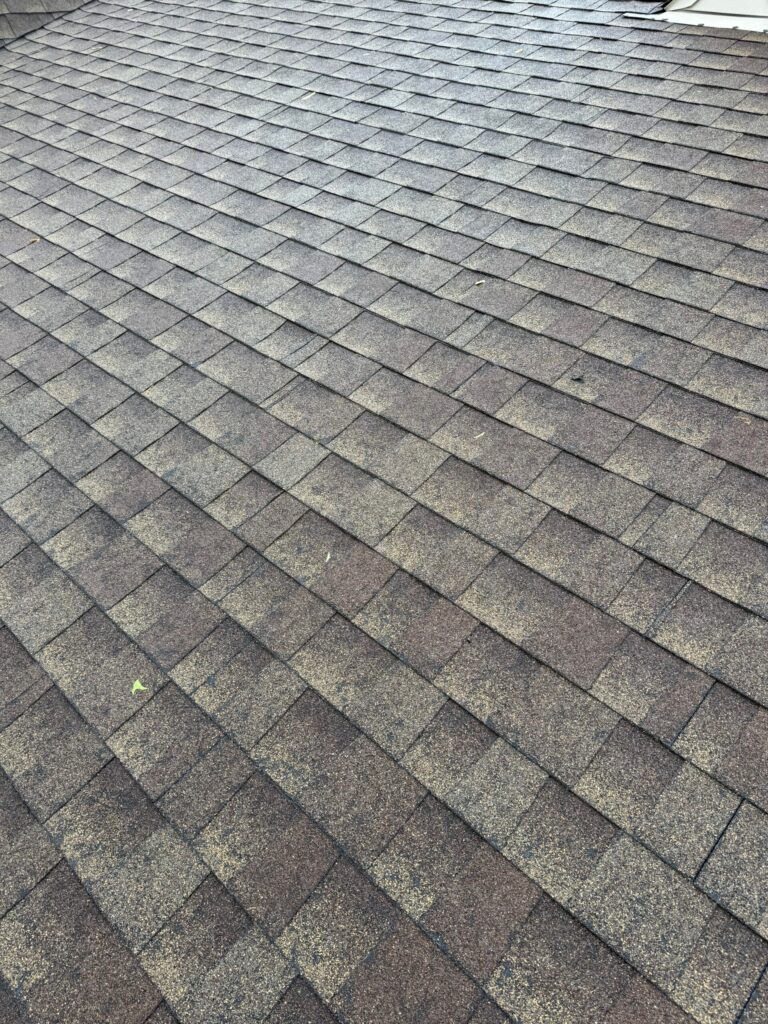
Within a single product line, shingle color is almost always price-neutral. A charcoal bundle and a weathered wood bundle of the same architectural shingle cost the same. Two exceptions: algae-resistant granules are standard on most architectural lines but can be an upcharge or a limited-color option on some economy lines, and reflective or 'cool roof' shingles often carry a premium with limited color choices. The real price drivers on your estimate are decking replacement, how many layers come off, pitch and roof complexity.
Get My Free Estimate →- Does shingle color change the price of the roof?
- Does a dark roof make your house hotter in Wisconsin?
- Will a black roof wear out faster or void the warranty?
- Fading, granule loss, and which colors show their age
- Quick comparison: how color families behave
- Roof color and resale: what it does and does not do
- Lead times: the color question that can cost you a fall install
- If your color gets discontinued, what happens on repair day
- Can you mix colors or do an accent slope?
- Which colors hide a complicated roof, and which expose it
- How to actually choose
- The bottom line
- Talk it through with someone who has watched these colors age
- FAQs
Short answer: yes, shingle color matters, but not for the reasons most homeowners worry about.
If you are searching "best roof color for Wisconsin homes," someone has probably told you a dark roof will spike your cooling bill or melt your ice dams. Neither holds up here. Shingle color in Wisconsin matters for curb appeal, for how well the roof hides imperfections, for how it ages, and for whether you can match it in year nine. It matters much less for energy, and nothing at all for ice dams.
Here is the honest version, written for Wisconsin roofs, not for Phoenix.
Reviewed by the Buckshot Exteriors estimating team. Family-owned and installing roofs in south-central Wisconsin since 1979.
Does shingle color change the price of the roof?
Almost never, within a product line. A bundle of charcoal and a bundle of weathered wood in the same architectural shingle cost the same. Color is not a pricing lever, and if a salesperson tells you the color you like costs more, ask to see the line's price sheet.
Three real cost notes:
- Algae-resistant (AR) granules are standard on most quality architectural lines. On some economy or three-tab lines, AR is an upcharge or only offered in certain colors. Confirm it.
- Reflective or "cool roof" SKUs (usually very light grays and whites) often carry a premium, come in limited colors, and frequently have to be special-ordered.
- Tax credits will not bail that premium out. Asphalt and metal roofs with cooling granules could qualify under the older federal 25C credit through tax year 2022. The version that took effect in 2023 dropped roofing entirely, and 25C no longer applies at all, because it cannot be claimed for property placed in service after December 31, 2025. Wisconsin's Focus on Energy dollars go to insulation, air sealing, HVAC and water heating. Verify with your tax professional, but do not plan on getting paid to go light.
So what does move your number? Decking condition, how many layers come off in the tear-off, pitch, and how cut up the roof is. Our page on asphalt shingle roof replacement walks through those line items. Prices move with the market, so treat any number you read online as a range, never a quote.
Does a dark roof make your house hotter in Wisconsin?
The surface gets hotter. Your living room mostly does not notice.
A black shingle in July reads hotter on an infrared gun than light gray on the same roof. That is real physics. What matters to your comfort is how much of that heat gets past the shingle, through the deck, across the attic and through your insulation.
With adequate insulation depth and balanced ventilation, most of it leaves through the ridge before it reaches your ceiling. With a shallow, poorly vented attic, a light roof will not save you either. The attic is the lever, not the color.
Then there is the Wisconsin part. Heating season runs roughly October into April. Real cooling season is a handful of weeks. In Dane, Rock and Green counties we spend far more of the year keeping heat in than keeping it out, which flips the math that "cool roof" marketing was built on in the Sun Belt.
We will not quote you a savings percentage, because anyone who does is guessing. Too much depends on insulation, ductwork, shade trees and thermostat habits. What we will say: if summer heat upstairs bothers you, put the money into insulation and attic ventilation before you pick a shingle based on temperature.
Does a dark roof help in winter?
Slightly, and honestly, not enough to choose on. On a clear, sunny February day a dark exposed slope will absorb a little more solar energy and can clear a light dusting faster than a white roof. That is the extent of it.
Once you have a few inches of accumulation, the snow reflects the sun and the shingle underneath is out of the conversation. Winter sun angles here are low, days are short, and half of them are overcast. Call the winter benefit real but negligible, the same way the summer penalty is real but modest. They roughly cancel, which is exactly why we tell homeowners to pick the color they like.
What actually helps with attic temperature, summer and winter
- Insulation depth at the attic floor that meets or beats current code
- Air sealing at can lights, bath fans, top plates and the attic hatch
- Balanced soffit intake and ridge exhaust, sized to the attic square footage
- Soffit vents that are not stuffed shut with insulation (we see this constantly)
Will a black roof wear out faster or void the warranty?
No, and no. Manufacturer limited warranties do not vary by color. No major shingle maker publishes a shorter term for black than for white.
Heat aging is real. It is also modest compared to what a hot, stagnant attic does. An unvented roof deck cooks shingles from below year-round, and that is the failure mode we actually see: curling, cracking and premature granule loss where soffits were blocked or the previous crew relied on two box vents for a whole attic. Most warranties require code-compliant ventilation to stay valid, which tells you where the manufacturers think the risk lives.
Does color affect blistering or defect claims?
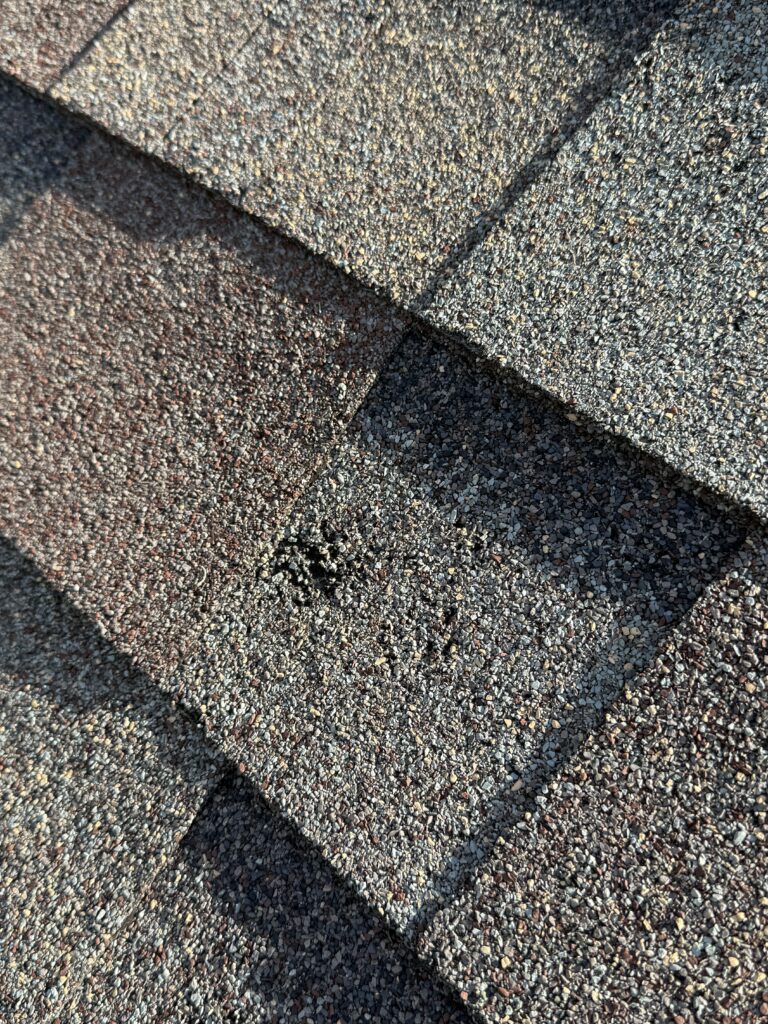
You may have heard a contractor say dark shingles blister more. Here is the nuance. Blistering comes from moisture or volatiles trapped in the asphalt expanding when the shingle heats up, so a hotter surface can bring blisters out sooner and make them more visible. Color can influence timing and appearance. It does not create the defect, and it does not change your warranty terms.
What it does change is how the claim goes. Manufacturers routinely attribute blistering to inadequate ventilation rather than to a manufacturing fault, and that is where most claims die. Your best protection is documented, code-compliant intake and exhaust plus the wrapper information from your install. Pick the color. Then make sure the roof breathes.
Fading, granule loss, and which colors show their age
Modern shingles hold color far better than the ones your parents put on. Granules are ceramic-coated for UV stability, so true fading is slow and subtle. Over a couple of decades contrast softens a little, most noticeably on deep blacks, dark browns and red tones. South and west slopes go first because they take the most UV.
Granule loss is the bigger cosmetic issue, and here color matters a lot. The fiberglass mat under the granules is light colored. When a dark roof sheds granules from age, foot traffic or hail, you get pale blotches and shiny spots visible from the driveway. On weathered wood, driftwood or mid-gray, the same loss hides much longer.
That cuts both ways. Dark roofs tell you sooner that something is wrong. Lighter roofs look fine longer, which means "it looks fine from the ground" is not a hail inspection.
Algae streaking and why north slopes matter here
Those black vertical streaks on older roofs are not dirt or mold. They are algae, and they thrive on shaded, slow-drying slopes. Around here that means north-facing slopes and anything under mature oaks and maples, which describes a lot of established blocks in Madison, Janesville, Monroe, Stoughton and Sun Prairie.
Streaking shows worst on light and medium colors. On light gray or almond it reads as a stain across the whole plane. On charcoal you may barely see it.
Two things to know:
- Get algae-resistant granules (copper-infused). On most architectural lines this is standard.
- Know what that coverage actually is. Algae resistance is normally a separate limited term, commonly in the 10 to 25 year range depending on manufacturer and product line, sitting alongside the main limited warranty rather than inside it. Higher-tier lines generally carry the longer algae terms. Get the number in writing before you sign.
Trimming branches that keep that slope wet does more than any cleaning product. Airflow and two hours of sun beat a pressure washer, which you should never point at a shingle roof anyway.
Still comparing product lines? Our breakdown of the best shingle brands for Wisconsin roofs covers what really differs between them.
Quick comparison: how color families behave
| Color family | Visible fading | Algae streaks show | Granule loss shows | Resale neutrality (our experience) |
|---|---|---|---|---|
| True black | Most noticeable | Least | Most | Good |
| Charcoal / slate blends | Slight | Low | Noticeable | Excellent |
| Weathered wood / driftwood / barkwood | Minimal | Moderate | Hides longest | Excellent |
| Mid-tone brown | Slight | Moderate | Moderate | Good, best with brick |
| Light gray / almond / tan | Minimal | Most obvious | Hides well | Fair |
| Saturated red, green, blue | Most noticeable | Moderate | Noticeable | Weakest |
The last column is our judgment from years of exterior work in this market, not a published statistic. Treat it that way.
Roof color and resale: what it does and does not do
Color rarely adds appraised dollars. Appraisers value roof age, material and condition against comparable homes, not the shade you picked. A new architectural roof helps the appraisal. Charcoal versus brown does not move that line.
What color affects is the showing. From what we see on pre-sale inspections, a roof gets flagged two ways: it looks old and worn, or it clashes hard with the siding and brick. Both cost first impressions, and first impressions cost days on market.
The practical rules:
- Neutral families travel well. Charcoal, weathered wood, driftwood, mid-tone grays and browns sit comfortably with nearly every siding and brick combination around here.
- Polarizing colors narrow the buyer pool. Bright blue, green or red reads as a project unless the house style genuinely calls for it (some Victorians and true bungalows do).
- Consider the block, do not copy it. Matching your neighbors does not raise your appraisal, but departing wildly from the neighborhood norm is a risk without an upside.
Most popular shingle colors in Wisconsin
The volume in south-central Wisconsin sits in three buckets: charcoal and slate-type grays, weathered wood and driftwood blends, and mid-tone browns like barkwood. Those are what distributors stock deepest, which also means they are the easiest to get and the easiest to match later.
Best roof color for a brick house
Brick is the boss, because you are not changing it. Red or orange-toned brick generally likes weathered wood, mid-brown, charcoal and driftwood blends, and fights greens and blues. Buff, tan or cream brick opens up to charcoal, gray blends and true black. Multi-tone brick with gray in it handles a gray-family roof beautifully.
Pull the warmest and coolest brick tones out of the wall with your eye, then pick a blend that contains one of them.
Shingle color to match siding
Work in this order: brick or stone first (permanent), then siding (semi-permanent), then trim and doors (easy to change). Cool siding, meaning grays, blues and crisp whites, pairs with gray and black families. Warm siding, meaning tans, creams, clay and sage, pairs with weathered wood and browns. Mixing a warm roof over cool siding is the most common mismatch we get called to fix on the siding side, not the roof side.
Not sure what your roof actually needs before you start picking colors? We will get on the roof, take photos, and give you a straight assessment at no cost and no pressure. Call (608) 909-9109 for a free inspection.
Lead times: the color question that can cost you a fall install
This one catches people. Common colors in the big architectural lines sit on the shelf at Wisconsin distributors year-round. Designer lines, premium colors, reflective SKUs and anything low-volume can be a special order, sometimes a week or three out, longer in the spring and after a regional hail event when demand spikes.
That matters in October. Asphalt shingles need warmth for their sealant strips to bond properly, so a late-season job you were hoping to finish before the first hard freeze can get squeezed by a color that has to ship. If you are booking in fall, ask us what is stocked locally before you fall in love with a special order. If you love it, order early.
Want a straight answer on your roof?
We'll inspect it, document everything, and tell you honestly what you're looking at, even if the answer is patch it for now. No pressure.
If your color gets discontinued, what happens on repair day
Manufacturers retire and rename color lines every few years. That is fine until a limb takes out a section in year nine.
Here is the actual repair-day answer:
- On blended colors, the closest current match usually disappears from the ground within a season or two, once the new shingles weather down. Blends are forgiving. Most homeowners never see the patch again.
- On solid colors, especially true black, a near-match patch reads obvious. The fix we often use is to pull good shingles off a hidden slope (back of the garage, a low rear plane) to patch the visible area, then shingle the hidden area with the new color.
- Full-slope replacement is the clean answer when the damage is large or the visible plane faces the street. Replacing to a break line, like a valley or a ridge, keeps each plane uniform so the eye never catches it.
- Any new shingle looks brighter next to a weathered one for the first year or two, even in the exact same color. That is normal, not a mismatch.
Five minutes of habit prevents most of this. When your project wraps, write down the manufacturer, product line and exact color name for your house records, photograph the bundle wrapper before it hits the dumpster, and keep two or three spare bundles stored flat and dry. Any crew doing quality residential roofing work will hand you that information without being asked.
Can you mix colors or do an accent slope?
You can. It usually looks like a mistake. Two colors meeting on one connected roof reads as a repair, and the eye finds the seam every time, especially in low sun.
A detached garage is more forgiving. If it gets reroofed in a different year, matching still looks better and helps at resale, but a close neutral will not hurt you. On attached garages and porch roofs, match the house.
If you want visual contrast, put it where contrast belongs: siding, trim, shutters, the front door. The roof should read as one surface.
Which colors hide a complicated roof, and which expose it
Multiple planes, dormers, valleys, skylights, old framing that has settled: color can flatter that or put every flaw on display.
- Blended, multi-tone colors break up sightlines and hide slight deck waviness, patched sheathing and minor plane inconsistencies.
- Solid true black reads as one flat surface, so every dip, ripple and uneven course jumps out in late afternoon sun.
- Very light colors throw strong shadow lines, which flatter a simple gable but look busy on a cut-up roof.
Dimensional product helps too. The shadow band built into architectural shingles adds depth that a three-tab cannot, and depth is what disguises imperfection.
How to actually choose
Never pick from a brochure chip. A two-inch swatch under showroom light is nothing like 30 squares on a sloped plane in Wisconsin daylight.
- Get full-size sample boards or loose shingles. Set them on the actual slope, or lean them against the house at roof angle.
- Look three times in one day. Morning, midday, late afternoon. Grays shift blue, browns shift red, charcoal can look almost navy under overcast.
- Walk to the curb and across the street. Roof color reads completely differently at 100 feet.
- Hold it against everything at once. Siding, brick or stone, soffit and fascia, window trim, garage door, front door.
- Check the rules. Some Madison-area subdivisions keep HOA approved-color lists, and homes in local historic districts may need review. Confirm before you sign, not after the truck shows up.
The bottom line
Pick the color you will be happy looking at for 25 years and let the energy myths go. Then spend your real attention on what decides whether the roof lasts: decking condition underneath, ice-and-water shield at eaves and valleys, nailing pattern, flashing at walls and chimneys, and an attic that actually breathes.
Color is the part you see. Those items are the part that keeps water out of your house.
Talk it through with someone who has watched these colors age
Buckshot has been family-owned and working in south-central Wisconsin since 1979, and we do the whole exterior, so we are used to making roof, siding and trim work together instead of guessing. You can read what neighbors say about us in our customer reviews, which pull from our Google, Birdeye, Angi and HomeAdvisor profiles.
The inspection is free and there is no obligation. We get on the roof, take photos, show you what we found, and give you a straight recommendation, including "you have good years left, call us in five" when that is the truth. Nobody sits at your kitchen table waiting for a signature.
If a storm just came through, we run 24-hour emergency response, and we will meet your insurance adjuster on-site to document hail and wind damage so nothing gets overlooked. To be clear about how that works: we document and advocate, your carrier makes the coverage decision, and we will never promise you an approval we do not control. For a quick look at hail and wind claims, start with our guide to storm damage restoration in Dane County.
Call (608) 909-9109 or request your free inspection here.
Get a straight answer on your Madison roof
Wisconsin storm season and insurance non-renewal letters do not wait. Get a free, no-obligation inspection and an honest assessment of exactly what your roof needs, even if the answer is to wait.