
Some granule loss is normal. A brand-new roof sheds loose factory granules for the first few months, and every asphalt shingle sheds a little every year after that. What matters is how much, where it is coming from, and how old the roof is. A handful of grit on a 6-year-old roof is nothing. A half-inch of granules packed in the gutter trough on a 20-year-old roof means the shingles are near the end.
Get My Free Estimate →- What shingle granules actually do (this is why it's not cosmetic)
- Are shingle granules in the gutter normal? The five patterns
- Safe checks you can do from the ground today
- Roof losing granules: how long will it last?
- What to do about the granules already in your gutters
- If the roof is young, check the warranty before you check the price
- What a replacement costs here, and what drives the number
- Winter installs and lead times after a storm
- Insurance reality, briefly
- What happens when you call
- FAQs
Short answer: some shingle granule loss is completely normal, and three things decide whether what you are seeing matters. How much. Where it is coming from. And how old the roof is.
A coffee cup of black grit at the bottom of a downspout on a five-year-old roof is nothing to lose sleep over. A gutter trough packed a half-inch deep with granules on a roof you think is twenty years old is a different conversation.
Here is how to tell which one you have, without climbing anything.
What shingle granules actually do (this is why it's not cosmetic)
Those little ceramic-coated rocks are the roof's sunscreen. They are pressed into the asphalt while it is still hot, and their job is to block ultraviolet light from reaching the asphalt mat underneath.
Asphalt hates UV. Once the granule layer thins, the sun cooks the mat directly. The mat dries, loses its oils, turns brittle, then cracks, curls and splits. In south-central Wisconsin that gets a second helping of abuse from freeze-thaw cycling: a dried-out shingle flexes every time the temperature swings across 32 degrees, and we do that dozens of times in a single spring.
So granule loss is not an appearance issue. It is the opening act of shingle failure.
It also explains why south and west slopes almost always look worse than the north side of the same house. More sun, faster wear.
Are shingle granules in the gutter normal? The five patterns
Pattern tells you more than volume does. Here is what we look for on roofs across Dane, Rock and Green counties.
1. Heavy shedding on a brand-new roof (normal)
If your roof went on in the last few months and you are finding granules in the gutters, relax. Shingles carry loose excess granules from the factory that never fully bonded. Rain and the first hot spell wash them off.
It settles down after a few rain events and does not shorten the life of the roof.
2. Even, gradual loss across the whole roof, 15+ years old (end of life)
This is the big one. Look up with binoculars. If the slopes have a faded, salt-and-pepper look with darker areas where the mat shows through, the roof is telling you it is done.
What usually shows up with it:
- Shingle corners curling or lifting
- Shingles that look thin and bony, with fiberglass mat visible
- Granules in the gutters every spring, not just once
- Cracks running across the shingle face
Even wear like this is not a repair situation. New shingles bonded to bald, brittle shingles never last. That is when we talk about a full asphalt shingle roof replacement instead of throwing money at patches.
3. Bare patches in one spot (concentrated water flow)
A stripe or fan-shaped bare patch, usually below a valley, below where an upper roof dumps onto a lower roof, or right at a downspout outlet, is water scouring, not age.
Valleys funnel runoff from hundreds of square feet into a channel a foot wide, and the velocity strips granules. A plugged gutter backing water onto the shingles all winter does the same.
Good news: if the rest of the field is healthy, this is often a genuine roof repair. The real fix is correcting the drainage, not just swapping shingles and waiting for it to happen again.
4. Scattered circular spots with granules knocked clean off (hail)
This one deserves real attention. Hail leaves random, roughly circular spots where granules are gone and the mat is exposed, often bruised, meaning it feels soft when you press it, like a bruise on an apple.
Key word: random. Hail does not make neat lines or even spacing. It also arrives with a direction, so one or two slopes take the worst of it.
Check the soft metals from the ground. Hail big enough to bruise shingles almost always dents aluminum gutters, downspouts, furnace and bath vent hoods, AC condenser fins and metal window wraps. Dented gutters plus granules in those gutters is a strong hail signature.
South-central Wisconsin gets these in waves, and plenty of hail cores clip parts of Dane, Rock and Green counties without ever making statewide news. We meet homeowners every year who never knew they took a hit. Our storm damage restoration work is built for exactly this, including meeting your adjuster on the roof so the test squares and soft-metal evidence get documented instead of written off as wear and tear.
5. Small popped craters (blistering)
Blisters look like tiny volcanoes: a raised bump that has broken open and shed granules in a small ring. Not impact marks, not hail.
Blistering comes from moisture trapped in the asphalt at manufacturing, or far more commonly around here, a deck running too hot because the attic is not ventilated. Blocked soffit intake, insulation stuffed into the eaves, bath fans dumping into the attic. Replacing shingles without fixing ventilation just restarts the same clock, so any honest roofer looks in your attic before quoting.

Safe checks you can do from the ground today
Check the downspout outlets and splash blocks. A dusting is normal. A cone of coarse black sand is not.
- Look at the driveway after heavy rain. Grit washed out along the drip line is a tell.
- Use binoculars or your phone camera zoomed in. Compare south and west slopes to the north slope.
- Walk the perimeter and study the metal. Dented gutters, downspouts, vent hoods, pockmarked window wraps.
- Dark streaks are usually algae, which is cosmetic. Bald asphalt is not.
- Look in the attic with a flashlight. Daylight through the deck, dark staining on rafters or rusty nail tips means water is already getting in.
Why not to get on the roof yourself
Walking an aging asphalt roof knocks off more granules than a storm does. Shingles that are hot and soft scuff under a boot, and shingles that are cold and brittle crack under one. You can easily damage the roof you are trying to inspect, and our inspections are free, so there is no reason for you to be up there.
Not sure which pattern you're looking at? Send us a photo or call (608) 909-9109 and we'll tell you straight, no charge and no pressure.
Roof losing granules: how long will it last?
Rough field judgment, based on what we see on roofs in this part of the state:
- Light even shedding, roof under 12 years: normal aging. Keep gutters clean, look again next spring.
- Noticeable thinning, some exposed mat, 15-20 years: last stretch. Start budgeting and get it documented before a leak makes the decision for you.
- Large bare areas, curling and cracking, 20+ years: finished. Measure remaining life in seasons, not years.
- Scattered bruises plus dented gutters, any age: get it inspected and check your policy's notice requirement.
- One localized bare patch, healthy field: likely a drainage repair.
Why we push on the middle categories: a worn shingle leaks small first, and small water soaks quietly into OSB or plank decking. We have opened up more than one 1970s ranch around Monroe and Evansville where the homeowner described "one small leak by the chimney" and sheets of decking came off crumbling in our hands. Insulation next, then drywall. Waiting rarely saves money.
What to do about the granules already in your gutters
Scoop them. Packed granules mixed with shingle grit and leaf sludge sets up like wet concrete and blocks the gutter trough, which is the exact condition that backs water onto your shingles and feeds ice dams at the eaves all winter.
- Clean gutters twice a year here, once after the maples drop and once in spring.
- Flush each downspout with a hose. Granule sludge collects in the elbows and at the bottom outlet, where you cannot see it.
- Gutter guards help with leaves but fine granules still get through, so guards do not remove the need to flush the downspouts.
- If you are scooping heavy granules every single cleaning, that is a roof signal, not a gutter problem.
If the roof is young, check the warranty before you check the price
Heavy granule loss on a roof only 8-12 years old is not normal aging, and it may not be your bill. Premature shedding, blistering and cracking can be a product defect claim under the shingle manufacturer's limited warranty.
Dig up the original invoice, the shingle brand and product line, and the install date. Manufacturers typically want photos and sometimes physical samples pulled from the roof. Understand the limits: most limited warranties are prorated, and labor coverage usually ends after the first several years. Still worth filing. As a GAF Master Elite contractor, we know what that paperwork needs to look like.
Want a straight answer on your roof?
We'll inspect it, document everything, and tell you honestly what you're looking at, even if the answer is patch it for now. No pressure.
What a replacement costs here, and what drives the number
For a typical 1,800-2,400 sq ft home in the Madison, Janesville or Monroe area, a full tear-off and re-shingle with architectural shingles commonly lands in the $11,000-$22,000 range. That is wide because roofs are wide. Two real-world anchors:
- Lower end: a simple 22-square gable at 5/12 pitch, one layer of old shingles off, sound decking, standard ridge vent and no skylights.
- Upper end or beyond: a cut-up 30-square roof at 9/12 with multiple valleys, two skylights, two existing layers to remove, several sheets of bad decking and new chimney flashing.
What moves the price: squares and pitch, how many layers come off and the dump fees on them, decking repair by the sheet, ventilation corrections that cheap bids skip, flashing at chimneys and skylights, shingle grade (Class-4 impact-resistant shingles cost more but some carriers discount your premium, so ask your agent), and gutters if yours are dented.
On affordability: financing is available on approved credit, and we walk you through the options at the estimate instead of after. On insurance-funded work, you generally pay in stages, ACV at the start and the depreciation once it is invoiced, so you are not fronting the whole roof. Ask us and we will lay out numbers, not vague reassurance: get in touch here.
Winter installs and lead times after a storm
Yes, shingles can go on in Wisconsin winter. Cold shingles are more brittle and their self-seal strips will not bond until warm sun hits them, so cold-weather work means careful handling and hand-sealing hips, ridges, rakes and any wind-exposed edges with roofing cement. Ice-and-water shield still goes down in the valleys and eaves. We replace emergency and insurance roofs through January.
If your roof is worn but not leaking, spring or early fall is the better install window. And if a hail core just went through your township, do not wait until March to call. After a widespread event, every reputable local company's board fills and lead times stretch, and claim notice deadlines keep running whether the schedule is open or not.
Insurance reality, briefly
Before you file, find three things in your policy:
- RCV or ACV on the roof? Replacement cost value releases held-back depreciation after the work is invoiced. Actual cash value or a roof-surface payment schedule pays depreciated value only, and on a 17-year-old roof that gap can be thousands.
- Your deductible, and whether wind/hail is separate. Many Wisconsin policies carry a separate, often percentage-based wind/hail deductible larger than the standard one.
- Any cosmetic-damage exclusion. Some carriers now exclude hail damage they classify as cosmetic, which matters on metal, gutters and siding.
Weather losses are generally treated differently than at-fault liability claims, but carriers do watch frequency and many are tightening roof terms at renewal. We are roofers, not your agent. Ask your agent before you file.
One red flag worth memorizing: if a contractor offers to eat, waive or rebate your insurance deductible, walk away. In Wisconsin that is illegal for a residential contractor to promise, and a company willing to break that law is telling you how it will handle the rest of your job.
What happens when you call
We come out, inspect the slopes, valleys, flashings, soft metals and the attic, and show you photos of what we actually found. If the roof is fine, we say so and give you a rough timeline. If it is hail, we tell you whether we believe it is claimable and we meet your adjuster on-site to walk the test squares. If it needs replacing, you get a written estimate with exclusions spelled out, and nobody leans on you to sign.
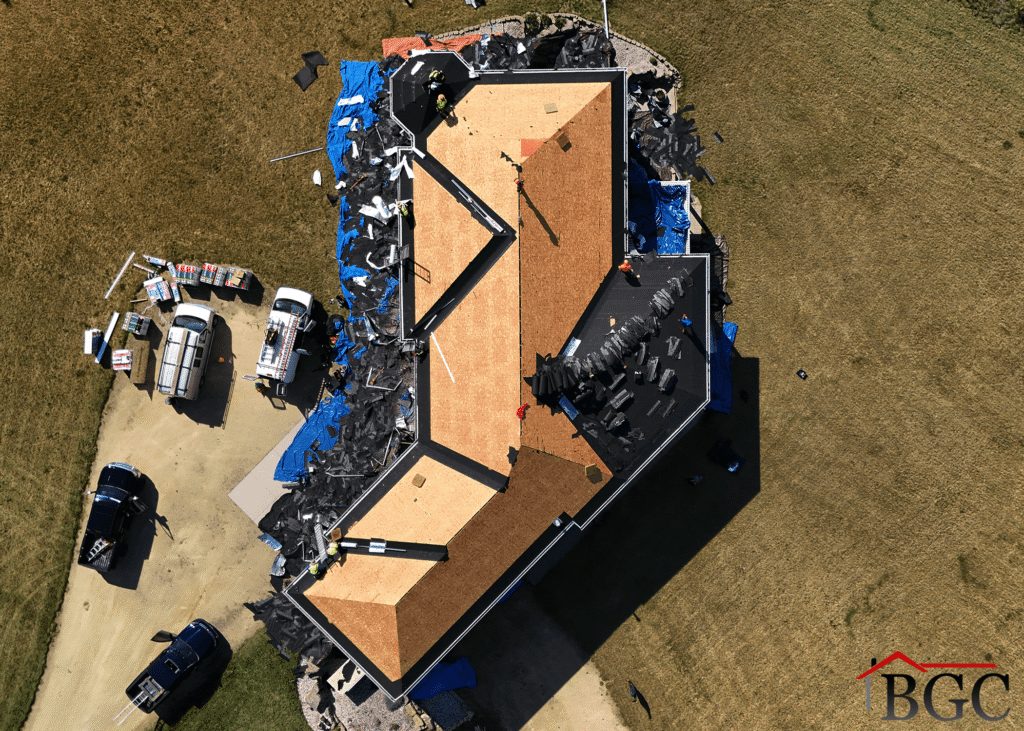
On the job: most homes this size are a one to two day tear-off and install. We protect landscaping and AC units, put the dumpster where you tell us, and magnet-sweep the driveway, lawn and beds for nails before we leave. Full tear-off, decking inspected and repaired, ice-and-water shield in the valleys and along the eaves where our ice dams form, corrected intake and exhaust ventilation, then quality architectural shingles. That system is the core of our residential roofing work.
And the honest part worth repeating: no product puts granules back. Not a sealer, not an elastomeric coating, not a rejuvenation spray.
The inspection costs you nothing and there is no obligation. Call (608) 909-9109 and we will get you on the schedule. We would much rather look at your granules than your water-stained ceiling.
Get a straight answer on your Madison roof
Wisconsin storm season and insurance non-renewal letters do not wait. Get a free, no-obligation inspection and an honest assessment of exactly what your roof needs, even if the answer is to wait.