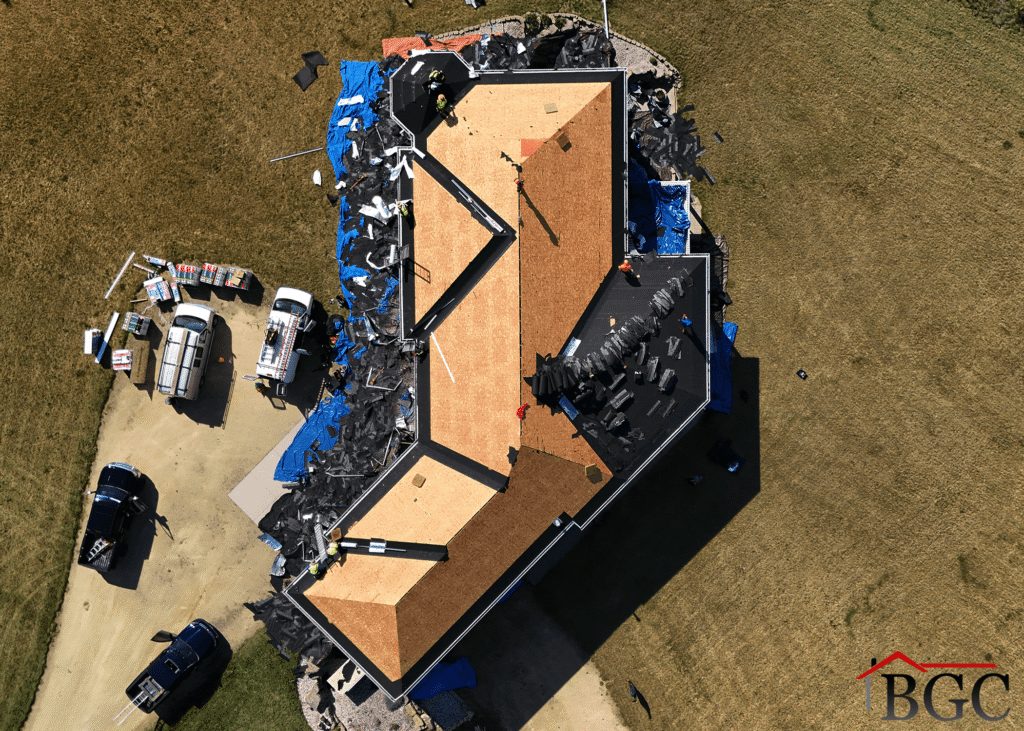
Most Waterloo-area single-family homes with architectural asphalt shingles land somewhere in the $9,000-$18,000 range. Steeper pitch, two or three layers of tear-off, rotted decking, and cut-up roofs with valleys, dormers and skylights push the number up. The only way to know your number is a measured inspection, which we do free.
Get My Free Estimate →- What roofing and seamless gutters cost in Waterloo
- Repair or replace: how to tell which one you need
- How long should a new roof last in Iowa?
- Northeast Iowa weather: what actually kills roofs here
- Gutters in Waterloo: flat lots, clay soil, and where the water goes
- Storm damage and insurance claims in Iowa
- How to vet roofing companies in Waterloo, Iowa
- Warranties: what's covered, for how long, and does it transfer
- Timeline, permits, payment and protecting your property
- Metal and other options in hail country
- What the free inspection covers, and what we won't do
- FAQs
If you're comparing roofing companies in Waterloo, Iowa, here's the short version: get a real measured estimate (not a phone quote), verify the contractor in the Iowa Division of Labor registration database, and don't sign anything the day someone knocks on your door. Most Waterloo asphalt shingle roof replacements land in the $9,000-$18,000 range, and seamless gutters commonly run about $8-$15 per linear foot for 5-inch and $12-$25 for 6-inch.
Now the longer version, because the Cedar Valley has specific problems a generic national roofing article will never mention.
We've been a family-owned exterior contractor since 1979, with offices in Centerville, Iowa and Madison, Wisconsin. We work Waterloo and Cedar Falls as one market, because that's how the weather treats it.
What roofing and seamless gutters cost in Waterloo
Expect a typical single-family asphalt shingle roof replacement in the $9,000-$18,000 range, with most mid-size homes clustering in the middle. Those are honest ranges from real Iowa work, not a quote. Here's what moves your number:
- Roof size and pitch. Roofers price by the "square" (100 square feet of roof surface). A 6/12 pitch walks fine. A 10/12 needs roof jacks and staging, and that's labor.
- Tear-off layers. One layer is standard. Two or three means double or triple the disposal, and Iowa landfill tipping fees are part of your bill.
- Decking condition. Older Waterloo housing stock, especially pre-1950 homes near downtown and on the older east side, often has 1x6 plank decking with gaps. Soft or spongy planks get replaced. Nobody can see this until the old roof is off, which is why a good estimate states the per-sheet decking price up front instead of surprising you.
- Shingle grade. Three-tab is nearly gone. Most homes now get architectural shingles (also called dimensional or laminate), which carry higher wind ratings and look better on a steep front elevation. Class 4 impact-resistant shingles cost more but may earn a premium credit worth asking your agent about, and they handle Iowa hail better.
- The details that leak. Ice-and-water shield at the eaves and valleys, correct step flashing at walls and chimneys, new pipe boots, and balanced ridge and soffit ventilation. Cheap bids skip these. That's usually where the price difference is hiding.
One real example: a 1940s two-story off Falls Avenue, hail claim, tear-off exposed 1x6 plank decking with wide gaps and rot around an old bathroom vent. It took 14 sheets of 7/16 OSB to make the deck sound, which added roughly $1,100 at our per-sheet price. The homeowner knew that number was possible before we started, because it was on the estimate as a contingency line.
We break the full math down by component in our Iowa roof replacement cost guide.
Is a second layer (roof-over) a cheaper option?
Almost never worth it. Going over the old shingles saves maybe $1,000-$1,500 in tear-off and disposal, and in exchange you get: no look at the decking, doubled dead load, a lumpy surface that telegraphs through the new shingles, flashing and valley work that can't be done properly, hotter shingles that age faster, and a stack most codes cap at two layers anyway. If hail hits later, you'll be paying to tear off two layers instead of one. Tear it off.
Repair or replace: how to tell which one you need
Repair is legitimately the right call more often than most roofing companies admit. Use these criteria.
A repair usually makes sense when:
- The damage is isolated to one slope, one valley, one flashing, or a failed pipe boot
- Shingles elsewhere still flex without cracking and hold their granules
- The roof is under roughly 15 years old with no widespread seal-strip failure
- The decking is solid and there's no interior staining beyond the one spot
Replacement is the honest answer when:
- Hail bruising or granule loss shows up on multiple slopes
- Shingles crack when lifted (brittle mat, usually 20+ years or a long heat-soaked south slope)
- Tabs are unsealed across whole courses from wind, so the roof no longer sheds water
- Decking is soft, or there are two or three layers already
- You're patching the third leak in two years
"Will the new shingles match?"
Honest answer: close, rarely perfect. Your existing shingles have weathered and lost granules for years, so even the identical product off the shelf reads brighter next to them for a season or two. And colors do get discontinued, especially on roofs older than 10-12 years. When that happens we have three options and we'll show you all three: pull matching shingles from a hidden slope (garage back, rear dormer) to patch the visible one, replace one full slope so the color break falls at a ridge or valley where the eye expects it, or accept the mismatch on a back elevation nobody sees. What we won't do is install a mismatched patch on your front slope and call it good.
We'd rather sell you a $600 repair and be your roofer in six years than talk you into $14,000 you didn't need. That's what the free inspection is for.

How long should a new roof last in Iowa?
Warranty length and service life are two different things. Here's what we actually see on Cedar Valley roofs:
| Roof system | Realistic service life in Iowa |
|---|---|
| 3-tab asphalt | 15-20 years |
| Architectural asphalt | 20-30 years |
| Class 4 impact-resistant asphalt | 25-30 years |
| Stone-coated steel | 40-50 years |
| Standing seam metal | 40-60+ years |
Two things shorten every one of those numbers: a hailstorm, and an attic that can't breathe. A poorly ventilated roof deck cooks shingles from underneath and can cost you five to eight years. That's why ventilation is a line item on our estimates and not an afterthought.
Northeast Iowa weather: what actually kills roofs here
Three things, in this order: straight-line wind, hail, and freeze-thaw.
Derecho and straight-line wind
The August 2020 derecho reminded everyone in eastern Iowa what 80 to 100+ mph straight-line wind does. It doesn't always take the whole roof off. More often it breaks the adhesive seal strip between courses, so tabs flap loose and stop shedding water. From the ground the roof looks fine. Two summers later you have a stained ceiling.
Wind also lifts ridge caps, peels drip edge, and creases shingles at field edges. A creased shingle is a functional failure even if nothing blew off, and a trained eye finds them fast.
Hail
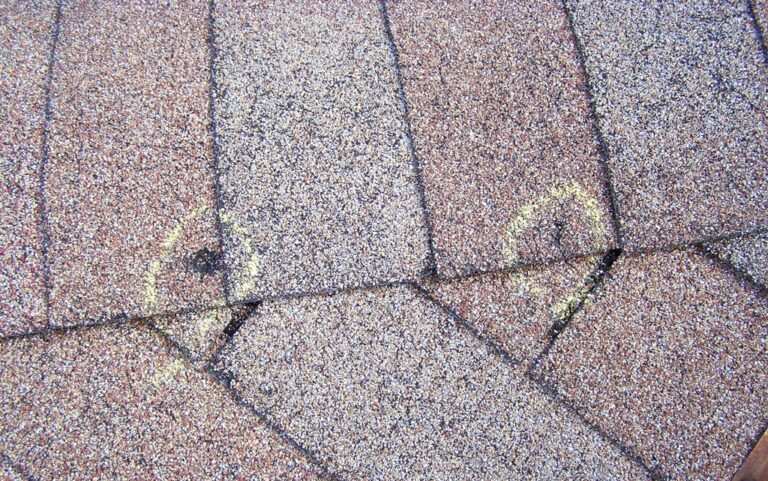
Cedar Valley hail is mostly a spring and early summer story. On asphalt it leaves bruises: soft, dark impacts where the mat is fractured and granules are knocked loose. Granule loss exposes asphalt to UV and the shingle ages years in one season.
Adjusters look for a minimum number of hits per test square on each slope, plus collateral damage on soft metals: gutters, downspouts, gutter aprons, furnace and dryer vents, AC condenser fins, window wraps. This is why gutters matter to your claim. Dented gutter faces are some of the clearest evidence a real hail event hit your property, and they often get a borderline roof approved.
Ice dams and freeze-thaw
Waterloo winters do the rest. Snow melts off a warm deck, refreezes at the cold eave, and builds an ice dam that pushes water backward under the shingles. Older homes with shallow attic space, thin insulation, and blocked or missing soffit venting are the classic candidates.
The fix isn't heat cable and hope. It's air sealing and insulation at the attic floor, balanced intake and exhaust ventilation, and ice-and-water shield membrane up from the eave when the roof is replaced. Any roofer who won't talk about your attic is solving half your problem. Our residential roofing work always includes that conversation.
Not sure if you're looking at storm damage or just age? Finding out costs nothing. Ask for a free inspection and we'll come look.
Gutters in Waterloo: flat lots, clay soil, and where the water goes
Gutters here fail less from bad gutters and more from bad drainage planning. Much of Waterloo and Cedar Falls sits on flat to gently sloped lots over heavy clay. Clay doesn't absorb. Water that lands next to your foundation sits there and works on your basement wall through every freeze-thaw cycle.
| 5-inch K-style | 6-inch K-style | |
|---|---|---|
| Typical downspout | 2x3 | 3x4 |
| Capacity | Standard | Roughly 40% more trough cross-section; a 3x4 downspout carries about twice the water of a 2x3 by area |
| Best for | Modest ranches, Cape Cods, shorter runs | Big roof planes, steep pitch, long runs, valleys dumping into one trough |
| Cost | About $8-$15 per foot installed | About $12-$25 per foot installed |
Most Cedar Valley 6-inch jobs land in the low-to-middle part of that range. What pushes a quote toward the top: two-story or three-story staging where ladders won't safely reach, fascia board replacement behind the old gutter (very common on 1940s-60s homes), buried discharge lines out to daylight or a pop-up emitter, heavier .032 aluminum or steel instead of standard .027, custom colors, and gutter guards. If your quote is at the ceiling of that range, ask which of those items is driving it. A straight tear-off-and-replace on a one-story ranch should not be.
What we look at on a Cedar Valley gutter job:
- Downspout count and placement. One downspout per 30-35 feet of gutter is a reasonable starting point, more on high-volume slopes.
- Extensions and discharge. Get water 6 to 10 feet from the foundation, downhill.
- Hanger spacing and fascia condition. Hidden hangers screwed into solid fascia roughly every 24 inches. New gutter on rotten fascia is money thrown away.
- Gutter apron. A small piece of metal that keeps water from wicking behind the gutter and rotting the fascia and deck edge. Cheap during a roof job, expensive to ignore.
A Hudson ranch we did is the textbook case: 5-inch gutter on a 40-foot back run under a 6/12 pitch, overshooting in heavy summer downpours and dumping right against the foundation. We put on 6-inch seamless, added a second 3x4 downspout, and ran a buried extension out to daylight. The basement wall stayed dry the next spring, and it cost a fraction of interior waterproofing.
If your basement gets damp every spring, start at the roofline. Our seamless gutter work is usually the cheaper first move.
Storm damage and insurance claims in Iowa
Document first, then call. Photograph what you can safely see, note the storm date, and get a professional inspection so you know whether you have a claim before you file one.
- Deductibles. We increasingly see percentage wind and hail deductibles (commonly 1-2% of the dwelling amount) on Iowa declarations pages rather than a flat dollar figure. On a $300,000 dwelling, 2% is $6,000. Read your declarations page before you file, or call your agent and ask which one you have.
- ACV vs RCV. Actual cash value pays the depreciated value only. Replacement cost value pays the initial ACV check, then releases the held-back recoverable depreciation after the work is completed and documented. A supplement is a different thing: a separate request for line items the adjuster missed or underpriced.
- Does roof age kill a claim? Age alone isn't a denial reason, but some policies now carry roof payment schedules or ACV-only roof endorsements above a certain age. That detail lives in your declarations, and it's worth reading before hail season, not after.
- Iowa law bars a contractor from paying, waiving, rebating, or absorbing your deductible. Anyone offering that is telling you where they'll cut corners. Iowa residential storm-restoration contracts must also give you a written right to cancel if your claim is denied.
- Claim windows close. Carriers expect prompt reporting. Wait a year and it's hard to prove which storm did it, and easy for the carrier to call it wear and tear.
Will filing a claim raise my rates?
We're not your insurance agent and we won't pretend to be. What we can tell you honestly: weather claims are generally treated differently from liability claims, and after a major Cedar Valley hail event carriers frequently adjust rates area-wide whether or not you personally filed. Call your agent and ask the question directly. Don't let a rumor keep you from a covered loss you already paid premiums for.
What if the adjuster and I disagree?
You don't get stuck in the middle. We meet your adjuster on the roof, which is when test squares get chalked and collateral damage on gutters and vents gets photographed. If line items are missing (ice-and-water shield, drip edge, code-required ventilation, gutter aprons), we submit a documented supplement request with photos and measurements. If it stalls, you can request a reinspection, and most policies contain an appraisal clause. Here's how we handle hail and storm damage restoration.
Want a straight answer on your roof?
We'll inspect it, document everything, and tell you honestly what you're looking at, even if the answer is patch it for now. No pressure.
How to vet roofing companies in Waterloo, Iowa
After any hail event, out-of-town crews arrive in the Cedar Valley within days. Some are competent. Many will be three states away when your roof leaks.
- Iowa contractor registration. Contractors earning at least $2,000 a year from construction work in Iowa must register with the state. Search the Iowa Division of Labor contractor registration database and confirm it yourself. Ask us for ours and it's on your written estimate, along with our certificate of insurance.
- A local office you can drive to. A P.O. box, a hotel, or a magnet sign on a rental truck is not an office.
- Insurance certificates. General liability and workers' comp, current, in the company's name.
- Who is actually on my roof? Ask every bidder, and here's our answer: a mix. Our own people handle the measurement, material order, permit, on-site oversight, final walk-through and cleanup check. Installation is done by crews we've worked with for years, not a rotating pool of whoever a lead-generation company sends to town after a storm. Ask us who's coming and we'll name the crew lead.
- Manufacturer credentials and reviews. We're a GAF Master Elite contractor, which is what makes the enhanced warranties below available. Read our customer reviews and ask us for Cedar Valley references you can call.
- Full written scope. Underlayment type, ice-and-water footage, drip edge, ventilation, flashing, per-sheet decking price, permit, cleanup, and the warranty terms in writing.
Red flags: pressure to sign today, "special price if your neighbors sign too," a demand for a large deposit before materials are ordered, and any version of "we'll take care of your deductible."
Warranties: what's covered, for how long, and does it transfer
Two separate warranties come with a new roof, and homeowners mix them up constantly.
Materials are covered by the manufacturer. Workmanship (the install itself) is covered by the contractor, or by the manufacturer if the contractor is certified to register an enhanced warranty. Most leaks in the first ten years are installation, not material, so the workmanship side is the one that protects you.
Our labor warranty term is written in years directly on your estimate, so you see it before you sign and don't have to ask twice. On top of that, because we hold GAF Master Elite status, we can register these GAF system warranties when your roof is built with the qualifying GAF components (starter strip, leak barrier, underlayment, ridge cap, ventilation):
- System Plus: 50-year limited material coverage, 10 years of workmanship coverage
- Silver Pledge: 50-year limited material coverage, 20 years of workmanship coverage
- Golden Pledge: 50-year limited material coverage, 25 years of workmanship coverage, plus a GAF factory inspection of the finished roof
GAF generally allows one transfer to a new owner within the first 20 years, which is a genuine selling point when you list the house. There's a registration cost tied to roof size on the upgraded tiers, and we show it as its own line item so you can decide rather than having it buried. Confirm current GAF terms with us at signing, since manufacturers do update their programs.
Timeline, permits, payment and protecting your property
How long it takes. Most Waterloo roofs are torn off and finished in one day. Steep, cut-up, or multi-layer roofs take two, occasionally three. Gutters are typically a half day. From signing to install is usually one to three weeks in a normal season; after a widespread hail event, longer, and we'll tell you the truth about the queue.
Permits. A roof replacement inside the City of Waterloo requires a building permit through the city's inspection services office. Surrounding jurisdictions vary, so we verify requirements per address, pull the permit, and put the fee in the estimate.
Paying for it. On insurance work you generally pay your deductible plus any upgrades you chose, and the carrier funds the rest in stages (ACV first, recoverable depreciation after completion). On retail work, a deposit in the 10-30% range at material order is normal, with the balance at completion. Nobody should ask for the full amount up front.
Financing, plainly. We don't lend money ourselves. Exterior financing runs through third-party lenders, and the mechanics matter: prequalification is usually a soft credit pull that doesn't affect your score, while the actual application is a hard pull. Programs typically come in two shapes, a promotional deferred-interest or reduced-rate window (often 6 to 18 months) or a longer fixed-term loan amortized over roughly 5 to 15 years. Rates and terms are set by the lender based on your credit, not by us, so we won't quote you a rate we don't control. Ask which programs are active when you're deciding and compare them against your own bank or credit union. If financing isn't the right answer, tell us before we write the estimate and we'll phase the work (roof now, gutters in spring) rather than leave you sitting on a leak.
Skylights, dishes and solar. Skylights get addressed during tear-off, not shingled around and hoped for. If a unit is 20 years old, replacing it while the deck is open is far cheaper than doing it later, and at minimum it gets a new flashing kit. Satellite dishes we remove and reset, though we can't guarantee signal alignment, so plan on a quick call to your provider to re-aim (relocating the dish to a fascia or ground mount is often the better long-term move). Solar panels get removed and reinstalled by a licensed solar contractor; we coordinate the scheduling and it appears as its own line item, including on insurance claims.
Your yard, driveway and AC. We tarp and plywood over landscaping along the drip line, cover the AC condenser, and set the dumpster on plywood so the driveway doesn't crack or stain. Gutters get cleared of tear-off debris before we leave. Then a magnet sweep, a hand pick of the beds and lawn, and a walk-around with you. If we miss a nail, call and we'll come back with the magnet. Keep pets inside and kids off the drive during tear-off. You don't need to be home, though most people like being there for the final walk.
Winter installs. We shingle through Iowa winters when we need to. Cold weather means hand-nailing where appropriate, keeping bundles warm, no work over frost or ice, and hand-sealing critical courses because shingles won't fully self-seal until spring sun. Active leak or storm damage in December? Don't wait. Old but sound roof? Spring is fine.
Metal and other options in hail country
Worth a real look, not a hard sell. Standing seam and stone-coated steel run 40-60+ years and 40-50 years respectively against 20-30 for architectural asphalt, they shed snow, and they don't lose granules to hail (heavy hail can dent exposed-fastener panels cosmetically). Cost runs meaningfully above asphalt, so the long-term math works best if you're staying in the home 15+ years or you're tired of re-roofing after every hail cycle. Class 4 impact-resistant asphalt at 25-30 years is the middle path most Cedar Valley homeowners choose. We'll price metal roofing alongside asphalt so you can compare real numbers, not just take our word for it.

What the free inspection covers, and what we won't do
No cost, no obligation, no pitch on your porch. We get on the roof when it's safe: shingle condition, seal-strip failure, hail bruising and granule loss slope by slope, flashings, valleys, pipe boots, ventilation, and the decking from the attic side if we can get in. Then the gutters: sizing, pitch, hangers, fascia rot, and where water actually ends up. You get photos, a plain explanation, and a written estimate.
What we don't do: masonry chimney rebuilds or tuckpointing (we flash chimneys and can point you to a mason), interior drywall and ceiling finish work, foundation waterproofing, or tree removal. We won't shingle over rotted decking or add a third layer, and we won't take a job we can't schedule honestly. If you're well outside the Cedar Valley and our southern Iowa corridor, we'll say so and help you find someone closer.
Waterloo, Cedar Falls, Waverly, Hudson, Evansdale, Denver, La Porte City: if you're worried about your roof or your gutters, let a real contractor look before it turns into decking rot or a wet basement. Reach out for a free, no-pressure inspection and get a straight answer, with the warranty terms and the price in writing before you decide anything. Family owned since 1979, and still here when you need us.
Get a straight answer on your Madison roof
Wisconsin storm season and insurance non-renewal letters do not wait. Get a free, no-obligation inspection and an honest assessment of exactly what your roof needs, even if the answer is to wait.