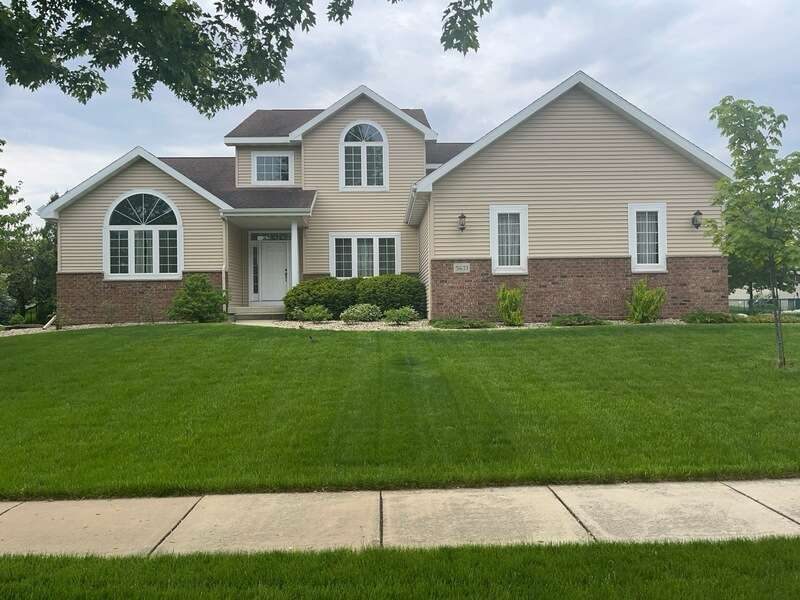
Yes, and it is often the smart move. The steep rear roof that dumps into one valley can get 6-inch while the low porch roof keeps 5-inch. Water does not care about matching; it cares about capacity where the volume is. Visually the difference is hard to spot from the ground, and both profiles come in the same colors.
Get My Free Estimate →Here is the short answer: 5-inch K-style gutters handle most one-story Wisconsin homes with moderate roofs, but if your roof is steep, your roof planes are large, you have a metal roof, or your gutters already overflow in a hard summer storm, 6-inch is the right call - and the price difference is smaller than most homeowners expect.
We have hung seamless gutters on homes across Madison and Dane County since 1979, and gutter size is one of those decisions that gets made by default instead of by math. Installers quote what their machine runs. But the size question has a real answer, and getting it wrong shows up as overflowing gutters, tiger-striped siding, and water pooling against your foundation.
What the sizes actually mean
Residential gutters in Wisconsin are almost all K-style seamless aluminum, formed on site from coil stock. A 5-inch K-style gutter holds roughly 1.2 gallons per foot; a 6-inch holds about 2 gallons per foot. That sounds like a small step, but capacity scales faster than width: the 6-inch profile moves roughly 40 percent more water, and it pairs with larger 3x4-inch downspouts that clear debris far better than the standard 2x3s.
Downspouts matter as much as the trough. A 2x3 downspout clogs on a wet maple leaf; a 3x4 swallows most of what a Wisconsin fall throws at it. When we upsize a system, the downspouts are usually where the owner notices the difference first.
When 5-inch gutters are the right choice
There is nothing wrong with 5-inch gutters on the right house. They are the correct choice when:
- The roof planes draining to each run are modest - most ranches, split-levels, and story-and-a-half homes in older Madison neighborhoods qualify
- The roof pitch is moderate (under roughly 8/12), so water arrives at the gutter at a civilized speed
- Downspouts are placed frequently enough - as a rule of thumb, one for every 30 to 40 feet of run
- You are matching existing gutters on part of the house and the current size has never overflowed
On homes like this, paying for 6-inch adds capacity you will never use.
When your home needs 6-inch
Wisconsin summer storms drop a lot of water in a hurry, and some roofs concentrate it. We recommend 6-inch gutters when any of these apply:
Steep pitches. Water coming off a 10/12 or 12/12 roof is moving fast enough to overshoot a 5-inch trough in heavy rain. The extra inch of mouth catches it.
Large or complex roof planes. A big two-story colonial or a home where two roof planes funnel into one valley can send an enormous volume to a single stretch of gutter. Valleys are the classic overflow point - you will see the washed-out mulch below them.
Metal roofing. Water sheets off standing seam and steel shingle roofs faster than off asphalt, and snow slides in sheets. Metal roofs almost always get 6-inch gutters and often snow retention above them. If you are considering a metal roof, plan the gutters as part of the same project.
A history of overflow. If your current 5-inch gutters are clean, correctly pitched, and still overflow in storms, the diagnosis is done - they are undersized for the roof above them.
What each costs in the Madison area
Seamless aluminum gutters are priced per linear foot, installed. On Dane County homes, 5-inch systems commonly land in the range of $8 to $14 per foot and 6-inch in the range of $10 to $17, with the spread driven by home height, tear-off of the old gutters, fascia condition, and how many downspouts and corners the layout needs. On a typical home with 150 to 180 feet of gutter, stepping up to 6-inch usually adds a few hundred dollars to the whole project - not thousands.
Two honest caveats. First, if your fascia boards are rotted, they need repair before any gutter hangs on them, and that is added carpentry. Second, nobody can quote your house accurately from a satellite photo; footage, corners, and height do the pricing. That is exactly what a free on-site estimate is for, and ours comes with no pressure and no obligation - we measure, we do the math on your roof area, and you get a number in writing.
Want a straight answer on your roof?
We'll inspect it, document everything, and tell you honestly what you're looking at, even if the answer is patch it for now. No pressure.
The sizing math a good installer actually does
A proper installer does not guess. The method is simple: multiply the area of each roof plane draining to a gutter run by the pitch factor (steeper roofs collect rain faster per square foot of footprint), and compare that adjusted area to the capacity of the gutter profile for our local rainfall intensity. Southern Wisconsin design storms are commonly figured around 6 to 7 inches per hour for short bursts - the gully-washers we get in July.
You do not need to do this yourself. But you should expect whoever quotes your gutters to talk about roof area and pitch, not just walk the house with a tape measure. If a quote never mentions your roof, the size on it is a habit, not a recommendation.
Half-round, box and specialty profiles
K-style is the default for good reasons - capacity per dollar and clean lines - but it is not the only profile. Half-round gutters suit some historic homes and hang from round hangers; they hold less water per inch of width, so they usually go 6-inch. Some older Madison and small-town Wisconsin homes have built-in box gutters concealed in the roof edge, which are a different animal entirely - repair and lining decisions there deserve their own conversation.

Gutter guards change the math a little
If you are adding gutter covers, size matters more, not less. A guard slightly restricts how fast water enters the gutter, and in a downpour a 5-inch guarded gutter on a steep roof will shed water over the front lip. On guarded systems for steep or large roofs, we default to 6-inch with 3x4 downspouts so the system keeps up even at reduced intake. Whether guards are worth it at all depends on your trees - we have written honestly about where they earn their cost and where they do not.
Get a straight answer on your Madison roof
Wisconsin storm season and insurance non-renewal letters do not wait. Get a free, no-obligation inspection and an honest assessment of exactly what your roof needs, even if the answer is to wait.