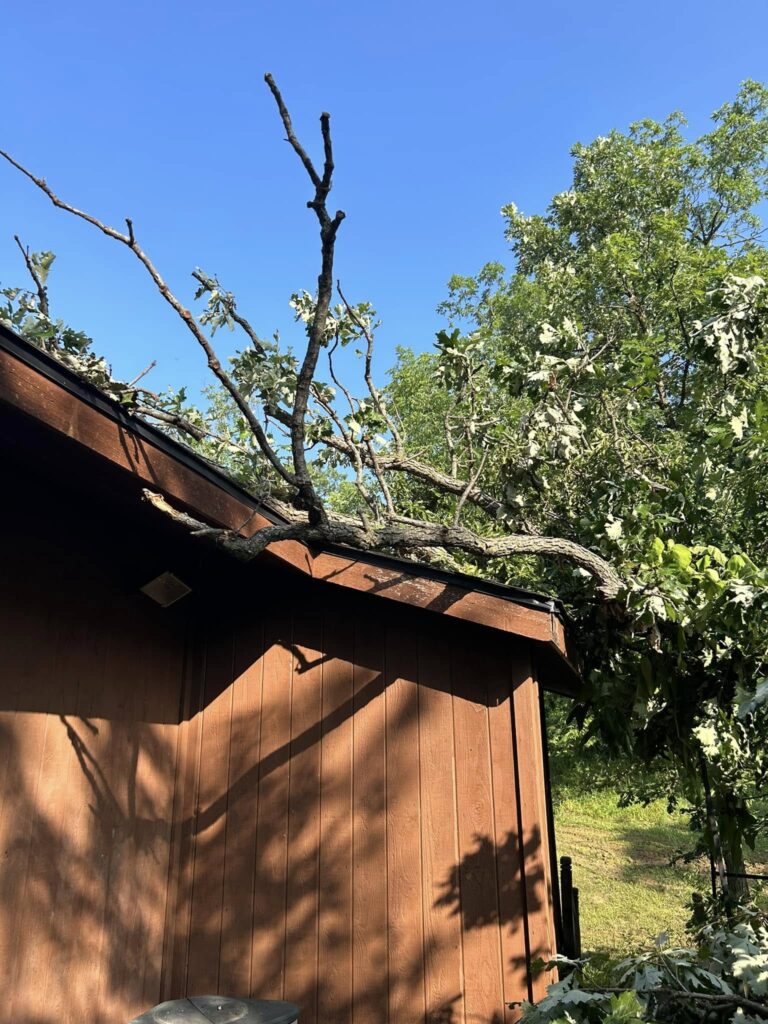
Most standard 3-tab asphalt shingles last 15-20 years in Wisconsin's climate. Architectural (dimensional) shingles typically run 25-30 years. Harsh freeze-thaw cycles, ice dams, and hailstorms common in Dane, Rock, and Green counties can shorten that lifespan, so age alone isn't the only factor-condition matters just as much.
Get My Free Estimate →- 1. Your Roof Is 20-25 Years Old (or Older)
- 2. Shingles Are Curling or Cupping
- 3. You're Finding Granules in Your Gutters
- 4. Shingles Are Cracked, Broken, or Missing
- 5. Daylight Is Visible in Your Attic
- 6. Your Energy Bills Have Been Creeping Up
- 7. You've Had Repeated Leaks or Water Stains
- 8. Flashing Is Cracked, Lifted, or Missing
- 9. The Roof Deck Is Sagging or Uneven
- 10. Your Neighbors Are Getting New Roofs
- What Does a Roof Replacement Actually Cost in South-Central Wisconsin in 2026?
- What About Insurance?
- Don't Wait Until It's an Emergency
- FAQs
Your roof doesn't send you a text message when it's done. It just starts failing quietly-a stain here, a few missing shingles there-until one day you've got water running down your interior wall during a March rainstorm and you're scrambling for a bucket.
We've been doing this since 1979 in south-central Wisconsin. Dane County, Rock County, Green County-we've seen every way a roof can age, get beat up, and finally give out. The homeowners who catch it early almost always spend less money and lose less sleep than the ones who wait.
Here are the ten signs we see most often that tell us a roof has reached the end of its road-along with honest information about what replacement actually costs around here in 2026.
1. Your Roof Is 20-25 Years Old (or Older)
Age is the first thing we ask about. Standard 3-tab shingles installed in the 1990s and early 2000s were never designed to outlast 25 Wisconsin winters. Architectural shingles hold up better, but even they start breaking down after 25-30 years of freeze-thaw cycles, ice dams, and summer UV exposure.
If you don't know how old your roof is, check your closing documents or call your local municipality-permits are often on record.
Roof replacement cost by home size (Madison, 2026)
| Home | Roof size | Typical total |
|---|---|---|
| Small ranch / bungalow | 14-18 squares | $9,000-$13,000 |
| Average two-story | 18-26 squares | $12,000-$18,000 |
| Large or complex (steep) | 26+ squares | $17,000-$25,000+ |
Cost by roofing material (average Madison home, installed)
| Material | Lifespan | Typical total |
|---|---|---|
| Architectural asphalt (standard) | 25-30 yrs | $12,000-$18,000 |
| Impact-resistant (Class 4) | 30+ yrs | $15,000-$22,000 |
| Standing-seam metal | 40-50 yrs | $25,000-$45,000 |
Common add-on costs
| Item | Typical cost |
|---|---|
| Extra tear-off layer | $500-$1,500 |
| Decking replacement | $50-$80 per sheet |
| New flashing & pipe boots | $300-$700 |
| Seamless gutters | $1,000-$2,500 |
Typical Madison-area 2026 ranges. Your exact price depends on an on-site inspection. A new asphalt shingle roof recoups about 61% of its cost at resale on average (2024 Remodeling Cost vs. Value Report).
Quick roof replacement cost estimator
Get a ballpark in 20 seconds. For an exact figure, book a free on-site inspection.
2. Shingles Are Curling or Cupping
Walk to the edge of your driveway and look at the roof plane. If shingle edges are turning up (curling) or the middle of shingles is lifting while the edges stay flat (cupping), that's the asphalt drying out and losing flexibility.
Once shingles start curling, they're brittle. The next windstorm-and we get plenty of them across the Janesville and Madison corridor-will peel them off in sections.
3. You're Finding Granules in Your Gutters
Clean out your gutters and look at what comes out. A handful of granules is normal on a new roof. Cups and cups of them on an older roof? That's the protective coating wearing away.
Granules are what shield the asphalt from UV rays. Without them, the shingles bake, crack, and fail fast. You'll also see bald, dark patches on the roof itself where granules have worn completely through.
- A price dramatically lower than every other bid (corners are getting cut somewhere)
- Pressure to sign on the spot, or a "today only" discount
- A request to sign over your insurance claim (Assignment of Benefits)
- An offer to "waive your deductible" (that is insurance fraud, and it puts you at risk)
- No written, itemized estimate, or no proof of insurance
- A large upfront payment (more than 30%) before any work begins
4. Shingles Are Cracked, Broken, or Missing
One or two cracked shingles after a bad storm might be a repair. Cracking spread across multiple sections of the roof is a systemic failure-the material is simply too old and brittle to hold together.
Missing shingles are an immediate problem. Every bare spot is an open door for water. Don't wait on those.
5. Daylight Is Visible in Your Attic
On a bright day, go up into your attic and turn off the lights. If you see pinpoints or streaks of daylight coming through the roof deck, you have gaps-and if light can get in, so can water and cold air.
While you're up there, look for water stains, soft spots in the decking, or dark streaking on the rafters. Any of those is a sign water has already been getting in.
6. Your Energy Bills Have Been Creeping Up
A failing roof often means failing ventilation and compromised insulation. If your heating bills have climbed over the past couple of winters without a clear explanation, your attic may be losing conditioned air through a deteriorating roof system.
This one's easy to overlook because it sneaks up gradually. But it's a real cost that compounds every month.
7. You've Had Repeated Leaks or Water Stains
One leak after a freak storm might be a flashing issue. Recurring leaks in the same spot, or new stains appearing in different places, usually mean the roof is failing in multiple areas.
Chasing individual leaks on an old roof is like patching a tire that's completely bald. You fix one spot and another lets go. At some point, the math on repairs versus replacement shifts-and a good contractor will tell you honestly where that line is.
Want a straight answer on your roof?
We'll inspect it, document everything, and tell you honestly what you're looking at, even if the answer is patch it for now. No pressure.
8. Flashing Is Cracked, Lifted, or Missing
Flashing is the metal that seals the joints around chimneys, skylights, vents, and valleys. It's one of the most leak-prone parts of any roof.
Older homes in Monroe, Stoughton, Beloit, and similar communities often have original flashing that's been patched with roofing cement over the years. That cement dries out and cracks. If your flashing looks like it's been duct-taped together for two decades, it probably has been.
9. The Roof Deck Is Sagging or Uneven
Stand back and look at your roofline. It should be straight and true. Any sagging, dipping, or wavy sections mean the decking underneath-the plywood or OSB layer the shingles sit on-has been compromised by moisture.
Rotted decking is a structural issue, not just a cosmetic one. It needs to be replaced before new shingles go on, which does add to the cost-but there's no safe shortcut here.
10. Your Neighbors Are Getting New Roofs
This one sounds simple, but it's real. If you're in a neighborhood where homes were all built around the same time and your neighbors are replacing roofs, yours is likely the same age and in similar condition.
After a significant hail event-and south-central Wisconsin gets hit hard some years-a whole neighborhood can have damage that isn't obvious from the ground. If your street looks like a roofing contractor convention, it's worth having yours inspected. Storm damage from hail and wind is often more extensive than it looks from the curb.
What Does a Roof Replacement Actually Cost in South-Central Wisconsin in 2026?
Here's the honest answer: it depends on several real factors, and anyone who gives you a firm number over the phone without seeing your roof is guessing.
That said, here's what actually moves the cost:
Square footage. Roofing is priced by the "square" (100 sq. ft.). A 1,500 sq. ft. ranch and a 2,800 sq. ft. two-story are very different jobs.
Roof pitch. A steep roof requires more safety equipment, more time, and more labor. Expect a meaningful price increase on anything above a 6/12 pitch.
Number of tear-off layers. Wisconsin code generally allows two layers of shingles. If you already have two, everything has to come off before new shingles go on. That's a full day of labor you're paying for before a single new shingle is installed.
Decking condition. If we pull off shingles and find soft, rotted, or delaminated decking, it has to be replaced. We price it by the sheet and won't know the full extent until tear-off.
Material choice. Standard architectural shingles are the most common choice and the most cost-effective. Impact-resistant shingles cost more upfront but can reduce your homeowner's insurance premium and hold up better to Wisconsin hail-worth asking your insurance agent about.
For a ballpark: most residential roof replacements in the Madison, Janesville, Beloit, and Monroe areas run somewhere in the $8,000-$18,000+ range in 2026 for a full tear-off and architectural shingle re-roof. Larger homes, steep pitches, significant decking work, or premium materials can push well beyond that. Smaller, simpler roofs can come in below it.
We know that's a wide range. That's because it's an honest range, not a marketing number. The only way to know what your roof will actually cost is to have someone walk it.
If you're in Dane, Rock, or Green County and want a straight answer about your roof's condition and what replacement would run, we're happy to come out and look. No pressure, no obligation-just an honest assessment from people who've been doing this work locally for over four decades.
What About Insurance?
If any of the signs above showed up after a storm, don't assume insurance won't cover it. Hail and wind damage claims are legitimate and common in Wisconsin. The key is documentation.
We meet homeowners' insurance adjusters on-site and walk the roof with them to make sure nothing gets missed. Adjusters are thorough, but they're also moving fast. Having a contractor there who knows what storm damage looks like-and where adjusters sometimes overlook it-can make a real difference in what your claim covers.
Don't Wait Until It's an Emergency
The homeowners who call us in a panic during a January ice storm or after a July hailstorm almost always wish they'd had an inspection sooner. A roof that's showing three or four of the signs above isn't going to get better on its own over winter.
Our residential roofing work covers the full process-inspection, honest recommendation, insurance coordination if needed, and quality installation backed by real warranties. We're not a storm-chaser crew that shows up after a weather event and disappears. We've been here since 1979 and we'll be here after the job is done.
Check out what our customers say about working with us on Google, Birdeye, and Angi-real reviews from real neighbors across south-central Wisconsin.
Ready to find out where your roof actually stands? Call Buckshot Exteriors or use our contact page to schedule a free, no-pressure inspection. We'll give you a straight answer about what we see, what it'll cost, and whether repair or replacement makes more sense for your situation. No scare tactics, no high-pressure sales-just honest work from a family that's been roofing Wisconsin homes since before most of our customers were born.
Get a straight answer on your Madison roof
Wisconsin storm season and insurance non-renewal letters do not wait. Get a free, no-obligation inspection and an honest assessment of exactly what your roof needs, even if the answer is to wait.